I woke to a sharp beeping that sliced through the dark. The kind of sound that yanks you out of sleep before your mind understands what is happening.
For a moment, I lay completely still, staring at the faint outline of my ceiling as the automatic blinds in my waterfront condo at Harborline Towers began to rise. A thin ribbon of dawn light brushed across the floor. The alarm kept going, steady and insistent—the building’s security alert that only triggered when someone tried to force access or insisted on entry without permission.
I pushed myself upright and felt the familiar pull in my lower back. A reminder of the day everything in my life had changed.
My condo on the 12th floor had always been my sanctuary. The one place where I could breathe without the weight of the world pressing against my ribs. But at 5 in the morning, even the sanctuary feels fragile.
My phone started to vibrate on the nightstand. I rolled toward it and answered, expecting maybe a malfunction or some kind of fire drill.
Instead, I heard Trent from security, and his voice shook in a way I had never heard before. He said that my sister Lydia and her husband were downstairs in the lobby. He said they had arrived with a moving truck and were insisting they owned my place.
Now, he said, they were asking that I come down immediately and leave the condo because they were taking possession today.
For a few seconds, I listened without saying a word. There was something almost surreal in hearing my life described as if it were already gone.
I told him that it was fine, that he should let them sign in.
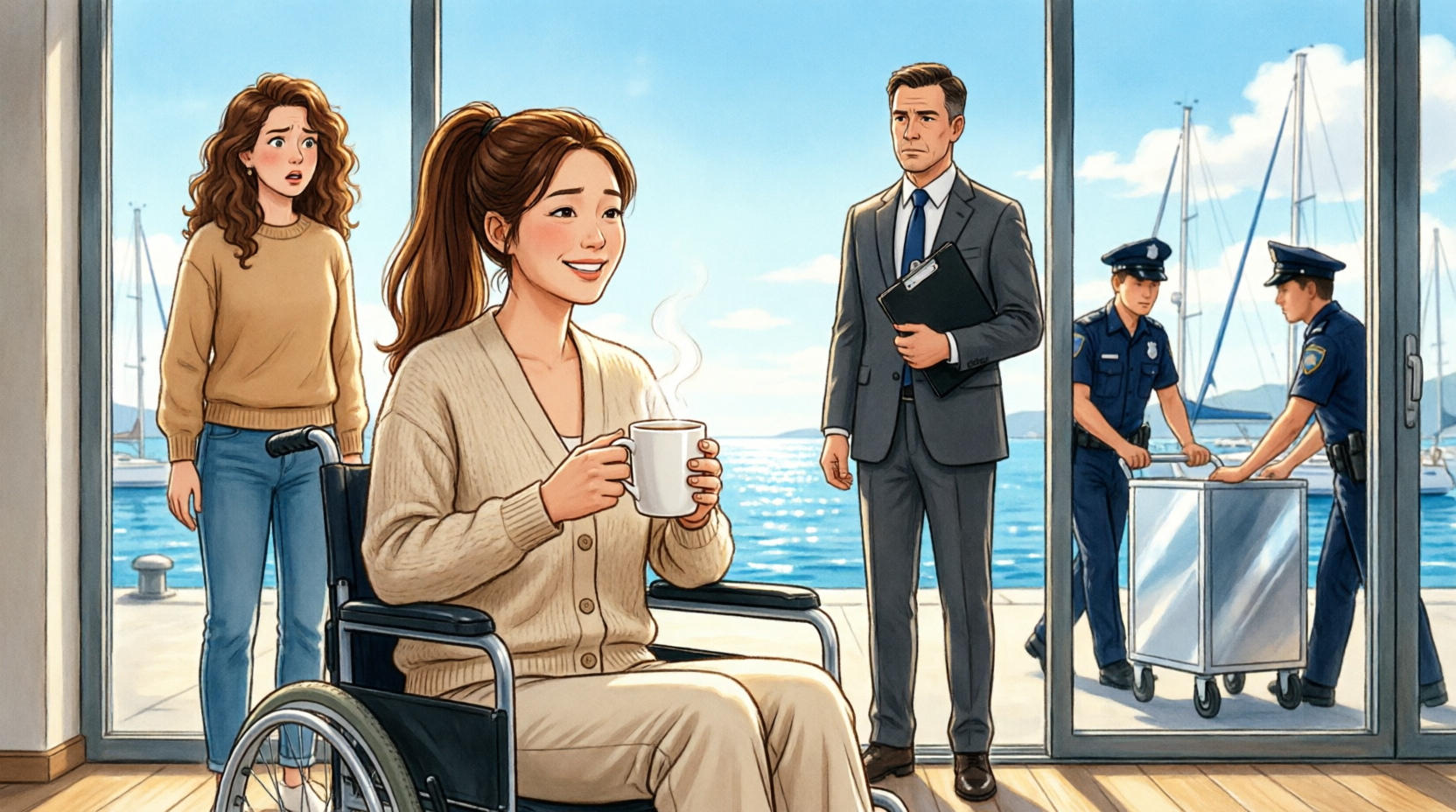
Then I wheeled myself toward the kitchen area and reached for the mug I had left on the counter the night before. The coffee inside was cold, but that familiar bitterness grounded me. I took a slow sip and breathed in.
That sip held the same kind of steadiness I used to feel right before a high pressure briefing back when I worked in the bureau, before the accident that took the mobility from my legs and gave me a new version of myself to live with.
Outside the windows, the harbor was silver and quiet, the boats rocking gently as if they did not care that my life was breaking open.
You know, I always wonder what people are doing when they listen to stories like mine. Maybe you are driving to work or folding laundry or sitting with your own cup of coffee as the sun comes up.
For me, on the morning this happened, I was sitting in my wheelchair near the open blinds, feeling the chill from the glass doors and trying to understand how my own sister could show up with a moving truck before dawn.
If you want to share where you are listening from, feel free to leave a comment. I always love hearing how these moments connect strangers in unexpected ways.
The lobby cameras sent live feeds to my phone. I tapped in and watched from above as the sliding doors opened and Lydia stepped inside, her arms crossed tightly over her chest. She looked smaller than I remembered, like she had folded into herself.
Next to her stood Bronson, her husband, calm as still water, holding a folder that he kept tapping against his leg.
Behind them, two men in navy shirts stood by a bright white moving truck. They looked half awake, half confused. Their faces said they were not sure if they were part of something legal or something messy, but they were there because they were being paid.
Trent approached them from the security desk. Even without sound, I could tell he was trying to explain protocol. Residents do not lose ownership overnight. Possession is not transferred because someone happens to arrive with a truck.
The movers kept glancing at the folder in Bronson’s hand as if it were some kind of permission slip they were waiting for.
Lydia rubbed her forehead and looked toward the elevators like she expected me to appear any second.
They all stood under the warm glow of the lobby chandelier while outside the sky shifted from charcoal to pale blue.
Watching them on the screen, I felt incredibly calm. Not numb, not detached—just steady.
This was the moment everything had led to. The subtle lies. The little stories whispered about my memory lapses. The neighbors had suddenly begun asking me about whether I slept poorly or forgot things.
I remembered the look on May’s face at the cafe downstairs a few days earlier when she asked if I was doing all right and if it was true that sometimes I woke up shouting from nightmares. I remembered how Lydia’s voice had trembled when she brought up the idea of helping me manage my finances so I would not stress myself.
At the time, those things felt strange but not alarming. Now they lined up perfectly, following into place like pieces of a puzzle I had not known I was solving.
The lobby camera shifted angles and caught Bronson turning toward Lydia, touching her elbow gently as if calming her. The gesture would have looked caring to anyone else, but I knew better. That touch had purpose. Manipulators always cloak control in gentleness.
I studied his face carefully. His jaw was tight. His eyes kept flicking toward the elevator bank.
Whatever he had been planning today was supposed to be his victory lap. He thought he had outsmarted me. He thought he had laid the perfect trail and that I would crumble under the pressure.
I took another sip of the cold coffee and let the bitterness settle on my two tongue. There was something almost poetic about watching them stand there in my lick building, waiting to take away the home that had become my lifeline.
I had rebuilt myself in this condo. I had learned how to move through pain, how to breathe when anxiety gripped my ribs so tightly I thought they might crack. I had cried in that living room when the memories of my accident felt too heavy. I had laughed on that balcony when Lydia brought me dinner in the early months of my recovery.
This space had held my broken pieces until I could put myself back together.
And yet here they were, believing that with one morning surprise they could erase me.
I set my cup down and rolled a little closer to the window. The sun was rising fully now, turning the harbor bright gold. Boats pushed gently against their ropes.
I brushed a strand of hair from my cheek and let the moment settle over me.
This was not a crisis. This was the opening act of a story I had already prepared for.
They were walking straight into the plan I had finished just one day earlier. Every detail arranged, every document secured, every piece of evidence gathered.
They had no idea.
Trent looked up toward the camera, maybe knowing I was watching, his shoulders lifted as if to ask whether he should stall them, call the police, or quietly escort them out. I did not need any of that.
I opened the microphone to his station and spoke clearly so he could hear me without question. I told him to let them in, to allow them to write their names in the visitor log. I wanted everything documented. I wanted each step recorded in writing.
When I ended the connection, the condo felt strangely quiet. The alarm had stopped. The blinds were fully open. The gentle clink of howiards against masts outside drifted up from the marina.
I sat there with my hands resting against the wheels of my chair, breathing evenly.
They did not know what I had done yesterday, and they were about to learn.
Before that morning in the lobby—before the moving truck and the cold coffee and the calm in my chest that even surprised me—there was another version of me. One I sometimes still wake up searching for in the dark.
Back in the year 2019, I was not the woman sitting in a wheelchair in a waterfront condo in San Diego. I was still running on adrenaline and coffee in a different way, chasing shadows for the bureau, working in counter intelligence, trying to untangle threats before they ever reached the news.
My days were measured in briefings and field reports and coded conversations that I could not talk about at family dinners. I had a body that did what I asked it to do and a mind that believed I could outrun almost anything if I pushed hard enough.
When people think about accidents, they imagine a single dramatic impact. The truth is, the moment that changed everything for me started with something small: a strange pattern in financial records, a familiar name on an unfamiliar list, a lead that looked like nothing at first and then refused to go away.
We followed it until it pulled us into a late night car, into a surveillance op that should have been straightforward.
It did not end that way.
I remember pieces of it. The wet pavement. The glare of headlights cutting across the median. The sickening feeling when another vehicle came out of nowhere, running from a different crime and intersecting with ours in the worst possible way.
The world tilted. Metal screamed. Glass rained down in tiny cold stars.
Then there was nothing for a while.
When I woke up in the hospital, drugs softening the edges of everything, I learned that the people who loved me had been told they might lose me. Then they were told I would live, but my legs would never again carry me the way they had.
My spine had paid the price for the collision. There would be rehab and chairs and limits I had never imagined for myself.
The bureau did what it could. There were medals and handshakes and words about service and sacrifice. Eventually, there was a settlement, a carefully calculated number that someone somewhere decided was the monetary value of my lost mobility and altered future.
They told me I would receive $2 million in insurance compensation.
And on top of that, donations began to come in from people who had read about the accident and wanted to help the injured agent who had nearly died. It was touching in a way that made my throat ache. It was also overwhelming. I did not grow up thinking about money on that scale.
My childhood had been simple and modest. We did not have a lot. But my parents managed to keep the lights on and the fridge never completely empty. They gave us love when there was not much else to give.
Then in the year 2010, a drunk driver crossed a line he should not have, and my world split in two again. Mom and dad were there one moment and gone the next. No lingering illnesses, no gentle fades—just a phone call and a crash and then silence.
I was 17 when I became the adult in the house. My little sister Lydia was 11 with wide eyes and a laugh that broke out of her without warning.
The state could have stepped in. People suggested guardianships and foster options and all the careful phrases that systems use. I looked at my sister and I knew there was no way I would let her be raised by strangers.
So I did what I have always done. I made a plan.
I worked. I studied. I took care of bills while other kids were going to high school dances. There were nights when I sat at the kitchen table doing homework after putting Lydia to bed. And I would suddenly feel the weight of it all. This role I had never asked for.
Then I would wipe my face, finish the assignments, and wake up to do it again.
In some ways, becoming an agent later felt like a natural extension of that part of me. I was good at carrying burdens quietly, at watching instead of speaking, at seeing the lines people drew around themselves and the ones they tried to cross.
The training was grueling, but it was almost a relief to face challenges that had structure, rules, and clear objectives. When I joined the counter intelligence division, I thought I had finally turned all that early responsibility into purpose.
The accident did not just break my spine. It broke that sense of certainty.
After months in rehab, after I learned how to transfer from bed to chair without falling, after I learned how to navigate ramps and narrow doors, and the way strangers avoided my eyes in public, I had to make another decision.
I could not stay in the same city where every corner reminded me of the life I had lost. I needed somewhere that felt like air again. Somewhere my lungs could expand without bumping into old ghosts.
San Diego ended up on my list because of one simple thing: the ocean.
I had visited once as a teenager, a three-day trip with dad and mom that lived in my memory like a treasure. I remembered the way the air had smelled salty and sweet at the same time, the way the sun dipped into the water like it was slipping into bed.
When I received the final package of paperwork and payments and medical reports, I sat with all of it spread out on the table and thought about where a woman like me could rebuild.
The answer kept turning back to that coastline.
I used part of the settlement to buy a small one-bedroom condo at Harbor Line towers overlooking the marina. It was not extravagant by the standards of some people in the building, but to me it felt like a palace.
The building had ramps and elevators and security staff who learned my name quickly.
The first night I slept there, propped up on pillows with the sliding door open just enough to let in the sound of the water, I cried quietly into my blanket, not entirely from sadness. It was grief and gratitude tangled together.
Lydia came to visit often in those first months. She would arrive with takeout containers and new plants and stories about her job as an assistant to an event planner. She had a knack for describing people in detail, the way she always had, and I would listen as she talked about brides with impossible demands and corporate clients who changed their minds every 5 minutes.
We would sit on the balcony, my chair angled so I could see the horizon, her legs tucked underneath her on the outdoor sofa.
Sometimes she would go quiet and look at my chair and then away. That hurt, but it was honest. We had both lost something in my accident. The sister she had known, the one who could chase her around the yard or pick her up and spin her in circles, was gone.
In her place was a woman who still teased her about her taste in television shows, but now had to ask for help reaching certain shelves.
At night, after she left, the condo would feel too large. The ocean sounds were soothing until they were not. Sleep did not come easily. When it did, it came with images I could not control. Headlights bearing down, the spin of tires losing traction, the moment of weightlessness before impact.
I would jerk awake with my heart hammering, breath sawing in and out, my hands clutching at the sheets as if I could still grab a steering wheel that was no longer there.
Those episodes started to repeat, an echo built into my nights.
Some nights I could hear myself make a small sound. Not quite a cry, but not silence either. A low, startled noise of someone caught between then and now.
If Lydia happened to be staying over, she would sometimes knock gently on my bedroom door in the morning and ask if I had slept okay. I would shrug it off and tell her I was fine, just restless, that the new meds made my dreams too vivid.
It was easier than watching worry bloom in her face.
That pattern settled in. The rhythm of my new life. Therapy appointments twice a week where a calm-faced woman asked me to talk about the crash and about being the kind of person who had always taken care of everyone else and now had to accept help.
Physical therapy sessions where I learned how to strengthen what muscles I still had full control over.
Trips to the downstairs cafe where May would slide a cup of coffee across them counter and tell me about her grandchildren while I tried not to flinch every time a car backfired outside.
On the surface, it probably looked like resilience: a woman who had taken a devastating injury and carved out a careful, stable existence in a sunny city with pretty views.
Underneath, there were cracks. I felt them when a siren screamed too close to the building. I felt them when a stranger pushed past my chair without apologizing. I felt them when I saw families walking along the harbor hand in hand.
The parents carrying kids who were sleepy but safe.
There were days I missed dad and mom with an ache that felt almost physical.
Lydia remained my anchor through most of that. She called often, texted memes and photos of cakes from weddings she worked on. She complained about long hours and difficult clients.
But there was a lightness in her voice.
She started talking about a man she had met through work, someone who was smart and funny and understood contracts better than anyone she had ever seen. She described how he listened to her, how he made her feel safe, like she did not have to worry about practical details anymore because he always seemed to have a plan.
At the time, those words sounded like a blessing. After everything we had been through, I wanted so badly for her to have someone kind.
I did not yet know that the same traits that made him seem so responsible in her eyes would look very different in mine.
There is a certain irony in the fact that my own trauma would become the tool he used later. The nights when I startled awake, the bad dreams, the moments when my voice shook a little as I told Lydia I was fine—those private vulnerabilities would eventually be spun into a story about a woman who could not be trusted with her own life.
In a way, the accident did not stop hitting me when the car stopped moving. Its shock waves kept traveling outward, touching people and choices years later.
But back then, in those quieter months, I was just a woman in recovery, doing my best to build a new routine out of broken pieces. I did not yet know how much of my life had been noted and studied, how my sister’s new boyfriend would file away every small detail.
I did not know that he had read the article about the injured agent who received a large settlement and that he had already pictured Harborline Towers before he ever shook my hand.
All I knew was that I was tired and hopeful and trying to trust that the worst was behind us.
I did not yet know that he had read the article about the injured agent who received a large settlement and that he had already pictured Harborline Towers before he ever shook my hand.
Bronson Reeves entered our lives the following spring. The kind of spring San Diego is known for, warm enough that the breeze off the water feels playful rather than sharp.
Lydia showed up at my condo one afternoon with a brightness in her face that I had not seen in a long time. She was wearing a pale blue dress that swayed when she walked, and she talked so fast I had to remind her to breathe.
She told me she had met someone at a corporate event, a parallegal who had helped her sort out a lastminute contract issue. She said he was smart and calm, that he had a way of making everything feel manageable.
When she spoke about him, something softened in her expression, and I felt my heart lift just a little. After everything she had endured, I wanted her to have someone who did not hurt her.
He came by the condo about a week later. Lydia had invited him for coffee so I could meet him, and he arrived exactly on time.
He carried a small box of pastries and placed it on my kitchen counter with a polite smile. He thanked me for letting him visit. Said I had a beautiful place and asked how long I had been living there.
His voice was warm, steady, and practiced. Not in a fake way exactly—more like someone who had experience putting others at ease.
If I had met him under different circumstances, I might have thought he was genuinely thoughtful.
He sat across from me at the small dining table, turning the coffee mug in his hands as Lydia talked about her week. Occasionally, he added a detail or two, something supportive or gently teasing.
He asked me questions about my rehab, about whether the building was comfortable for me, about the view from my balcony. They were harmless questions on the surface, the sort that make normal conversation.
Yet even then, I noticed the way his eyes flicked around the condo with a kind of evaluation. Not admiration. Not curiosity. Calculation, as if he was taking inventory of more than furniture.
I brushed the thought aside at the time. People look around when they visit new places. I told myself I was being overly sensitive, that years in the bureau had hardwired me to look for things that were not always there.
I had been trying so hard to stop seeing every stranger as a potential threat. It was a habit that kept me alive in one world, but it was exhausting in this new one.
As summer moved in, Bronson became a regular figure in our routines. He would pick Lydia up from the building lobby after her long shifts or meet her at the cafe downstairs before they went out.
I often saw them from the balcony, his hand resting lightly on the small of her back, her head. He had a way of seeming attentive without being clingy, charming without being showy.
Even May at the cafe commented on how put together he seemed. She said he had a kindly face and that he always tipped well.
Those were the kinds of details that shape impressions quickly in a building like ours.
One more, I went downstairs for coffee. My chair glided easily across the polished lobby floor. I could smell the roasted beans before the elevator doors fully opened.
May greeted me with her usual warmth and handed me my regular order before I could even ask.
Then she asked if I had been sleeping all right.
I paused, caught off guard. She said that Lydia had mentioned I sometimes made noises in my sleep, that I might still be having nightmares from the accident.
She asked if I ever woke up disoriented or if I had someone checking on me.
I felt something tighten in the back of my throat because the question did not feel random. It felt planted.
I told her I was fine, just adjusting to new medication. She nodded in that gentle, worried way older women sometimes do when they are not sure they should push further.
It hovered just beneath the surface, even as I rolled out of the cafe and back toward the elevator.
I pushed the button and waited, listening to the quiet hum of the building. When the door, he was a middle-aged man who usually kept to himself, polite, but distant.
As he passed me, he slowed down just a little and asked if everything was all right in my unit. He said the weak.
That struck me as strange because I was meticulous about that sort of thing. Trauma sharpens habits like lockchecking. I never left my door unsecured.
I told him I had not, and he gave a small awkward smile before walking away.
The elevator ride to the 12th floor felt longer than usual. I replayed his question again and again. There was something off about the way he had phrased it, like he had been repeating something he had been told, not something he had personally seen.
When I reached my floor and rolled toward my unit, the hallway felt different. Not physically, but something about the energy had shifted, as if whispers had trailed through it.
People in buildings like ours talk. They notice when someone struggles, when someone changes routines, when someone receives too many deliveries.
And if someone wanted to shape a narrative about me, about my mental stability, or lack thereof, this was the perfect environment to start sewing seeds.
I unlocked my door, moved inside, and closed it behind me.
For a moment, I stayed still, letting the quiet settle around me. The condo felt familiar and safe, yet a sliver of unease had found its way in.
I tried to remember if I had said anything recently that could be misunderstood. Had Lydia mentioned my rough nights to anyone else? Had I said something while half awake?
It was possible, but the timing felt too deliberate. Two conversations in one morning touching the same nerve. Both wrapped in concern, but threaded with implication.
I went to the balcony and looked down at the marina. The sun reflected off the water in shimmering strips. A couple walked along the pier, holding iced drinks and talking quietly.
The world looked calm and predictable from up there, but inside my mind, a quiet alarm had begun to ring.
I thought back to the first time Bronson had visited. The way he glanced at my medical equipment near the bedroom door. The way he lingered over the framed news article on my bookshelf that detailed my accident. The way he had asked gently whether I was adjusting well or if I ever felt overwhelmed living alone in isolation.
None of those things would have been remarkable. Together, they formed a shape I could no longer ignore.
Bronson had access to legal knowledge. He understood guardianships and power of attorney and the subtle language that suggested someone needed oversight.
If he had been planting ideas quietly through Lydia, through casual conversations with neighbors, through harmless remarks, then what I had felt as unease might have been something much more intentional.
I rolled back inside and sat near the edge of the counter, my hand wrapped around the warm mug of coffee May had given me.
My heart was not racing exactly, but it was alert, tuned like an instrument to the smallest shift in tone.
Something was happening around me, something I had not invited, but that had been carefully set in motion.
And if I was right, the little comments and worried questions were not random. They were rehearsal lines in a story someone was trying to tell about me.
I knew then that it was time to pay close attention, to watch what Bronson said and how he said it, to listen not just to my sister’s words but the weight behind them, to trace the shape forming in the shadows before it solidified into something harder to undo.
The accident had taken my legs, but it had not taken my instincts.
The next morning, I rolled into my living room with a kind of steady focus I had not felt since my bureau days.
My condo had always been a refuge, a place where the sound of the harbor and the pulse of city life mixed into something that felt healing. Now I looked at the walls differently, the entryway, the hallway, the doors—any point of access, any place where someone with the wrong intentions could slip in unnoticed.
I had no desire to become paranoid again. But I also knew how manipulation began. It always started quietly.
People with intentions like Bronson never lunged first. They tiptoed. They asked questions that seemed harmless. They presented concern as care.
And if no one questioned them, their confidence grew until they pushed hard enough to cause irreparable damage.
So I went back to my training piece by piece.
I started with the camera installation. Nothing expensive or dramatic, just highquality devices that blended into the surroundings.
One in the hallway pointed toward the front door. One in the small foyer where my mail and packages were usually dropped. Another near the bedroom entrance, positioned high enough that you would never see it unless you knew exactly where to look.
I set each one to record continuously and transmit footage to a secure cloud server that Bronson would never know existed.
The last camera I placed was near the window that faced the internal corridor outside my unit.
I used to think those open air hallways felt airy and safe. Now I watch them the way I would watch an alley during surveillance. Tracing movement, memorizing faces, learning patterns.
I tested each camera with a calculated calm, rolling out of frame, then back, then leaving the unit for a few minutes to confirm the motion detection.
When I finally sat back in my chair and viewed the synced feeds from my tablet, I felt something subtle in me. I was not helpless. I was not offbalance. I had tools. I had a strategy.
And despite what Bronson hoped, my mind was clear.
It only took 3 days for the first confirmation.
I had left the building for a physical therapy session and returned earlier than planned because the schedule shifted. When I accessed the feed from my hallway camera, I saw Bronson standing outside my condo door.
The footage showed him glancing left and right, then reaching into his pocket for something metallic. He stood there in clean, deliberate silence, inserting a key, cracking the door only enough to slip in, then pulling it shut behind him.
My hands stayed steady on the tablet as I watched him move through my home.
He walked with eerie confidence, like someone who had already measured the space and knew exactly where every item belonged.
He checked the drawers near the living room, paused near my bookshelf, then walked toward the bedroom hallway. He opened the small filing cabinet I kept beside my desk. He sifted carefully through documents, placing some back, moving others slightly out of place.
He was looking for paperwork, ownership documents, settlement papers, anything that could be twisted into a narrative he was building.
I watched him close the drawer, smooth the surface with his fingertips, and leave without taking anything.
That meant he was not finished yet. He was scouting.
When Lydia came to my condo that evening for dinner, she had no idea anything was wrong. She talked about work, about a large wedding client who was demanding last minute decor changes, about a co-orker who kept volunteering her for things she had not agreed to do.
When she mentioned that Bronson had borrowed her spare key earlier that afternoon so he could check on a delivery at his place, something clicked inside me.
He had used her kindness against her without hesitation.
I waited until she had gone home before I pulled out the old contact notebook from my desk drawer. I had not touched it in years. Near the back were names I used to call often, names that still felt familiar when I ran my fingers over them.
One of those names was Dorian Hail.
Dorian had worked with me at the Bureau in counter intelligence before I was injured. He had always had a talent for details, especially written ones. He could look at handwriting the way a biologist looked at cell structures, tracing patterns and deviations with startling precision.
After I left the bureau, he moved into private consulting for law firms and insurance investigators. We had exchanged holiday messages, but rarely more than that.
I called him anyway.
When he answered, his voice carried the same mix of dry humor and sharp intelligence I remembered. He asked how I was holding up. I told him I needed a favor. He said he owed me more than one.
I emailed him a handful of documents that Lydia had brought over a few days earlier. She had said Bronson found them through a colleague and that they were supposed to help her organize some financial matters in case anything ever happened to me.
I remembered feeling uneasy at the time because the wording had been vague and the signature sections had too many preparatory clauses. Now I saw them clearly for what they were: preparatory steps toward a guardianship claim or a transfer of authority.
Dorian called me back that same night. He asked if I was sitting down and I told him the chair was a permanent part of my life now. So yes, technically I was already sitting.
He told me the signatures were not mine.
They were very close. Close enough that someone unfamiliar with my writing would believe them at first glance, but they were not exact. The slope of certain letters was off. The pressure pattern along the baseline was inconsistent with my dominant hand.
He said whoever forged them had legal knowledge but not artistic skill. That was the signature range of parallegals who learned forgery through exposure rather than training.
My stomach went cold.
I asked him if this could hold up in court. He said absolutely not. The signatures were flawed enough that any handwriting specialist would detect fabrication.
He asked if I wanted him to prepare an official report. I told him not yet. I needed to understand the full scope of what Bronson was building.
After the call, I sat in the dim light of my living room for a long time, listening to the quiet hum of the city outside.
Harborline towers always felt safe to me, a place where people nodded politely in hallways and waved from their balconies. Now the air inside my unit felt heavier.
I began to think back to the earliest days after my accident, to the news articles that had circulated when the settlement was finalized. The local paper had run a feature about my service, about the mission that left me injured, about the way the community had rallied to support me.
There were photos, one of me standing before a row of flags, another of me in my wheelchair accepting a certificate of recognition.
Anyone with enough time and curiosity could have found those stories. Anyone with a certain kind of ambition could have followed the trail. And if they discovered that I had one younger sister and no other family, and that I was financially stable but physically vulnerable, then my life would have looked like an opportunity.
I had not wanted to believe Bronson targeted us. But now, watching the pieces fall into place, there was no other explanation.
I turned off the main lights and let the condo fall into shadow. Only the soft glow from the balcony filtered into the room.
I took a deep breath and let it sit in my lungs before I released it.
Bronson was not just manipulating Lydia. He was constructing a narrative about me. He was preparing evidence. He was testing the boundaries of access to my home.
He was forging signatures and planting concerns in the community. He was laying the groundwork for something bigger.
And I knew then that if I did not act quickly and precisely, he would take everything I had left.
The hardest part was knowing that Lydia still believed he loved her, that she did not know she had been chosen
long before she ever offered him her first smile.
I closed my eyes for a moment, feeling the weight of that truth.