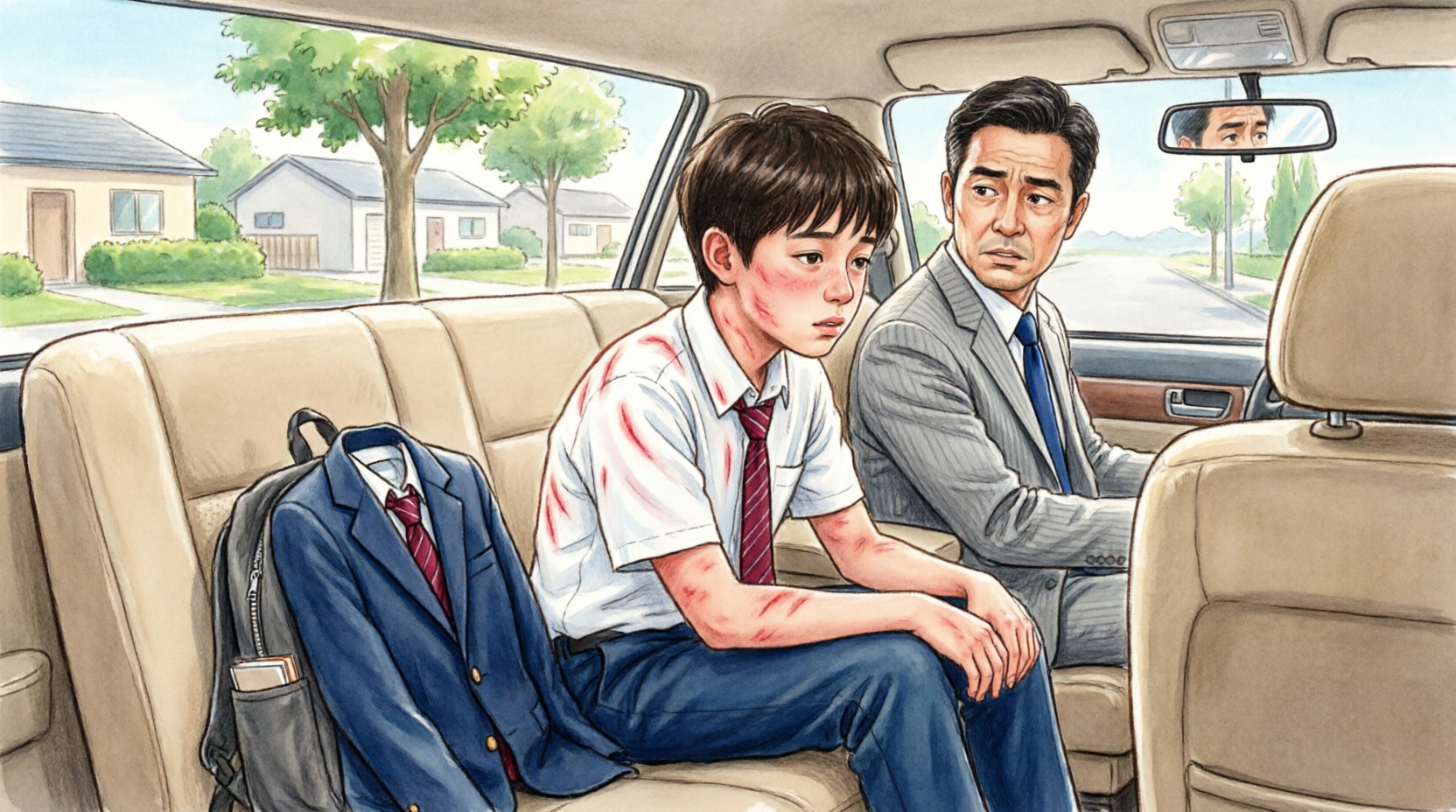
The afternoon I picked Mateo Herrera up from school, he leaned toward me in the back seat and whispered, “Mr. Rafael… my back hurts.” He said it so quietly it was almost lost in the sound of the door closing. But I heard him. And from that moment on, I could no longer pretend everything was alright………..
The afternoon Mateo Herrera told me his back hurt, the world did not stop. Cars kept crawling along Avenida Paseo de la Reforma. A woman in a white blouse kept selling gum at the intersection near the school gates. Two boys in crisp navy uniforms laughed while a bodyguard loaded their sports bags into another SUV. The guard at the private academy kept checking names off his clipboard with the same bored expression he wore every day. The city remained itself—loud, polished, indifferent. But inside the black SUV with tinted windows and cold leather seats, something split open that could never be sealed again.
“Mr. Rafael,” Mateo whispered from the back seat, “my back hurts.”
He said it almost apologetically, like a child confessing to a broken glass he hadn’t meant to drop.
I looked at him through the rearview mirror. He was buckling his seat belt with both hands, moving carefully, slowly, as though every small twist of his shoulders cost him something. The afternoon sun cut across his face through the darkened glass, and I saw the tightness in his mouth, the unusual stillness in his eyes. Mateo was not a noisy child, but he used to be a bright one. A year earlier, when I had first been assigned to drive him after school, he used to narrate the entire day to me—who had cheated during soccer drills, which teacher said “excellent” with a funny accent, whether the cafeteria pudding tasted like vanilla or chalk. Then, little by little, the words thinned out. The laughter disappeared first. Then the appetite. Then the habit of looking out the window like the city belonged to him.
Children do not fade all at once. They dim by degrees, like lamps in a house where no one bothers to change the wiring.
At first I had told myself it was grief. Mateo’s mother, Lucía, had died two years earlier after a sudden aneurysm that struck on a charity weekend in Valle de Bravo. I had never met her. By the time I entered Alejandro Herrera’s household, her photographs were already part of the furniture—framed silver smiles on piano tops and entry tables, elegant and distant as saints. The staff spoke of her in lowered voices. The little boy had become motherless. The father had become busier, harder. It was reasonable, I thought, that the child would become quieter.
Then Valeria Castillo entered the house, and my reasons for looking away grew less convincing.
She arrived first as a guest, then as a presence, then as an authority. She was one of those women whose elegance seemed engineered rather than worn. Her hair never moved unless it was meant to. Her voice could become velvet in front of guests and ice the instant a door clicked shut. The first few weeks, she treated everyone in the house with an overly polished courtesy that always made my shoulders tighten. I had worked for wealthy families long enough to know the difference between manners and performance. Manners are for the people who have no power over you. Performance is for those who do.
Within months, she had an opinion on everything. Which flowers were acceptable in the foyer. How the dining table should be set. Which maid folded napkins incorrectly. Which gardener needed to be replaced. Which tutor was not “sufficiently polished.” Then came the sharper changes. Mateo’s cartoons became “mindless.” His soccer practices became “undisciplined.” Dessert became “earned.” Playtime became “a privilege.” The boy’s life was reworded into obedience.
Still, I said nothing.
It is easy now, after everything, to imagine that courage is a switch a man either flips or fails to flip. That is not how it happens. Fear comes disguised as professionalism. Cowardice introduces itself as prudence. You tell yourself you are a driver, not a father. An employee, not a judge. You say the bruises on a child’s arm could come from rough play. The flinch when an adult says his name might be shyness. The silence might be grief. The bad dreams might be adjustment. The way he startles when footsteps approach at night could mean anything.
Then one afternoon a boy says, “Every night,” and all the lies you have told yourself burn away at once.
I parked three blocks from the mansion on a quiet side street lined with jacaranda trees, purple blossoms collecting in the gutters like spilled ink. I turned off the engine. The cold humming from the air conditioner died, and the car filled with thick stillness. I turned in my seat and looked at him.
“It’s okay,” I said. “I’m here with you.”
He hesitated a long time. A child who has been threatened properly does not reveal pain easily. He listens for traps hidden inside kindness. He studies your face the way soldiers study terrain. Mateo’s fingers trembled where they gripped the hem of his shirt. Then, with the shame of someone exposing a crime he believed he had committed, he lifted the fabric.
For a moment my mind refused to understand what my eyes were seeing. The skin across his back was mapped with welts and crossing lines, some yellowing, some deep violet, some red and raised. There were narrow cuts where the skin had split. There were older marks faded into brown shadows, as if his body had been forced to heal around memory. One shoulder blade was mottled dark blue. On the left side near the ribs, a fresh stripe had broken the skin.
I had seen men beaten bloody in my youth. I had seen drunken street fights and accidents on the highway outside Querétaro when I worked as a tow-truck assistant before I learned better trades. I had once found my own younger brother after he had been kicked half senseless behind a cantina. But I had never seen that kind of fury laid across the back of an eight-year-old child.
Mateo yanked the shirt down at once, horror flooding his face.
“I’m sorry,” he whispered. “I didn’t mean to.”
My hands went cold on my knees.
“Listen to me,” I said, and I had to force my voice not to shake. “You did nothing wrong. Nothing.”
His mouth trembled. “Aunt Valeria says if I behave better she won’t punish me.”
Aunt Valeria. Not mamá. Not even Valeria. Aunt Valeria, the title she had insisted on because it sounded warm and respectable without requiring real love.
“Did she do that to you?” I asked.
He nodded.
“With what?”
He swallowed hard. “A belt.”
I looked away because if I kept staring at him I would lose the little control I had. A hot rage had begun in the center of my chest, but rage is useless if it arrives before judgment. An angry man with no plan can protect no one.
“Does your father know?”
Mateo shook his head at once. “She says if I tell anyone, he’ll send me away where no one can find me.”
The words hit me with a special kind of sickness because they were too precise to be invented by a child. Children speak in feelings unless adults teach them fear with logistics.
I started the engine. The gate of the Herrera mansion would open in less than five minutes. Behind it waited Valeria, perhaps in linen and pearls, perhaps smiling into her phone, perhaps discussing floral arrangements for a gala or a weekend in San Miguel de Allende, while the boy she disciplined with a belt gathered himself in my back seat as though preparing to walk across broken glass.
The question before me was brutally simple. If I drove through those gates and handed him back, then everything I had seen became something I had accepted.
When I reached the mansion, the front gates rolled open soundlessly. The security booth’s mirrored windows reflected the SUV as if even stone and metal had learned to keep the family’s secrets. The driveway curved between trimmed hedges and white bougainvillea. The house itself rose pale and immaculate, a modern estate of limestone, glass, and money pretending to be taste. Most people entering it for the first time would have admired the symmetry, the fountains, the bronze doors high enough for a church. I only saw how many windows there were from which a child could look out and still remain invisible.
I parked beneath the covered entrance and got out. Normally a housemaid or a steward would open Mateo’s door. That day I did it myself. He climbed out slowly, his schoolbag hanging from one shoulder. Before we reached the front steps, Valeria appeared in the doorway.
“Mateo,” she called brightly, then looked at me. “You’re late, Rafael.”
We were four minutes later than usual.
Traffic, I almost said. But my mouth had stopped cooperating with ordinary lies.
“He wasn’t feeling well,” I answered.
Her eyes moved to Mateo at once, quick and sharp, and in that tiny flicker I saw something that has never left me: not concern, not even irritation, but calculation. She wanted to know what he had said.
She descended two steps, all polished calm. She wore a cream blouse tucked into tailored slacks, gold hoops catching the light at her ears. Beautiful, any magazine would have said. Refined. The kind of woman invited to discuss foundations and cultural initiatives over lunch at the Four Seasons. She touched Mateo’s cheek with two fingers, and he flinched so slightly most people would have missed it.
“What’s wrong, cariño?” she asked.
He stared at the floor.
“Nothing,” he murmured.
Her gaze shifted to me again. “Go put away your things, Mateo. Your tutor will be here in twenty minutes.”
He did not move.
“Now.”
The word remained soft, but his whole body obeyed it.
He went inside with his head bowed. I took one step after him.
“Señorita Valeria,” I said.
She paused, hand resting on the bronze door. “Yes?”
“We need to talk.”
Her eyebrows rose almost invisibly. Employees did not usually choose that tone with her. “About?”
“About Mateo.”
The pleasant expression on her face did not disappear. It simply hardened underneath, like lacquer drying.
“I’m afraid I have no time right now.”
“Then make time.”
That got her full attention.
For a second neither of us moved. Somewhere to the left, water hissed from the fountain into the basin. In the distant service corridor, a tray clinked. The world went on pretending not to hear.
“Careful,” she said quietly.
“Did you beat him with a belt?”
She laughed. Not loudly. Not like a woman amused, but like a woman insulted by the vulgarity of being named correctly.
“Excuse me?”
“You heard me.”
Her face changed. The silk went out of her voice. “You are a chauffeur, Rafael. Not a member of this family. Not a doctor. And certainly not a man in a position to question me.”
“I’m a man who saw a child’s back.”
“Then perhaps you should remember you are also a man with a job.”
There it was. The old weapon. Rent. Medicine. Age. Hunger. Every poor or ordinary man in a rich house understands the invisible hand around his throat.
I was fifty-two then. Too old to start over easily, too young to surrender the rest of my life to self-contempt. My wife Marisol had died six years earlier. Cancer takes the softest parts of a home first. Since then I had lived alone in a narrow apartment in Colonia Narvarte, sending what money I could to my sister in Pachuca and helping my nephew with his mechanics course when he needed it. The Herrera position paid well, better than any driving job I had held. It came with insurance. Predictability. Respect from outsiders. Men in my position are trained by necessity to calculate loss before honor.
But I had also buried a child.
Not my own. My daughter Alma had lived, thank God, and married young in Puebla. We saw each other too little, but she lived. The child I had buried was my little brother Tomás. He was nine when our stepfather broke his ribs. Ten when an infection no one treated properly turned a fever fatal. We were poor, and poor boys learn quickly that pain is a household matter until it becomes a funeral. I was fourteen when he died. Old enough to know. Not brave enough to stop it.
Some debts wait decades to be collected.
I took a breath. “I’m telling Señor Alejandro.”
For the first time, something like alarm flashed in her eyes, though it vanished almost immediately.
“You are overstepping in ways you cannot possibly understand,” she said. “Mateo is a difficult child. He lies. He has emotional disturbances. Grief, attachment issues, manipulative behavior. I have been trying to help him with structure because his father is too occupied to manage these episodes. If he showed you an old bruise and filled your head with nonsense, that is unfortunate, but I won’t tolerate hysterics from the staff.”
“Those weren’t old bruises.”
Her mouth went thin. “Do you have children, Rafael?”
“Yes.”
“Then you know children test boundaries.”
“With a belt?”
She stepped closer. The perfume she wore was expensive and faintly floral. “You have no proof of anything. And if you repeat such a vile accusation, I will personally ensure you never work in this city again.”
Then she smiled, the public smile, and opened the door wider as if we had merely concluded a minor scheduling discussion.
“Good afternoon,” she said.
I should tell you now that people imagine the decisive moments in life feel decisive while you are living them. They do not. They feel muddy, confusing, compromised by practicalities. I did not storm the house. I did not seize Mateo and run heroically into the street. I did not call the police from the driveway, because men like Alejandro Herrera had judges at their birthdays and officers at their charity dinners. A shouted accusation from a chauffeur could vanish before sunset if handled correctly. Worse, it could vanish while leaving the child behind.
I did the only thing I knew for certain I had to do: I did not leave.
There was a secondary driver’s office near the garage, a small cooled room with a desk, a camera monitor wall, and two metal cabinets for vehicle records. I went there, shut the door, and called the one person in the house whose loyalty I trusted above fear.
Rosa.
Officially she was the head housekeeper. In truth she was the spine of the service staff, a woman in her late sixties from Oaxaca with wise hands and a face made permanent by years of worry and discipline. She had worked in the Herrera family since before Alejandro inherited his first factory division. She had seen wives come and go among their social circle, children born and raised by nannies, fortunes rise, scandals buried. Unlike most staff, she never gossiped. She knew gossip feeds the rich and destroys the poor.
When she answered my call, I said only, “Can you come to the garage?”
She arrived seven minutes later through the service corridor, apron still on, eyes already narrowed.
“What happened?” she asked.
I told her.
Every line in her face seemed to sink deeper.
She crossed herself once. “Madre de Dios.”
“You knew?”
She lowered her gaze.
“Rosa.”
“I knew something was wrong,” she said softly. “Not everything. Enough.”
The heat rose in me again. “And you said nothing?”
Tears sprang to her eyes, but her voice stayed steady. “Do not think I do not ask myself that every night. I saw the fear. I heard him cry once from the upstairs sitting room. I found blood on the collar of one of his pajama shirts two weeks ago. I tried to speak to Señora Valeria indirectly, and she told me if I meddled in her parenting I would be out. Then last month one of the guards was dismissed after questioning why the child had a split lip. They said he drank on duty, but he did not. We all understood.”
I sat back against the desk.
“Why not tell Alejandro?”
Rosa gave me a look that held exhaustion older than either of us. “Have you ever tried to tell a powerful man something that would force him to admit he has failed the only person he loves?”
I knew what she meant. Alejandro Herrera was not one of those vulgar rich men who shouted for pleasure or threw glasses at walls. He was worse in some ways: controlled, efficient, selective with emotion. Since his wife’s death, grief had concentrated him into productivity. He expanded logistics networks, opened two new hotels, bought a vineyard in Baja California, and accepted profile interviews about resilience. He provided Mateo with everything that can be bought by wire transfer and almost nothing that cannot. He loved his son, I believed that then and still believe it now, but he loved him in the abstract way powerful men sometimes love those closest to them—as treasured facts within a life managed by others.
“He gets home after nine most nights,” Rosa said. “Valeria always meets him smiling. Mateo is already in bed or sent down for ten minutes looking washed and quiet. If the boy clings to him, she says he had a difficult day and needs routine. If he seems withdrawn, she says grief is returning. If he has a mark, she says soccer or the dog or rough play. Alejandro looks, but he does not see. Not really.”
“I’m going to make him see.”
She studied me. “Then do it carefully. If you fail, she will make sure you never get near that boy again.”
That was true. I needed proof stronger than the word of frightened employees and a child trained to retract the truth.
“Can you get Mateo alone?” I asked.
Rosa nodded after a moment. “After tutor hour. Valeria usually takes calls in the blue salon before dinner.”
“Bring him to the downstairs laundry room. No cameras there.”
She closed her eyes briefly, then opened them. “You understand what you are doing?”
“Yes.”
“No,” she said, and there was no anger in it. Only sadness. “You are deciding what kind of man you can bear to be for the rest of your life.”
When she left, I sat in the small office and listened to my own breathing. My hands were unsteady, so I pressed them flat on the desk until the shaking stopped. There was an old framed photo on the shelf of the Herrera fleet lined up for some holiday cleaning years earlier. I recognized the younger version of myself in it, newly hired, mustache darker, shoulders more square. Beside me stood Hugo, another driver, now retired. We both smiled like men grateful to have landed a stable harbor. I wondered what that younger version of me would think if he could see the path ahead in the next twelve hours. Perhaps he would call me foolish. Perhaps he would ask what took me so long.
At six-thirty, Rosa tapped twice on the laundry room door and entered with Mateo. He wore home clothes now: gray sweatpants, a pale T-shirt, socks. His face was washed, hair combed, but his eyes were wide.
“I told him only that you needed to speak with him,” Rosa said.
When she closed the door behind her, Mateo looked as if he expected punishment.
I crouched to bring my face level with his. “You remember what I told you in the car?”
He nodded faintly.
“You did nothing wrong.”
He stared at me, wanting to believe and not yet able.
“I need your help,” I said. “Not because what happened is your responsibility. It is not. But because if I am going to stop her, I need proof.”
His first reaction was terror. “No. She’ll know. She always knows.”
“She will not know from me.”
He hugged himself. “If Papa finds out, he’ll be angry.”
“Maybe at first. But not at you.”
He shook his head. “You don’t know him.”
Children often understand their parents with a brutal accuracy outsiders miss. I chose my next words carefully.
“I know this much: a father may fail to see what is in front of him. But if he sees it clearly and still does nothing, then he does not deserve to be called a father. We are going to find out which kind yours is.”
Mateo looked down. “What do I have to do?”
I took out my phone. “I need photographs of your back. Only if you say yes. And I need you to tell me, in your own words, what happened. I can record your voice without your face if that feels safer. No one will use it unless necessary.”
He hesitated, then whispered, “Okay.”
I have taken many photos in my life. Birthdays. My daughter’s first communion. The sea at Veracruz once when Marisol laughed because I aimed the camera too low and cut off the horizon. I have never hated a simple act more than taking those photographs. Each click felt like participating in violence, even though I knew I was preserving evidence of it. Mateo stood with his back to me, shoulders trembling, and I had to pause twice because my vision blurred. Then I recorded his voice. At first he answered in fragments. Valeria had started with “spankings” after he wet the bed twice soon after moving rooms. Later she used her leather belt. Sometimes because he cried too much. Sometimes because he forgot French vocabulary. Sometimes because he knocked over juice. Sometimes because he stared “rudely.” Once because he asked for his mother in front of guests. The punishments happened most often in the upstairs sitting room attached to Valeria’s dressing area because, he said, “the walls there are thick.”
“How many times?” I asked quietly.
He thought for a long moment. “Maybe… a lot. Maybe every week.”
“Did she ever hit your face?”
He touched his lip unconsciously. “Once. But she said that was an accident.”
“Has she ever locked you somewhere?”
He nodded. “My closet. Or the powder room near the stairs. Until I stop crying.”
“Has anyone else seen?”
“Rosa saw my arm one day. I told her I fell.”
He began crying then, not loudly, but with the exhausted shame of a child who believes he has made life difficult for adults. Rosa returned and gathered him against her while I stopped the recording.
“What now?” she asked.
I looked at the phone in my hand. Photos. Audio. Still not enough, perhaps, for a public war against a woman who would weaponize class, reputation, psychiatry, and money. But enough, maybe, to confront Alejandro privately before she could maneuver.
“What time is he expected home?” I asked.
“Nine fifteen. He comes straight from Santa Fe.”
I checked the security monitor in the driver’s office for vehicle movement. At eight-forty, Valeria left the house in her Mercedes with one of the guards to attend a planning dinner for the upcoming foundation gala. She would return around midnight. A less arrogant woman might have cancelled and stayed near the child she had beaten that afternoon. But cruelty often believes itself untouchable.
At nine-twenty-two, Alejandro’s silver sedan rolled through the gate.
He entered through the side office adjacent to the garage, as he often did after late workdays, preferring a quick review of the next morning’s driver schedule before going inside. He was still in his charcoal suit, tie loosened, phone in hand. At forty-six, he was handsome in the expensive, efficient way magazines admire—lean, controlled, hair beginning to gray at the temples. He nodded when he saw me.
“Rafael. I may need you at six-thirty tomorrow.”
“Señor, I need five minutes.”
He kept reading an email. “Tomorrow morning is fine.”
“No, señor. Now.”
That made him look up.
There is a way powerful men look at employees when the air shifts. Not with fear. With surprise that hierarchy has been ignored. He removed his glasses slowly.
“What is it?”
“It’s about Mateo.”
That name penetrated the armor at once. “What about him?”
“I need you to listen all the way through before you say anything.”
His jaw tightened. “Say it.”
I handed him the phone.
“What is this?”
“Proof.”
He frowned, irritated, and glanced at the screen. Then the irritation vanished. He looked again, closer this time. The color drained from his face so fast I thought he might faint. He swiped to the next photo. Then the next. His breathing changed. A sound came out of him—not a word, exactly. More like the body rejecting a truth too large for speech.
“What is this?” he said again, but now the question meant something else. Not what is the file in your hand, but what have I allowed into my house?
“Mateo’s back,” I said.
“No.”
“He showed me this afternoon.”
“No.” He set the phone down as if it burned. “No. This could be—when was this taken?”
“An hour ago.”
He stared at me. “Who did this?”
“You know who.”
“No.” He stepped back. “No, you are accusing my—”
I played the recording.
Mateo’s voice filled the room, thin and frightened: Aunt Valeria says if I behave better she won’t punish me… With a belt… Every night… If I tell, she says Papa will send me away…
Alejandro gripped the edge of the desk so hard his knuckles whitened. He listened to the entire recording without moving. When it ended, the silence that followed felt dangerous. Not because of me. Because something inside him had broken loose and not yet chosen a direction.
“I want to see him,” he said at last.
“He’s asleep.”
“I said I want to see him.”
We went together through the side hall and up the rear staircase. The house felt enormous and obscene in its quiet luxury. In Mateo’s room, a small lamp glowed beside the bed. The boy slept curled to one side, one hand tucked beneath his cheek. Alejandro approached slowly, like a man nearing an altar where he expected judgment. He pulled back the blanket, then looked at me once. I nodded.
He lifted the boy’s shirt.
I had thought he might cry out. Instead he stopped breathing for several seconds. His shoulders seemed to cave inward with no visible movement. Then he touched one bruise with two fingers so lightly it was almost not contact at all, and Mateo jerked awake with a gasp.
“It’s okay,” I said at once.
Mateo blinked, disoriented, then saw his father and froze.
Alejandro let the shirt fall. “Mi amor,” he whispered.
Mateo’s eyes flew to me, then back to his father. Terror spread across his face so nakedly that even Alejandro recoiled from it. A child should not look at his own father that way unless he has learned that fathers are the doorway through which danger arrives.
“Did she do this?” Alejandro asked, voice raw.
Mateo did not answer.
“Mateo.” He swallowed. “Please. I need the truth.”
The child’s lower lip trembled. “Will you send me away?”
Alejandro made a sound I hope never to hear again as long as I live. It was the sound of a man understanding, in one cruel flash, the shape of his failure.
“No,” he said, sinking to his knees beside the bed. “No. Never. Never, do you hear me? I swear to you. Look at me, Mateo. I swear on your mother’s memory. I will never send you away.”
Mateo looked at him uncertainly.
“Did Valeria hurt you?”
A pause. Then a tiny nod.
“With the belt?”
Another nod.
“How long?”
Mateo began to cry.
Alejandro gathered him carefully into his arms, and when the boy winced, his father shut his eyes. “I’m sorry,” he whispered over and over. “I’m sorry. I’m sorry.”
I stood at the door and looked away. There are private griefs a man should not watch too closely.
But remorse, however genuine, is not rescue. Rescue requires action before dawn.
By ten-thirty that night, Mateo and Rosa were in Alejandro’s study while Alejandro called a pediatric specialist he trusted and an attorney whose loyalty had been tested in darker matters than property disputes. He also called his head of security and ordered Valeria’s access codes deactivated quietly, her guard reassigned, her name removed from internal gate permissions pending “a private domestic matter.” He did not call the police yet. Part of me hated that. Another part understood. In families like that, one wrong move gives the abuser time to destroy evidence, spin narratives, recruit allies, and paint the child unstable.
The pediatrician, Dr. Esteban Márquez, arrived just before midnight through the service entrance with a black medical bag and the expression of a man who had been told enough to understand that sleep no longer mattered. He examined Mateo gently in the downstairs guest suite, documenting every bruise, welt, abrasion, and sign of repeated trauma. He estimated some marks were weeks old, others less than twenty-four hours. He photographed them professionally and noted emotional distress consistent with ongoing abuse. Hearing those neutral clinical terms felt obscene, but necessary. Language like “patterned injury” and “non-accidental trauma” survives in court where words like monstrous and evil can be dismissed as passion.
At twelve-fifteen, Valeria’s Mercedes rolled toward the front gate.
Alejandro was waiting in the blue salon when she entered, still glowing from the evening, one heel dangling from her fingers, phone in hand.
“You’re awake,” she said lightly. “I thought you’d be in bed. The dinner was unbearable, by the way. If one more person says peonies are out this season—”
“Sit down.”
She stopped.
He rarely raised his voice. He did not raise it then. Which made the command worse.
She studied him more carefully. “Alejandro?”
“Sit down.”
I stood in the hall just beyond the half-closed door with the head of security, a former military man named Salgado who had seen enough of life not to ask unnecessary questions. Alejandro had insisted I stay. I think he did not want to face her alone. Or perhaps he believed I had earned the right to hear what came next.
Valeria sat slowly.
Alejandro placed three photographs on the glass table in front of her.
For the first time since I had known her, her control snapped visibly. Not all the way. But enough.
“What is this?” she said.
“You tell me.”
She looked at the photos again, then back at him. “I have no idea what grotesque game—”
“That is my son’s back.”
Silence.
Then came the strategy. Denial first. Outrage second. Reframing third.
“Alejandro, if this is some misunderstanding arising from one of his episodes—”
“He told me.”
“He lies.”
“He told Dr. Márquez. He told Rafael. He told Rosa. And I have the injuries documented.”
Her face chilled. “You involved staff and a doctor before speaking to me?”
Before speaking to me. Not before protecting your son. A narcissist always reveals herself in grammar.
“I am speaking to you now,” Alejandro said.
She leaned forward. “Then listen. Mateo is disturbed. You know that. Since Lucía died, he has had attachment problems, emotional manipulation, self-harming impulses—”
“Enough.”
“He scratches himself. He throws himself against furniture. He exaggerates. And frankly, Rafael has become inappropriately attached. He oversteps. He’s from outside this environment; he doesn’t understand—”
I moved before I thought, but Salgado’s hand on my arm stopped me. Alejandro did not need my interruption. Something colder than anger had entered him.
“If you mention class to explain violence against a child inside my house,” he said quietly, “you will regret it in ways my current self-control is barely containing.”
She stared.
He went on. “Did you beat my son with a belt?”
“No.”
He slid a small audio recorder onto the table. Mateo’s voice filled the room again. At the words Aunt Valeria says if I behave better, she closed her eyes briefly—not in guilt, but in recalculation.
When the recording ended, she spoke with chilling composure. “Children are suggestible.”
Alejandro laughed once. It was not a sound of humor.
“You should leave,” he said.
She blinked. “Excuse me?”
“Tonight. You will gather nothing except the bag you brought in. Tomorrow your lawyer may coordinate with mine for collection of personal effects under supervision. You will not go near Mateo again. You will not contact him. You will not enter this property. If you attempt to, I will make every recording, report, photograph, and witness statement available to the Fiscalía, the press, and every board where your charitable smile still has currency.”
A flush rose in her face. “You are destroying us over the fantasies of a damaged child and two servants?”
“No,” he said. “I am destroying you over what you did.”
She stood, every line of her body vibrating with fury. “You think this ends because you say so? Do you know what I know about you? About this family? About the timing of certain acquisitions, certain favors, certain buried problems Lucía spent years managing while you built your empire? If you drag me down, I will not go alone.”
That made him pause, but only for a second.
“Then speak,” he said. “For once in your life, let daylight in.”
She looked toward the hall as if sensing me there. “This is not over.”
“No,” Alejandro said. “For Mateo, it begins now.”
By one in the morning, she was gone.
If you think the story should end there—with the abuser expelled, the father awakened, the child held at last—you do not understand how the powerful protect themselves when cornered. Valeria left the house, yes. But she did not leave empty-handed. She left with rage, reputation to salvage, contacts to manipulate, and the instincts of someone who had always mistaken consequence for a problem to be managed.
The next morning, by nine, a psychiatrist whose name appeared in glossy magazines had emailed Alejandro a “professional concern” about Mateo’s history of behavioral fabrication, citing a private consultation he had once conducted after Lucía’s death. By eleven, an entertainment blog had posted a blind item about a prominent businessman “facing extortion from disgruntled staff amid wedding tensions.” By noon, two board members from Alejandro’s foundation had called to delicately ask whether “domestic instability” might affect the upcoming gala. By two, Valeria’s lawyer had requested immediate access to retrieve medication and personal documents, alongside a warning that “false allegations causing reputational harm” would be met vigorously.
Predators rarely flee quietly. They stage counterattacks.
Mateo stayed home from school under Dr. Márquez’s recommendation. A child psychologist specializing in trauma, Dr. Inés Villalobos, came to the house that afternoon. Unlike the magazine psychiatrist, she spoke to Mateo as if he were a person rather than a case file. She did not ask leading questions. She did not pressure disclosure. She observed his startle reflex, his fear response when footsteps passed the door, his instinct to apologize before speaking. Then she asked Alejandro to step outside and told him, in my presence because she wanted witnesses, “Your son shows multiple indicators of chronic abuse and coercive control. If anyone tells you this is fantasy, they are either incompetent or lying.”
Alejandro pressed fingers to his eyes. He had not slept.
“I should have known,” he said.
“Yes,” she answered, not unkindly. “You should have. That is now your burden to carry without making it the child’s.”
There are truths the rich almost never hear directly. One of the stranger satisfactions of that week was watching several competent women refuse to soften language for Alejandro Herrera.
As for me, I no longer drove routine school pickups. Alejandro reassigned me temporarily as part of Mateo’s close protection and transport team. It was an odd promotion born from moral emergency. I did not want the title. I wanted the boy safe. But in households where power shifts suddenly, titles create legitimacy. “Rafael is with Mateo at all times per my instruction,” Alejandro told the staff, the lawyers, the school administration. That sentence gave me a place from which I could act.
The school reacted with polished horror when informed. The headmaster requested discretion. The counselor cried. The legal department asked for documentation. The school nurse quietly admitted she had once noticed bruising near Mateo’s waistband during a sports physical but had accepted his explanation that he fell from a bunk bed at a cousin’s house. “I should have asked more,” she whispered. I had begun to hear that sentence everywhere.
Perhaps that is the truest sentence in all such stories.
On the third day after Valeria’s removal, we received the first direct strike.
Mateo had been coloring in the winter garden with Dr. Villalobos while I stood near the french doors. His face still held that post-storm fragility children carry when safety is new and therefore unbelievable. The gate intercom buzzed. Salgado answered. A minute later he came to the garden door, expression hard.
“There’s a delivery for Mateo,” he said.
“From whom?” I asked.
“No return name. Small box.”
Dr. Villalobos looked up at once. “Don’t bring it in.”
Salgado nodded and had it screened outside. Inside the box was a toy soldier set Mateo had once wanted and a folded note in Valeria’s handwriting: Good boys know when to stay quiet. I always come back for what is mine.
I felt Mateo go rigid before I even turned. His crayons slipped from his fingers.
Alejandro arrived from his office in under twenty minutes. When Salgado handed him the note, the change in his face was immediate and absolute. Until then, part of him had still been operating like a man handling a private crisis. That note transformed him into something else: a father at war.
By evening, he had filed the formal criminal complaint.
I went with him to the Fiscalía for victims of violence against minors because he asked me to. Not as an employee this time, but as a witness. The waiting room smelled of paper, coffee, and exhaustion. Mothers sat with folders on their laps. A grandmother held a sleeping toddler. A teenage boy stared at the floor while a social worker filled forms. It struck me then, with almost physical force, how many people arrive at such rooms having first spent months or years explaining away what should have been obvious.
Alejandro sat beside me in a dark coat, no assistants, no PR team, no private office arranged in advance. He had called ahead, of course—men like him always can—but the prosecutor assigned, Licenciada Teresa Moncada, turned out to be immune to polish. She asked blunt questions, read every page of Dr. Márquez’s report, listened to Mateo’s audio statement, and requested names of every staff member who might corroborate behavioral changes, overheard cries, injuries, or threats.
When she looked at me, she asked, “Why are you coming forward now?”
Because I was a coward yesterday, I thought.
Aloud I said, “Because now I know for certain, and because if I waited another night, she would hit him again.”
She held my gaze a moment, then nodded. “That is not as rare an answer as it should be.”
Over the next two weeks the case grew roots and teeth. Rosa gave a statement. So did the former guard who had been dismissed; Salgado found him working nights in Naucalpan and brought him in. The tutor admitted Mateo often arrived tense and unable to sit comfortably. The school nurse revised her earlier report after reviewing the medical findings. Dr. Villalobos documented trauma indicators. Phone records placed Valeria alone with the boy during multiple evenings when Alejandro was out. One housemaid remembered washing a child’s shirt with blood near the collar. Another recalled seeing Valeria carry a leather belt upstairs after dinner more than once. Separately, each detail might be explained away. Together they formed the shape of a nightmare.
Valeria, of course, did not collapse in shame. She countered with her own machinery. Her lawyer alleged a conspiracy by staff seeking financial gain. A television host who owed her favors hinted on air that wealthy men often scapegoat women after relationships sour. The psychiatrist repeated concerns about “grief-related fabrication.” Anonymous accounts online suggested Alejandro was manufacturing abuse claims to avoid a painful breakup settlement.
To watch these things unfold was to understand that truth does not triumph automatically. It must be escorted, documented, defended, repeated.
Through all this, Mateo lived day by day.
He did not ask much. Trauma had made him modest in terrible ways. He asked whether Valeria knew where his dinosaur pajamas were. Whether he still had to learn French verbs. Whether he had done something bad by telling. Whether his father would go away on another trip. Whether I would still drive him even if there was a trial. Once, while I waited outside his therapy session, he asked if scars on backs ever disappear. I told him some do, some fade, and some stay, but none of them mean the person carrying them deserved them.
“Then what do they mean?” he asked.
I thought for a moment. “That the person survived something that should never have happened.”
He considered that seriously, as children do. “Survived is good?”
“Yes,” I said. “Survived is very good.”
Alejandro changed more than I expected. Not instantly into some saint of fatherhood—that would be a lie too easy to tell—but in visible, difficult increments. He began coming home before sunset. He cancelled travel. He sat through therapy guidance sessions and accepted corrections without defensiveness. The first time Dr. Villalobos instructed him not to demand verbal reassurance from Mateo because “your guilt is not his task,” he simply nodded and asked what he should do instead. The answer, it turned out, was small and humbling: listen, remain, become predictable, apologize once without dramatics, and keep every promise.
Mateo did not run into his arms. Trust is not a faucet you turn back on because truth has been spoken. For the first several days, the boy still watched his father cautiously, expecting some reversal. But children are also astonishing in their capacity to test goodness until it holds. Alejandro began reading to him at night. Not because a therapist told him it was symbolic, though she did, but because he had never really done it and discovered he wanted to. At first Mateo chose short books and drifted to the far side of the bed. Later he brought longer ones and leaned closer. The first time he fell asleep with his hand curled around his father’s sleeve, Alejandro sat there two extra hours rather than risk waking him.
I saw all this because, in those early days, I was often nearby.
People may judge Alejandro for not knowing, and they should judge him. I do. He judged himself more harshly than any court could. But I will also say this: once he truly understood, he did not choose comfort over truth. More men should. More fathers should. Regret without action is vanity.
The most dangerous moment came a month after the complaint, on a Thursday evening thick with summer rain. Mateo had resumed partial school attendance with private security adjustments. I picked him up just after art club, and we took a different route home because of flooded underpasses. Traffic near Chapultepec was stalled. Horns layered over rain. Wipers beat time across the windshield. Mateo was in the back drawing superheroes on a notepad when a motorcycle cut between lanes and stopped beside us at the red light.
The rider wore a black helmet. He looked straight at the back window, then lifted one gloved hand and traced a line slowly across his own shoulder as if striking with a belt.
Mateo made a small strangled sound.
I was out of the vehicle before the light changed, but the motorcycle shot forward, vanishing between vans and buses. I memorized part of the plate. Salgado reviewed city camera feeds later. We could not identify the rider definitively, but the message was clear.
When I told Alejandro, he went white with controlled fury. That night the security perimeter doubled. Mateo’s schedule was restricted again. The prosecutor added witness intimidation concerns to the file. Still, the incident did one terrible thing: it reminded Mateo that telling the truth had not ended fear.
He began having nightmares again, worse than before. Rosa said he cried in his sleep for his mother. During one session with Dr. Villalobos, his voice rose in panic: “What if bad people always know where you are?” She helped him breathe through it, but there was no easy answer to the question. Sometimes bad people do know where you are. Safety is not the absence of risk. It is the presence of enough faithful people around you that risk no longer owns the whole map.
I tried to become one of those faithful people in ordinary ways. I brought him warm conchas from the bakery he liked on Saturdays. I taught him to spot old Volkswagen Beetles on the street and assign them ridiculous superhero names. We played a game during drives where he had to invent a secret history for each stranger at a red light: the woman with the green umbrella was a retired spy; the old man carrying lilies used to be a trumpet player; the boy on the bicycle was actually a prince escaping homework. Imagination returned before joy did, but it returned.
One Sunday he asked about my brother.
I had never told him directly, though perhaps he had overheard Rosa and me once.
“Did someone hurt him too?” he asked quietly as we sat in the service garden eating sliced mango with lime.
“Yes,” I said.
“Did you save him?”
The truth was a stone in my throat. “No.”
He looked at the mango in his hands. “Is that why you saved me?”
I did not answer immediately. Children deserve truth that fits inside their age, not truth polished into lies.
“I helped you because you needed help,” I said at last. “But maybe I also helped because a long time ago I learned what happens when too many adults stay quiet.”
He nodded as if filing away a rule of the world. “Then I’m glad you weren’t quiet.”
I had to look away.
The preliminary hearing took place three months after that first afternoon in the car. By then the case had grown large enough to attract media attention despite the family’s efforts to shield Mateo’s identity. Reporters clustered outside the courthouse. Cameras flashed. Commentators discussed privilege, child protection, the culture of silence among domestic staff, and the performative philanthropy of elite circles. Several women who had once posed beside Valeria at charity luncheons released statements about “deep concern” and “support for due process.” None admitted they had ignored earlier signs of cruelty in her treatment of those beneath her.
Valeria arrived in ivory, of course. She had always understood optics. Her hair was impeccable, her expression grave, her lawyers expensive. She did not look like a person who beat children. That is another sentence I have come to hate. Very few abusers look the way innocence expects them to.
I was called as a witness in that early phase because I was the first adult to whom Mateo disclosed and the first to document the injuries. As I sat outside the hearing room, palms damp despite all my efforts, I thought of my small apartment, of Marisol’s rosary still hanging from the bedpost, of the life I had before one frightened whisper in a school pickup line pulled me into the machinery of justice. I was not educated in law. I did not speak in the polished rhythms of the rich. I worried they would make me sound petty, resentful, opportunistic.
They tried.
Valeria’s attorney, a man whose smile never touched his eyes, asked whether I had financial grievances against the household. Whether I resented class differences. Whether my “personal attachment” to the child compromised my objectivity. Whether I had ever witnessed the alleged abuse directly. Whether I might have misinterpreted routine disciplinary practices due to “cultural and socioeconomic gaps in child-rearing norms.”
I remember the courtroom going very quiet at that.
Licenciada Moncada objected, of course, but before the judge ruled, the attorney had already revealed exactly the sort of defense they meant to build: wealth as refinement, class as credibility, violence as discipline mislabeled by the uncultured.
When it was my turn to answer, I kept my voice steady.
“I know the difference,” I said, “between a child who was corrected and a child who was terrorized. I know the difference between a bruise from falling and marks from a belt. I know the difference between respect and fear. And I know what it looks like when a little boy apologizes for being beaten because an adult taught him pain was his fault.”
For the first time, the attorney’s composure cracked.
Later I learned that statement circulated in clipped form across social media. People called it powerful. Memorable. I did not mean it as either. I meant it as true.
Mateo did not testify in open court that day. The judge approved protective procedures for later recorded testimony appropriate to his age. Still, the hearing exhausted him. Though he remained physically absent, proceedings about children consume them from a distance. He asked that evening whether “the bad lady” had seen his drawings in the folder from therapy. She had not. He asked whether judges can tell who is lying by looking. I told him not always. That is why they must listen carefully, ask many questions, and compare every story against facts. He frowned as though the world had once again failed an efficiency test.
Months passed. Cases like that do not move at the speed grief demands. But the evidence kept tightening. Investigators recovered messages from Valeria to a friend complaining that “the boy is impossible unless you break his stubbornness early.” They found online purchases of specialty Italian leather belts around the period abuse intensified. One former spa assistant described seeing deep scratches on Valeria’s forearm after a “discipline incident” she laughingly attributed to “the little beast.” The psychiatrist who had initially supported her began retreating after his assumptions were contradicted by trauma specialists and after questions arose about who had paid him and when. The school updated its mandatory reporting policies. Two charities quietly removed Valeria from advisory boards.
Then the final crack came from a place none of us had expected.
Lucía’s sister, Elena, returned from Madrid.
She had been estranged from Alejandro for over a year before Lucía’s death and entirely distant afterward, blaming him, perhaps unfairly, for how much Lucía had managed alone in the marriage. When she heard about the case through international coverage, she came straight to Mexico City and asked to see Mateo. Alejandro hesitated. Dr. Villalobos recommended caution. But Mateo remembered her—“Tía Elena with the loud laugh”—and agreed.
The reunion took place in the music room on a bright afternoon. Elena knelt down in a linen jacket and cried before she even touched him. Mateo studied her carefully, then stepped into her arms. Sometimes love stored far away can still survive travel.
Over coffee later, Elena told us something that widened the whole story. In the last months of Lucía’s life, she had confided concerns about Valeria. Not abuse—Valeria had not yet become a fixture—but a strange, hungry interest in Alejandro’s household. Lucía had once laughed it off as social climbing, yet she also mentioned that Valeria seemed impatient with children, especially “sensitive ones,” and had mocked a nephew at a dinner for crying. More importantly, Elena had old voice messages from Lucía worrying that Mateo was becoming “too eager to please adults” and that Alejandro underestimated how much staff rotation and emotional distance unsettled him after her illness. They were not direct evidence of the abuse, but they did something profound: they restored Lucía’s presence to the record. Not as a dead woman framed in silver, but as a mother whose instincts had once been alive and trying to protect her son.
Alejandro listened to those messages alone in his study. Later I passed the door and saw him sitting with his head bowed, Lucía’s old voice leaking thinly through the speaker. In wealth, as in poverty, the dead often become most unbearable when they are proved right too late.
The trial itself began the following spring.
By then Mateo’s back had mostly healed. The scars had faded to pale lines and faint unevenness visible only in certain light, but his startle responses remained. He no longer asked whether truth was bad behavior. He laughed again sometimes—fully, unexpectedly, the way sunlight breaks through after days of rain. He had taken up drawing obsessively. Superheroes, dragons, cityscapes, a strange recurring figure of a giant dog guarding a small boy at the gates of a castle. Dr. Villalobos called it symbolic protection. I called it excellent taste.
He also began, very slowly, to trust his father.
One evening I arrived to take Alejandro and Mateo to a medical follow-up and found them arguing over homework at the kitchen island. Arguing, not fearing. Mateo insisted a history assignment about Benito Juárez was boring; Alejandro insisted it was important; Mateo rolled his eyes; Alejandro almost smiled. I stood in the doorway and felt something loosen inside me. Ordinary irritation is a luxury safe children get to have.
At trial, Valeria remained composed to the point of eeriness. She dressed like innocence redesigned by a luxury brand. She cried at strategic moments. She denied everything. She framed herself as a disciplined would-be stepmother destroyed by a traumatized child, manipulative servants, and a rich man desperate to preserve his image. Her lawyers attacked timing, memory, chain of custody, motive, class resentment, therapy influence, even cultural assumptions about corporal punishment.
But truth has a weight that accumulates when multiple people carry it together. Dr. Márquez testified with clinical precision. Dr. Villalobos explained trauma, coercion, delayed disclosure, and why children often defend their abusers. Rosa, hands shaking but voice clear, described what she saw and what she had feared. The former guard spoke. The tutor spoke. The school nurse spoke. Elena spoke about Lucía’s concerns and Mateo’s personality before Valeria entered the house. Salgado described the threatening note. I testified again.
The most devastating moment came in Mateo’s recorded testimony, taken in a child-friendly room and shown in court under protective order. He sat at a low table beside a trained interviewer, clutching a stuffed jaguar Rosa had given him. He did not cry much. That almost made it worse. He simply answered. Yes, she used the belt. Yes, she said his father was too busy to want whining. Yes, he thought maybe he deserved some of it because he kept making mistakes. No, he had not told sooner because she said people who ruin families get sent away.
Then the interviewer asked, “What did you think would happen if you told the truth?”
Mateo looked down at the jaguar in his lap and said, “I thought maybe nothing. And that was the scariest part.”
There are moments in a courtroom when language stops being strategy and becomes judgment all by itself. You could feel that sentence settle over everyone present. Even some reporters outside later repeated it with stunned faces. A child had named the secret architecture of abuse more clearly than any expert: the terror was not only being hurt. It was believing the truth might change nothing.
The verdict came two weeks later.
Valeria Castillo was found guilty on charges related to aggravated abuse of a minor, coercive threats, and witness intimidation. There were appeals, of course. There are always appeals when money can purchase delay. But the first and most important line had been drawn publicly: what happened to Mateo had happened, and the law said so.
I was standing beside Rosa on the courthouse steps when the decision was announced. She pressed a hand to her mouth and cried silently. Alejandro stood a few feet ahead, jaw clenched, not triumphant. No father should celebrate having needed a guilty verdict to prove he failed to protect his son. He merely closed his eyes for a moment, then turned and walked back inside because there were more documents to sign, more procedures, more barriers between judgment and peace.
As for Mateo, he was not there. Thank God. He was at home with Elena and Dr. Villalobos baking a lopsided chocolate cake because healing should not depend on court calendars.
When I returned that evening, he met me in the kitchen with flour on his cheek.
“Did the judge know she was lying?” he asked.
“Yes,” I said.
He absorbed that.
“So I’m not in trouble?”
“No.”
“For real?”
“For real.”
He stood very still, then exhaled, as if he had been holding that breath since the day he lifted his shirt in the back seat. After a second he said, “The cake is ugly.”
“It looks excellent.”
“It’s burned on one side.”
“That’s character.”
He laughed.
That might have been the moment I finally believed survival was not the end of his story.
Life after disaster is not dramatic enough for the movies, but it is the part that matters most. Trials end. Headlines fade. Then a child still has to sleep through the night, attend school, trust a raised voice is not danger, learn that mistakes do not summon pain, and discover that love can be firm without being cruel. Houses have to be rearranged. Habits broken. Adults retrained in gentleness.
The Herrera house changed.
Some changes were visible. The upstairs sitting room near Valeria’s old dressing area was converted into a library-playroom and eventually painted in warmer colors after Mateo said the gray walls looked “mean.” The leather belt—hers—was kept as evidence until the legal process allowed disposal, after which Alejandro burned it privately. The staff hierarchy softened. Doors remained more open. Schedules were adjusted around the child instead of forcing the child around adult convenience.
Other changes were quieter. Alejandro stopped hosting dinners where optics mattered more than people. He reduced public appearances for a year. He began attending a support group for non-offending parents of abused children, though he told almost no one. Once, while I waited outside his office, I overheard him on the phone declining an award and saying, with a bitterness that sounded honest, “I’m not interested in being celebrated for the season in which I failed most profoundly at home.”
He and I developed something like friendship, though neither of us used the word. Class does not disappear because truth passes between men, but it can be crossed by respect. One late evening on the terrace, after Mateo had finally fallen asleep following a fever, Alejandro poured two coffees and handed one to me.
“I owe you everything,” he said.
“No,” I answered. “You owe your son the rest of your life.”
He nodded. “That too.”
After a pause he asked, “Why did you really stay that day? Most men would have looked away. I almost did, and I’m his father.”
The city lights glittered below us like expensive lies.
“Because I knew what it cost once before,” I said.
He did not ask for details. Some griefs become clear enough from the outline. Instead he said, “I won’t waste what your courage bought.”
“Good,” I told him. “Because courage is expensive.”
Mateo grew.
Children are rude enough to keep growing even when adults think the emotional climax has already occurred. By ten, he wanted to know how engines worked. By eleven, he decided he hated piano and loved sketching buildings. By twelve, he informed us all with great seriousness that most adults dressed badly. He continued therapy. He had setbacks. Certain sounds still triggered him. He hated belts on sight for years. He once panicked in a department store when a salesclerk snapped a leather strap through loops. We left immediately, and he shook for twenty minutes in the car. Healing is not linear; that phrase became part of our household vocabulary whether we liked it or not.
But he also became funny. Sharp. Kind in the attentive way trauma sometimes teaches the best people to be. He noticed when staff looked tired. He remembered birthdays. He was especially gentle with younger children who cried. When Rosa’s arthritis worsened, he drew cartoons to make her laugh during bad mornings. When I had a bout of vertigo and had to sit down in the garage, he brought me water and ordered me, with ridiculous authority, not to pretend I was invincible because “that’s a disease rich men get.”
At thirteen, he asked if he could see the route where I had parked the day he told me.
I considered refusing. Dr. Villalobos, by then more consultant than constant presence, said only, “Ask him what he hopes the visit will mean.”
When I asked, he said, “I want to remember that it changed there. Not only before.”
So one Saturday afternoon I drove him to the jacaranda-lined side street. He was taller then, shoulders beginning to broaden, hair falling into his eyes the way it did when he forgot about appearances. The trees were in bloom again, purple petals along the curb. I parked where I believed I had parked years before and turned off the engine.
For a while neither of us spoke.
Then he said, “I used to think this was the scariest place in my life.”
“And now?”
He looked out the window. “Now I think maybe it was the first safe place.”
I swallowed hard.
He smiled a little. “You looked very angry that day, didn’t you?”
“I was.”
“At me?”
“No. Never.”
He nodded as though confirming an old suspicion. “I think I knew that.”
He opened the door, stepped out, and stood on the sidewalk under the falling purple blossoms. I joined him. We were just two people on an ordinary street in a city too busy to understand what ground can hold for those who survive on it. After a moment Mateo bent, picked up one jacaranda flower, and tucked it into the seam of the car door.
“For luck,” he said.
Years later, when people asked me—because eventually they did ask, through articles, through charitable panels on child protection, through journalists seeking a quote from “the driver who spoke up”—what made the difference, they expected some grand answer about heroism or moral clarity. I disappointed them.
The difference, I would say, was that a child told the truth to one adult, and that adult refused to hand him back to the lie.
That is all.
Not all in difficulty, of course. Not all in consequence. But all in structure. Evil often survives not because it is brilliant but because ordinary decent people keep placing the next practical step above the next right one. The right thing rarely arrives with music. It usually arrives in an awkward seat behind you, speaking very softly, hoping you are the sort of person who can hear.
I remained in the Herrera household until Mateo turned sixteen. By then he no longer needed a dedicated driver every afternoon, and I no longer wanted to spend every working day among gates and intercoms and polished stone. Wealth exhausts me more now than poverty ever did. Alejandro offered me a managerial position overseeing transport and security logistics across his companies. The salary was absurdly generous. I declined. Instead, with his help and no shame in accepting it, I opened a small driving and protective transport service of my own. We specialized eventually in school pickups and secure family logistics. Quiet work. Honest work. I trained younger drivers personally, and in their first week every one of them heard the same speech from me:
You are never only a driver. You are an adult in the vicinity of children. Learn the difference between routine silence and frightened silence. Learn what bruises say. Learn what flinching says. Learn that your paycheck does not excuse your blindness.
Some thought me dramatic. A few later thanked me.
On the last day I worked full time for the Herreras, Rosa hugged me so hard my ribs protested. Salgado, gruff as always, shook my hand twice. Alejandro embraced me like a brother despite the years between our worlds. And Mateo—already lanky, already pretending not to be sentimental—gave me a wrapped rectangular package.
Inside was a drawing, framed simply. It showed a black SUV parked under jacaranda trees on a purple-lit street. In the front seat sat a man with graying hair, hands on the wheel. In the back sat a small boy lifting his shirt, though the angle preserved his dignity and revealed no marks. Above them, through the windshield, the city looked immense and uncertain. Yet the light inside the car was warm.
At the bottom, in Mateo’s increasingly elegant hand, were the words: The day someone stayed.
I keep that drawing in my office now.
Sometimes parents waiting for invoices or route confirmations glance at it and say it’s beautiful. They ask if it’s from my grandson. I smile and say no, it was made by someone very brave. I do not always tell the rest. The world is full of stories people enjoy in the abstract and resist in practice. Still, whenever I can, I speak plainly. I tell them bruises hide beneath expensive uniforms as easily as cheap ones. I tell them abuse loves houses with reputations. I tell them silence is not neutrality. It is shelter provided to the wrong person.
A few years ago, long after the trial, I attended an exhibition at a young artists’ collective in Roma Norte because the invitation came from Mateo himself. He was nineteen then, studying architecture and visual design with the restless intensity of someone who had spent childhood surviving and meant to overlive it. The exhibition featured city drawings—Mexico City reimagined with secret guardians hidden in plain sight: bus drivers as knights, street vendors as oracles, janitors as keepers of memory, children as cartographers of escape routes adults never notice. One large piece stopped me cold. It was a mansion of stone and glass, but its walls were transparent, filled with hundreds of watching eyes—not threatening eyes, but witnessing ones. On the front gate stood a driver in plain clothes, not grand, not young, simply present.
When Mateo joined me, hands in his pockets, he looked embarrassed. “Too obvious?”
“No,” I said. “Exactly obvious enough.”
He smiled. “My professor said the theme was protection versus surveillance. I told him sometimes being seen is what protects you.”
We stood there a while among the murmuring guests and wine glasses and earnest students pretending not to care who was buying what. Then he said quietly, “I don’t remember every detail anymore.”
“That’s allowed.”
“But I remember the feeling. Before and after.”
I looked at him—tall now, alive in a way that once seemed uncertain, his face carrying traces of the frightened boy and also something larger, harder won.
“Which feeling stays more?” I asked.
He thought for a second.
“After,” he said. “Most days, after.”
If I have learned anything worth passing on, it is this: justice matters, but it is not the same as healing. Exposure matters, but it is not the same as safety. Punishment matters, but it is not the same as love. The law can name what was done. The newspapers can repeat it. Society can nod solemnly and move on. None of that, by itself, teaches a child that bedtime is not a threat, that mistakes are survivable, that adults can be trusted with tears.
That work belongs to the people who stay.
And staying, I have learned, does not always mean remaining physically in the same house forever. Sometimes it means answering when called. Sometimes it means believing on the first whisper what others require blood and signatures to accept. Sometimes it means risking the job, the comfort, the order of your own days. Sometimes it means allowing another man’s child to alter the course of your life because morality is not abstract anymore once you have seen the marks beneath the shirt.
I still drive sometimes. Not because I need to, though work is work, but because I love the ordinary intimacy of roads. Children speak in cars. Perhaps because the world passes by and does not stare. Perhaps because forward motion helps truth loosen from the chest. I have heard confessions of failed exams, secret crushes, stolen candy, broken trophies, terrible songs being written in hidden notebooks. And once, years after Mateo, a little girl in pigtails told me she did not like going home on Tuesdays because her mother’s boyfriend drank “the angry bottle” on those nights. I pulled over. I called the right people. This time I knew exactly what kind of man I could bear to be.
The world did not stop then either. It rarely does. But one small life bent away from danger because someone interrupted the routine.
That is how change really happens, I think. Not as thunder. As interruption.
Whenever jacarandas bloom, I remember the purple petals gathering along that curb, the hot pressure behind my ribs, the polished gate beginning to open while a bruised child sat in my back seat and waited, without knowing it, for the adults around him to decide what truth was worth. That memory no longer crushes me the way it once did. It instructs me.
Some afternoons, if work is light, I drive past that old street. The city has changed. A new café opened on the corner. One house was torn down and replaced by apartments with too many balconies. Traffic is worse. The trees still bloom. I park sometimes for a minute with the engine off and let the quiet settle around me. In the rearview mirror I see only empty seats and my own aging face. But in another sense, that car is never empty. It still holds the child who whispered. It still holds the man deciding. It still holds the distance between cowardice and courage—a distance no longer than the space between a gate and a street.
People talk often about monsters as if they are rare creatures. In truth, cruelty is horribly ordinary. But so is protection. So is decency. So is the stubborn refusal to let a child believe that telling the truth changes nothing. Every system may fail for a while. Every powerful person may hesitate. Every house may teach silence. Yet all it takes to begin breaking that pattern is one adult who hears a tremor in a small voice and does not look away.
The afternoon I picked Mateo Herrera up from school, he leaned toward me in the back seat and whispered that his back hurt. He thought he was confessing pain. He did not know he was also handing me back my own unfinished life, the part still standing beside my brother’s grave, ashamed and voiceless. He did not know that in choosing to trust me, he was giving two people a chance at survival.
He survived the woman who hurt him.
And I survived, at last, the man I might have remained if I had driven him through those gates and said nothing.