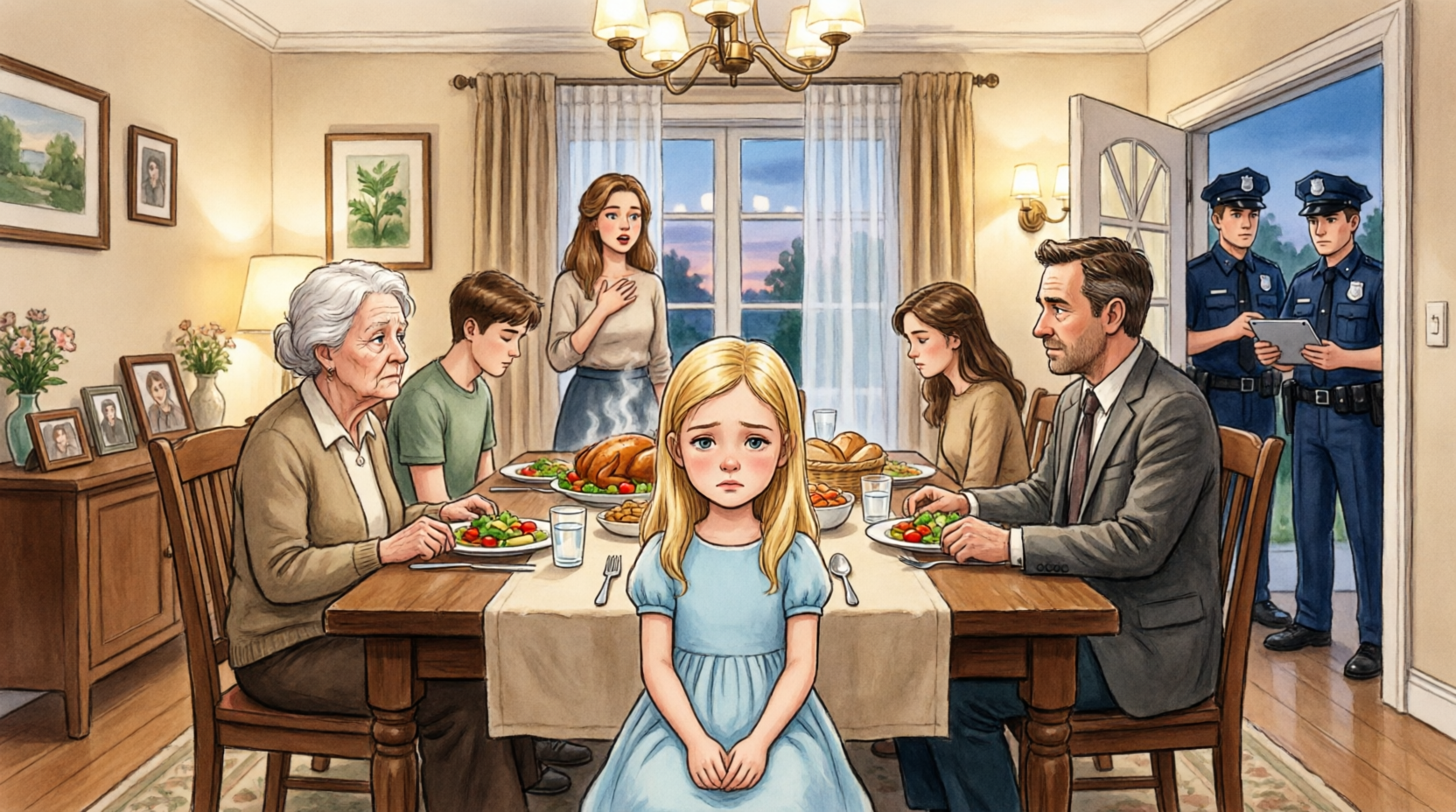
The sound lived in my skull long after the room went quiet.
It was not the loud, cinematic kind of blow people describe later with too much distance and too little truth. It was a clean, ugly crack. The kind of sound that tells you something fragile has just been treated like it was disposable.
Lily’s face snapped sideways. Her chair skidded. Then my ten-year-old daughter slid off the seat and struck the tile shoulder first, her head following with a blunt little knock that made the whole room stiffen.
For half a second no one moved.
That was what I remember most clearly now. Not only the hit itself, though God knows I will hear that for the rest of my life. It was the pause afterward. A table full of adults, all with hands and voices and working eyes, choosing stillness.
My daughter lay on the floor with blood on her lip, and the people around her acted like they were waiting to see who would define reality first.
My brother-in-law Jared stood over her, breathing hard through his nose, bourbon on his breath, his hand still lifted a little as if some part of him had not gotten the signal that the strike was over. At the head of the table, his mother Claudia gave a small approving smile and said, “That will teach her.”
My wife Sarah stared at her plate.
I knew that look. I had seen shadows of it before in quieter moments. Raised voices. A slammed cabinet. A family joke that cut too close. Sarah would go still in a way that did not match the present. It used to confuse me. Then it started to worry me. That night I finally understood it.
But in that first moment all I knew was that Lily was hurt, Jared was standing over her, and if I let rage take control of my hands, Claudia would spend the next year telling anyone who would listen that Jared had only been trying to correct a rude child before his unstable brother-in-law attacked him.
So I did the coldest thing I knew how to do.
I called Alex Ramirez.
Alex and I had known each other since high school. He had become a lieutenant with the county sheriff’s office. I had become the kind of man who built things for a living and trusted paper trails more than raised voices. We were not drinking buddies. We were something more useful than that: men who understood each other clearly.
When he answered and heard my tone, he did not waste time with false calm.
“What happened?”
“Adult male assaulted my ten-year-old daughter,” I said, keeping my voice level. “Possible concussion. I have audio. I need you at 1294 Oak Haven Lane now.”
A short silence. Then: “Units are on the way. I’m close.”
I ended the call and dropped beside Lily.
Her freckles stood out sharply against her pale skin. Her lip was split along the inside. Her eyes had gone unfocused in that way that turns a parent’s blood to ice.
“Hey, baby, stay with me,” I whispered. “Look at Daddy.”
She blinked slowly. “He hit me.”
The sentence was soft. Confused. As if she still needed a witness.
“I know,” I told her. “I saw.”
PART 2-He Slapped My Daughter at Dinner—Ten Minutes Later His Entire Life Collapsed
scoffed from above us. “Oh, give me a break. She jerked away from me. I barely touched her.”
That was a lie and all of us knew it.
But in that family, truth had always been negotiable if the right person was speaking.
I should explain what led to that dinner, because violence almost never drops out of a clear sky. It gathers. It rehearses. It teaches the room how to react before the worst moment ever arrives.
The dinner was at Claudia’s house in Oak Haven, one of those large suburban homes built to signal respectability. The dining room looked like a magazine spread every holiday season. Lace tablecloth. Silverware polished until it reflected candlelight. Family photos in matching frames. From the outside, it was the kind of house neighbors described as warm.
Inside, it ran on fear.
Sarah had grown up in that house. By the time I met her in college, she had already learned how to make herself small in rooms where loud people wanted obedience. She never called her childhood abusive. Not at first. She used words like strict, traditional, intense. She said Jared had always had a temper, that Claudia believed in toughening children up, that everyone in the family fought sometimes.
I wanted to respect the fact that it was her family and her language.
I see now that some people survive childhood by building softer words around hard truths.
Over the years I saw enough to know I did not like being around Jared. He was the kind of man who used volume as authority and cruelty as humor. He would grab shoulders too hard. He would clap kids on the back hard enough to make them stumble and then laugh at their expressions. He had once yanked his nephew by the wrist because the boy spilled juice on a deck chair, and when I told Sarah it bothered me she said quietly, “That’s just Jared when he’s drinking.”
The problem was that Jared was drinking more and more often.
That Sunday had started badly and only worsened. We were supposed to stay for dinner and leave before dark because Lily had school the next morning. Jared was already two bourbons in when we arrived. By the time the roast was carved he had moved into that swollen, self-righteous mood alcohol gave him. He mocked one of Sarah’s brothers for changing jobs. He told me people in my line of work were overpaid for “swinging hammers.” He criticized the game on television, the food, the weather, and eventually the children in the room.
I started recording when his voice changed.
I had learned that trick on job sites years earlier. When tempers flare and later everyone starts telling the story differently, the truth becomes whatever got captured first. I slipped my phone beneath the edge of the table and let it run.
What set him off with Lily was insultingly small.
Claudia had made one of her usual comments about children finishing everything on their plates because waste was disrespectful. Lily, who was small for her age and had already told Sarah she did not feel great, said politely, “May I be excused? My stomach hurts.”
Jared laughed at her in that mean way some adults talk to children when they enjoy