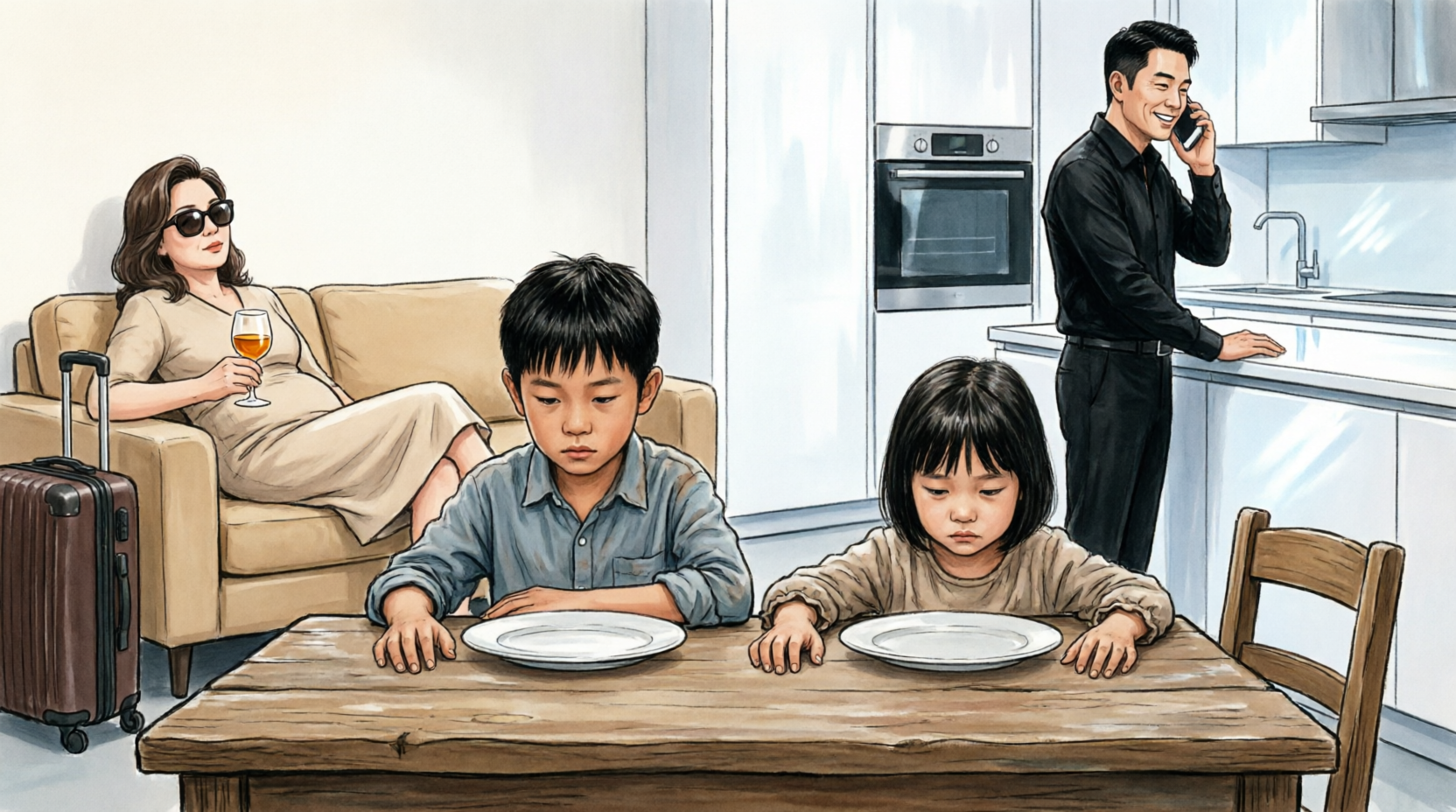
The night I understood that my husband had not only stopped loving me, but was willing to erase our son with me, the house smelled of a hot dinner and a lie that was too well rehearsed.
Steven moved around the kitchen with an odd calm, arranging plates, folding napkins, and smiling with such an artificial sweetness that even the air seemed to watch him with suspicion.

She had put out the good tablecloth, the one we only used at Christmas, anniversaries or important visits, as if she wanted that night to feel special before it turned into a nightmare.
Tommy, my nine-year-old son, looked happy.
That was the most unbearable thing to remember afterwards.
Her calm little face, her questions about school, her enthusiasm for a dish served by her father, her way of still believing that a family table was a safe place.
—Look at Dad —she said, smiling—. Today he really does look like a restaurant chef.
I barely smiled, because for weeks I had already gotten used to living with a knot in my chest that I didn’t quite know how to name, but that grew a little more each day.
Steven let out a short laugh.
—I just wanted to do something nice for you.
The phrase should have sounded tender.
Instead, it sounded rehearsed, like a line repeated under its breath too many times before saying it in front of the right audience.
During the last two months I had noticed him being different.
No kinder, no more affectionate, no more attentive, but more measured, more careful, more empty, as if he had already crossed an internal border and was just waiting for the best moment to leave us behind.
It started with small changes.
The phone is always face down.
Calls from the garage.
Deleted messages.
The new habit of watching me when I wasn’t looking, not with love, but with calculation, as if he were adjusting a life he no longer wanted but still didn’t know how to dismantle.
Even so, I was still there.
By Tommy.
Out of habit.
Out of fear.
Because of that silent addiction that many women develop towards hope even when reality has already begun to bleed out in front of us.
We sat down to dinner.
The chicken tasted normal, perhaps a little more intense than usual, but nothing that at that moment could become a specific cause for alarm.
Steven barely touched his dish.

He said he had snacked so much while cooking that he wasn’t hungry anymore, and Tommy laughed because in his childish logic that seemed like a perfectly reasonable explanation.
Halfway through the meal, my tongue felt heavy.
At first I thought it was exhaustion.
She’d had a long day: calls from work, unpaid bills, a visit to Tommy’s school, and that underlying tiredness that becomes part of the body when a woman sustains a life that’s already crumbling for too long.
But then my arms felt heavy.
Then the legs.
And when I saw Tommy blink several times, confused, with the glass still in his hand, I realized that this was not tiredness or anxiety or a bad moment.
“Mom… I feel strange,” he said in a low voice.
Steven leaned towards him and touched his shoulder with a tenderness that chilled me more than any blow.
—It’s just sleep, champ. Get some rest.
I wanted to get up.
I couldn’t.
The table tilted, the floor turned to liquid, and my knees gave way with humiliating slowness as the world faded away at the edges.
I fell sideways onto the dining room rug.
Before everything completely collapsed, I saw Tommy collapse too, small and helpless, with the glass still just inches from his fingers.
At that moment I made the most important decision of my life.
I don’t know if it was instinct, pure fear, or a clarity born of horror, but I understood that I should appear more absent than I actually was.
So I left my body still.
I relaxed my expression.
And I clung to my conscience with a discipline I didn’t even know I possessed.
I heard the chair scraping.
Steven’s footsteps approaching.
I felt the tip of his shoe brush against my arm, not affectionately, but like someone checking if an object has stopped responding.
“Good,” he murmured.
Then he picked up the phone.
She went towards the hallway, but her voice came back to me just as clear, perhaps because fear sharpens the ear in a brutal way, as if the body understood that listening can be surviving.
“That’s it,” she said in a low but calm voice. “They both fell.”
There was a pause.
A woman answered on the other end.
I couldn’t make out every word, but I could hear the tone: a restrained joy, an obscene anxiety, the intimate relief of someone who had been waiting too long for another person to disappear.
“Is it done?” she asked.
Steven exhaled, satisfied.
—Yes. It all ends tonight.
That phrase tore me apart inside, in a place that no longer had a name.
It wasn’t just betrayal.
It wasn’t just the end of the marriage.
It was the revelation that the man with whom I shared eleven years of my life was talking about my son and me as administrative obstacles about to be resolved.
The woman said something again.
This time I did understand part of it.
“When this is over, we can finally stop hiding.”
I felt my blood run cold.
There wasn’t just one other woman.
There was a plan.
There was a wait.
There was intent.
There was a future designed where Tommy and I had no place.
Steven walked back.

He opened a drawer.
Something metallic jingled.
Then I heard the scraping of a canvas bag being dragged across the hallway floor.
He stopped in front of us and, in a voice that was almost soft, almost kind, almost unrecognizable, he whispered:
-Bye bye.
The front door opened.
A gust of cold air came in.
Then silence.
I waited several seconds, counting each heartbeat as if the number could hold me to life.
Then I barely moved my lips.
—Don’t move yet…
A second later I felt Tommy’s fingers tremble against mine.
He was still awake.
The relief almost broke me.
But she couldn’t cry, she couldn’t hug him, she couldn’t let go of anything yet, because fear was still lurking inside the house like a crouching animal.
With unbearable slowness, I took the cell phone out of my back pocket.
The screen illuminated my face and I had to turn the brightness down to the minimum.
There was no signal in the dining room.
I dragged myself down the corridor, feeling clumsy, breathing heavy, my throat closed from the effort of staying conscious while panic pounded inside like a second illness.
Tommy followed me as best he could.
Pale.
Sweaty.
Scared.
Too quiet for a nine-year-old.
A signal bar appeared on the wall of the hallway.
I dialed 911.
The call was cut off.
I tried again.
Nothing.
He got in on the third try.
The operator answered, and my voice came out broken, low, almost alien, but enough to push the truth to the other side.
—My husband hurt us. My son and I are still alive. We need help. Fast.
The operator’s voice changed instantly.
He asked me for the address.
He asked me if he was still there.
I told him no, that he had left, that he had spoken on the phone, that he would return, that I didn’t trust how much time we had.
He asked us to lock ourselves in a room if we could.
I dragged Tommy to the master bedroom bathroom.
I locked it.
I sat him down against the tub and moistened his lips with the few drops of water I could gather in a glass.
I asked him to look at me, to keep breathing, not to fall asleep, to think about anything, about his school, about his imaginary dog, about his favorite video game, about me.
While I was answering the operator’s questions, my phone vibrated.
Unknown number.
CHECK THE TRASH. THERE’S EVIDENCE. COME BACK.
I read the message three times.
He had no name.
There was no explanation.
Only that dry urgency that somehow seemed to come from someone who knew exactly what was happening and, for his own reasons, had decided to intervene from the shadows.
In the distance, sirens began to sound.
Tommy squeezed my hand desperately.
I was about to believe that help would arrive in time, that the horror had already shown its worst face, when I heard something that chilled me to the bone.
The front doorknob.
Turning again.
Steven had returned.
And he wasn’t alone.
There were two steps.
A female voice whispered something I couldn’t understand.
Then Steven’s, lower, more tense, less confident than before.
—We have to do it right. Nothing can be left out.
My son started trembling.
I covered his mouth with my hand just long enough for him to understand that silence was no longer fear, but defense.
The sound of drawers was heard.
Doors.
Furniture moving.
Footsteps in the hallway.
The woman asked where we were.
Steven replied that it was probably in the bathroom, that I always hid when things got tough, and that sentence showed me something fierce: even in the midst of crime he was still using the language with which he had reduced me for years.
Dramatic.
Difficult.
Exaggerated.
Frightened.
Words always come before real blows.
I understood that with unbearable clarity as I hugged Tommy and listened to the man who once swore to take care of us talk about us as a nuisance about to disappear.
The first knock against the bedroom door made me jump.
The second one made the floor vibrate.
The operator was still online.
I had left my phone on the sink, with the speakerphone on the lowest setting.
I heard his voice say:
—The units are already outside. Stay inside. Don’t make any noise.
Then the most beautiful sound of my life was heard.
The main door, this time broken from the outside.
Shouting.
Orders.
A male voice demanding that no one move.
Another one identifying herself as a police officer.
The woman screamed.
Steven shouted that it was all a misunderstanding.
That I was unstable.
That our son had suddenly become ill.
That he had returned to help us.
He lied even with the law inside his own house.
He lied with that monstrous agility of men who have practiced for years the convenient version of themselves until they believe they can turn any atrocity into domestic confusion.
Someone knocked on the bathroom door.
This time not with violence, but with authority.
—Police. Ma’am, if you’re inside, open up when you can.
I couldn’t get up at first.
I had to use the tub to push myself up and open it with one hand while with the other I held Tommy, who was still clinging to me as if letting go would mean falling into the void.
When the door opened and I saw the officer in front of me, something inside me finally gave way.
I didn’t faint.
I didn’t scream.
But my body stopped pretending to be strong and I trembled all over with that humiliating violence that comes when there is no longer any need to keep acting.
The officer took us out first.
I saw Steven in the hallway, pinned against the wall, with the blonde woman beside him, her makeup smeared and the broken expression of someone who never thought that a night planned so coldly would end under blue lights.
She was not a stranger.
It was Erin.
The “external consultant” of the firm where Steven had been working for eight months.
The woman he mentioned so casually, the one who always sounded too comfortable in his stories, too frequent to be casual.
When he saw me, he looked away.
That enraged me more than any scream.
Cowardice is immediately recognizable in the eyes of people who participate in something monstrous but cannot bear to see it reflected in the face of the person who was about to be destroyed.
Tommy was taken to the paramedics.
Me too.
The house, our home, was filled with flashlights, questions, photos, gloves, evidence, serious voices, and that kind of cutting energy that appears when normality officially ends and no one can pretend anymore.
An officer asked me if there was anything else they needed to check.
Then I remembered the message.
The garbage.
I told them about the text.
I told them that someone had warned us.
One of the detectives went to the kitchen, checked the jar under the sink, and minutes later returned with a different expression, harder, more focused, like that of someone who had found the piece that transforms a suspicion into a complete structure.
Inside the trash there was an empty jar.
Also, medicine wrappers that did not belong in our house.
And, even more importantly, a folded napkin with a handwritten number and a single word underneath: CALL ME.
I didn’t sleep again that morning.
At the hospital, while they were monitoring Tommy and asking me questions that I answered with my mind fractured into pieces, a detective named Moreno asked me for my phone.
He checked the unknown message, copied the number, and left the cubicle with a speed that told me the case had just gotten bigger.
He returned two hours later.
I was carrying coffee in one hand and a truth that split my story in two.
The number belonged to Lila Turner.
Steven’s secretary.
The same woman in her forties whom I had seen only once at a company dinner, discreet, kind, almost invisible, like so many women who go unnoticed right where men believe that protects them.
Lila was not his lover.
He was her witness.
I had found messages.
I had overheard conversations.
I had seen documents related to policies, accounts, debts, and a plan to legally disappear from Steven’s life long before the night of the dinner arrived.
He didn’t intervene at first, he said later, because he was afraid, he needed proof, and he didn’t know if I would believe him.
But when Steven left early and she understood what he was going to do, she followed him, saw Erin get into the car, and realized that this night was no longer just another business lie.
It was the end of something much darker.
That’s why he wrote to me.
That’s why he also called the police from another number while I was locked up with Tommy.
That’s why he knew to tell them to check the trash.
Steven had been preparing for months.
Not just to leave me.
To ruin myself first.
He had diverted money from our accounts.
I had applied for loans using shared digital signatures.
He had tried to change the ownership of the house.
I had changed policies.
And in some internal emails he spoke of starting a new life “without burdens” with a coldness that made even the detectives fall silent for a few seconds after reading it aloud.
Tommy slept for most of the next day.
I sat by his bed watching him breathe, with the unbearable feeling that one night had aged my soul more than the entire previous decade.
Every time I closed my eyes, I heard Steven’s voice.
That’s it.
They both fell.
Now I’m finally going to be free.
There are phrases that a woman never leaves behind.
Not because I want to remember them.
Because they become the exact place where love finally rots away and reality takes its place.
My sister came that afternoon.
Also my neighbor, Mrs. Howell, the same one who always said that Steven smiled too much to seem sincere.
My father arrived at nightfall and wept in the hallway when he saw Tommy asleep, because the fear of almost losing a child makes all the old pride of men seem ridiculous.
But the visit that changed me the most wasn’t any of those.
It was Lila.
She entered with her hair up, a folder in her hands, and the shoulders of a woman who had been carrying information heavier than her own peace of mind for too long.
He apologized before sitting down.
He said he knew he was late.
He said he should have come earlier.
He said he had been gathering things for weeks without understanding how far Steven was willing to go.
He opened the folder.
There were emails, screenshots, call logs, a copy of a recent policy, internal notes, and something that took my breath away.
A draft guardianship.
Steven had been gathering material to portray me, after my disappearance, as an unbalanced, unstable, and erratic woman, someone incapable of sustaining a normal life, someone whose loss would be tragic, yes, but understandable within a narrative of collapse.
He wanted to keep everything.
The house.
Insurance.
The narrative.
He even wanted to manage the pain himself.
Lila told me that Erin wasn’t just a fling.
It was greed with expensive perfume.
Both had gambled money, lived beyond their means, and planned to start over using what was left of their lives.
As she spoke, I watched her and thought something almost obscene: the woman who really tried to save us was the one no one in that company looked at twice.
Not the bright one.
Not the young woman.
Not the elegant one.
The one who was listening.
The one who filed it.
The one I saw.
The following weeks were brutal.
Statements.
Lawyers.
Hearings.
Expert reports.
People who wanted details.
People who wanted drama.
People who were feigning shock now that the violence had come close enough to shake them but not close enough to compromise them.
Erin tried to break away.
He said he didn’t know everything.
That Steven was exaggerating.
She thought he was only talking about separating.
But the calls, the messages, and the way she came back to the house with him that night ended up destroying her.
Steven, for his part, chose the most predictable path.
He denied it.
Cry.
He complained of stress.
He said I was confused.
Then he said it had been an accident.
He then insisted that he never really meant to hurt us, a phrase that only a monster or a coward can utter when the damage has already been done and he has not achieved the result he expected.
I never responded to him directly after that night.
Not a single word.
Because there are men who turn any female reaction into fuel, and I had already understood that my silence this time was not submission.
It was a death sentence.
Tommy took longer to heal than I did.
Not physically.
That was the shortest part.
The difficult part came later.
The questions in a low voice.
Sudden awakenings.
The need to double-check who was cooking.
The fear of falling asleep if I wasn’t nearby.
The way he looked at doors before entering a room, as if the world had forever lost its right to surprise him.
That was the price that made me hate Steven the most.
Not the money.
Not betrayal.
Not the other woman.
Not even the intention.
Rather, it was to rob a child of the basic trust that his father could not become a danger.
A month after the night of the dinner, I returned to the house for the first time.
No to living.
Time to pack up.
I went in with an officer, my brother, and a plastic document box.
Everything seemed the same.
The table.
The curtains.
The photos.
The kitchen.
That false normality made me more nauseous than any explicit memory.
Evil rarely lives in dark settings.
She often uses warm lamps, good napkins, and a house that looks peaceful from the outside.
While putting papers away in my old desk, I found a notebook I didn’t remember seeing.
It was mine, but not of the present.
An old notebook where years ago I used to write down work ideas, plans, purchases, savings, and small dreams.
On a page written in my own handwriting, I saw a phrase underlined twice.
If I ever feel like I’m becoming invisible, I have to leave before I believe I deserve it.
I stared at her for a long time.
Because the most humiliating truth wasn’t discovering that Steven could destroy us.
It was accepting that a part of me had known for years that the house was no longer about love, just habit with threats, and yet I stayed out of fear of starting over.
But starting over, I discovered, wasn’t quite as much like a fall as I had imagined.
It resembled a necessary amputation.
Painful.
Bloody.
Irreversible.
But necessary if one wanted to stay alive.
Six months later, Tommy and I were living in a smaller, brighter house, with a kitchen where nobody pretended to be anything and a door whose lock never sounded threatening again.
Lila was still in contact with us.
She didn’t become an official heroine, nor did she want to be.
He only appeared when needed, with a discretion that taught me something powerful about the true value of certain people.
Detective Moreno came by once to say goodbye when the case moved to another legal phase and told me a phrase that I still remember.
—Dangerous people almost always believe that if they tell the story first, the truth will belong to them. Your job now is to not give them that privilege.
That’s what I did.
When the final hearing arrived, I didn’t look at Steven.
I didn’t need to do it.
Not to be strong.
Not to close anything.
Not to prove anything.
Tommy didn’t look at him either.
And in that small, dry, almost silent gesture, I understood that my son had already begun to leave the place where his father wanted to bury us.
People sometimes ask what the exact moment was when I stopped loving my husband.
It wasn’t when I heard it on the phone.
It wasn’t when he saw the other woman in the hallway.
It wasn’t when I discovered the accounts, the policies, or the drafts of papers where I was trying to erase myself.
It was before.
Long before.
Except that night it forced me to stop negotiating with the truth.
And the truth was this: I had been married for years to a man who smiled too well, lied too easily, and felt too comfortable being the center of a story where the rest of us only existed in terms of his freedom.
What happened next surpassed anything I could have imagined, yes.
But not because an impossible twist or a magical salvation appeared.
It surpassed my imagination because I understood something much worse and much more useful than a great scandal.
I understood that love doesn’t always die in a spectacular instant.
Sometimes it dies slowly, in small permissions, in ignored intuitions, in silences that are an apology for tiredness, for fear, for routine, for the child, for the house, for what others will say.
And sometimes a woman doesn’t survive the big night through sheer bravery.
She survives because a secret part of her had been preparing for too long to stop lying to herself.
I didn’t come out of that night transformed into someone invincible.
I left trembling.
With rage.
With guilt.
With insomnia.
With a broken voice.
But I also went out with my son.
And sometimes that’s enough to start rebuilding something more sacred than an intact family.
A real life.