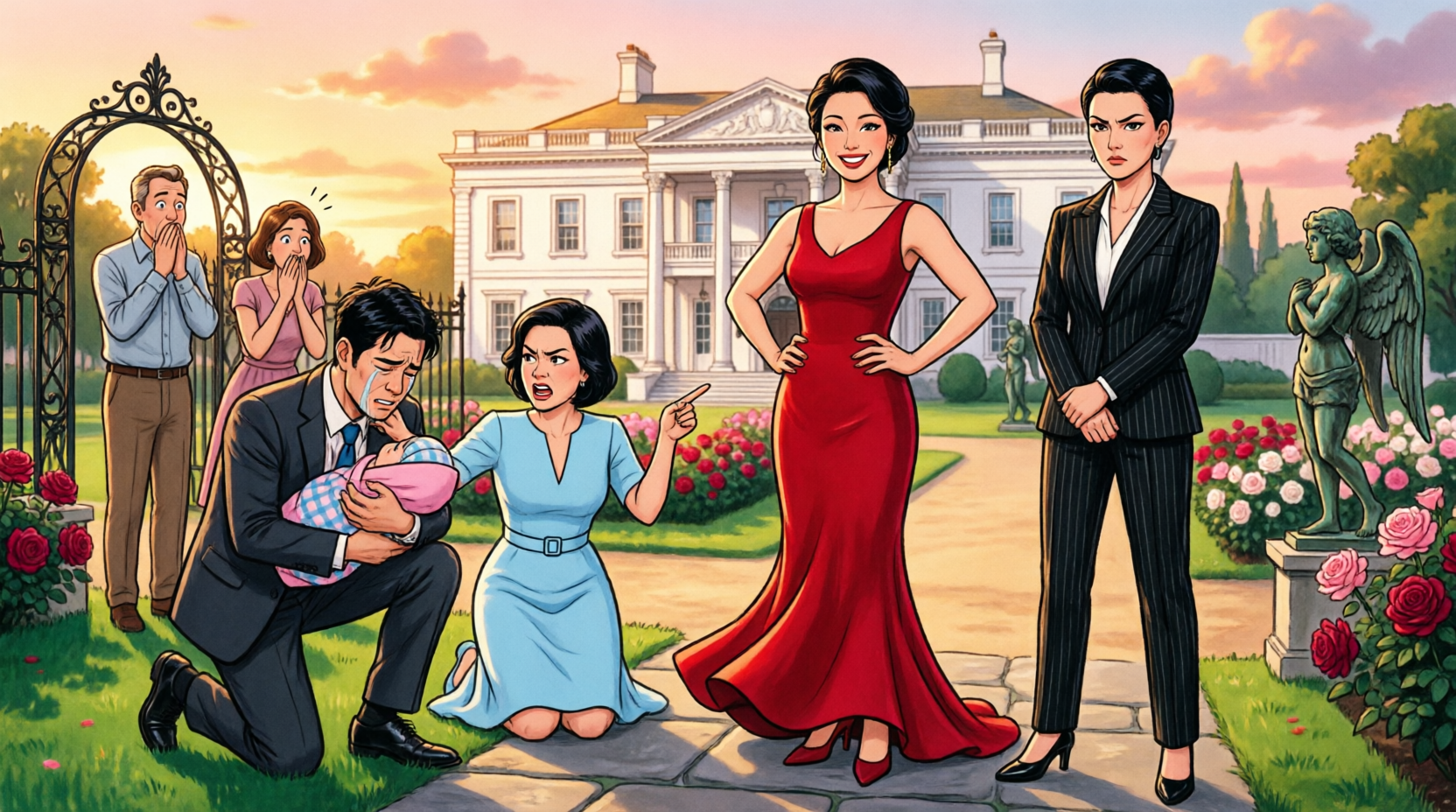
My husband kissed my forehead and said, “France. Just a short business trip.” A few hours later, as I stepped out of the operating room, my heart nearly stopped. He was standing at the end of the maternity hallway… holding a newborn in his arms, leaning close to a woman I had never seen before.
The morning Ethan kissed my forehead and said, “France. Just a short business trip,” I was standing barefoot on the cold tile in our kitchen, trying to convince myself that reheated coffee still counted as coffee.
The house smelled like toast I didn’t have time to eat and the sharp lemon soap our cleaning lady used on the counters every other Thursday. Dawn was barely through the windows, just a weak gray shine over the brownstone across the street. I had on navy scrubs, my hair twisted into a knot that was already loosening, and I was mentally reviewing a trauma case before I even walked out the door.
Ethan looked polished, as usual. Charcoal coat. Expensive suitcase. The same watch I’d given him on our tenth anniversary, the one with the dark face and the leather band he used to say made him look “like a man who actually understood airports.” He kissed my forehead, warm and familiar, and gave me that easy smile that had gotten him through twelve years of marriage, three house renovations, my residency, and every tight season in between.
“Back by Sunday,” he said. “Don’t let the hospital steal your whole weekend.”
I remember rolling my eyes and saying, “Tell Paris I said hi.”
“South of France, technically,” he said, lifting his suitcase. “But sure.”
Then he left.
Nothing dramatic. No hesitation. No guilt leaking through the cracks. Just the front door opening, the suitcase wheels bumping once over the threshold, then shutting behind him with that heavy old-house click I’d heard ten thousand times.
I believed him because believing Ethan had become muscle memory.
I was a trauma surgeon at St. Vincent’s in Chicago. I lived by sequence. Bleeding before beauty. Airway before everything. In my world, people either told the truth or they died fast enough that truth didn’t matter anymore. There wasn’t much room for fiction. Ethan’s job, on the other hand, seemed built out of polite vagueness. He worked in medical logistics, which meant conferences, supplier dinners, “networking,” calls taken in hallways, and trips that popped up with boring regularity. I never loved it, but I accepted it. Marriage is partly made of trust and partly made of exhaustion, and exhausted people call a lot of things normal.
That afternoon, after six brutal hours trying to save a seventeen-year-old boy from the damage a guardrail had done to his chest, my lower back felt like someone had hammered a metal rod through it. I peeled off my gloves, stripped off my mask, and stepped out of the operating room into the fluorescent brightness of the hall. The air outside smelled like antiseptic, stale coffee, and overheated machinery. Somewhere down the corridor, a monitor beeped in a steady, indifferent rhythm.
I had one goal: caffeine, sugar, and maybe ninety seconds of quiet before the next case.
The nearest vending machines were past maternity. I cut through automatically, half-reading a chart on my phone, my mind still inside the boy’s rib cage, when I heard a laugh that didn’t belong there.
It was Ethan’s laugh.
Not a close-enough laugh. Not a maybe. My husband’s laugh had a soft hitch at the end, like the joke had surprised him. I knew it better than I knew my own pulse.
My head lifted before the rest of me caught up.
He was standing just outside a postpartum room.
For one split second, my brain did something almost kind. It tried to hand me a harmless explanation. Vendor tour. Lost visitor. Helping someone. Anything but what was right in front of me.
Then I saw the baby.
A newborn, pink-faced and impossibly small, bundled in one of those striped hospital blankets. Ethan held her with the easy caution of a man who had practiced. Not stiff, not scared, not figuring it out as he went. He adjusted the blanket under her head with two fingers and bent down, smiling in a way I hadn’t seen in years. Soft. Full. Undivided.
Inside the room, propped against white pillows, was a woman I had never seen before.
She looked exhausted in the unmistakable way women look after labor—skin pale, hair damp at the temples, hospital gown loose against narrow shoulders. But she was smiling through tears, one hand stretched toward Ethan like she had every right to touch him. Like she’d been reaching for him for a long time.
Then I heard him say, low and tender, “She has your eyes.”
Not mine.
Hers.
I stopped moving so completely it was like my body had been switched off. The chart on my phone dimmed. My badge swung once against my scrubs and settled. Everything around me sharpened in a strange, vicious way: the waxy smell of the floor, the squeak of a nurse’s shoes somewhere behind me, the pale pink balloon tied to the room’s handrail, the condensation rolling down a Styrofoam cup on the windowsill inside.
He hadn’t gone to France.
He hadn’t gone to the airport.
He hadn’t even left Chicago.
Every little thing I had filed away over the past year without wanting to name it came back all at once, hard and fast. The late-night “client calls” taken outside. The extra phone he said was only for international travel. The canceled weekends. The hotel charges he blamed on billing mix-ups. The way he’d been oddly calm every time I brought up finally trying for kids “when things slowed down,” as if slow was some weather system that might drift through on its own.
I didn’t walk into the room.
I didn’t throw anything.
I didn’t ask the universe for strength, because strength is for people who still think they have choices. In that moment, I had something better than strength. I had clarity.
I took one step backward, letting the angle of the hallway hide me in shadow. Ethan shifted the baby, smiling down at her. The woman reached up and touched the sleeve of his coat.
My husband looked like a man arriving at the center of his life.
Something in me went very still.
I slid my phone into my palm, opened it, and stared at the screen until my fingerprint unlocked every door we had ever built together.
Our joint checking account sat there with its neat, stupid number. Our savings. The vacation fund we never used because my schedule kept collapsing it. The reserve account for the house. The brokerage cash sweep tied to both our names. Numbers I had fed with overtime, bonuses, missed holidays, nights I ate crackers from the surgeons’ lounge at 2:00 a.m. because I didn’t have time to leave.
Inside room 614, my husband was whispering to his mistress and their baby daughter.
Outside, under hospital lights that made everyone look a little dead, I opened the banking app and touched “Transfer.”
Then I looked up and saw the name on the room’s whiteboard.
Lauren Mercer.
And suddenly I knew this was only the first thing I was about to lose, or the first thing I was about to take back.
Part 2
Shock is useful for about ten seconds. After that, if you’re lucky, training takes over.
I stood beside a vending machine humming like an old refrigerator and turned my marriage into a trauma protocol.
First: stop the bleeding.
My fingers moved fast, but my thoughts were cold and clean. Joint checking into my private account. Vacation fund moved. House reserve moved. Brokerage sweep moved. I knew exactly what I could legally touch and what I couldn’t. Ethan had always liked to joke that I treated Excel spreadsheets like surgical fields. That afternoon, it saved me.
I didn’t drain anything that was solely his. I wasn’t trying to be reckless. Reckless is noisy. Reckless gets punished. I was being precise.
The vending machine smelled faintly of hot plastic and peanut dust. Somebody had spilled orange soda near the base, sticky under my shoe. Through the glass wall across from me, I could still see the edge of the postpartum hallway. I never saw Ethan come out, but I kept my back angled so he wouldn’t see me if he did.
Next: secure access.
I locked the joint credit cards through the apps. Changed the passwords on our utility accounts, streaming services, and home security. Downloaded the last eighteen months of bank statements to a cloud folder only I controlled. Then I called the one person in Chicago I knew would not waste my time with sympathy before strategy.
Rebecca Sloan answered on the second ring.
Her voice was brisk, low, already halfway through three things. “Rebecca.”
“It’s Claire Bennett.”
A beat. Then warmer. “Claire. Is your brother okay?”
I’d operated on her brother after a pileup two winters earlier. Surgeons become family legends that way.
“He’s fine,” I said. “I need a divorce attorney. Today.”
Silence. Not shocked silence. Alert silence.
“What happened?”
“My husband told me he was flying to France this morning. I just found him in maternity holding a newborn with another woman.”
Rebecca inhaled once. “Did you confront him?”
“No.”
“Good. Don’t. Not yet. Screenshot everything. Preserve every account record, every message, every transfer. If the house is jointly titled, do not physically lock him out. Protect liquid assets. Secure your identification, passport, licenses, anything irreplaceable. Can you still work?”
I looked at the trauma pager clipped to my waistband. “For another hour.”
“Then do your job,” she said. “And after that, come to my office. Today means today.”
I hung up and leaned my head back against the wall for one second. The fluorescent light above me buzzed softly. Somewhere nearby, a baby started crying with that thin, furious, brand-new sound that always made the air feel fragile.
Then my pager went off.
A stabbing in Bridgeport. Male, thirty-two, unstable vitals.
I went back to work.
People like to imagine betrayal as some huge cinematic thing that leaves you screaming in the rain. Mine happened under LED lights while I tied off an artery and asked for another clamp. The man on the table was bleeding into his abdomen. My resident’s glove was slick to the wrist. Suction hissed. Metal touched metal. I was calm, because panic doesn’t stop blood loss and it sure as hell doesn’t fix a husband.
When it was over, one of the nurses said, “You look weirdly rested for someone on your third coffee.”
I almost laughed.
By six-thirty, I was in Rebecca Sloan’s office on the thirty-first floor of a building that smelled like fresh paint and expensive carpet. Her conference room overlooked the river. Evening light turned the water the color of old steel.
Rebecca herself looked exactly like someone you hire when you want the other side to regret your existence. Dark suit, silver pen, eyes that didn’t miss much.
She went through my screenshots in silence, nodding once in a while. Transfer confirmations. Account balances. The joint credit card lock notices. Access logs from our home security app. The statement showing repeated charges to an LLC I’d assumed was tied to one of Ethan’s vendors.
“You did well,” she said at last.
That should not have been comforting, but it was.
“I want facts,” I said. “Not guesses.”
“You’ll get facts.”
She called in a forensic accountant she used on difficult cases and texted a private investigator before I’d even finished the second half of my coffee. While they got started, I logged into our shared cloud drive and pulled down tax returns, property deeds, mortgage statements, retirement records, insurance documents, and every folder Ethan had ever told me was too boring for me to care about.
Turns out “too boring” is often where men hide the bodies.
There was an LLC folder. Renewal paperwork. Utilities. A lease guarantee. Only the apartment wasn’t for a supplier. It was for a two-bedroom condo downtown with a parking space and a monthly rent that made my stomach turn.
My money had been paying for another woman’s windows.
Rebecca read in silence, then said, “We need to know whether this was an affair or a parallel household.”
The distinction sounded legal, but I knew what she meant. A mistake or an architecture.
By eight-fifteen, the answer started arriving.
The investigator sent a basic profile first: Lauren Mercer, twenty-nine, formerly in pharmaceutical sales, currently on maternity leave. Then came the address. Then the utility bills tied to the condo. Then a parking registration listing Ethan’s second car key code.
And then, at 8:41 p.m., a photograph.
It had been posted seven months earlier on a private social account and tagged by a friend before being deleted. Lauren stood in profile in a mustard-colored dress, one hand under a small pregnant belly, smiling at something outside the frame. Ethan stood behind her with his palm spread over her stomach like it belonged there.
The caption read: Building our little future.
For a long moment, the room went very quiet.
Not a fling.
Not an accident.
Not a drunken wrong turn.
A future. Planned in installments while I covered mortgage payments, maxed out retirement contributions, missed Christmas dinners, and came home too tired to question a man who knew exactly how to sound offended by doubt.
At 9:12, my phone lit up with Ethan’s name.
I stared at it until it almost stopped ringing.
Then I answered.
His voice was casual, practiced, warm in that irritatingly intimate way only a liar can manage. “Hey. Flight got delayed. I may land pretty late.”
I looked at the photo on the table. Ethan’s hand on Lauren’s belly. His smile. The soft domestic confidence of it.
My voice came out flatter than I felt. “That’s strange.”
A pause. “What is?”
“France usually doesn’t deliver babies in Chicago.”
Silence fell so hard I could hear the heating vent rattle in the ceiling.
When he finally spoke, his voice had changed. Lower. Tighter. Like a man hearing floorboards crack beneath him.
“Claire,” he said. “I can explain.”
I looked out at the dark river and thought, with sudden certainty, that whatever came next was going to be uglier than I’d guessed.
And I still had no idea how much of my life he had been living somewhere else.
Part 3
There are people who say they want the truth. Most of them want something softer—truth with cushions, truth with music under it, truth that leaves room for them to still be the hero at the end.
Ethan wanted that version.
I didn’t give it to him.
He started talking the second I stopped speaking, words rushing in like he’d been waiting months for a stage and thought urgency might pass for honesty.
“It’s not what you think.”
That was his first mistake. Men like Ethan always begin by trying to manage your interpretation before they admit a single fact.
I leaned back in Rebecca’s conference room chair and watched downtown Chicago burn in reflections across the glass. “You were holding a newborn,” I said. “Try again.”
He exhaled sharply. “Lauren had the baby early.”
I closed my eyes for one beat. Not because it hurt. Because the sentence was so absurdly intimate. Like I had asked why he was late to dinner and he was explaining traffic.
“How long?” I asked.
“Claire—”
“How long?”
A scrape of breath on the line. “About a year.”
A year.
Not an impulsive mistake. Not one bad month. A year of breakfasts, anniversaries, tax filings, my birthday dinner in March when he’d toasted to “the next decade of us.” A year of him kissing my forehead and taking my dry cleaning while building a second household with enough stability to produce a child.
Rebecca was taking notes across from me, her face still and unreadable.
“I’m going to say a few things,” I told him, “and you’re not going to interrupt.”
“Claire, please—”
“Do not come to the house tonight. I moved our joint liquid funds this afternoon. I have account records, transfer confirmations, and a lawyer sitting across from me. Every device, every statement, every lie is evidence now. If you delete anything, move anything, or try to empty any account, Rebecca will make your life very difficult.”
On the other end of the line, his breathing changed. The softness was gone.
“You had no right to touch the accounts.”
There it was. Not shame. Not grief. Not I’m sorry. Property.
“I had every right,” I said. “You used our marriage as infrastructure.”
His voice sharpened. “You don’t understand how complicated this got.”
I laughed then. I couldn’t help it. A short, ugly sound. “Complicated is a twelve-car pileup in freezing rain. This is math.”
He tried another angle. They hadn’t planned the baby. He’d been confused. He hadn’t known how to tell me. He still cared about me. He didn’t want to lose me. The whole pathetic script came out in pieces, each sentence asking for moral credit because he felt bad while lying.
Rebecca slid a yellow legal pad toward me. On it she’d written one line.
Ask nothing. Offer nothing.
So I stopped trying to understand and started listening for structure.
He had rented the condo “to help Lauren through the pregnancy.” He was “trying to do the right thing.” He had “never stopped loving me.” He kept repeating that one, as if love was some abstract gas that filled any container he poured it into.
Finally I said, “Did you tell her you were married?”
The silence that followed answered me before he did.
“Yes,” he said. Too fast.
Rebecca lifted one eyebrow.
“Did you tell her you were happily married?”
“Claire—”
“Did you tell her I existed as your wife, in this house, right now?”
He didn’t answer.
I ended the call.
After that, there was paperwork. Temporary orders. A timeline Rebecca helped me build from the bank records. Three years of statements showed patterns once you knew what you were looking for: flowers I never received, furniture deliveries to the condo, prenatal pharmacy charges, rent checks routed through the LLC, restaurant bills on nights he’d told me he was stuck at O’Hare.
By the time I left Rebecca’s office, it was close to midnight. The city was wet with old rain, streetlights reflected in the pavement like torn ribbons. I drove home with both hands tight on the wheel and the radio off.
The brownstone looked exactly the same.
That was the cruelest part. Betrayal almost never changes the furniture.
Inside, the house smelled faintly of cedar and the tomato sauce I’d frozen last week in glass containers lined up like orderly little lies. Ethan’s coffee mug was in the sink. His shoes were still by the radiator. The framed photo from our trip to Seattle sat on the entry table—me laughing into the wind, him looking at me like I hung the moon.
I set my bag down and stood in the foyer until the silence settled properly.
Then I went room by room.
Not because I thought he’d left some cartoon-villain clue behind. Because I needed to touch the life I had built and understand where the seams were. In the bedroom, his dresser drawer held cuff links, rolled ties, and the extra passport holder we used for “big trips.” Empty. In the bathroom cabinet, his expensive shaving cream and cologne were still lined up like soldiers. In the office, I found the file box where we kept warranties, tax documents, the lake house paperwork, old cards from my mother.
Underneath a stack of dull corporate folders, I found a receipt from a jewelry store downtown.
It was dated eleven months ago.
White gold bracelet. Infant charm attached.
The note line read: For Sophie.
I sat down slowly in Ethan’s desk chair.
Sophie.
Not “the baby.” Not “our daughter.” A name. Chosen. Engraved. Paid for.
I pulled harder through the drawer and found more. A folded pamphlet from a birthing class. Parking stubs from obstetrics appointments. A tiny gift card from a children’s bookstore on Lincoln Avenue with ducks painted on the envelope. Ethan hadn’t been improvising. He’d been collecting fatherhood in careful little purchases and hiding it in my house.
My phone buzzed again.
A text from him.
Can we please talk in person like adults?
I looked at the bracelet receipt in my hand, the loops of his handwriting on the note line, the easy certainty of a man buying a charm for his daughter while coming home to sleep beside me.
Then another message arrived, this one from a number I didn’t know.
You’re Claire, right? I think we need to talk too.
It was signed with one name.
Lauren.
And for the first time that night, my pulse actually jumped.
Part 4
I didn’t answer Lauren right away.
Not because I was afraid of her. Because I didn’t know which version of her existed. Was she the kind of woman who had knowingly built herself inside another woman’s marriage and wanted to bargain? Was she another liar with better mascara? Was she angry? Defensive? Triumphant? I had spent enough years in emergency medicine to know that the wrong conversation at the wrong time can turn bleeding into hemorrhage.
So I slept on it.
That’s not quite true. I lay in my bed with the lamp off, staring at the faint orange streetlight pressed through the curtains, and listened to the house settle around me. Pipes ticking. Refrigerator humming. A car passing outside with bass low and heavy enough to make the window vibrate. At some point around three, I must have drifted off, because I woke with my cheek creased from the pillow and my phone in my hand.
Lauren had sent one more message.
I didn’t know about you the way I should have. He said things. Please just hear me out.
I read it three times.
Then I got up, showered, and went back to the hospital.
The day smelled like rain and overbrewed coffee. In trauma, two ambulances arrived back-to-back before 8:00 a.m., and for six straight hours the only things that mattered were blood pressure, airway access, and whether a spleen could be saved. That’s the relief nobody tells you about in a disaster: if your work is hard enough, it becomes a place to hide.
At noon, I found Rebecca in the physicians’ lounge downstairs, standing beside the vending machine with a paper cup of tea and the kind of expression that meant she had come not for social reasons.
“I ran the condo records deeper,” she said quietly.
The lounge smelled like chicken broth and microwaved plastic. A TV in the corner played a cooking show nobody was watching.
“And?”
“It’s worse than rent. Utilities. Furniture. Car payments. He used marital funds for all of it. Also, the LLC? It’s basically a curtain. Thin one.”
I rubbed my temple. “How much?”
“We’re still tallying.”
I was too tired to feel the number yet, whatever it was.
Rebecca lowered her voice another notch. “And before you ask, yes, I think you should meet Lauren. Public place. Short window. No promises, no emotion, no legal discussion beyond what she volunteers. We need to know what story he told her.”
So at four-thirty, after my shift, I went to a coffee shop in River North that smelled like espresso and wet wool. It was the kind of place with mismatched wood chairs and chalkboard menus full of drinks nobody over thirty actually orders. I chose a table near the front window.
Lauren came in ten minutes late, moving carefully the way women do after giving birth, one hand on the strap of an oversized diaper bag. She was smaller than I expected. Tired in an honest way. No makeup except what was left under her eyes from yesterday. Her hair was pulled back badly. She looked at me once, took a breath, and came straight over.
“Claire?”
“Yes.”
She sat. For a second, neither of us spoke.
Up close, she looked very young. Not childish. But young enough to still think love can be sorted out if everyone just says the hard thing in a brave voice.
“I’m sorry,” she said first. Her hands were shaking. “I know that sounds useless.”
“It does,” I said.
She nodded like she deserved that. “He told me you and he were basically finished.”
I let the words sit between us.
“He said you stayed legally married because of finances and because your life was too tied together to unwind quickly. He said you lived more like roommates. He said you were… emotionally gone.”
There are insults you can fend off and insults that crawl under your skin because part of them is built from truths you supplied. I had worked eighty-hour weeks. I had missed dinners. I had fallen asleep on the couch. But there is a difference between a marriage under strain and a marriage abandoned. Ethan had used my exhaustion as a costume and worn it to someone else’s bed.
Lauren swallowed. “I found out you still lived together three months ago. We were fighting about why he hadn’t filed yet. He said timing was complicated because of property and taxes and your job. He said if I pushed too hard, everything would explode before he could do right by the baby.”
“The baby,” I repeated. “Not your baby. The baby.”
Her eyes flashed wet. “Her name is Sophie.”
I looked away toward the front window. Rain had started again, thin silver lines on the glass.
Lauren opened the diaper bag and pulled out a stack of folded papers. “I didn’t come here to beg you for anything. I came because once I realized he lied to me too, I started collecting things.”
She pushed the papers across the table.
Printouts. Screenshots. Apartment invoices. Text messages. An email thread with a realtor discussing “eventual family housing options.” Ethan had sent Lauren links to houses in Evanston with fenced yards and said things like, Give me a little more time. I’m almost free.
Almost free.
I turned a page and found a screenshot of Ethan telling her, in black and white, Claire can’t have kids and stopped wanting a family years ago.
The coffee shop noise faded for a second. Milk steaming. Cups clinking. Someone laughing too loudly at the counter. It all went cotton-soft.
I had wanted children. Not with the desperate, singular ache some women describe, but honestly, earnestly, enough to have raised it with Ethan more than once. Enough to have bookmarked a fertility clinic when time finally made it obvious that “later” was a lie we were telling ourselves.
I looked back at Lauren. “Did he tell you that before or after he got you pregnant?”
She flinched. “Before.”
Of course.
I went through the rest of the pages with the numb steadiness I usually reserve for bad CT scans. Then Lauren said, quieter, “There’s one more thing.”
She slid over a printed confirmation from a title company.
It was for a preliminary inquiry on our lake house.
Estimated equity release options.
Dated six weeks ago.
“He told me,” Lauren said, staring at the table, “that once the paperwork with you was done, he’d use the Michigan property to buy us something bigger.”
My throat went tight.
The lake house wasn’t just an asset. It was the one dream Ethan and I had built slowly, faithfully, year by year. Summers there. Quiet. A dock. Maybe kids one day running through cold grass with towels around their necks. He had been using that future as collateral somewhere else too.
I gathered the papers into a neat stack because my hands needed a job.
Lauren looked at me, pale and wrecked and newly less sure of her own life. “What are you going to do?”
I thought of Ethan’s forehead kiss that morning. France. Just a short business trip.
Then I thought of our lake house under gray Michigan skies, and a line of credit inquiry made behind my back.
“I’m going to find out,” I said, “whether he only lied to me.”
When I stood to leave, Lauren reached into the diaper bag again. “Wait.”
She handed me a key on a brass ring.
“What is this?” I asked.
“Storage unit,” she said. “He told me it was for vendor samples. I think it’s where he keeps whatever he doesn’t want either of us to see.”
I stared at the key in my palm, cold and small and heavier than it should have been.
Then I looked up.
And for the first time, Lauren looked scared in exactly the same way I was.
Part 5
The storage unit key sat in the center of Rebecca’s conference table the next morning like it had been placed there by a very petty god.
Unit 4C. North Side Storage. No name on the brass ring, just a fading strip of white tape.
Rebecca didn’t touch it at first. She folded her hands and looked at me over the top of her glasses. “We do this properly.”
That meant no dramatic break-in, no righteous trespassing, no me showing up in sneakers and fury with bolt cutters in the trunk. It meant records, subpoenas if necessary, and letting the investigator confirm whether Ethan had rented it personally, through the LLC, or through some other layer of cowardice.
I sat back in the leather chair, still in scrubs, and tried to unclench my jaw. The office smelled like printer toner and the cinnamon gum Rebecca chewed when she was thinking.
“I know,” I said.
“Do you?”
“No,” I said honestly. “But I’ll behave.”
That got half a smile out of her.
The investigator moved quickly. By noon, we had confirmation: the unit was rented under the LLC Ethan had used for Lauren’s condo. Monthly payments from our joint account. Nice and tidy. By three, Rebecca had enough to start the legal steps that would make accessing it a very unpleasant surprise for my husband.
While she handled that, I kept digging.
There is something almost obscene about learning how thoroughly another person has revised your reality. You don’t just find the big lie. You find the little supports underneath it. The tiny screws. The hidden braces. The whole ugly architecture that kept the fake version standing.
On our shared cloud drive, buried in a folder labeled Home Projects 2025, I found an email trail with a fertility clinic.
My heart kicked once, hard.
Two years earlier, after a night on the lake house deck when the mosquitoes were vicious and the stars were bright and I had said, maybe next year we stop talking about it and actually try, Ethan had kissed my temple and said, “When you’re ready, I’m ready.” Six months after that, I’d sent him the name of a specialist a colleague recommended. He’d said he’d handle the initial consult because my schedule was impossible.
Apparently he had.
The emails showed he had booked it. Then canceled it.
Not postponed. Not rescheduled. Canceled.
Reason given: Patient and spouse choosing not to pursue family planning at this time.
I read the line twice, then a third time, because some betrayals arrive so quietly they don’t feel real at first. He hadn’t just slept with someone else. He had been curating my future, trimming it into whatever shape made room for his other life.
My chest felt hollow, not sharp. Sharp is easier. Sharp you can point to.
I took the printout to Rebecca.
She read it, very still. “Did you authorize this?”
“No.”
“Did you know about it?”
“No.”
She put the paper down with extraordinary care. “That matters.”
I knew she meant legally. But it mattered in every language.
That night Ethan emailed. Not texted. Emailed, as if a more formal format might make him sound respectable.
Subject: We Need to Handle This Like Adults
He wrote that he wanted a fair resolution. That he understood I was angry. That he hoped I would not let “emotion” drive financial decisions. That Sophie was innocent in all this. That Lauren was struggling physically and emotionally. That everyone involved needed compassion.
I read it in my office at the hospital while somebody down the hall laughed so hard a chair scraped backward on the tile.
He wanted compassion from the woman whose life he had split open with accounting tricks and a baby blanket.
I forwarded the email to Rebecca and deleted it.
Friday evening, the investigator called.
“We’ve got lawful access tomorrow morning,” he said. “You want to be there?”
Rebecca would have preferred I wasn’t. I could hear her caution already. Emotional volatility. No strategic value. Risk of confrontation if Ethan somehow showed up.
“I’m coming,” I said.
Saturday in Chicago came in low and cold, the kind of April morning that pretends it might snow just to keep everybody humble. The storage facility sat behind a chain-link fence beside a tire shop and a boarded-up laundromat. The office smelled like dust, stale coffee, and industrial cleaner.
Unit 4C was on the second floor.
The hallway was narrow, concrete underfoot, fluorescent strips overhead flickering at the ends. My own breathing sounded too loud. The investigator slid the key into the lock. For one ridiculous second I thought, Maybe it’s nothing. Maybe boxes. Maybe old brochures. Maybe I’m about to feel stupid for imagining some hidden chamber of proof.
The door rattled up.
It was not nothing.
There were boxes, yes. But not vendor samples.
A crib still in pieces. A changing table. A rolled nursery rug with little yellow moons on it. Plastic bins labeled Baby Clothes 0–3, Bottles, Winter Gear. A framed print of a watercolor fox leaning against the wall. There were also file boxes, banker’s boxes, three of them, taped and dated in black marker.
The sight that broke me wasn’t the crib.
It was the tiny assembled bookshelf in the corner with three children’s books already standing on it, waiting. Goodnight Moon. The Very Hungry Caterpillar. Guess How Much I Love You.
He had been building a room.
I didn’t cry. I didn’t have enough spare fluid for that.
The investigator opened the first file box. Inside were folders. Condo lease records. Car financing. Retail receipts. Printed emails. A second phone bill. Cashier’s check stubs. The second box held tax paperwork, LLC renewals, insurance forms.
The third box held something else.
Personal things.
A blanket from the hospital gift shop at St. Vincent’s. An envelope of ultrasound photos. A card in Ethan’s handwriting that said To my girls—just a little longer.
Under it all was a manila folder with my name on it.
Not Mrs. Ethan Bennett. Not household. Claire.
My mouth went dry.
I pulled the folder free, opened it, and saw copies of my pay stubs, my bonus notices, my retirement projections, and a draft loan application listing expected marital asset distribution after divorce.
Estimated applicant post-settlement liquidity: significant.
Rebecca, who had come despite herself and stood two feet behind me, swore under her breath.
Ethan hadn’t just been cheating. He had been planning my usefulness after the marriage as if I were a line item he could predict.
Then the investigator lifted one last envelope from the bottom of the box and said, “You should see this too.”
Inside was a printed itinerary.
Paris, France.
Not for that week.
For next month.
Two tickets.
Names: Ethan Bennett and Lauren Mercer.
I stared at it until the words blurred.
He hadn’t just lied about France.
He had promised it to her.
Part 6
There are moments when anger burns hot and clean, and there are moments when it turns almost elegant.
Finding the Paris itinerary did something strange to me. The first discovery in the maternity wing had been impact. This was refinement. Not because it hurt less, but because it clarified the shape of the man I had married. Ethan didn’t just lie when he needed cover. He recycled fantasies. He used the same glittering little props on multiple women and trusted charm to do the rest.
France. The place he used as a morning lie to me and a future reward to her.
By the time I got home from the storage facility, the sky over Chicago had turned bright and hard, sunlight bouncing off car roofs like broken glass. I stood in my kitchen with the Paris printout in my hand and suddenly hated every beautiful thing that had ever come out of Ethan’s mouth.
Rebecca came by later with copies of everything and a bottle of wine we never opened.
“You need rest,” she said.
“What I need,” I said, “is for his confidence to become a disability.”
That got the real smile this time.
By Monday, the machine was moving. Temporary financial restraints. Discovery demands. Requests for full account disclosure. A forensic review of marital spending. Ethan’s lawyer—a smooth-faced man named Philip Gaines who probably billed by the smirk—tried the usual opening move. My client hopes this can remain private and respectful.
Rebecca wrote back three brutal paragraphs that translated to: Then your client should not have built a duplex out of a marriage.
Meanwhile, Ethan tried every side door into my life.
Flowers at the house. Returned to sender.
Voicemails. Unheard.
A text saying We owe each other one conversation without lawyers.
Deleted.
An email saying I know you’re angry, but don’t turn twelve years into a war.
That one I almost answered, because twelve years had been war. I had just been the only one not carrying a weapon.
Instead, I went to Michigan.
The lake house sat under a pale sky and a wind so cold it made my eyes water as soon as I stepped out of the car. The place was still half-finished in the ways old dreams usually are. One bathroom fully renovated, one still wearing the sins of the seventies. Deck boards stacked near the shed. A porch swing Ethan had promised to hang last summer still leaning against the garage wall.
Inside, the place smelled like pine cleaner, lake damp, and the faint metallic scent old houses collect when they’ve been closed too long. Dust floated in the late-afternoon light. My boots echoed on the wood floors.
I was there for inventory. Photos. Documentation. Breathing room.
Instead, I found another wound.
In the kitchen drawer where we kept manuals, batteries, and random takeout menus, there was a folder from a local contractor. I almost ignored it. Then I saw a penciled sketch clipped to the back.
A nursery layout.
Small room off the upstairs hall. Soft green walls. Built-in shelving. Safety gate at the stairs.
For a long second, I just stood there, hearing the lake slap the dock outside in slow, ugly rhythm.
Maybe it had been old. Maybe hypothetical. Maybe Ethan had once imagined some version of our future in that room before he handed it to somebody else. But tucked behind the sketch was a printed email thread from six weeks ago.
Subject: Timing the room for August occupancy
August. Sophie would be old enough then to be carted up to the lake in a little sunhat and introduced to a life I thought was mine.
I sat down on the floor because my legs stopped cooperating.
The room upstairs was small and square with one window facing the water. I had always thought it would make a perfect office or maybe, one day, a child’s room if life settled enough for dreaming. Ethan had been talking to a contractor about window locks and washable paint while still climbing into bed beside me in Chicago.
I walked up there anyway.
The room smelled like dust and raw wood. The lake outside the window looked pewter under the evening light. I ran my hand over the windowsill and pictured a crib, a stack of board books, Sophie in that room. Then, against my own will, I pictured another child. My child. A future quietly canceled through an email I was never meant to see.
That was when I finally cried.
Not loudly. Not dramatically. Just a leak in a closed system. Tears I wiped away almost immediately because they didn’t change the facts and I still had photos to take.
On my way back to Chicago, I stopped at a gas station somewhere in Indiana and bought bad coffee and a packet of peanut butter crackers I didn’t want. At the register, the cashier had a radio playing old country songs and smelled like cigarette smoke. Ordinary life went on all around me with a rudeness I hadn’t appreciated before.
When I got home, there was an overnight envelope tucked through the mail slot.
No return address, but I knew Ethan’s handwriting before I even bent down.
Inside was a single sheet of paper.
Claire,
I never meant for any of this to happen like this. I know that sounds weak. I know I’ve hurt you. But the truth is, with you, things had become duty. With Lauren, things felt alive again. That doesn’t mean what we had wasn’t real.
Please don’t destroy me because I fell apart.
E.
I read it once.
Duty.
That word sat in my chest like a stone.
Duty was paying the mortgage on time. Duty was sitting through my mother’s endless Thanksgiving stories with a smile. Duty was me driving across Chicago after a twenty-hour shift to pick him up from O’Hare because he said cabs made him carsick. Duty was showing up. Duty was what he called the life I had protected while he treated “alive” like a coupon code for selfishness.
I took the note, set it in the sink, and lit a match.
Paper curls fast. It blackened from the edges inward, the ink shrinking into itself. The kitchen filled with the dry, bitter smell of burning fiber.
My phone buzzed just as the last corner turned to ash.
It was Rebecca.
“We found something else,” she said. “Your electronic signature appears on a home equity inquiry tied to the lake house.”
I went still. “I never signed anything.”
“I know,” she said. “That’s why you need to sit down before I tell you what the timestamp says.”
I gripped the counter edge with one hand.
“It was submitted,” Rebecca said, “while you were in the operating room.”
Part 7
I didn’t sleep much that week.
Not because I was crying. Crying would have been cleaner. I just kept waking up at 2:11, 3:37, 4:52, the hours when Chicago is all sodium-vapor light and truck brakes in the distance and your thoughts sound louder than they should.
The forged signature changed the legal case, but it changed something else too. Until then, a small, embarrassing part of me had still been trying to sort Ethan into a category that would hurt less. Weak. Cowardly. Selfish. Those are all terrible, but they’re familiar. People know what to do with familiar terrible.
Forgery is different.
Forgery says he didn’t merely betray me because he was lost or flattered or pathetic. He studied the edges of my life and calculated what he could take without me noticing.
Rebecca filed fast. Her emails came at odd hours and read like polished violence. Ethan’s lawyer responded with indignant nonsense about misunderstandings, implied consent, and marital informality. Apparently Philip Gaines believed a marriage license turned identity theft into a scheduling issue.
At the hospital, I operated. Outside the OR, I assembled evidence.
Around noon on Thursday, after a gunshot wound that left my shoulders aching and my scrubs stiff with sweat, I ducked into the little bookstore two blocks from St. Vincent’s because I couldn’t face the hospital coffee again and their café made decent tea.
The place smelled like dust, espresso, and paper that had been warmed by radiators all winter. A bell chimed when I pushed in. Quiet jazz played somewhere near the front. It was one of those narrow neighborhood shops with handwritten shelf labels and uneven wood floors that complain under your shoes.
“Rough day?”
The voice came from behind the counter. I looked up.
A man about my age stood there with a mug in one hand and a pencil tucked behind one ear. Dark sweater. Tired kind eyes. He had the look of someone who noticed things without making a performance of it.
“I’m a surgeon,” I said.
He nodded like that explained enough. “Tea?”
“Strong enough to dissolve a spoon.”
“That I can do.”
His name, according to the little tag on the register, was Noah.
I almost never talked to strangers. But there was something humane about the way he moved, unhurried and steady, and when he handed me the tea he said, “You look like someone who might benefit from either poetry or murder fiction. We’re fresh out of poetry worth trusting.”
I actually smiled.
“Murder fiction,” I said.
He set a paperback on the counter. “Smart woman takes apart a bad man. No spoilers.”
I paid, took the book, and left with the strange feeling of having stepped briefly into another species of life, one where people argued about novels instead of affidavits.
That evening, Ethan tried to corner me in person.
I was walking to my car in the hospital garage, the concrete air cold and damp, fluorescent strips humming overhead. I heard my name before I saw him.
“Claire.”
He stepped out from behind a pillar wearing a navy coat and the face he used at funerals—solemn, handsome, carefully worn down at the edges.
For one second, pure instinct rose in me. Twelve years of familiarity. The old reflex to read his mood, anticipate his next sentence, prevent embarrassment. Then I remembered the forged signature.
I stopped six feet away. “You should leave.”
“Just five minutes.”
“You should leave before I call security.”
He put both hands up. “I’m not here to fight.”
“No,” I said. “You’re here because your lawyer told you the equity inquiry is bad.”
His jaw tightened. Good. Let him lose texture.
“It wasn’t like that.”
“Wasn’t it?”
He looked around the garage, then back at me. “You’re acting like I’m some criminal.”
I laughed once. “You forged my signature, Ethan.”
“It was a preliminary inquiry.”
“Done while I was in surgery.”
“I was trying to solve things.”
There it was again. His favorite myth. That every theft he committed became noble if he narrated it as a problem-solving exercise.
I stepped closer, enough to make him hear me without raising my voice. “You didn’t fall in love and make a mess. You built a system. You used my money, my time, my work, my name. And the part that really fascinates me? You still think this is about tone.”
Something shifted in his face then, something uglier and more honest.
“You were never home,” he snapped. “You want to talk about systems? You married the hospital long before Lauren existed.”
The words hit exactly where he meant them to. But hitting isn’t the same as landing.
“I was home enough to fund your second family,” I said.
He opened his mouth, then shut it.
I saw it in real time—that tiny internal scramble when charm fails and a person has to decide whether to go sentimental or vicious. Ethan chose both.
“I loved you,” he said. “I still do.”
“And yet here we are.”
He took a step forward. “You don’t have to ruin me.”
That sentence did what nothing else had managed to do. It made me cold all over.
Because finally, at last, there it was in its cleanest form. Not sorrow. Not accountability. Not even apology. Just the naked assumption that my job, even now, was to absorb injury gracefully so his life could remain recognizable.
I took out my phone and held it up.
“For the record,” I said, “this is me telling you never to approach me in private again.”
His face drained.
I got in my car and locked the door.
When I reached home, there was a message from Rebecca waiting.
Temporary hearing moved up. Judge saw enough on the signature issue to accelerate discovery.
I read it twice. Then there was a second message.
Also—Lauren’s attorney just contacted Philip Gaines. She’s leaving the condo with the baby.
I sat very still in the driver’s seat, engine ticking as it cooled.
If Lauren was leaving, it meant she had finally seen what I had seen. And if she was leaving now, Ethan was about to discover what happens when both lives stop protecting him at once.
Then my phone lit up with an unknown number.
I knew before I answered who it was.
Part 8
Lauren sounded different.
Not stronger, exactly. Just scraped clean.
“I’m sorry to call,” she said. In the background I could hear a baby fussing, then the squeak of what sounded like a rocking chair. “I thought you should know before he spins it.”
“I’m listening.”
“He came by tonight. He knows I talked to you.”
I closed my eyes for a second. “How?”
“I’m not sure. Maybe the storage unit key. Maybe he guessed. He was angry at first, then desperate. Said I was overreacting. Said you were trying to destroy him out of pride.”
That tracked.
Lauren took a breath. “Then he asked me to sign something.”
Every muscle in my shoulders tightened. “What kind of something?”
“A statement. Basically saying I knew he was separated from you in every way that mattered. That he’d been financially supporting me with his own money, not marital funds.”
Of course.
“And?”
“I told him to leave.”
The baby cried harder, small and outraged. Lauren murmured something soft away from the phone, the kind of voice women don’t know they have until it appears.
“Did he leave?” I asked.
“Eventually. After he said you were cold enough to let him drown.”
That almost made me smile. Ethan had always hated finding out that other women possessed mirrors.
“Do you need help?” I asked. “Practical help, not emotional.”
There was a pause on the line. “My sister’s here.”
“Good.”
Before hanging up, Lauren said one more thing. “He brought flowers. For me. Same arrangement he used to send after every fight.”
“How do you know it was the same?”
She gave a humorless little laugh. “Because I found an old receipt in his coat pocket once. Same florist. Same card stock. Same line—For brighter days.”
When the call ended, I sat in the dark of my parked car and stared at the dashboard. Ethan, apparently, had a template for remorse too.
The hearing was the following Tuesday.
Courtrooms have their own smell. Old paper, cold air, coffee gone stale in travel mugs, fabric that has absorbed too many anxious bodies. Rebecca and I sat at the petitioner’s table with our files organized into labeled tabs. Ethan sat across the aisle beside Philip Gaines, wearing a charcoal suit that fit him beautifully and a face arranged to suggest he had been dragged into tragedy against his will.
He looked tired. Good.
The judge was a woman in her sixties with glasses low on her nose and the kind of expression that tells you she has heard every variation of human nonsense already and resents being asked to hear it again.
Philip went first. He used words like misunderstanding, overlap, emotionally complicated, and regrettable. He implied I had acted rashly with the finances. He described Ethan as a man under pressure trying to meet obligations in more than one direction.
Rebecca stood and politely turned him into pulp.
She walked through the joint transfers I had made lawfully. The condo expenses. The LLC payments. The forged home equity inquiry. The storage unit records. The email from the fertility clinic. The baby expenses paid from marital funds. She did it without drama, which made it far worse for him. Facts, when stacked correctly, sound like doors closing.
At one point the judge looked directly at Ethan and said, “Did you or did you not represent yourself to a lender using your wife’s electronic authorization while she was unaware?”
Philip tried to object on scope. The judge ignored him.
Ethan cleared his throat. “It was preliminary. We were exploring options.”
“That is not an answer.”
His face flushed. “Yes. But—”
She raised one hand. “Thank you. The but does not interest me yet.”
I kept my eyes on my own notes because if I looked at him too long I might remember the old choreography of us. The dinner parties. The vacations. The lazy Sunday mornings with the paper spread across the table between us. He didn’t deserve any help from nostalgia.
Halfway through, Philip tried one more trick. He implied that my work schedule had effectively dissolved the marriage long before Ethan sought companionship elsewhere.
I actually felt the air in the room change.
Rebecca didn’t even blink. “Your Honor, if professional workload now qualifies as abandonment, half the city’s hospitals are about to see a spike in divorce filings. Dr. Bennett’s schedule did not authorize fraud.”
A faint sound came from the back row. Not quite a laugh. More like relief.
The judge’s mouth twitched.
By the end of the hearing, temporary possession of the brownstone remained with me. The court froze additional discretionary transfers from certain accounts and ordered expedited full financial disclosure, including LLC activity, communications related to the property inquiry, and records tied to the condo. Ethan was instructed—in a tone that made even I sit straighter—not to contact me outside counsel except in documented emergencies.
When we stepped out into the hallway afterward, Ethan caught my arm with his voice.
“Claire.”
I turned, but didn’t stop walking. He moved in front of me anyway, Philip hissing his name a second too late.
“You’ve made your point,” Ethan said quietly. His face had gone pale under the courtroom lights. “This is enough.”
I looked at him. Really looked.
He still had the same mouth. The same eyes. The same tiny scar by his chin from college, when he’d tried to learn to shave in a hurry and sliced himself open before a formal. My body recognized him. My life no longer did.
“No,” I said. “Enough was before the baby.”
Something flashed across his face then—not anger, not guilt. Fear.
Because for the first time, I think he understood that this was not a fight he could charm, flatter, or exhaust me out of. I was not waiting to calm down. I was building an ending.
Rebecca touched my elbow. “Come on.”
We walked away.
In the elevator down, my phone buzzed with a new email forwarded from Rebecca’s office. Subject line from Ethan’s disclosure packet.
Additional account not previously listed.
I opened the attachment and saw the balance.
He had been hiding more than I thought.
Part 9
The hidden account sat in the disclosure packet like a final insult.
Not millions. Nothing dramatic enough for television. But enough. Enough to matter. Enough to prove intention. Enough to make the whole “emotionally overwhelmed man caught between two lives” routine look exactly as flimsy as it was.
The account had been opened fourteen months earlier.
Fourteen.
Which meant Ethan had likely begun planning concealment before Lauren’s third trimester, before the condo furniture, maybe before the pregnancy at all. Money doesn’t hide itself by accident. It takes repetition. It takes foresight. It takes a person deciding, over and over, that deception is a reasonable use of an afternoon.
Rebecca’s reaction was almost cheerful.
“I’d like to thank your husband,” she said dryly, “for never understanding that paperwork is a species that reproduces.”
We spent three hours with the forensic accountant tracing transfers in and out. Consulting fees that were not consulting fees. “Travel reimbursement” that mapped neatly onto condo expenses. Cash withdrawals in amounts just low enough to avoid attention if nobody was looking.
I had two jobs by then: stay functional and stop being surprised.
The second one was harder.
At the hospital, spring came the way it always does in Chicago—sudden and rude, one warm day after a month of damp insult. The city smelled like thawing earth, bus exhaust, and somebody’s first backyard grill. Outside St. Vincent’s, tulips had gone up in the front beds, bright as if they’d never heard of grief.
I started walking home some evenings when my shift allowed it. Not because the city was calming. Because movement helped. There’s a stretch on Dearborn where the late light bounces off old windows and makes even tired brick look almost forgiving. On one of those walks, I passed the bookstore again.
Noah was outside, kneeling beside a crate of discounted hardcovers, sleeves rolled up, forearms dusty with cardboard grit.
He looked up. “Tell me you finished the murder fiction.”
“I did.”
“And?”
“The bad man underestimated the woman.”
“Classic mistake.”
I surprised myself by stopping. The sidewalk smelled like rain on warm concrete. Traffic hissed at the corner.
“You own this place?” I asked.
“With my sister. She handles books people read to improve themselves. I handle books people read to avoid other people.”
“Healthy.”
“I try.”
He stood, brushed off his hands, and nodded toward the café window. “Tea still strong enough to dissolve cutlery.”
I should have said no. I had disclosures to review, a deposition outline waiting in my inbox, and the emotional range of a sharpened spoon. Instead I heard myself say, “Ten minutes.”
We sat near the window with paper cups between us. I told him I was in surgery. He told me he’d taught high school English for eleven years before buying half a bookstore during what he called “a textbook midlife correction at thirty-eight.” He did not pry. He did not flirt in that oily way some men do when they smell fresh damage. He just existed in front of me like a person with weather of his own.
When my phone buzzed, I glanced down and saw Ethan’s name attached to an email forwarded by Rebecca for recordkeeping.
Subject: Last Attempt
I almost deleted it unread. Then I opened it.
Claire,
I know you think this is all strategy now, but I need you to remember there was a real marriage here. I made terrible choices. I won’t deny that. But the punishment no longer fits the crime.
Lauren left. The baby is with her sister. I’m in a hotel. I am asking for one conversation as the man who loved you for twelve years.
Please.
E.
I read it twice, then set the phone face down on the table.
Noah looked at me, not curious, just present. “Bad news?”
“Predictable news,” I said.
He nodded like that had a shape he recognized.
I did not answer Ethan.
Two nights later, he showed up anyway.
Not at the house. At the lake house.
The security camera alert hit my phone at 8:17 p.m. I was still in Chicago, standing barefoot in my kitchen, cutting basil over pasta I barely wanted. The notification showed movement at the front porch. I opened the live feed.
Ethan.
Wind pushed at his coat. The lake behind him looked black. He kept glancing toward the driveway like a man hoping for witnesses and fearing them at the same time.
I called Rebecca first.
“Do not engage directly,” she said. “Call local police non-emergency if he attempts entry. Save the footage.”
I watched him on the screen as she spoke. He rang the bell, waited, rang again, then used his own key.
The door didn’t open.
Good. Temporary order and lock update.
He stood there a few seconds, stunned, then something in his face twisted. He walked around the side of the house, tried the back. Came around again. Pulled out his phone.
Mine rang.
I let it.
Then I watched him leave a voicemail on the porch of the house he had tried to mortgage in my name for a future with another woman.
When he finally stepped back and looked straight at the camera, I saw not grief but disbelief. Genuine disbelief that a door could now deny him.
After he left, I played the voicemail.
His voice was ragged, angry under the edges. “Claire, this is insane. You can’t just erase me from places we built together. Call me back.”
Erase me.
As if I were the one who had created the blank space.
The next morning, Rebecca called before I was fully awake.
“You’re going to enjoy this,” she said.
“That’s a dangerous promise.”
“Lauren’s attorney sent over an affidavit. Apparently when he showed up at her sister’s place, he brought a folder.”
I sat up. “What kind of folder?”
“The kind containing draft budgets for a proposed settlement. With your expected payout estimates and notes about how long he thought you’d stay ‘emotionally frozen’ before dating again.”
For a moment I thought I’d misheard her.
Then Rebecca read one line aloud.
Claire avoids discomfort. Likely to overcompensate financially to keep proceedings quick and private.
I stared at the bedroom wall, morning light laying pale bars across the paint.
He had gamed my pain. Predicted it. Reduced me to behavior patterns in a folder.
“Send me everything,” I said.
Rebecca’s voice softened just a fraction. “I already did.”
When the email came through, I opened the attachment and found, on the second page, a line that finally stripped the last sentimental skin off the whole thing.
If cornered, remind her she chose career over family first.
I looked at the words until they steadied into something useful.
At that exact moment, I knew not only how this marriage would end.
I knew exactly where I would stop feeling sorry for the man I had once loved.
Part 10
By the time mediation began, I no longer felt like a wife in a collapsing marriage.
I felt like a witness with excellent records.
The conference center where we met was all muted carpet, chilled air, and those little wrapped mints no one actually wants but everybody absentmindedly eats. Ethan and I were placed in separate rooms, our lawyers moving between us like diplomats trying to avoid a border incident.
Rebecca spread the proposed terms across the table in front of me. Brownstone. Equity split on the lake house strongly in my favor based on misuse attempts and financial deception. Hidden account disclosed and counted. Condo expenditures factored into dissipation of marital assets. Retirement accounts divided by law. No spousal support.
Clean. Firm. Painfully fair.
“Philip will fight the lake house number,” Rebecca said.
“He can fight gravity too,” I said.
She smiled. “That’s my girl.”
I hadn’t felt like anyone’s girl in months, but I took the comfort anyway.
At noon, the mediator asked whether I would be willing to sit in a joint session for “human closure.”
Rebecca made a face so severe I almost laughed.
“No,” I said.
Ten minutes later, Ethan requested it directly.
“No,” I said again.
Then, because apparently the universe has a mean sense of timing, I saw him in the hallway when I went to the restroom.
He looked thinner. Hotels and panic are unflattering. The expensive suit was still there, but the ease had gone out of him. He carried himself like a man who had discovered too late that he’d confused being admired with being safe.
“Claire,” he said.
I kept walking.
“Please.”
I stopped, turned, and gave him exactly as much of my attention as the tiled hallway deserved.
He looked at me for a long second. “I know I can’t fix this.”
That was new. Not because it was profound, but because it was one of the first true things he’d said in months.
“Then don’t waste my time.”
His mouth twitched. “I never wanted to hurt you.”
I almost rolled my eyes, but he kept talking.
“I wanted… I don’t know. More life. More warmth. Something that didn’t feel like passing each other in doorways.”
It was amazing how even then he spoke as if he had stumbled onto weather. As if passion had rolled in and rearranged his furniture while he stood helpless in the middle of the room.
“You had options,” I said. “Counseling. Honesty. Divorce before babies. You chose management.”
His face tightened.
“I did love you.”
“Maybe,” I said. “But not enough to stop using me.”
That landed.
He looked past me for a second, down the hall toward the big glass lobby where strangers came and went with coffees and folders and ordinary lives. Then he said the thing that finalized him for me in a way even the affair hadn’t.
“I thought you could take it.”
I stared at him.
“What?”
He swallowed. “I thought if it came out, you’d be angry, but… you handle crisis better than anyone. You always have. I thought you’d survive it. I thought Lauren and the baby needed more immediate… fragility.” He winced, hearing himself, but it was too late. “I thought you’d land on your feet.”
There it was. The private religion of men like Ethan. The strong woman as impact absorber. The competent wife as emotional insurance policy. Hurt her, yes, but only because she seems built to carry hurt attractively.
I felt something in me close with a soft, almost merciful click.
“That,” I said quietly, “is why you lost.”
He looked at me like he wanted to argue, but there was nothing left to argue with. Not the condo. Not the signature. Not the hidden account. Not the folder where he had tried to predict how efficiently I would digest betrayal on his behalf.
I walked away before he could answer.
Mediation lasted another four hours. Philip fought. Rebecca fought better. In the end, settlement came not with thunder but with signatures. Initial here. Sign here. Date there.
Just like that, twelve years became an organized stack.
When it was done, Rebecca and I walked out into late-afternoon sun that made the river look bright and false. She hugged me, which she had never done before.
“You okay?” she asked.
I considered the question honestly.
“I think,” I said, “I’m unstitching.”
She nodded like that made perfect sense.
The divorce decree was entered two weeks later.
I kept the brownstone. The lake house equity split in my favor. The financial findings sat where they should in the record. Ethan moved into a smaller apartment after Lauren refused to let him move back in. I heard, through a chain of people I did not ask, that they tried for a few strained weeks to look like a family for the sake of Sophie. Then Lauren took the baby and went to stay with relatives in Milwaukee.
I didn’t celebrate.
I bought herbs.
Basil, thyme, rosemary, mint. Small green things in clay pots lined up on my back steps where the evening light hit warm and slanted. I repainted the guest room. I changed the art in the hallway. I slept with the windows cracked open when the weather softened enough for it. The house, little by little, stopped feeling like a stage where a lie had performed and started feeling like shelter again.
On a Tuesday in June, after a shift that ended before sunset for once, I walked into the bookstore.
Noah looked up from behind a tower of hardcovers. “You’re alive.”
“Debatable.”
“Tea?”
“Please.”
He handed me a cup and studied my face with that careful, unintrusive kindness of his. “You look different.”
“I got divorced.”
He nodded once, not startled. “That’ll do it.”
There was no pity in his voice. Thank God.
I wandered the fiction shelves while the tea cooled in my hand. The store smelled like paper and cardamom. Outside, somebody was playing saxophone badly on the corner. After a minute Noah came to stand at the end of the aisle, holding a book.
“Not murder fiction this time,” he said. “Travel essays.”
I took it. On the cover, a train curved through a green French countryside.
I laughed before I could stop myself.
“Too much?” he asked.
“Maybe exactly enough.”
He leaned one shoulder against the shelf. “Ever been?”
“To France? No.”
“You should go.”
I looked down at the cover again, at the soft wash of color over fields and tracks and sky. Ethan had used France as a lie because he thought it sounded elegant, unattainable, just beyond verification. A glamorous fog bank.
Maybe that was reason enough to go someday. To place my own body there and remove his fingerprints from the idea.
Noah’s voice cut gently through my thoughts. “There’s a café around the corner that makes excellent pear tarts. Strictly for research purposes, do you want to come?”
I looked at him.
Not because I was ready to fall into some cinematic second act. I wasn’t interested in rescue and I sure as hell wasn’t interested in proving anything by being wanted. But he was kind. And steady. And he had asked me as if my answer could honestly go either way, which felt almost luxurious.
“Yes,” I said.
His smile was small and real.
We stepped out into the warm June air together, the city full of traffic and leaf-shadow and the smell of bread from somewhere down the block.
And for the first time in a very long time, the future did not feel like something someone else was stealing while I wasn’t looking.
Part 11
In October, I went to France.
Not because of Ethan. Not really. That part of the story was over, signed and stamped and filed. I went because once a lie has occupied a place in your mind long enough, reclaiming that place starts to feel practical.
I flew into Paris on a clear morning so bright it made the airport glass shine like water. Then I took a train south because I had no interest in reenacting anybody’s fantasy version of romance. I wanted stone streets, markets, ugly little hotel rooms with honest windows, coffee strong enough to reset a heart, and days no one could invoice against my life.
The first town I stayed in smelled like rain on limestone and butter from the bakery downstairs. Church bells marked the hour with unreasonable confidence. At night, people talked in the square below my window until late, forks clinking against plates, laughter rising and falling in waves. I walked until my calves ached. I bought peaches from a market stall and ate them over the sink. I sat by a river one afternoon with my shoes off and watched light move over the current.
It was not healing in the dramatic sense. No violins. No sudden revelation. Just the slow, quiet pleasure of being somewhere my ex-husband had once used as decoration and finding it full of ordinary, beautiful facts that belonged to me now.
On the fourth day, Noah called.
We had been seeing each other carefully, which is to say like two adults with actual lives and no appetite for theater. Dinners. Walks. A museum. One excellent kiss outside the bookstore in September that tasted faintly of tea and cinnamon. He knew the broad outline of Ethan. I knew the broad outline of the marriage he’d left in his early thirties with a mutual goodbye and no courtroom. We were not building a fantasy. We were building comfort, which I had come to think was far more dangerous in the right way.
“How’s France?” he asked.
I was sitting on a stone wall overlooking a vineyard the color of old gold. The air smelled like dry grass and distant woodsmoke.
“Very inconsiderate,” I said. “Turns out it was real all along.”
He laughed. “I had my suspicions.”
I told him about the market, the tiny train station, the old woman at the bakery who kept correcting my pronunciation with ruthless affection. He told me the bookstore boiler had finally died and his sister was declaring war on the landlord. The conversation was easy, and ease still startled me sometimes.
Before we hung up, he said, “Bring me back something impractical.”
“Such as?”
“A story. Or a spoon.”
“I can do better than a spoon.”
“Dangerous promise, Claire.”
After the call, I sat there a while longer with the phone warm in my palm and the wind pressing lightly at my jacket. Then my email notification appeared.
From: Ethan Bennett
Subject: I owe you an apology
I stared at the screen.
For a second, the old reflex stirred. Open it. Assess it. Manage it. Translate it into usefulness.
Then I deleted it unopened.
Not because I was finally powerful. Power had nothing to do with it.
Because I was done treating his internal weather as relevant to mine.
When I got back to Chicago a week later, the maple trees on my block had gone red at the edges. The brownstone smelled like cedar and the clean mineral scent of a house closed up for a few days. On the back steps, the mint had taken over one corner of the planter box like it owned the deed.
There was a small parcel waiting inside.
No sender name, but I recognized Rebecca’s assistant’s handwriting. I opened it in the kitchen.
Inside was the last piece of administrative cleanup from the divorce. Final transfer confirmation on the lake house equity. Deed adjustments. Closed account notices. A short note from Rebecca in the margin:
All finished. For real this time.
I stood there in the late-afternoon light, papers in one hand, suitcase still by the door, and let that sentence settle all the way through me.
For real this time.
Not because the marriage had ended on a judge’s docket months earlier. Not because the money was divided or the signatures were dry. But because something in me had finally stopped bracing for impact from a man who no longer had access to my life.
A week later, on a cold Sunday morning, I met Noah at the bookstore before opening. He was trying to hang a string of paper stars in the front window and doing a questionable job of it.
“You’re too tall to be this bad with angles,” I said.
“I contain multitudes.”
I set a small wrapped package on the counter.
He looked at it. “Is this my impractical thing?”
“Open it.”
Inside was a little hand-painted ceramic dish from a market in Provence. Blue glaze. Crooked edges. Useless except for being lovely.
He turned it over in his hand and smiled. “I love it.”
“Good.”
He looked up. “Tea?”
“Always.”
The store was quiet. The radiator hissed. Outside, people in coats passed under a weak winter sun. Noah made tea in mismatched mugs and handed me mine without asking how I took it anymore, because by then he knew.
That, I had learned, is what intimacy sounds like when it is honest. Not grand declarations. Not forehead kisses before lies. Just attention, repeated gently enough to trust.
We stood by the window, shoulder to shoulder.
After a minute, Noah said, “You know, for someone who looked like she might bite me the first day we met, you’ve become alarmingly easy to be around.”
I smiled into my tea. “Don’t tell anyone. I have a reputation.”
He bumped my shoulder lightly with his.
There are endings that explode and endings that settle. Mine had started in a maternity hallway with a laugh I recognized too well and a baby that proved my marriage had been split long before I saw the crack. It moved through bank statements, courtrooms, forged signatures, and one terrible, clarifying sentence after another. It passed through grief, humiliation, anger, and that colder thing beyond anger where you finally stop negotiating with reality.
And it ended here.
Not with forgiveness.
Not with reunion.
Not with some noble speech about how pain made everyone wiser.
It ended with me keeping my house, keeping my name, keeping the part of myself Ethan had mistaken for infinite damage tolerance. It ended with herbs on the back steps, a real trip to France, work I still loved, and a man beside me who had never once asked me to make myself smaller so his choices could fit.
Ethan had believed he could live two lives until one afternoon in Chicago, under hospital lights, I chose not to keep either one alive for him.
He lost me in the maternity wing.
He just didn’t know it yet.