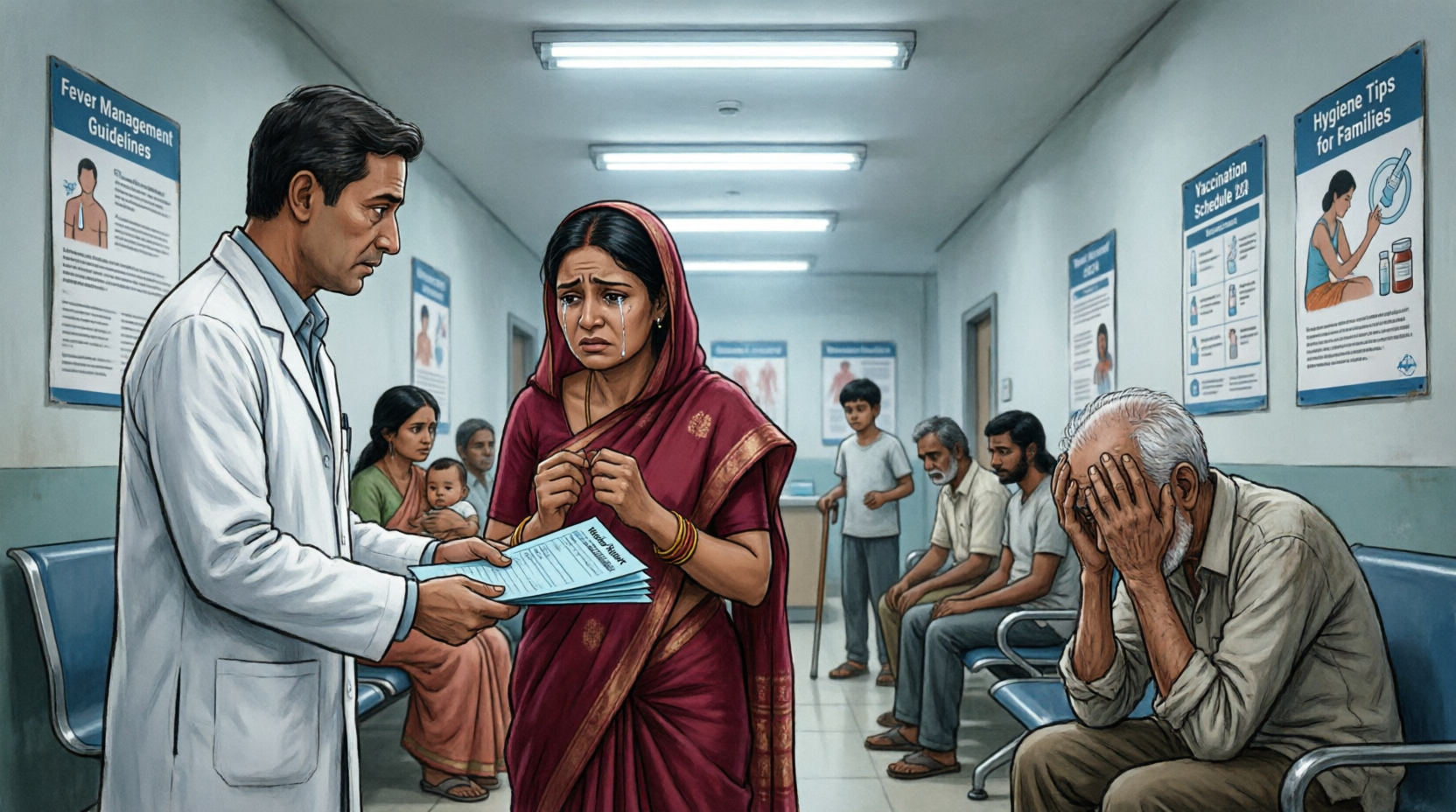
“Mrs. Naina… before I speak about your husband’s condition, I need to know whether you were ever told what he signed eighteen years ago.”
The room stopped breathing.
I looked at Arvind.
His face had gone grey.
Not pale. Grey.
Like ash after the fire has forgotten it was once wood.
“What did he sign?” I asked.
Arvind closed his eyes.
“Naina,” he said, and my name in his mouth sounded older than both of us. “Don’t.”
The doctor looked uncomfortable. He was young, maybe the age our son had been when he first left home for Pune. Too young to hold our eighteen years in his clean hands.
“I am sorry,” he said. “But she is listed as spouse and medical decision-maker. She needs to know.”
“Know what?” I whispered.
The doctor opened the yellow file and spread three papers on the desk.
The first was a lab report.
The second was a consent form.
The third was a handwritten note.
The date at the top made my stomach turn.
Eighteen years ago.
Three days after the night I confessed.
The doctor tapped the report. “Mr. Deshmukh was diagnosed then with advanced infectious complications. It appears he had contracted a serious blood-borne infection and refused full disclosure to his family.”
Blood-borne infection.
The cheap lodge.
The rain.
Sameer’s hands.
My mangalsutra on the bedside table.
“No,” I said.
Arvind stared at the floor.
The doctor continued, “According to the file, he insisted his wife be tested immediately, but anonymously. He paid for it himself. Your results were negative.”
I gripped the edge of the chair.
“My results?”
“Yes. He brought you here under the pretext of a women’s health camp. You may not remember.”
I did remember.
A week after my confession, Arvind had said the municipality was doing free tests in the office colony and told me to go because “women neglect themselves.” I had gone, ashamed even to stand in line, thinking it was one more way he was reminding me my body had become dirty.
I had not known he was checking whether I would live.
The doctor picked up the consent form.
“After his own diagnosis, he refused marital contact permanently to avoid any risk to you. That is what this declaration says.”
My breath left me.
The white pillow.
Eighteen years.
Every night.
Every untouched morning.
Not punishment?
No.
I turned to Arvind.
He was still looking at the floor, hands clasped together, knuckles white.
“You knew?” I whispered.
He did not answer.
“You knew all these years?”
His voice was barely audible. “Yes.”
A sound came out of me, too broken to be a word.
The doctor looked away, giving us the mercy of not watching.
I snatched the handwritten note.
The paper trembled so badly I could hardly read.
If my wife is negative, she must never be told unless medically necessary. I do not want her to live afraid of me. She has already made one mistake. I will not let that mistake take her life. I will maintain distance. I accept responsibility for her safety.
Signed,
Arvind V. Deshmukh.
My tears fell onto his name.
Responsibility.
Safety.
For eighteen years, I had slept beside a wall and called it hatred.
For eighteen years, he had slept beside me like a man guarding a flame from his own storm.
I looked up at him.
“Why?” I asked.
One small word.
A lifetime inside it.
Arvind’s mouth tightened. He looked like he might finally shout, finally break, finally become the angry man I had once thought I deserved.
Instead, he said, “Because I loved you.”
The sentence destroyed me.
I sat down hard.
“No,” I whispered. “No, don’t say that.”
“It is true.”
“No.” I pressed both hands to my chest. “Don’t make it worse. I can survive your hatred. I built a whole life inside your hatred. I don’t know how to survive this.”
His eyes filled then.
In eighteen years, I had seen Arvind cry only twice. Once when our daughter was born too early and blue. Once when his father died.
Now tears stood in his eyes because of me.
The doctor spoke gently. “Mrs. Deshmukh, his current reports show severe liver damage and cardiac strain. The old infection, long-term medication, and untreated complications have progressed. He needs urgent care.”
I heard the words, but they came from far away.
“Why untreated?” I asked.
Arvind rubbed his forehead.
The doctor answered for him. “The file indicates he stopped regular follow-up several times. Financial difficulty, perhaps.”
Financial difficulty.
I remembered those years.
Our children’s school fees.
My mother’s cancer.
My gallbladder surgery.
The wedding loan for our daughter.
Arvind selling his scooter and saying the trains were better for health. Arvind refusing new glasses. Arvind cutting his tablets in half and telling me the doctor had reduced the dose.
I turned to him slowly.
“You paid for my surgery.”
He closed his eyes.
“You paid for Aai’s treatment.”
Silence.
“You paid for the children’s college.”
His jaw worked once.
“And you stopped your medicines?”
He said nothing.
That was answer enough.
I began to shake.
The doctor placed a hand on the file. “He needs admission today.”
“No,” Arvind said.
I stared at him.
“No?”
“I am old. Tired. Let it be.”
Something inside me rose like fire.
For eighteen years, I had bent my head.
For eighteen years, I had accepted the pillow, the silence, the cold tea of our marriage.
But not this.
I stood.
“Enough.”
Arvind looked at me.
My voice came out sharper than I expected. “You do not get to decide alone anymore.”
“Naina—”
“No. You made one decision for both of us eighteen years ago. You made it from love, yes, but also from pride. You thought you could suffer quietly and call it protection. You thought I was too weak to carry truth.”
His face flinched.
“I was weak,” I said. “I was foolish. I was selfish. I broke our marriage with my own hands. But I was still your wife.”
The doctor stepped back, pretending to organize papers.
I did not care.
“You should have told me.”
Arvind’s voice broke. “And what would you have done? Touched me out of pity? Sat outside hospitals because of guilt? Spent every day remembering him?”
Him.
Sameer.
His name had not been spoken in our home for eighteen years, yet he had slept between us more faithfully than any pillow.
“I already remembered,” I said. “Every day. Every night. I thought you could not bear my skin because another man had touched it.”
Arvind covered his face with one hand.
“I wanted to touch you,” he whispered.
The room blurred.
He lowered his hand.
“Do you know what it is like to lie beside the woman you love and not reach for her when she cries? When your mother died, you were shaking in your sleep. Your hand fell over the pillow. I stayed awake until sunrise because I wanted to hold it. I wanted to put your head on my chest and say, ‘Cry, Naina, I am here.’ But what if I forgot? What if one night grief became bigger than caution? What if I harmed you because I could not control my heart?”
I pressed my fist to my mouth.
He laughed once, bitter and tired.
“So I made myself stone. Then you began looking at me like I was your jailer. Maybe I became one. Maybe love can become cruelty if it refuses to speak.”
I stepped toward him.
He stepped back.
Even now.
Even after the truth.
The habit of distance stood between us.
I hated it.
I hated myself.
I hated that lodge, that rain, that younger Naina who had searched for warmth in the wrong hands and burned down the whole house.
But most of all, in that moment, I hated silence.
I took the white pillow from my memory and threw it away.
Then I reached for my husband’s hand.
Arvind jerked back.
“No.”
I kept my hand in the air.
“The doctor said I was negative.”
“That was then.”
“Then test me again. Test us both. Wear gloves. Wash hands. Teach me every rule. But do not stand there and die untouched because you are afraid of loving me.”
His lips trembled.
“Naina…”
“For eighteen years, you punished yourself and made me think it was my punishment. Now listen to me. I did wrong. I betrayed you. I will carry that truth until my last day. But you do not get to turn your sacrifice into another grave.”
The doctor cleared his throat softly. “With modern treatment and precautions, many risks can be managed. The immediate issue is his failing health. Admission should not be delayed.”
“Admit him,” I said.
Arvind looked at me helplessly.
I looked back with all the strength I had not known I still possessed.
“Admit my husband.”
That evening, our children came to the hospital.
Rohan arrived first, shirt half-tucked, panic on his face. Priya came with wet hair and kajal smudged, still holding her daughter’s school bag.
“What happened?” she cried. “Why didn’t anyone tell us?”
Arvind looked at me.
For once, I did not lower my eyes.
“Because your father and I are experts at hiding pain,” I said.
We told them only what was needed. Illness. Old condition. Long treatment neglected. Immediate care.
Not the affair.
Not the pillow.
Not yet.
Some truths belong first to those who bled inside them.
Rohan cried in the corridor where his father could not see. Priya sat beside Arvind and scolded him through tears for skipping medicine “like an irresponsible college boy.”
Arvind actually smiled.
A small, tired smile.
I stood near the door, watching my family orbit the man I had spent eighteen years losing.
At midnight, after the children left, the nurse allowed me inside.
Arvind lay under a thin hospital blanket, an IV taped to his hand. He looked smaller without his office shirt, smaller without duty around him like armor.
I sat beside him.
For a long time, neither of us spoke.
Then he said, “Sameer died.”
I froze.
“What?”
“Seven years ago. Liver failure. I heard from someone at your old office.”
I closed my eyes.
A man I had once mistaken for escape had become only a shadow at the edge of my life. I felt no love. No grief. Only a dull sadness for all the ruin born from hunger and loneliness.
“Did you hate me more after that?” I asked.
Arvind turned his face toward the window.
“I hated myself more.”
“Why?”
“Because part of me was relieved.”
The honesty sat between us, ugly and human.
I nodded.
“I understand.”
He looked at me, surprised.
“Do you?”
“Yes.” My voice shook. “Because part of me spent years wishing you would shout, hit me, leave me, do anything except be decent in front of the world and dead beside me. Then I hated myself for wishing cruelty from a good man.”
His eyes shone.
“I was not good, Naina. I was proud. Wounded. Afraid. I wanted to protect you, but I also wanted you to remember what you had broken.”
I swallowed.
“I did.”
“I know.”
“I am sorry.”
“I know.”
“Will you ever forgive me?”
He closed his eyes.
“I forgave you many years ago.”
The words stopped my breath.
“Then why…”
“Because forgiveness is not the same as knowing how to return.”
I bent my head and cried silently into my saree.
After a while, I felt something touch my hair.
Light.
Trembling.
Barely there.
Arvind’s fingers.
For the first time in eighteen years, my husband touched me.
Not like a lover.
Not yet.
Like a man opening the door of a house he thought had burned down.
I did not move.
I did not breathe.
His hand stayed on my head for three seconds.
Then five.
Then ten.
When he pulled away, both of us were crying.
The treatment was not easy.
Hospitals are not places where love becomes pretty. Love there is paperwork, urine bottles, unpaid bills, tablet alarms, arguing with nurses, learning side effects, wiping vomit, pretending the blood report is not frightening.
Arvind’s body had suffered too long in silence.
There were bad nights.
Nights when fever burned him.
Nights when he pushed food away.
Nights when he whispered, “Let me go,” and I whispered back, “Not until you learn how to be properly stubborn with me again.”
I moved into the hospital chair.
Then into the bedroom after he came home.
The first night back, he stood at our bed and looked at the white pillow in the middle.
It was old now.
Flat.
Faithful.
Hateful.
He picked it up.
His hands shook.
“I don’t know how to sleep without it,” he admitted.
I nodded.
“Then we won’t throw it.”
His face fell.
I took the pillow from him and placed it at the foot of the bed.
“Not between us,” I said. “But not forgotten.”
He looked at me for a long time.
Then he lay down on his side.
I lay beside him.
There was space between us.
A cautious, trembling space.
But no wall.
At two in the morning, thunder rolled over Mumbai.
I woke, heart racing.
Arvind was awake too, staring at the ceiling like old times.
I whispered, “Arvind…”
For eighteen years, he would have said, “Sleep.”
That night, he turned his head.
“Yes?”
The word broke something open inside me.
“Can I hold your hand?”
Fear crossed his face. Then trust. Then fear again.
Finally, slowly, he placed his hand palm-up on the sheet.
I put mine over it.
His skin was warm.
Thin.
Alive.
We lay like that until morning.
Not healed.
Not young again.
Not innocent.
But together in the truth.
Months passed.
The children noticed changes before anyone else. Priya saw us sitting closer during tea and burst into tears in the kitchen. Rohan caught Arvind adjusting my shawl and stared like he had witnessed a miracle.
Relatives said retirement had made him soft.
Neighbors said illness had made me devoted.
Let them.
People always prefer simple stories.
They cannot bear the messy ones where sin and sacrifice sleep in the same bed for eighteen years and still wake up breathing.
One evening, during Ganesh Chaturthi, Arvind asked me to take out our wedding album.
We sat on the floor, knees aching, laughing at old hairstyles and serious faces.
In one photo, he was looking at me during the pheras.
So young.
So certain.
“I loved you very much that day,” he said.
I touched the picture.
“I ruined that love.”
“No,” he said quietly. “You wounded it. I buried it alive. We both must answer for what we did.”
I looked at him.
“Is it still there?”
He did not answer immediately.
Then he reached for my hand without asking.
“Yes,” he said. “Old. Scarred. Badly behaved. But there.”
A year after the retirement checkup, we went back to the same clinic.
The young doctor smiled when he saw us enter together. This time, Arvind’s fingers were wrapped around mine.
His reports were not perfect.
They would never be perfect.
But they were better.
Medication had steadied him. Treatment had given him time. Not endless time. No one gets that. But real time. Honest time.
Outside the clinic, rain began to fall over Andheri.
The same kind of rain that had once covered my worst mistake.
Arvind opened his umbrella.
For a second, we both remembered another monsoon, another version of me, another version of us.
I whispered, “If you could go back, would you leave me?”
He looked at the rain for a long time.
Then he said, “If I could go back, I would tell you I was lonely too.”
My throat closed.
“I would have listened.”
“Maybe,” he said. “Maybe not. We were young and proud and very stupid.”
I laughed through tears.
He smiled.
Then, under the grey Mumbai sky, my husband lifted my hand to his lips.
The kiss was light.
Almost nothing.
But after eighteen years of nothing, almost nothing was a universe.
People walked around us with umbrellas and bags and impatient horns blaring from the road.
No one noticed.
No one knew.
That was fine.
Some punishments happen privately.
So do some resurrections.
That night, when we returned home, Arvind took the old white pillow from the foot of the bed.
I watched him carry it to the balcony.
“What are you doing?” I asked.
He looked embarrassed. “It is only cotton.”
“No,” I said softly. “It is eighteen years.”
He nodded.
Together, we opened the cover.
The cotton inside had yellowed with age. He pulled it apart slowly. I helped. Piece by piece, we placed it into a clay pot, the kind I used for tulsi.
The next morning, we mixed it with soil.
Priya brought a small jasmine plant.
Rohan laughed and said only our family would perform last rites for a pillow.
Arvind smiled.
I did not explain.
Weeks later, the jasmine bloomed.
Small white flowers.
Fragrant.
Soft.
Every evening, Arvind watered it carefully.
Every evening, I stood beside him.
Sometimes his shoulder touched mine.
Sometimes his hand found mine without fear.
And every time it did, I forgave the past a little more—not because it deserved forgiveness, but because we deserved whatever life remained after it.
I had betrayed my husband once.
For eighteen years, I thought he punished me by not touching me.
But the truth was more terrible, and more tender.
He had built a wall to save my life, then got trapped behind it with his own breaking heart.
Now, old and scarred, we were learning to live without walls.
And on nights when Mumbai rain tapped against our window, Arvind no longer slept with his back to me.
He slept facing me.
One hand resting between us.
Open.
Waiting.
And every night, I took it.