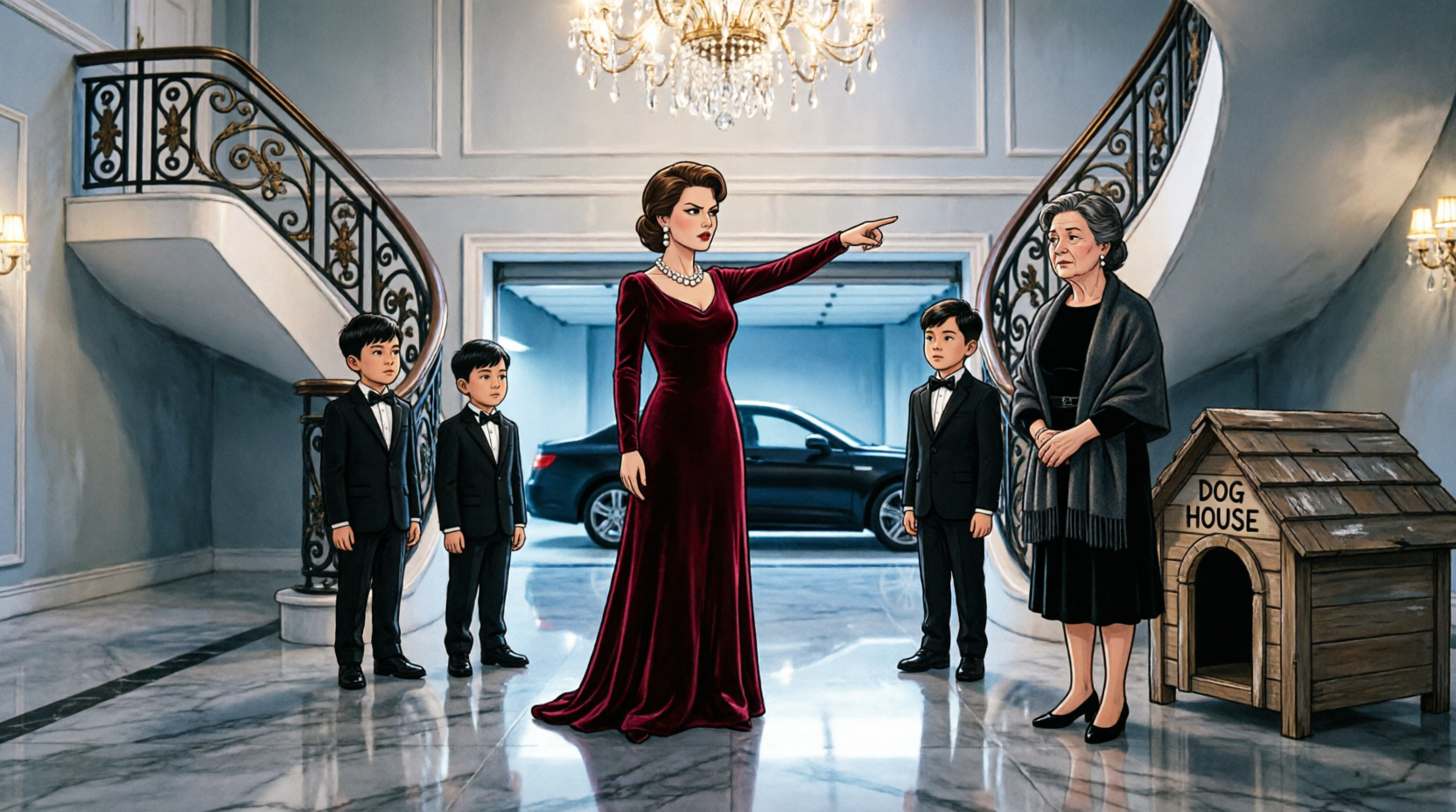
I came back from my husband’s funeral and my daughter-in-law shoved me into the dog room, convinced I was a penniless widow—never imagining I was sitting on seventeen million dollars, a beachfront mansion in Cancún, and the kind of truth that could shatter her carefully built lies.
The first time she called me a burden, it was in front of my husband’s portrait—still draped in fresh grief.
We hadn’t even been home from the cemetery for two hours when Patricia planted herself in the foyer, heels still damp from the rain, and pointed at my suitcases by the garage like they were garbage bags. The scent of funeral lilies clung to my black dress. My hand still remembered the cold of Robert’s fingers before they sealed the casket.
And still, she had the nerve to look me up and down, smile tightly, and say,
“Good life’s over, Eleanor. Starting tonight, you sleep where the dog sleeps.”
My son, Daniel, stood beside her.
My only son. The boy I stayed up with through fevers, the man his father paid through college, funded in business, and helped into this very house. He looked down. Said nothing. Not “don’t talk to her like that.” Not “Mom, I’m sorry.” Nothing.
In the living room, my grandchildren, Sophie and Liam, watched with those wide, frightened eyes children get when something is terribly wrong but they don’t yet understand it. The clock ticked 5:20. Rain tapped steadily outside.
Inside me, something worse was collapsing.
“Patricia,” I said, my voice dry, “I don’t understand.”
“Oh, you do,” she replied, crossing her arms. “Robert’s gone. The will leaves everything to Daniel. This house isn’t yours anymore. We’re letting you stay out of compassion—but we’re not funding luxuries for a widow with no income.”
For a moment, I heard nothing but a low hum in my ears.
Because I knew the will.
I knew exactly what she was saying was a lie.
What I didn’t know yet… was how far she was willing to go. Or how far my son would sink in his silence.
“Mom…” Daniel muttered at last, still not looking at me. “Just for a little while. Until things settle.”
Patricia laughed lightly.
“Oh honey, don’t confuse her. Eleanor will move into the service room by the garage. We’ll put in a small bed. Assuming Lucky doesn’t need it.”
Lucky was the Labrador.
My face burned—not with shame, but with fury.
Every inch of that house had passed through my hands. The ivory curtains, the carved mirror from Santa Fe, the bougainvillea Robert and I planted one spring afternoon when we still believed time was endless. My laughter lived in those walls. My recipes in that kitchen. My holidays, my losses, my life.
And this woman—standing on marble floors I polished for years—dared to reduce me to an intruder.
“Your things are already outside,” she continued. “And tomorrow, you start helping. If you’re going to live here, you’ll earn your place.”
Sophie stepped forward.
“Mom, don’t talk to Grandma like that—”
“Upstairs. Now,” Patricia snapped.
Silence followed.
And in that silence, I understood something that chilled me deeper than the funeral rain: this wasn’t impulsive. They had planned it. Waited until Robert was buried to drop the mask.
I picked up one of my suitcases, feeling the pull in my back. No one moved to help.
Then I did something Patricia never expected.
I nodded.
That was all.
No argument. No shouting. No reminder that the house was also in my name. No mention of the trust, the accounts, the beachfront property Robert had bought in Cancún—documents I’d found just a week before the funeral.
Nothing.
Just a calm, quiet nod.
Confusion flickered across her face. She had expected tears, pleading, collapse.
But I wouldn’t give her that satisfaction.
“Fine,” I said evenly. “I’ll do what you think is best.”
She smiled in victory. Daniel closed his eyes in relief.
That night, I slept in a damp little room near the garage, the air heavy with detergent and rust. Lucky, for the record, had a better setup—in the laundry room, with a fan.
I lay there fully dressed, staring at the cracked ceiling, fingers curled around the documents hidden deep in my bag: a bank safety key, copies of the trust, and the deed to a multimillion-dollar mansion overlooking the Caribbean.
I cried for Robert until my ribs hurt.
And then I stopped.
Because somewhere in the middle of that humiliation, something cold and precise formed inside me:
I would let them believe I had nothing.
I would let Patricia feel like a queen.
I would let Daniel show me exactly how low he could fall without his father’s shadow over him.
And when the time came—when every mask dropped—
I wouldn’t rise to reclaim what was mine.
I would rise to teach them what it costs to mistake kindness for weakness.
The next three months stripped away every illusion I had left.
Patricia turned my days into a parade of orders. Fresh coffee at 5:30 a.m. Gourmet breakfasts. Laundry pressed to perfection. Floors spotless. She said if I was taking up space, I needed to “add value.”
She never said thank you. Never called me “Mom.” Just Eleanor—short, sharp, dismissive.
Daniel hid behind work, grief, excuses.
“Mom, don’t start.”
“Mom, let’s not make this harder.”
“Patricia’s just trying to organize things.”