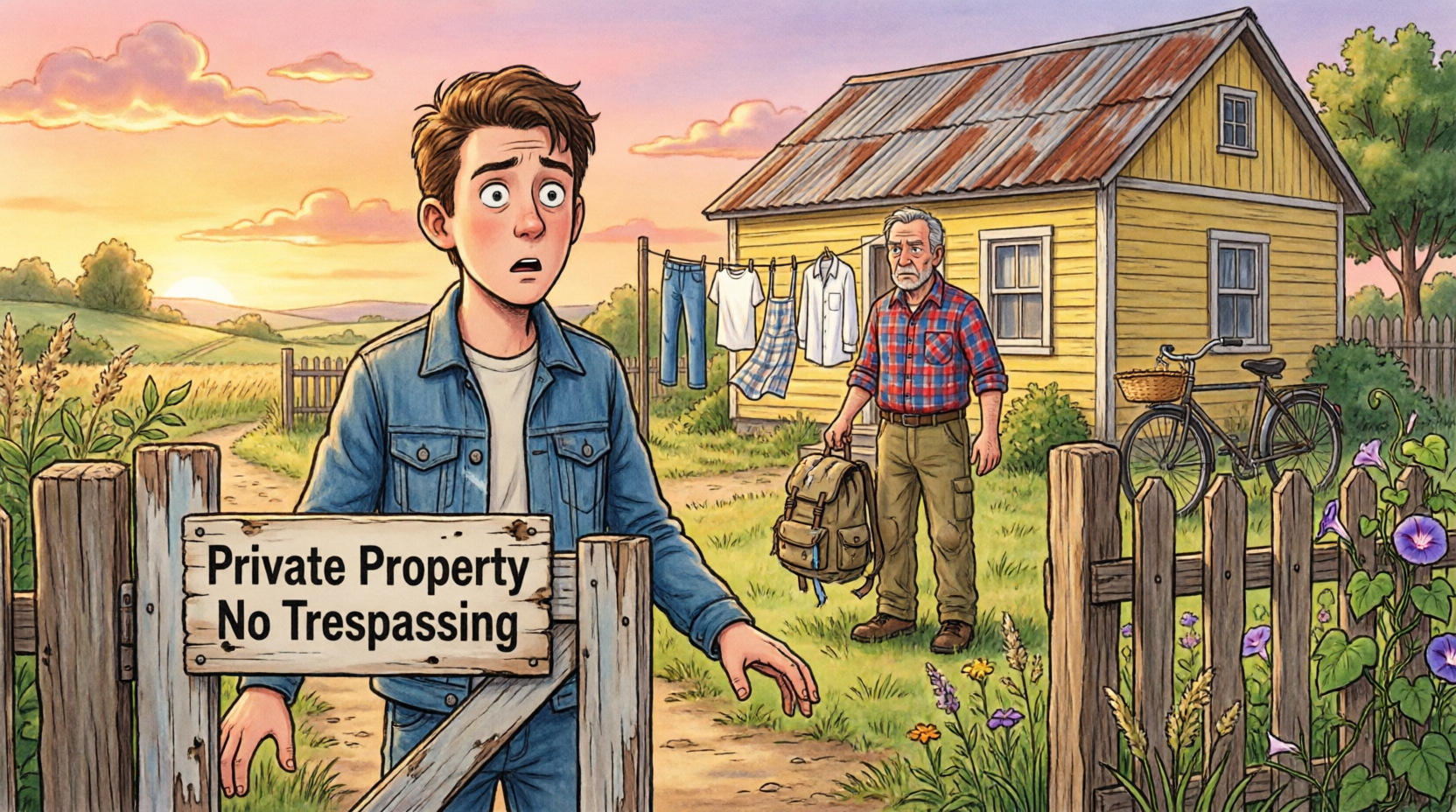
The years passed, and fate put us to the test once again.
First, it was the workshop where I had worked since high school. It closed down from one month to the next, without any decent severance pay, while the boss swore that “if things improved,” he would call us back. He never called. Then my mother began to get sick more often from the stress. It wasn’t anything life-threatening, but it was enough for her medication to become another impossible expense. The house, which had always been humble but tidy, began to look exhausted: leaks appeared when it rained, paint peeled off the kitchen walls, and the refrigerator started making the noises of a dying animal before finally quitting for good.
I was twenty-six years old and, for the first time, I felt in my bones what the word “ruin” actually means. It’s not just a lack of money. It is the moment you begin to ration the oil, the milk, the gas, and even your own dignity. It’s opening your wallet as if you were checking a wound. It is pretending in front of others that “everything is working out,” while at night you do the math in a notebook and end up erasing figures because no combination of numbers is ever enough.
The relatives, of course, only showed up to offer their opinions.
“Your mother should never have brought that ex-convict into the house.”
“Since that man returned, our luck has turned for the worse.”
“There are families whom God tests…” and others he simply charges a debt.
I would grit my teeth and walk away. My mother didn’t even argue. She just lowered her head and continued washing, cooking, and mending. And my uncle, every time he heard one of those insults, became even quieter. He did not respond. He did not defend himself. He just went out to the yard, grabbed the shovel, and began to work the earth as if by burying seeds, he could also bury the shame the others threw at him.
I grew angry with him.
It wasn’t because of what he had done fifteen years ago. That was already a distant memory, mixed with stories that even I didn’t fully understand. I was angry at his calmness—his way of just holding on. While I felt like we were sinking, he continued to leave early every morning, returning at noon with his boots caked in dirt and a bag filled with seeds, used tools, or pieces of wood that someone had given him. Sometimes he found odd jobs carrying sacks or fixing fences. Other times, he brought nothing home. And yet, the moment he arrived, the first thing he did was head to the garden.
That garden made me furious.
It wasn’t even a large garden. It was just a few poorly defined patches of soil behind the house, next to the old laundry room. There, he planted tomatoes, peppers, mint, onions, and some plants I didn’t even recognize. He cared for them as if they were treasure. He pulled every weed, spoke softly to them, and moved the earth with his bare fingers. And I, who couldn’t find a steady job, who saw my mother cutting her pills in half to make them last longer, began to think that my uncle had lost his mind in prison.
One night, I finally exploded.
It happened after our electricity was cut off because we were two months behind on the bills. We ate dinner in the dark, with a single candle on the table and reheated beans. My mother tried to pretend everything was fine, telling an old story about my father to distract me, but I had a knot of rage in my throat. When I finished eating, I slammed my spoon onto the plate.
“And what good are those plants?” I snapped, glaring toward the courtyard. “Are they going to pay our debts? Are they going to turn the lights back on? Are they going to buy Mom’s medicine?”
My mother looked at me with immediate disapproval.
“Don’t talk to your uncle like that.”
But I couldn’t stop myself.
“No, Mom. Enough. Everyone here acts like that garden is some kind of hope. We’ve been falling apart for months. I go out looking for work and find nothing. You’re pawning your earrings. And him… he seems to live in another world.”
My uncle put his cup down slowly on the table.
He didn’t get angry.
He didn’t even raise his voice.
He just looked at me with tired eyes that, for the first time, didn’t seem resigned, but determined.
“Come with me tomorrow,” he said. “I want to show you something.”
I let out a dry, bitter laugh.
“What? Your miracle plants?”
My mother started to silence me, but he raised his hand.
“Tomorrow, at dawn,” he repeated. “If you still want to hate me after that, you can do it with my blessing.”
I didn’t answer.
I went to sleep with my rage still burning, listening to the hollow hum of a house without power and the distant barking of dogs. I thought about staying in bed. I thought about stooding him up just out of pride. But at half-past five in the morning, when I heard the patio door creak open and his footsteps fading away, something was stronger than my anger: curiosity.
I went out.
The air was cold and smelled of damp earth. My uncle was already out front with a lamp, an old backpack on his shoulder and his usual faded cap. He didn’t say good morning. He just gestured for me to follow him. We walked along the path behind the town, the one that passes the dry stream and climbs up through the cacti and mesquite trees. The sky was only just beginning to lighten in the east.
I was in a foul mood.
“If this is just to show me more plants, I’m telling you now, I’m not in the mood.”
He smiled slightly, without turning around.
“No. This no longer fits in pots.”
We kept walking for more than half an hour. We crossed a fallen gate I had never seen before, then an abandoned lot with old wire fences, and finally, a narrow path between guamúchil trees. Suddenly, the landscape opened up.
I stood completely still.
Stretching down into a small ravine before me was a massive piece of land. It wasn’t just a plot; it was an estate. There were entire rows of fruit trees, beehive boxes painted white, perfectly straight furrows, and, in the distance, a low concrete building with a new tin roof. Everything was clean, well-tended, and alive.
I blinked several times, unable to process it.
“What… what is this?”
My uncle finally turned to face me.
“What I’ve been planting.”
I didn’t even know what expression to make. I let out a breath of pure disbelief.
“What do you mean, ‘what you’ve been planting’? Where did all of this come from?”
He walked a few steps toward the first row of trees. He ran his hand over the leaves with a level of care that gave me a strange feeling—a mix of embarrassment and admiration.
“When I got out of prison,” he said, “I knew that no one would trust me with so much as a soda. Your mother was the only person who opened her door to me. I couldn’t repay that with just words. I was too old for that. So I started looking for another way.”
He bent down, scooped up a handful of soil, and showed it to me.
“This was dry mountain land years ago. Nobody wanted it because it wasn’t good for corn and because the owner went north and died without ever coming back. The land was stuck in a legal dispute. I knew his son. I found him. I proposed that I would work the land in exchange for a share, and that I would buy it from him little by little.”
I stared at him.
“Buying it with what money?”
He smiled crookedly.
“With the little bit I collected from odd jobs. With what I saved in prison by sewing sacks and making furniture. With the money I earned fixing fences. With everything you didn’t see because I preferred for you to keep thinking I only planted peppers behind the house.”
I froze.
It wasn’t just that it all suddenly made sense. It was the opposite. I realized how many things I had refused to see.
My uncle continued walking, and I followed behind him as if I were in a daze.
He showed me the hives. There were fourteen of them. He was already selling honey to two organic stores in the city. He showed me the grafted lemon trees, the young avocados, a small water pump connected to an underground cistern, and, inside the concrete building, neat stacks of sacks, labeled jars, a packing table, and a meticulously kept account book.
Everything was functional.
It was small, yes.
It was silent, yes.
But it was working.
“I didn’t tell you anything,” he continued, “because people in this town have loose tongues. And because, if I learned anything where I was, it’s that plans grow better when no one spits on them. Your mother knew. Not everything, but enough. That’s why she never asked for explanations when I was gone all day.”
I felt a sharp pang of guilt.
“Mom knew?”
He nodded.
“She knew I was doing something to leave you both with something before I died. The rest she guessed—that’s how women are who have spent their whole lives making a meal out of two tomatoes and good intentions.”
I leaned against the frame of the warehouse because my legs felt a bit weak.
“So… why are things still so bad? Why aren’t we using this already?”
My uncle’s expression changed. He became more serious.
He took a folder from the top shelf and placed it in my hands.
Inside were deeds, contracts, receipts, permits, a simple partnership agreement… and, on top of everything, a sheet signed by him and my mother.
I read my own name.
And then I read it again.
It wasn’t a will. It was a transfer.
Half of the land and the business, present and future, had already been put in my name.
“I didn’t want to touch it before,” my uncle said, “because it was still taking root. If we harvested it while it was still green, we would have failed anyway, just faster. But not anymore. This is it. It’s not much yet, but it provides. And if you work it well, in three years it can support you, your mother, and whoever comes after you.”
I looked up.
I couldn’t find the words to speak.
All the anger from the night before was turning into a shame so pure that it almost physically hurt.
“Why me?” I finally whispered.
My uncle let out a slow breath.
“Because your mother saved my life twice. The first time was when she opened the door for me. The second was when she didn’t let you become bitter like the rest of the family. And because you—even if you are angry with me—you aren’t lazy. You’re just tired. There’s a difference.”
He was silent for a moment. Then he added:
“Besides, I don’t want people to remember me only for the day I ruined a life. I want it so that when I die, at least one good thing continues to grow where I put my hands.”
I couldn’t maintain eye contact with him.
I looked around again: the young trees, the bees, the sun barely rising over the hills, the thin stream of water running through a black hose into the furrows. All of this had been happening for years behind the backs of the townspeople, the family, and me.
I thought of the relatives who had turned their backs on him.
I thought of the aunts who told my mother she was a fool for bringing him home.
I thought of myself, last night, complaining about the plants.
And I felt small.
Very small.
“I’m sorry,” I said, my voice almost gone.
My uncle smiled with a soft, quiet sadness.
“Don’t tell me. Tell the work. It’s time you start learning.”
That made me laugh, but the laughter broke in the middle.
That same day, we returned home with a small truck borrowed from a neighbor, filled with boxes of honey, lemons, mint, and two small sacks of red onions. My mother was waiting for us at the door with her apron on. As soon as she saw my face, she knew that I finally understood.
She didn’t say, “I told you so.”
She said nothing at all.
She just hugged her brother-in-law first, just as she had done the day he came home from prison, and then she hugged me.
That afternoon, for the first time in months, we ate without feeling like the table was shrinking beneath us.
But the real surprise came three days later.
As soon as we began to move the merchandise and look for buyers, the family that had despised us for so many years suddenly appeared, as if affection could sprout like mint after a rain.
First, an aunt arrived with sweet bread “just to say hello.”
Then a cousin showed up offering “help with marketing.”
Then another arrived, saying he remembered perfectly where that land was and that, in reality, “it was always the family’s plan to keep it.”
My uncle wasn’t upset.
He didn’t even mock them.
He just looked at me from the courtyard as he arranged the honey boxes and said, almost in a whisper:
“Now you will really understand why some seeds have to be sown in silence.”
I followed his gaze toward the gate.
Outside, parked in the midday sun, was a black pickup truck that I recognized immediately.
It belonged to my cousin Raúl.
And if Raúl was there, he didn’t come out of love.
He came for something much more dangerous:
He came with a lawyer.