$5. I stared at the crumpled bill in my palm, its edges worn soft from years of passing through strangers’ hands. The fluorescent lights of the Greyhound station hummed above me, casting everything in that sickly yellow glow that made even the healthiest person look like they were dying. My sister June slept against my shoulder, her breathing shallow and whistling slightly. That whistle scraped against my nerves like fingernails on a chalkboard because I knew exactly what it meant. Her inhaler was almost empty. We had maybe two doses left. After that, I would have to watch my fourteen-year-old sister gasp for air with nothing I could do to help her. The bus station clock read 2:47 in the morning. Around us, a handful of other travelers slumped in plastic chairs, their faces hidden under jackets and hoods. Nobody looked at us. Nobody cared about two teenage girls with everything they owned stuffed into garbage bags at their feet. That was fine. We were used to being invisible. Eleven years in the foster care system taught you that invisibility was often your best friend. It meant nobody noticed when you took an extra roll from the dinner table and hid it in your pocket for later. It meant nobody asked questions when you showed up to school with the same clothes three days in a row. It meant you could slip through life without leaving a mark, which also meant life couldn’t leave too many marks on you. But invisibility had a price. When you aged out of the system at seventeen, like I just did, nobody noticed that either. Three days ago, I walked out of St. Agatha’s Home for Children in Columbus, Ohio, with June beside me. The state had decided she could stay with me since I was her only living relative. They gave us two garbage bags, a folder of paperwork, and directions to the nearest homeless shelter. They did not give us hope. Our mother died when I was six and June was three. Car accident on a rainy night in November. She was driving home from the grocery store with a gallon of milk and a box of cereal. The truck that hit her ran a red light. The driver was texting his girlfriend. He walked away with a broken arm. Mom was pronounced dead at the scene. Our father left before June was born. I have exactly one memory of him, the smell of cigarette smoke and motor oil as he lifted me onto his shoulders at a county fair. I was maybe four years old. A month later, he was gone. No grandparents. No aunts or uncles who wanted two little girls with too much baggage and not enough charm. So the system took us in, shuffled us through seven different foster homes in eleven years, and spat us out when I turned seventeen with nothing but each other. But we had each other. That was everything. June stirred against my shoulder, and I felt the familiar tightening in my chest, the same tightening I felt every time she breathed wrong. Every time she coughed too hard. Every time her lips took on that bluish tinge that meant her lungs were struggling. Asthma. The doctors called it severe persistent asthma. I called it the thing that was slowly killing my sister because I couldn’t afford the medication that would save her. Her inhaler cost two hundred dollars a month. We had five. I pulled out my phone. The screen was cracked from when I dropped it running to catch the bus that would take us away from Columbus, away from the shelter that had no beds, away from the social worker who kept suggesting maybe June would be better off in a medical foster home without me. Over my dead body. The Wi-Fi in the bus station was slow and spotty, but I had learned to be patient. I scrolled through listing after listing. Apartments for rent. Rooms for rent. Anything for rent that cost less than nothing. Everything required a deposit. Everything required proof of income. Everything required a credit check and references and a hundred other things we didn’t have. I was about to give up when I saw it. The listing was buried at the bottom of a county auction page, almost hidden among foreclosed properties and seized vehicles. The thumbnail showed a building that looked like it had been abandoned in the 1970s and never looked back. Abandoned roadside diner. Brierwood, Montana. Starting bid $5. Sold as is. Buyer must claim keys in person. No inspection available. Property includes all contents. I read it three times. Then I read it again. Five dollars. The same five dollars sitting in my palm. I clicked on the listing. The description was sparse. Former restaurant, closed fifteen years. County had been paying property taxes to keep it out of legal limbo. No one wanted it. The building was probably falling apart. The land was probably worthless. But it was a roof. It was walls. It was something. Montana was far away, two thousand miles from Ohio. But what did we have keeping us here? A shelter with no beds. A system that had already forgotten us. I looked at June. Her face was pale in the yellow light, dark circles under her eyes making her look older than fourteen. She deserved better than this. She deserved a home. My thumb hovered over the bid button. Five dollars for a building nobody wanted. It was probably a scam. It was probably too good to be true. It was probably going to end with us stranded in the middle of nowhere with nothing but regret. But we already had nothing. What was there to lose? I pressed the button. The confirmation email came at 6:23 that morning. I had dozed off against the hard plastic chair, June still sleeping against my shoulder. My phone buzzed and I jerked awake, heart pounding. Congratulations, you are the winning bidder. Property parcel 7742, Ridgeway Diner. Final bid $5. Please claim keys at Brierwood County Clerk’s Office within fourteen days. I stared at the screen, read it again, read it a third time. Nobody else had bid. In fourteen days of the auction being live, not a single person had wanted this property badly enough to offer five dollars for it. That should have been a warning sign. That should have told me everything I needed to know about what we were getting into. But June chose that moment to wake up. She lifted her head from my shoulder, blinking sleep from her eyes, and looked at me with that expression she always had first thing in the morning. Half asleep. Completely trusting.
“Where are we?” she asked.
I showed her the phone.
“We’re going to Montana,” I said. “We just bought a house.”
The bus ride took two days. We changed buses three times, slept sitting up, ate vending-machine crackers, and drank water from bathroom sinks. June’s breathing troubled me somewhere around Nebraska. Not worse, exactly, but not better either. The steady whistle that had become the background music of my life. She didn’t complain. She never complained. Instead, she pressed her face against the window and watched America roll by. Cornfields stretching to the horizon. Small towns that appeared and disappeared in minutes. Mountains rising in the distance like promises.
“What do you think it looks like?” she asked somewhere in Wyoming.
“What?”
“Our diner.”
She was already calling it ours, already building a life there in her imagination. I should have told her not to get her hopes up. I should have warned her that it was probably a pile of rubble, that we would probably end up sleeping on the street anyway, that five dollars doesn’t buy you a future. But I looked at her face, pale and thin and lit up with something I hadn’t seen in years, and I couldn’t do it.
“I don’t know,” I said instead. “I guess we’ll find out.”
Brierwood, Montana, was the kind of town that time had forgotten and progress had left behind. The bus dropped us off at a gas station on the edge of town. The main street stretched before us, lined with buildings that looked like they hadn’t been updated since the 1950s. A hardware store with a hand-painted sign. A feed store with bags of grain stacked in the window. A small diner with red vinyl booths visible through dusty glass. Fourteen hundred people lived here according to the welcome sign. I counted maybe a dozen walking the sidewalks, and every single one of them stopped to stare at us as we walked past. Two teenage girls with garbage bags over their shoulders. We must have looked exactly like what we were. Runaways. Orphans. Trouble. The county clerk’s office was in a small building next to the post office. The woman behind the counter was maybe sixty, with steel-gray hair pulled back in a tight bun and reading glasses perched on her nose. She looked up when we walked in, and her expression shifted from boredom to something close to concern.
“Can I help you girls?”
I set my crumpled five-dollar bill on the counter.
“We’re here to pick up the keys to the Ridgeway Diner.”
Her eyebrows rose so high they nearly disappeared into her hairline.
“You’re the ones who bought that place?”
“Yes, ma’am.”
She looked at me, then at June, then back at me.
“How old are you?”
“Seventeen. And her? Fourteen. She’s my sister.”
The clerk’s mouth pressed into a thin line. She pulled open a drawer and retrieved a manila envelope, but she didn’t hand it over. Instead, she held it against her chest and looked at us with something that might have been pity.
“You girls know what you’re getting into. That building’s been sitting empty for fifteen years. Nobody’s touched it since Walter Brennan closed the doors and walked away. It’s probably full of rats and mold and God knows what else.”
Walter Brennan. The previous owner. I filed the name away.
“We know,” I said, even though I didn’t. “Do you have somewhere to stay? Someone to call if this doesn’t work out?”
“No. No, we’ll be fine,” I said.
The clerk studied us for another long moment. Then she sighed and handed over the envelope.
“The property is about four miles east of town, right off the old highway. The new interstate bypassed this whole area back in the nineties. That’s why nobody comes through anymore. That’s why the diner closed.”
She paused.
“Good luck. You’re going to need it.”
We walked those four miles in the late afternoon sun. The road wound through farmland and forest, past fields that had gone fallow and farmhouses that looked abandoned. The further we got from town, the quieter everything became. Just the crunch of our footsteps on gravel, the whisper of wind through the trees, and June’s breathing beside me. I saw the sign first. It rose from the weeds beside the road, tilted at an angle that suggested decades of neglect. The neon tubing was dark and cracked. The metal frame rusted. But the words were still readable. Ridgeway Diner. Open 24 Hours. The 24 Hours part had a piece of wood nailed over it. Someone had painted closed on the wood, but time and weather had faded it to a ghost. And beyond the sign, sitting in the center of a gravel parking lot that had more weeds than gravel, was our diner. It was smaller than I expected. Just one story, long and rectangular, with large windows across the front and a chrome trim along the roofline that had turned dull with age. The white paint was peeling. The roof sagged slightly in the middle. One of the windows had been boarded up. But the walls were straight. The foundation looked solid. And when a gust of wind came through, the building didn’t creak or groan. June grabbed my arm.
“Wave,” she whispered. “It’s real.”
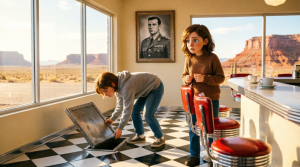
It was real. Five dollars and two thousand miles. And this was real. I pulled the keys from the envelope. Two brass keys on a simple metal ring. My hands were shaking as I approached the front door. The lock was stiff, but it turned. The door swung open with a creak that echoed through the empty building. And then we were inside. The smell hit first. Dust and old grease. Wood that had been baking in the summer sun and freezing in the winter cold for fifteen years. Something else underneath. Something organic and slightly sweet. Maybe rotting fabric. Maybe dead mice. Maybe just the smell of a place that had been forgotten. But beneath all of that, something else. Potential. The late-afternoon sunlight poured through the dusty windows, illuminating the interior in golden shafts. I could see motes of dust floating in the air, disturbed for the first time in years by our presence. The layout was exactly what you’d expect from a roadside diner. Booths lined the walls, upholstered in red vinyl that had cracked but not split. A long counter stretched across the back with chrome stools mounted to the floor. Behind the counter, a pass-through window opened into the kitchen. Everything was covered in a thick layer of dust. But beneath the dust, everything was intact. Coffee cups sat upside down near the register, waiting to be filled. Menus were stacked beside the cash register. Salt and pepper shakers stood at attention on every table. It was like stepping into a time capsule, like the last person to leave had just walked out for a smoke break and never came back. June walked slowly down the center aisle, trailing her fingers through the dust on the booth backs. Her eyes were wide, taking in every detail.
“It’s like a movie set,” she said.
I walked behind the counter and opened one of the cabinets. Stacks of plates wrapped in newspaper that had yellowed with age. Cups and saucers and silverware, all carefully packed away. Whoever closed this place hadn’t abandoned it. They had preserved it.
“Wave! Look!”
June was standing at the far end of the counter, pointing at something on the wall. I walked over to see. It was a photograph in a simple wooden frame. Black and white, faded but still clear. A man in military dress uniform stood in front of the diner, one hand resting on the hood of a vintage pickup truck. He was young in the photo, maybe mid-twenties, with a serious expression that didn’t quite hide the pride in his eyes. Beneath the photo, engraved on a small brass plate: Walter Brennan, 1978. Opening Day. Walter Brennan. The man who built this place. The man who closed it and walked away. I wondered what had happened. Why someone who was clearly proud of what he’d built would just leave it to rot.
“We should look at the kitchen,” I said.
The kitchen was larger than I expected. A big steel griddle dominated one wall, flanked by two industrial fryers. Refrigerators lined another wall, their doors standing open and their interiors dark and silent. There was a prep station with cutting boards still in place, a dishwashing area with a massive sink, and shelf after shelf of equipment that I couldn’t identify. Everything was dusty but intact.
“This is incredible,” June said. “If we clean this up, we could actually…”
She trailed off, but I knew what she was thinking. We could actually run this place. We could make it work. It was a crazy thought. We were two teenagers with five dollars and no experience. But standing in that kitchen, surrounded by everything we would need to start over, crazy didn’t seem so impossible. That’s when I noticed the floor. Most of the kitchen was covered in standard commercial tile, off-white and scuffed from years of foot traffic. But in one corner, partially hidden behind the largest refrigerator, the tile was different. Newer. Cleaner. Like someone had replaced it recently.
“Help me move this,” I said.
Together, we pushed the refrigerator aside. It took all our strength, but eventually it scraped clear, revealing the floor beneath. And in the center of that cleaner tile was a metal handle. June’s breath caught.
“Is that a trap door?”
I knelt down and grabbed the handle. It was cool against my palm, the metal smooth with use. I pulled. Nothing happened. I adjusted my grip and pulled harder. This time there was a click, and the tile lifted slowly, revealing a dark opening beneath the kitchen floor. A staircase descended into the darkness. Cool air drifted up from below, carrying a different smell. Cleaner. Drier. Like a room that had been sealed away from time. I looked at June. She looked at me. Then I pulled out my phone, turned on the flashlight, and started down the stairs. The beam of my flashlight cut through the darkness, illuminating concrete walls and metal shelves. I reached the bottom of the stairs and stopped. The room was huge, much bigger than the kitchen above us. The ceiling was maybe eight feet high, supported by thick concrete pillars. Metal shelving units lined every wall, stretching from floor to ceiling. And on those shelves, arranged with military precision, were supplies. Canned goods. Boxes of dried food. Cases of bottled water. Medical supplies still sealed in their packaging. Blankets and sleeping bags and portable stoves. I walked deeper into the room, my flashlight sweeping across the inventory. There was a generator in one corner hooked up to what looked like a ventilation system. Fuel containers were stacked nearby. On another shelf, I found batteries, flashlights, a hand-crank radio, and tools of every description. This wasn’t a basement. This was a bunker. Someone had spent years building this place. Years stocking it. Years preparing for something that might never come.
“Wave.”
June’s voice came from behind me. She had followed me down the stairs and was standing beside a metal desk tucked against the far wall. A lamp sat on the surface, and beside it, a stack of papers and a thick leather journal. I walked over. The journal was old, its cover worn soft with age. I opened it to the first page. The handwriting was neat and careful, the ink slightly faded but still readable. If you’re reading this, then you found the basement. I don’t know who you are. I don’t know how you came to own this place, but if you’re reading these words, then you’re the person I’ve been waiting for. My name is Walter Brennan. I built this diner in 1978, and I built this bunker in the years that followed. I spent forty years preparing for a day that might never come. A day when people would need shelter, a day when this room could save lives. Some people thought I was crazy. Maybe they were right. But I was a soldier once. I saw what happens when people are caught unprepared. I promised myself I would never let that happen to my community. I’m old now. Too old to keep this place running. Too old to wait anymore. So I’m leaving it to the universe. I’m trusting that the right person will find their way here when the time is right. If that person is you, then welcome. Use this place well. Walter Brennan, 2022. I turned the page. More entries followed, dated over several years. Instructions on how to use the generator. Inventory lists. Maintenance schedules. Everything someone would need to keep this place running. The final entry was dated eighteen months ago. I can feel it coming now. The end. I mean, my heart isn’t what it used to be. And there’s only so long a man can fight time. I have one regret. I never found her. Savannah. The girl who worked here twenty years ago, the one I came to love like a daughter. She left one day and never came back. And I’ve spent every year since trying to find her. I know she’s gone now. The private investigator I hired found the records. She died years ago in a car accident. But she had children, two daughters. I’ve been trying to find them. If I could just see them once, if I could just let them know that someone out there loved their mother, that someone is still thinking of her. But the system is complicated. Foster care records are sealed. I don’t have much time left. So I’m leaving this place the only way I know how, with a five-dollar auction and a prayer that somehow, someway, the right person will find it. If you’re reading this, whoever you are, know that you are exactly where you’re supposed to be. This place was built for you. I read the entry again. Then again. Savannah. A girl who worked here. Who Walter loved like a daughter. Who died in a car accident and left behind two daughters. My hands started to shake.
“Our mother’s name was Savannah.”
June’s voice was small.
“What does it say?”
I couldn’t answer. My throat had closed up, my eyes blurring with tears I didn’t know I had left. Five dollars. Two thousand miles. A diner nobody else wanted. And it had been waiting for us all along. I held that journal in my hands, and for the first time in eleven years, I let myself cry. Not because I was sad. Not because I was hurt. But because somewhere out there, someone had loved our mother. Someone had spent years trying to find us. Someone had built this place and filled it with hope and left it for us to discover. Have you ever found something that changed everything you thought you knew about your life? Have you ever discovered that you were loved by someone you never even met? Tell me in the comments. I want to hear your story. That first night, we slept in the bunker. The generator rumbled to life after a few tries, filling the underground room with soft electric light and warm air. We found sleeping bags on one of the shelves, still sealed in their packaging, and made ourselves a small camp beside the desk. June fell asleep almost immediately, exhausted from the journey and the excitement and the weight of everything we had discovered. I watched her face in the dim light, listened to her breathing, and thought about our mother. I barely remembered her, just fragments. The smell of her perfume. The sound of her laugh. The way she used to sing while she cooked dinner. But Walter remembered her. Walter had loved her. And now, in a way, he had given us a home. I opened the journal again and read through the earlier entries. Walter had been meticulous. Every can of food was cataloged. Every piece of equipment was documented. He had even included instructions on how to maintain the diner upstairs, which parts of the roof needed attention, which pipes were prone to freezing in winter. He had thought of everything, as if he knew somehow that two teenage girls with no money and no experience would one day need this place. Around midnight, I heard footsteps outside. I froze, my hand reaching instinctively for the flashlight. The footsteps were quiet, careful, moving around the perimeter of the building. Then they stopped. Silence. I held my breath, counting the seconds. Ten. Twenty. Thirty. The footsteps started again, moving away this time, fading into the distance. I didn’t sleep well after that. Morning came gray and cold. I climbed out of the bunker to find frost on the windows and my breath fogging in the air. November in Montana was nothing like November in Ohio. The cold here had teeth. But the diner looked different in the morning light. Less abandoned. More waiting. I found a broom in a closet and started sweeping. June joined me an hour later, still rubbing sleep from her eyes but smiling anyway.
“What’s the plan?” she asked.
“Clean,” I said. “And then figure out the rest.”
We worked all morning. Dust clouds rose and settled. Cobwebs came down. Windows got wiped. By noon, the main dining room actually looked like somewhere people might want to eat. The kitchen took longer. Fifteen years of neglect had left its mark. But the equipment was sound. The pipes ran clear, and when I finally got the old coffee machine working, the smell that filled the room was the best thing I had experienced in years. It was almost three when the truck pulled into the parking lot. I heard it before I saw it. The crunch of tires on gravel. The rumble of an engine that sounded like it had seen better decades. I stepped out the front door just as an ancient pickup rolled to a stop. The man who climbed out was seventy-six if he was a day. Tall and thin, with white hair that stuck out at odd angles and eyes the color of faded denim. He wore overalls over a flannel shirt, and his boots were caked with mud. He looked at me for a long moment, not speaking. Then his eyes moved to the diner behind me, and something shifted in his expression.
“Well, I’ll be damned. Someone finally bought the place.”
I didn’t know what to say, so I just nodded. He walked closer, his gaze taking in everything. The swept parking lot. The cleaned windows. The sign that was still crooked but somehow looked less forgotten.
“You the one who bid five dollars?”
“Yes, sir.”
His eyes came back to me, sharper now, assessing.
“You know who I am?”
I shook my head.
“Name’s Emmett Hollis. I run the general store in town. I was Walter Brennan’s friend for going on forty years.”
He paused.
“I was there the day he closed this place. Watched him lock the door and walk away. Always wondered what would happen when someone finally came back.”
He was looking at me differently now, studying my face like he was trying to place something.
“What’s your name, girl?”
“Waverly. Waverly Sinclair.”
The name hit him like a physical force. I saw him rock back on his heels, his eyes widening.
“Sinclair,” he repeated. “Your mother. What was her name?”
My heart started pounding.
“Savannah. Savannah Sinclair.”
Emmett Hollis stood very still. His mouth opened, then closed. When he finally spoke, his voice was rough.
“You look just like her. Same eyes. Same chin. I knew it the minute I saw you, but I couldn’t believe it.”
He reached into the pocket of his overalls and pulled out a worn leather wallet. From inside, he extracted a photograph, yellowed with age. A young woman stood in front of the diner wearing an apron and a smile that seemed to light up the entire frame. She was maybe twenty years old, her hair pulled back in a ponytail, her hand raised in a wave. I knew that face. I had one photograph of my mother, just one, and it showed that same smile.
“Walter took this photo the day he hired her,” Emmett said. “Kept it in his wallet for twenty years after she left. Never stopped looking for her. Never stopped hoping.”
My eyes burned.
“He knew our mother?”
“He loved her, girl. He loved her like she was his own daughter.”
Emmett’s voice cracked slightly.
“She came to town when she was about your age. No family. No money. Nowhere to go. Sound familiar?”
I couldn’t speak.
“Walter gave her a job. Gave her a place to stay. Gave her a reason to believe she was worth something.”
Emmett shook his head slowly.
“Then one day she left. Just packed up and disappeared. Walter spent the rest of his life trying to find her.”
“She died,” I whispered. “Car accident when I was six.”
“I know. Walter found out a few years back. Damn near killed him. But then he learned she had daughters. Two little girls in the foster system. He tried to find you, but the records were sealed. The courts wouldn’t help. So he did the only thing he could think of.”
I knew. I already knew.
“He left the diner, put it up for auction with a five-dollar minimum bid and a requirement that the buyer pick up the keys in person. Figured if someone was desperate enough to travel all the way here for a five-dollar building, they might be the right kind of desperate. The kind of desperate your mother was when she showed up here twenty years ago.”
I looked back at the diner, at the sign, at the windows we had just cleaned.
“He knew we would come.”
Emmett smiled, and there was something sad and beautiful in it.
“He hoped. Every day until the end, he hoped.”
Here I was, standing in front of a building my mother had once called home, built by a man who had spent twenty years trying to find us. Five dollars and two thousand miles. And somehow we had ended up exactly where we were supposed to be. Do you believe in fate? Or do you think there’s something else at work when impossible coincidences bring us to the places we need to be? I still don’t know the answer. But standing there that day, I started to believe. Emmett came back the next day with groceries and the day after that with tools. By the third day, he had stopped asking if we needed help and just started showing up.
“Walter would haunt me if I let his girls go hungry,” he said when I tried to thank him.
His girls. That’s what he called us, like we had always belonged here. He told us stories while we worked. About Walter and the diner. About our mother and the summer she spent here. About the town and its people and the way everything had changed when the interstate bypassed them in the nineties.
“Used to be trucks coming through here all day and night,” Emmett said. “Diner was packed from sunrise to midnight. Walter hired eight people just to keep up. Your mother was the best of them. Best waitress he ever had. Best person, too.”
“Why did she leave?” June asked.
Emmett’s expression grew complicated.
“She got pregnant. Father was some trucker passing through. He wasn’t interested in being a daddy. And her own family…”
He shook his head.
“They were the religious type. The judging type. They told her she brought shame on the family. Said they didn’t want anything to do with her or her child.”
I felt a cold weight settle in my stomach.
“She had nowhere to go.”
“Walter offered to let her stay. Offered to help raise the baby. But your mother was proud. Too proud to be a burden, she said. One morning she was just gone. Left a note thanking him for everything and asking him not to follow.”
“But he did,” I said.
“He tried. Lord, he tried. But she was smart. Your mother covered her tracks. Changed her name. Disappeared into the world like smoke.”
Emmett looked at me with those faded blue eyes.
“I think that’s why he built the bunker. Couldn’t save your mother, so he decided he’d save whoever came next.”
I thought about the supplies downstairs, the careful organization, the generator and the water and the food. Walter Brennan had built a fortress against the unknown, and then he had left it to us. He also brought Opal Cincaid on the fifth day. She was seventy-one, small and wiry, with silver hair worn in a tight bun and hands that still remembered how to work. She had been a waitress at the Ridgeway Diner for fifteen years before it closed. And according to Emmett, she had cried the day Walter locked the doors for the last time.
“I was here the day your mother walked through that door,” Opal told us, her voice soft with memory. “She looked just like you do now, Waverly. Lost and scared, but trying so hard not to show it. Walter took one look at her and said, ‘You’re hired.’ Just like that. No questions, no interview, just you’re hired.”
“What was she like?” June asked.
Opal smiled.
“Sunshine. That’s the only word for it. She made everyone feel welcome. Made everyone feel like they mattered. The truckers loved her. The regulars loved her. We all loved her.”
She reached out and touched my hand.
“I see her in you. You’ve got that same light, that same strength. Don’t let anyone take this place from you. It’s yours. Walter made sure of that.”
It was Opal who noticed June’s breathing first.
“That child needs her medication,” she said quietly to me one afternoon when June was in the other room. “I can hear it in her chest.”
“I know. We’re almost out, and we don’t have…”
“Hush.”
She pressed a small envelope into my hand.
“My late husband had asthma too. I know how much those inhalers cost. This should cover a few months.”
Inside was two hundred dollars in worn bills.
“I can’t take this,” I started to say.
“You’re not taking it. I’m giving it. There’s a difference.”
Her eyes were fierce.
“Walter would have done the same thing. Now go get that girl her medicine before I change my mind.”
The trouble started on the fourth day. We were in the kitchen testing the old equipment to see what still worked when the sound of cars pulling into the parking lot made us freeze. Not one car. Multiple cars. I stepped out the front door and felt my stomach drop. A black SUV was parked in the center of the lot, so shiny it looked like it had been driven straight from the dealership. Behind it, a sheriff’s cruiser sat with its engine idling. And climbing out of the SUV was a woman who looked like she had never touched a piece of dust in her life. She was maybe fifty-six, with blonde hair cut in a sharp bob and a face that might have been beautiful if it weren’t set in an expression of pure contempt. Her suit probably cost more than everything June and I owned put together. Her heels clicked against the gravel as she walked toward me. Behind her, a young man climbed out of the passenger side. Mid-twenties, dark hair, nervous expression. He looked like he wanted to be anywhere else.
“Are you the one who bought this property?”
The woman’s voice was sharp enough to cut glass. I stood my ground.
“Yes, ma’am. Through the county auction.”
“Yes, ma’am.”
Her lips pressed into a thin line.
“I’m Marlene Brennan Cole. Walter Brennan was my grandfather.”
She paused, letting that sink in.
“This diner belongs to my family.”
I felt the ground shift beneath my feet.
“The county put it up for auction. I have the paperwork.”
“I don’t care what paperwork you have.”
She stepped closer. Close enough that I could smell her perfume, something expensive and floral.
“My family has owned this land for three generations. Whatever deal the county made while I was sorting out my grandfather’s estate is invalid. I’ve already filed a motion with the court.”
The sheriff had climbed out of his cruiser by now. A big man with a weathered face and careful eyes. He walked over slowly, like he was approaching a situation he didn’t particularly want to be involved in.
“Let’s everyone stay calm,” he said. “Mrs. Cole, you know the legal process. This isn’t the place to sort things out.”
“I’m not sorting things out, Sheriff Muir. I’m telling this girl that she has thirty days to vacate the premises or I will have her removed.”
Marlene’s eyes never left mine.
“Do you understand? Thirty days.”
The words echoed in my head.
“This property was legally sold,” I said, my voice steadier than I felt. “I paid the bid price. I have the deed.”
“A five-dollar sale while the legitimate heirs were unaware. Any court in the country will overturn that.”
Marlene smiled, but it wasn’t a friendly expression.
“You’re a squatter, and squatters don’t have rights.”
The young man behind her shifted uncomfortably.
“Mom, maybe we should…”
“Preston, not now.”
She didn’t even look at him.
“Thirty days, little girl. Use them wisely.”
She turned and walked back to her SUV, heels clicking like gunshots. Preston lingered for a moment, something apologetic in his expression, but then he followed. Sheriff Declan Muir let out a long breath.
“I’m sorry about that. Marlene Brennan Cole is…”
He searched for the right word.
“Determined.”
“Is she right?” I asked about the auction.
“I don’t know. That’s for the courts to decide.”
He looked at me properly for the first time.
“You’re young. Where are your folks?”
“Dead.”
The word hung in the air between us.
“I see.”
He nodded slowly.
“Well, you’ve got thirty days either way. I’d suggest you find yourself a lawyer.”
He walked back to his cruiser, climbed in, and drove away. I stood in the parking lot for a long time after that, watching the dust settle. That night, I lay awake in the bunker, staring at the ceiling. Marlene Brennan Cole. Walter’s granddaughter. The woman who wanted to take away the only home we had ever known. I thought about what Emmett had told us, how Walter had built this place with his own hands. How he had spent forty years preparing for someone who needed it. How he had specifically set up the auction to find the right person. He hadn’t left it to his family. He had left it to the universe. Why? The answer came to me slowly, pieced together from the journal entries I had read and the stories Emmett had told. Walter’s daughter had been like Savannah’s family, the judging type, the kind who valued appearances over people. Walter had tried to help our mother, and his own family had disapproved. They had been estranged for years before his death. He hadn’t left the diner to them because he knew they would destroy everything he had built. They would sell the land, tear down the building, and pave over the bunker without ever knowing what it meant. So he had found another way. But would a court see it that way? Would a judge understand what this place represented? Or would they just see a five-dollar sale to a homeless teenager and rule in favor of the woman with the expensive lawyers? I didn’t know. But I knew I wasn’t going to give up without a fight. Emmett came the next morning with news.
“Word’s all over town about Marlene’s visit,” he said. “People are taking sides.”
“Which side are most of them on?”
He hesitated.
“Marlene grew up here. Her mother was born in this town. A lot of folks remember her as a little girl, and she’s got money, influence. Makes people nervous to cross her.”
I felt the hope that had been building over the past few days start to crumble. But Emmett continued.
“Not everyone. There are people who remember what Walter really wanted. People who know the truth about why he did things the way he did.”
“Will they help?”
“Some might.”
He reached into his pocket and pulled out a folded piece of paper.
“I found something last night in the stuff Walter left me before he died. Thought you should see it.”
I unfolded the paper. It was a copy of a legal document, dense with text and official stamps. I scanned it, trying to make sense of the language, and then I saw it. Last Will and Testament of Walter Brennan. Article 3, Disposition of Real Property. The property known as Ridgeway Diner, including all structures and contents therein, shall be sold at public auction with a starting bid of $5. The sale shall be conducted by the county clerk’s office, and the buyer must claim the keys in person. This provision is made with full knowledge that interested family members may object. It is my express wish that this property go to someone who needs it, not someone who wants it. I read it again, then a third time.
“He knew,” I said. “He knew his family would fight it.”
“He knew Marlene. Knew she never cared about the diner or what it represented. She just wanted the land.”
Emmett’s jaw tightened.
“There’s a developer been sniffing around for years. Energy company wants to buy up property along the old highway for some kind of solar installation. Marlene stands to make half a million dollars if she can get her hands on this parcel.”
Half a million dollars. That’s what we were up against.
“Will this will hold up in court?”
“I don’t know. But it’s something.”
Emmett put his hand on my shoulder.
“You’re not alone in this, girl. Walter spent forty years building something special here. There are people who won’t let it be destroyed without a fight.”
Thirty days. That’s all we had. Thirty days to prove we deserved to keep a home we had only just found. Thirty days to fight a woman with lawyers and money and a legitimate claim to the land. I was seventeen years old with no job, no education, and no experience with the legal system. All I had was a dead man’s journal and the belief that he had wanted us to be here. Have you ever had to fight for something when everyone told you the odds were impossible? Have you ever stood up against someone more powerful than you because you knew you were right? I want to hear about it. Leave me a comment. The days blurred together after that. We cleaned. We organized. We made the diner look less like an abandoned building and more like somewhere people might actually want to spend time. It wasn’t much, but it was all we could do while we waited for the legal process to play out. Emmett helped when he could. He brought food and supplies and more stories about Walter. Opal came too, teaching us recipes she remembered from the diner’s heyday, her hands guiding ours through the motions of cooking the way she had cooked for twenty years. On the twelfth day, Preston Cole came to visit. He showed up alone, driving a beat-up sedan instead of his mother’s shiny SUV. When he knocked on the door, his expression was nervous, apologetic.
“Can I talk to you, please?”
I stepped outside, leaving June in the kitchen. Preston ran a hand through his dark hair.
“I know you have no reason to trust me. I know how my mother came across. But I need you to know I don’t agree with what she’s doing.”
“Then why are you here?”
“Because she’s my mother.”
He said it simply, without excuse.
“And because I think you deserve to know the truth.”
“What truth?”
He pulled a folder from inside his jacket and handed it to me.
“My mother doesn’t care about the diner. She never did. But the land it sits on, that’s worth money. A lot of money. There’s a company called Clear Path Energy that wants to build a charging station and solar array along this stretch of the old highway. They’ve been buying up parcels for years. This one is the last piece they need.”
I opened the folder. Inside were printouts of emails, legal documents, contract offers. The numbers were staggering.
“Clear Path offered my mother five hundred thousand dollars for this property.”
Preston continued.
“She can’t sell it if you own it. That’s why she’s fighting so hard.”
I looked at him.
“Why are you telling me this?”
“Because my grandfather didn’t spend forty years building something just to have it torn down and paved over.”
His voice was fierce now, nothing like the nervous young man who had followed his mother out of the SUV.
“I read his journals, all of them. He talked about this place like it was sacred. Like he was building something that would outlast him.”
He reached into his pocket and pulled out another document.
“This is a copy of his will. The original, not the one Marlene’s lawyers have been waving around. Read Article 5.”
I found the section he was pointing to. Article 5, Statement of Intent. I am leaving this property in the manner described above because I believe that homes should not be inherited by blood, but by need. My family has never understood what this place represents. They see land and money and potential profit. They do not see the souls who have passed through these doors or the lives that have been changed within these walls. If my granddaughter Marlene attempts to contest this will, I ask the court to consider the following. I have provided for her generously through other means. She does not need this property. But somewhere out there, someone does. Someone who is lost and scared and looking for a place to belong. This diner was my life’s work. I will not see it destroyed. My hands were shaking when I finished reading.
“This changes everything,” I said.
“It should. But my mother has good lawyers, and small-town courts tend to favor local families. You’re still going to have to fight.”
“Why are you helping me?”
He was quiet for a moment.
“Because I knew my grandfather really knew him, and this is what he would have wanted.”
The temperature dropped steadily as November wore on. Emmett warned us that Montana winters were nothing to take lightly. He helped us winterize the diner as best we could, sealing drafts and insulating pipes and making sure the bunker’s generator was in working order.
“There’s a storm coming,” he said one afternoon, looking at the sky with an expression I had come to recognize. “Maybe the worst in thirty years if the forecasts are right.”
“How bad?”
“Bad enough that you girls should be stocking up on supplies.”
He paused.
“Then again, I suppose you’ve got supplies covered.”
I thought about the bunker, the food, the generator, the warmth.
“We’ll be okay.”
“I know you will.”
Emmett’s eyes crinkled.
“That’s exactly what Walter built this place for.”
The storm hit on day twenty-three. It started as freezing rain in the early morning, coating everything in a layer of ice that made the world look like it was trapped in glass. By noon, the rain had turned to snow. By evening, the snow was coming down so thick I couldn’t see the road from the diner windows. The power went out at 7:42 p.m. June and I were in the kitchen when it happened. The lights flickered once, twice, then died. The hum of the refrigerators went silent. The heater stopped blowing. For a moment, we just stood there in the darkness. Then June’s hand found mine.
“The bunker,” she said.
We grabbed flashlights and made our way to the basement. The generator fired up on the first try, just like we had practiced. Within minutes, the underground room was filled with light and warmth.
“We’re okay,” I said. “We’ve got everything we need.”
June nodded, but her eyes were worried.
“What about everyone else?”
I thought about the town. The older residents like Emmett and Opal. The families with children. The people whose homes weren’t built to withstand a storm like this. The bunker had enough supplies for fifty people, maybe more. Walter had built it to save lives. The knock came at 9:15 p.m. I climbed the stairs from the bunker, flashlight in hand, and opened the front door. Sheriff Declan Muir stood on the porch, snow covering his shoulders and ice in his eyebrows. Behind him, I could see his cruiser with its light still flashing, barely visible through the whiteout.
“Power’s out across the whole county,” he said. “Temperatures are dropping to twenty-eight below. We’ve got people with no heat and no way to get warm.”
He paused, his eyes meeting mine.
“I heard there’s a generator in your basement. And supplies. Is that true?”
I looked at him, at the snow falling behind him, at the darkness that had swallowed the world. Thirty days ago, I had been sleeping in a bus station with five dollars to my name. Now, I had a choice to make. I could keep the bunker closed, keep the supplies for ourselves, keep the warmth and the safety, and let the town fend for itself. After all, these were the same people who had taken Marlene’s side. The same people who had looked at us like squatters. Like interlopers. Like we didn’t belong. But Walter hadn’t built this place for himself. He had built it for moments exactly like this. I stepped aside and opened the door wider.
“Bring everyone who needs shelter,” I said. “We have room.”
If you’ve made it this far, I want to ask you something. Have you ever had to make a choice between protecting yourself and helping others? Have you ever opened a door when it would have been easier to keep it closed? Drop a comment. Subscribe if you want to hear what happens next. Because the storm was just beginning, and the hardest part was still to come. They came in waves. The first were the people who lived closest. Mrs. Delgado from the farmhouse down the road, wrapped in a quilt that was older than I was. The Martinez family with their three young children, the littlest one crying from the cold. A young couple I had never seen before, their faces red with windburn and their eyes wide with gratitude. By midnight, thirty-eight people were crowded into the bunker beneath the Ridgeway Diner. We set up sleeping areas along the walls, pulling out every blanket and sleeping bag Walter had stored away. We heated soup on the portable stoves. We distributed water and granola bars and the canned fruit that had been sitting on those shelves for years, waiting for exactly this moment. Nobody asked about the lawsuit. Nobody mentioned Marlene or the court date or whether we had any legal right to be there. We were all just people trying to survive the night.
“How did you know this was here?” Mrs. Delgado asked me, her wrinkled hands wrapped around a cup of warm broth.
“The man who built it left instructions.”
“Walter.”
Her eyes softened.
“I remember him. Good man. Helped my husband fix our barn roof after the last big storm. Never asked for anything in return.”
I looked around the room at the families huddled together, at the children sleeping on coats, at the adults talking quietly, their breath no longer fogging in the air because we were warm. We were safe.
“This is what he meant,” I said quietly. “This is what he was building toward. This is exactly what he dreamed of.”
Mrs. Delgado reached out and squeezed my hand.
“Your mother would be proud of you, child. I never met her, but from what Walter used to say, she had the same kind heart you do.”
I didn’t know what to say to that, so I just nodded and went to check on June. She was sitting with a group of children, reading to them from an old book she had found on one of the shelves. Her breathing was steady. No whistling. No wheezing. The warmth was doing her good. The medicine Opal had helped us buy was working. She looked up when I approached and smiled.
“We’re helping people, Wave.”
“Yeah,” I smiled back. “We are.”
The second night was harder. The storm had intensified, burying the roads under three feet of snow and dropping temperatures to minus thirty. The wind howled against the walls of the diner above us, making sounds like a wounded animal trying to get inside. Emmett arrived around noon, having walked two miles through the storm to reach us. His face was white with cold, his movements slow and stiff, his eyebrows crusted with ice.
“You shouldn’t have come,” I said, helping him down the stairs.
“Couldn’t stay away.”
He accepted a blanket and a cup of coffee, wrapping his hands around the mug like it was the most precious thing in the world.
“Had to make sure you girls were okay.”
“We’re more than okay. We’re taking care of half the town.”
He looked around the bunker at the faces of people he had known his whole life, and his eyes grew bright with tears he didn’t try to hide.
“Walter spent forty years preparing for this moment,” he said softly. “And he found exactly the right people to carry it through.”
The call came at 3:47 that afternoon. Sheriff Muir was standing near the entrance, his radio crackling with static. His face was grim as he listened, his jaw tightening with each word. When the transmission ended, he looked at me.
“Marlene Brennan Cole is stranded. Her car broke down three miles outside of town, and she’s not responding to calls anymore. She must have tried to drive in from Denver when she heard about the storm.”
I felt something cold settle in my chest that had nothing to do with the temperature.
“How long has she been out there?”
“At least two hours. Maybe longer.”
Sheriff Muir’s voice was heavy.
“In these conditions, that’s a death sentence.”
The bunker had gone quiet. Everyone was watching us, waiting. I thought about Marlene, the woman who had called me a squatter, the woman who wanted to take away our home and sell it to the highest bidder. The woman who had made the last three weeks of my life a constant state of fear. I thought about Walter, the man who had built this place to save lives, not just the lives of people who deserved it, but everyone. I thought about my mother, the girl who showed up in this town with nothing and was given a chance anyway.
“I’m going out there,” I said.
Sheriff Muir’s eyebrows rose.
“That’s a three-mile walk in whiteout conditions. Even with a group, there’s no guarantee.”
“I know.”
“You could die.”
“I know that too.”
He studied me for a long moment.
“Why?”
I didn’t have a good answer. Just a feeling in my gut that if I let Marlene die out there, I would be betraying everything this place stood for.
“Because it’s what Walter would have done.”
We formed a search party. Me, Sheriff Muir, Preston, who had been sheltering in town and insisted on coming when he heard about his mother, and two local men whose names I learned were Frank and Dale. The storm hit us like a wall the moment we stepped outside. The wind was so strong it nearly knocked me off my feet. The snow was so thick I couldn’t see more than three feet in any direction. The cold was a living thing, clawing at my face, my hands, every inch of exposed skin. We tied ropes around our waists, connecting us to each other so no one would get lost. Then we started walking. Three miles. In normal conditions, that would be a forty-five-minute walk. In these conditions, it took almost two hours. We found Marlene’s car first. It was half buried in a snowdrift. The engine dead, the windows frosted over. I wiped the snow from the driver’s-side window and peered inside.
“Empty.”
“She must have tried to walk,” Preston said, his voice muffled by the wind. “She’s out here somewhere.”
We spread out, calling her name, our voices swallowed by the storm. The cold was seeping into my bones now, making my movements slow and clumsy. My fingers had stopped hurting, which I knew was a bad sign. Then I saw her. She was lying in a ditch about fifty yards from the car, curled into a ball. Snow had already started to cover her. She wasn’t moving. I ran. She was breathing when I reached her, but barely. Her skin was ice-white, her lips blue. Severe hypothermia. She was dying. The first-aid training I had picked up over years of taking care of June kicked in. I wrapped her in my coat, called for help, started rubbing her hands and feet to restore circulation. Sheriff Muir reached us first. Together, we lifted Marlene and began the long walk back. We made it to the diner just as my own legs started to give out. The warmth hit me like a wave when we descended into the bunker. Hands reached out to help, taking Marlene from our arms, wrapping her in blankets, moving her close to the heaters. I collapsed against the wall, too exhausted to move. June appeared beside me, her eyes wide with worry.
“You’re okay?” she said. “You’re okay.”
“Is she?”
June looked toward the corner where Marlene lay surrounded by people working to warm her up.
“I don’t know yet.”
I closed my eyes. Marlene woke up six hours later. I was sitting beside her when her eyes opened, watching the color slowly return to her face. She looked around the bunker, confusion evident in her expression. Then her gaze found me. For a long moment, neither of us spoke.
“You saved my life,” she finally said. Her voice was hoarse, barely more than a whisper.
“Yes.”
“Why?”
She sounded genuinely bewildered.
“After everything I’ve done to you, after the lawsuit, the threats, all of it, why would you risk your life for me?”
I thought about the answer for a long time.
“Because this is what this place is for,” I said finally. “Your grandfather built it to save lives. All lives. Not just the ones that deserve it.”
Her eyes filled with tears.
“You know about my grandfather?”
“I know he loved this place. I know he spent forty years preparing for a moment just like this. I know he wanted it to go to someone who would use it the right way.”
“And you think you’re that person?”
“I don’t know,” I was honest. “But I’m trying to be.”
Marlene was quiet for a while. Then she reached into the pocket of her coat, which someone had draped over her, and pulled out a piece of paper.
“Preston gave me this before I left Denver. I didn’t read it then. I was too angry, too focused on what I wanted.”
She unfolded the paper.
“But I read it while I was waiting in that car for someone to find me. Read it over and over while the cold closed in.”
It was a letter written in the same neat handwriting I had come to recognize from the journal. Marlene, if you’re reading this, then I’m gone, and you’re probably doing exactly what I hoped you wouldn’t do. Fighting over the diner. Trying to take what I left for someone else. I know you’re angry. I know you feel like I chose strangers over family. But I need you to understand something. When your mother was born, I was so proud. I had everything I ever wanted. A business, a family, a future. But somewhere along the way, I lost sight of what mattered. I spent so much time building this place that I forgot to build relationships. Your mother grew up feeling like the diner was more important than she was. She wasn’t wrong. I’m not proud of that. I’ve spent every day since she stopped speaking to me regretting it. But I can’t change the past. I can only try to make the future better. This diner isn’t about money. It isn’t about property values or investment potential. It’s about giving people a chance, a place to belong, a home when they have nowhere else to go. Your mother had everything she needed. She never had to struggle. She never had to wonder where her next meal was coming from. That’s a gift, and I’m glad I could give it to her. But there are other people who aren’t so lucky. People who need what this place can offer. People like Savannah, the girl who worked here years ago. People like her daughters, wherever they are. If you’re reading this, I hope you’ll understand, and I hope you’ll let them have this one thing. With love always, your grandfather, Walter. Marlene’s hands were shaking when she finished.
“I didn’t know about Savannah,” she said. “I didn’t know any of this.”
“She was my mother.”
Marlene’s head snapped up.
“What?”
“Savannah Sinclair? The girl your grandfather wrote about? She was my mother. She died when I was six.”
The color drained from Marlene’s face.
“My God. He found you. After all those years, he actually found you.”
“He didn’t find me. He trusted that I would find my way here.”
I looked around the bunker.
“And I did.”
In that moment, everything changed. A woman who had been my enemy became something else. Not a friend exactly, not yet, but someone who understood. Someone who finally saw what this place meant. Have you ever had an enemy become an ally? Have you ever seen someone change right in front of your eyes? I want to hear your stories. Subscribe and leave a comment. We’re almost at the end. The storm broke on the third day. The clouds parted. The snow stopped falling. And the sun came out with a brilliance that made the whole world look like it was covered in diamonds. The court date had been scheduled for day thirty. But by day twenty-six, when the roads finally cleared enough for communication to resume, Marlene had already contacted her lawyers.
“Withdraw everything,” she told them.
Preston showed me the email later.
“I was wrong.”
The lawsuit died before it ever reached a courtroom. One by one, the people we had sheltered began to leave. They went back to their homes to assess the damage and begin the long process of rebuilding. But before they left, every single one of them stopped to say thank you. Mrs. Delgado hugged me so tight I thought my ribs might crack. The Martinez children drew me a picture of the diner with the words Thank You written in crayon across the top. The young couple, whose names I had finally learned, David and Emma, promised to come back and help with renovations once the roads were fully clear. By evening, the bunker was empty except for me, June, Emmett, and Marlene. We sat around the small table near Walter’s desk, the four of us, and talked. Marlene told us about growing up as Walter’s granddaughter, about the resentment her mother had carried and passed down like an heirloom, about how she had spent her whole life believing that Walter cared more about the diner than his own family.
“I was wrong,” she said. “About all of it. He cared so much he built a fortress to protect strangers. He cared so much he spent forty years preparing for a moment that might never come. He cared so much he trusted the universe to bring the right person to this door.”
She looked at me.
“I’m dropping the lawsuit officially. First thing tomorrow, I’m signing over any claim I might have to this property.”
I didn’t know what to say.
“Thank you.”
“No.”
She shook her head.
“Thank you. For saving my life. For showing me what this place really means.”
She paused.
“My grandfather would have been so proud of you.”
Emmett brought out the box the next morning. He had been holding on to it for eighteen months, waiting for the right moment. Now, sitting in the bunker that had just saved thirty-eight lives, the moment had finally come. The box was simple, wooden, about the size of a shoebox, with a brass latch that had tarnished with age. Inside were photographs, letters, and memories. I pulled out the first photograph and felt my heart stop. It was my mother, young, maybe nineteen or twenty, standing behind the counter of the diner with a coffee pot in her hand. She was laughing at something off-camera. Her whole face lit up with joy.
“Walter took that on her first day,” Emmett said quietly. “Said he knew right then that she was special.”
There were more photographs. Mom refilling sugar dispensers. Mom arranging flowers on the tables. Mom standing with Walter in front of the diner, both of them grinning like they had just won the lottery. And at the bottom of the box, a letter. The envelope was addressed to my girls in Walter’s careful handwriting. I opened it with shaking hands. Dear Waverly and June, if you’re reading this, then my plan worked. You found your way home. I knew your mother for only one summer, but it was enough. She was kind and strong and full of light. She made everyone around her feel like they mattered. When she left, she took a piece of this place with her, and she left a piece of herself behind. I spent twenty years trying to find her. When I learned she was gone, I thought my heart would break. But then I learned about you, her daughters, her legacy. I tried everything to find you. But the system is complicated, and I ran out of time. So I did the only thing I could. I trusted fate. I trusted that somehow, someway, you would end up here, right where you belong. This diner is yours now. Not because I gave it to you, but because you earned it. You found your way here against all odds. You survived and fought and never gave up. Your mother would be so proud of you. Welcome home. With all my love, Walter. The tears came then. I couldn’t stop them. Didn’t even try. June wrapped her arms around me, and we held each other while the grief and joy and relief all mixed together into something I couldn’t name. We had spent our whole lives looking for a place to belong. A family to call our own. And we had found it in a diner nobody wanted, built by a man we had never met, filled with love that had been waiting for us all along. Six months later, the neon sign buzzed to life as the sun began to set. Ridgeway Diner. Every letter glowing bright, every word clear. I stood in the parking lot watching the light reflect off the freshly paved asphalt. The diner behind me had been transformed. Fresh paint. New windows. Repaired roof. It looked like a place people would actually want to visit. And they did. The first customers had arrived that morning when we officially opened the doors. Emmett and Opal. Sheriff Muir and his wife. The Martinez family. The young couple. And what seemed like half the town. They came for the food, which June and I had spent months learning to cook. But they stayed for something else. For the warmth. For the community. For the feeling that they were part of something special. Marlene came too. She arrived mid-afternoon, dressed down in jeans and a sweater, looking nothing like the cold woman who had threatened to take everything from us. She ordered coffee and apple pie and sat in a booth by the window for hours, watching the sunset paint the mountains in shades of gold and purple. Before she left, she handed me an envelope.
“What’s this?”
“Consider it a contribution.”
Her smile was genuine now, nothing like the sharp edge it used to carry.
“To the Savannah Sinclair Memorial Fund for local kids who need help with medical bills.”
I opened the envelope and nearly dropped it. Fifty thousand dollars.
“Marlene, I can’t…”
“Yes, you can.”
She put her hand on my shoulder.
“My grandfather spent forty years trying to give back to this community. Let me help continue what he started.”
June found me out by the sign as the last light faded from the sky. She was healthier now. The donations that had poured in after the storm had covered her medical bills with money to spare. New medications. New treatments. A future that didn’t include gasping for breath every few hours. She was also happy. Really, truly happy. For the first time since I could remember.
“Big day,” she said.
“Yeah.”
“We did it, Wav. We actually did it.”
I looked at the diner, at the lights glowing warm in the windows, at the customers visible inside, eating and laughing and living.
“No,” I said. “Walter did it. We’re just continuing the story.”
June leaned her head against my shoulder.
“Do you think Mom would be proud?”
I thought about Savannah, the girl who had shown up here with nothing and been given a chance. The woman who had raised two daughters before her time ran out, the mother we had lost but never stopped loving.
“Yeah,” I said. “I think she would.”
We stood there together, watching the sign blink its welcome into the darkness. Ridgeway Diner. Open 24 Hours. The 24 Hours was lit now, glowing bright for the first time in fifteen years. And beneath the main sign, a new addition, a smaller plaque, bronze letters catching the last light of day. Established 1978 by Walter Brennan. Reopened 2024 by Waverly Sinclair. Some legacies end. Others are just waiting for the right person to continue them. A car pulled into the parking lot, then another. Travelers passing through, drawn by the light and the promise of a warm meal. I watched them climb out, stretch their legs, look up at the sign with expressions of pleasant surprise. This is what Walter built. A place for travelers. A home for the lost. A sanctuary for anyone who needed one. We had been lost once. We had been travelers with nowhere to go and no one to care. But we had found our way here, to this place, to this moment. And now it was our turn to keep the light on for someone else. Thank you for staying with me through this whole journey. If this story touched your heart, I hope you’ll subscribe to this channel. We share stories about hope, about second chances, about finding family in unexpected places. Leave me a comment and tell me, have you ever found home where you least expected it? Have you ever been saved by a stranger’s kindness? Your story matters. I want to hear it. Until next time. In the small hours of the morning, when the diner was finally quiet and the last customer had gone home, I sat at the counter and opened Walter’s journal one more time. The final entry, the one I had read a hundred times but never grew tired of. If you’re reading this, then you’re exactly where you’re supposed to be. This place was built for you, even if I never got to meet you. I closed the book and looked around at the diner, at the booths where families would sit tomorrow, at the counter where travelers would rest, at the kitchen where June was already planning breakfast. I thought about five dollars, about a bus ride across the country, about a storm that nearly killed us in a bunker that saved us. I thought about my mother, who had stood in this exact spot twenty years ago and found someone who loved her like a daughter. I thought about Walter, who had spent forty years building something beautiful and then trusted the universe to deliver it to the right hands. And I smiled, because sometimes the universe gets it right. Sometimes five dollars is exactly enough. Sometimes home is a place you’ve never been, built by someone you’ve never met, waiting for you to walk through the door. And sometimes all you have to do is show up. The end.