“Mom, please… don’t bring the baby home.”
At first, you thought the pain medicine had twisted your daughter’s words into something impossible.
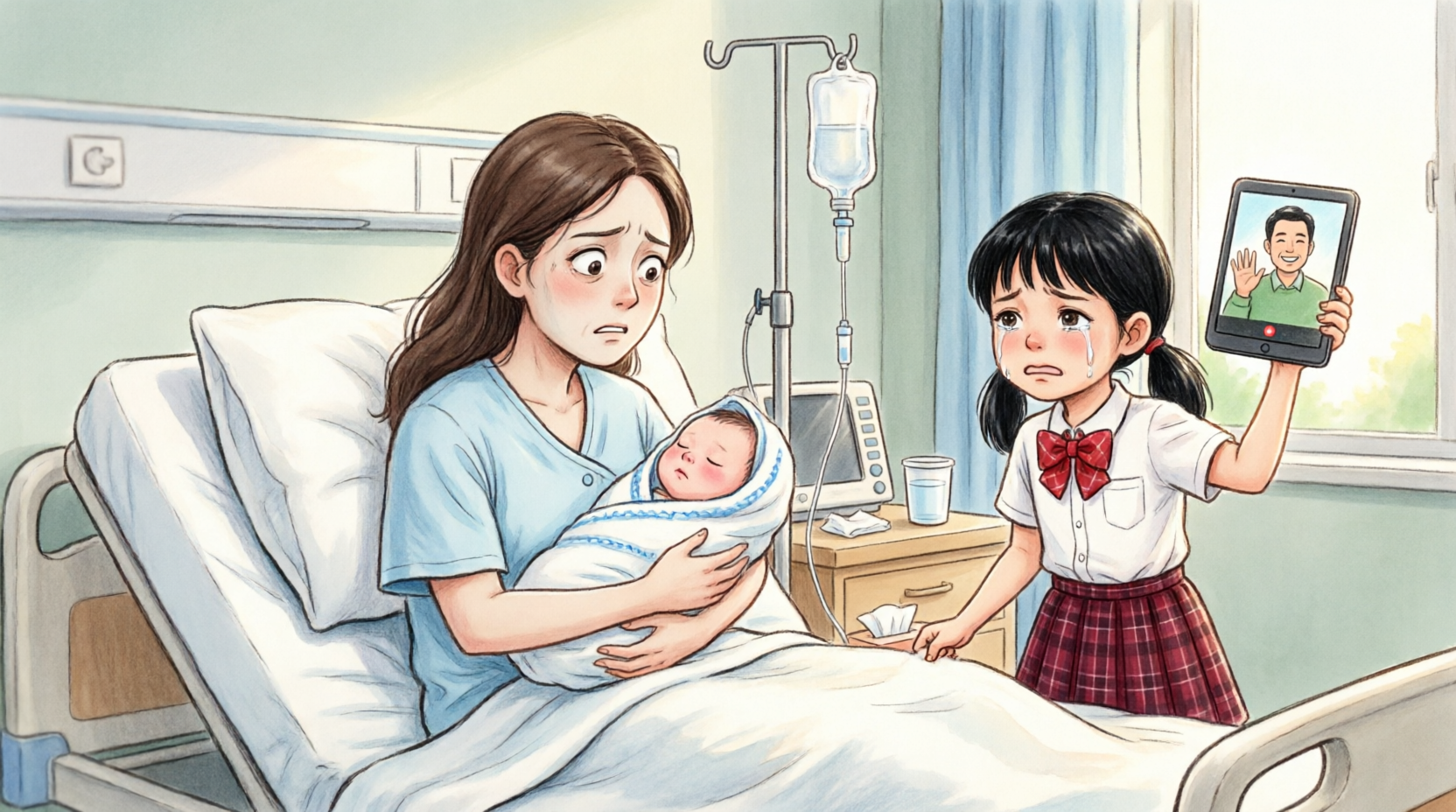
You were lying in a private maternity room at St. Catherine’s Medical Center in Dallas, Texas, exhausted after four hours of labor, your newborn son asleep against your chest. The room smelled like baby lotion, antiseptic, and the weak coffee someone had left untouched on the side table. Outside the window, January morning pressed gray and cold against the glass.
Your nine-year-old daughter, Valeria, stood near the hospital door in her school uniform, backpack hanging from one shoulder, a brand-new iPad clutched against her chest like a shield.
“Vale,” you whispered, trying to smile through exhaustion. “Come meet your little brother.”
She did not move.
Her eyes were swollen. Her lips trembled. Her small fingers gripped the iPad so tightly her knuckles had gone pale.
Your husband, Luis, had not arrived yet.
That should have been the first thing that scared you.
He had promised he would come back right after taking Valeria home to shower and change. He had kissed your forehead after the delivery, looked down at the baby, and said, “Our family is complete now.”
But even then, something in his eyes had felt wrong.
Too controlled.
Too careful.
Too empty.
Valeria stepped closer to the bed.
“Mom,” she said again, voice breaking. “Please listen before Dad comes back.”
Your heart began to beat harder.
The baby stirred against your chest, tiny mouth opening in sleep. You placed one hand protectively over his blanket.
“What happened?”
Valeria looked toward the hallway, then back at you.
“Daddy gave me this iPad last night,” she whispered. “He said it was because he loved me. But he forgot it was connected to his phone.”
Your breath caught.
“What do you mean?”
She unlocked the screen with shaking hands. For one second, she looked like a little girl asking permission to do something wrong. Then her face changed. A brave, terrified kind of determination settled over her.
“I recorded it,” she said. “Because I was scared nobody would believe me.”
Then she pressed play.
At first, there was only muffled sound.
A door closing.
A chair scraping.
Then your husband’s voice filled the hospital room.
“After the baby is born, we follow the plan. It has to look like an accident.”
The room tilted.
You stopped breathing.
A woman answered next.
Paola.
You knew her voice before your mind accepted it. Young, smooth, polished. The woman from his office. The woman he insisted was “just a coworker.” The woman whose perfume had clung to his shirts while he told you pregnancy had made you paranoid.
“And if Mariana suspects something?” Paola asked.
Luis laughed softly.
Not nervously.
Confidently.
“She won’t. She’ll be weak. She’ll be overwhelmed. The postpartum complications are already in her medical records. If something happens, everyone will believe it.”
Your blood turned cold.
The baby’s warm weight against your chest suddenly felt like the only real thing in the room.
Paola’s voice lowered. “And the insurance?”
“Already updated,” Luis said. “Two million dollars. Once she’s gone, we start over. You, me, and the baby.”
Valeria made a small broken sound.
You reached for her with one arm, pulling her close while the audio kept playing.
Paola said, “What about Valeria?”
There was a pause.
Then Luis answered, “She’s a child. Children adjust.”
Those three words cut deeper than the rest.
Not because he had planned to hurt you.
Because he had looked at your daughter, your sweet, observant, anxious little girl, and decided her heartbreak was manageable.
Children adjust.
Valeria buried her face into your shoulder and sobbed.
You held her as tightly as your exhausted body allowed.
Your hand moved blindly toward the call button beside the bed.
You pressed it once.
Then again.
Then you grabbed your phone from the table and called the one person Luis had always underestimated.
Your sister.
“Claire,” you whispered when she answered. “I need you at the hospital right now. Bring your badge.”
Claire went silent.
She was not only your sister.
She was a detective with the Dallas Police Department.
“Mariana,” she said slowly. “What happened?”
You looked down at your newborn son.
Then at Valeria, shaking beside you.
“Luis planned something,” you said. “Valeria recorded him.”
Claire’s voice changed immediately.
“Lock your door if you can. Don’t let him in. Don’t delete anything. I’m on my way.”
The nurse arrived seconds later.
Her name was Hannah, a kind woman with tired eyes and a calm voice. She stepped into the room expecting a normal postpartum concern, then saw your face and stopped.
“What’s wrong?”
You looked at Valeria.
Your daughter nodded, crying silently.
You played the recording again.
Hannah’s expression changed from concern to horror to professional focus in less than ten seconds.
She closed the door.
Then she locked it.
“Do not open this for anyone except hospital security, your sister, or me,” she said.
Your throat tightened. “My husband—”
“I heard enough,” Hannah said. “I’m calling the charge nurse and security. You and the baby are not leaving this room.”
For the first time since pressing play, you felt the smallest piece of air enter your lungs.
Someone believed you.
Someone believed Valeria.
That mattered more than you could explain.
Because for months, Luis had been building the opposite.
He had been building the version where you were emotional.
Hormonal.
Forgetful.
Suspicious.
Difficult.
The pregnant wife imagining betrayal because she felt unattractive. The tired mother making accusations because her husband worked late. The woman too unstable to trust her own instincts.
He had been writing your defense before committing the crime.
And you had almost let him.
You thought back to every warning sign you had swallowed because keeping peace felt safer than asking questions.
The late meetings.
The locked phone.
The sudden kindness before the birth.
The updated insurance documents he pushed you to sign because “every responsible parent does this.”
The new iPad for Valeria.
The way he had watched you take your prenatal vitamins the night before.
Your stomach twisted.
“Vale,” you whispered. “Last night, did your dad give me anything?”
Valeria lifted her tear-streaked face.
“He made your tea.”
Your heart stopped.
“He told me not to touch it because it was for you,” she said. “Then he and Paola went into the office. I was playing with the iPad in the hallway because it had his messages popping up. I heard them. I got scared. So I recorded.”
You closed your eyes.
Your labor had started two hours after that tea.
The doctors had said the contractions were sudden, intense, unusual given your previous history, but not impossible.
You had been too focused on the pain to question anything.
Now every memory sharpened into a blade.
Hannah returned with the charge nurse and two hospital security officers. Within minutes, your room became quiet chaos. The baby was moved briefly to the bassinet while they checked your vitals. Your blood pressure was too high. Your hands would not stop shaking. Valeria refused to leave your side, so Hannah brought her a blanket and pulled a chair right next to your bed.
The charge nurse, Denise, spoke firmly.
“We are placing you under a confidential patient status. That means no visitors without your direct approval. Your husband will not be given access.”
“What if he asks for the baby?”
Denise’s eyes softened but her voice stayed strong.
“He will not touch your baby unless you authorize it.”
You exhaled shakily.
That was when Luis called.
Your phone lit up on the bed.
Luis ❤️
The heart beside his name looked obscene now.
Everyone in the room saw it.
Valeria shrank back.
You stared until the call ended.
Then another call came.
Then another.
Claire arrived fifteen minutes later.
She wore jeans, boots, and a jacket thrown over her badge. Her hair was pulled into a messy ponytail, and her face went pale the moment she saw Valeria curled against you.
“Baby,” Claire whispered.
Valeria stood and ran to her.
Claire held her tightly, one hand on the back of her head, eyes locked on you over your daughter’s shoulder.
You handed her the iPad.
“Don’t let him take it.”
Claire’s jaw hardened.
“He won’t.”
She listened to the recording once.
Then again.
By the second time, her face had turned to stone.
“This is enough for emergency action,” she said. “Maybe more, depending on what we find.”
“What if he says it’s fake?”
“He will,” Claire said. “That’s why we preserve the device, metadata, cloud sync, everything. We also check your bloodwork.”
The word bloodwork made you cold.
Claire saw it.
“What did he give you?”
“Tea,” you whispered. “Before labor started.”
Claire turned to Hannah. “Can we request toxicology?”
Hannah nodded. “I’ll contact the attending physician.”
Your baby began to fuss in the bassinet.
Instinct overrode terror.
You reached for him.
Hannah placed him back in your arms, and the second his tiny body settled against you, the room narrowed into one fact:
You were alive.
Both your children were alive.
Luis had not counted on Valeria.
That was his mistake.
At 10:12 a.m., Luis arrived at the maternity ward carrying flowers.
White roses.
Your favorite.
Or what he thought were your favorite.
Your favorite flowers were yellow tulips. He used to know that when he was still pretending carefully.
Hospital security stopped him before he reached your room.
You could hear the faint edge of his voice from the hallway.
“I’m her husband. My wife just gave birth. Move.”
Claire looked through the small window in the door.
“He brought flowers,” she said flatly.
You almost laughed, but it came out like a sob.
Valeria gripped your hand.
“Don’t let him in.”
“I won’t,” you promised.
Luis’s voice grew louder.
“Where is my son?”
Your son.
Not our son.
My son.
Claire stepped into the hallway.
The door closed behind her, but through the window you saw the moment Luis noticed her badge.
His posture changed.
Not much.
But enough.
Claire spoke calmly. Luis argued. She showed him something on her phone. His face tightened. Then he looked past her toward your room.
For one second, his eyes met yours through the glass.
You saw the mask fall.
Not completely.
Just enough.
The loving husband disappeared.
Behind him stood a man furious that his plan had developed a witness.
You pulled your baby closer.
Security escorted him away.
But men like Luis do not disappear after the first locked door.
They change tactics.
By noon, his mother called.
Then his brother.
Then Paola’s number, blocked after one ring.
Then texts started pouring in.
Mariana, what are you doing?
You’re exhausted. Let me help.
Don’t let Claire poison you against me.
You’re not thinking clearly.
This is exactly what postpartum anxiety looks like.
There it was.
The script.
You handed the phone to Claire.
She read each message with a colder expression.
“He’s building a record,” she said.
“For what?”
“To make you look unstable before you accuse him.”
Your stomach rolled.
You looked at your daughter.
Valeria was watching cartoons on mute, pretending not to listen, but her little shoulders were tense.
You lowered your voice. “What do I do?”
Claire sat beside the bed.
“First, you stay alive. You stay here until doctors clear you and until we know what was in your system. Second, you don’t speak to him alone. Third, we get a protective order. Fourth, we secure the house before he does.”
“The house,” you whispered.
Your home in Plano.
The nursery you had painted pale green.
Valeria’s room with glow-in-the-dark stars on the ceiling.
Your computer.
Your files.
Your medicine cabinet.
The tea.
Claire followed your thoughts.
“I already sent two officers to preserve the scene.”
You looked at her.
She smiled slightly.
“You called the right sister.”
For the next twenty-four hours, the hospital room became your fortress.
Doctors came and went. Nurses checked you. A social worker spoke with you gently about domestic violence, coercive control, safety planning, and emergency custody. You wanted to say that was not your life, that women like you did not need those pamphlets, that Luis had never hit you.
But then you looked at the iPad.
Violence is not always a fist.
Sometimes it is a life insurance form.
Sometimes it is a cup of tea.
Sometimes it is a husband kissing your forehead while planning your funeral.
The toxicology results came back the next evening.
The doctor sat beside your bed and used a voice designed not to frighten patients.
It frightened you anyway.
“There were abnormal traces of medication in your blood,” she said. “A uterine stimulant not prescribed to you. We cannot say from this test alone exactly when or how it entered your system, but given the circumstances, we are reporting this.”
Valeria began to cry again.
You did not.
You had crossed into a kind of calm beyond tears.
Luis had tried to force labor.
Maybe not to kill you in that moment.
Maybe to weaken you.
Maybe to start the chain of “complications” he planned to finish later.
The details did not matter yet.
The intent did.
That night, Claire sat beside you while the baby slept.
“What are you going to name him?” she asked.
You looked down at your son.
Before everything, you and Luis had chosen Mateo.
Now the name felt stained.
“I don’t know,” you said.
Valeria looked up from her chair.
“Noah,” she whispered.
You turned to her.
“Why Noah?”
She shrugged, embarrassed.
“It means rest, right? My teacher said that. And he looks peaceful.”
Your throat closed.
Noah.
Your baby, born into danger, sleeping like a promise.
“Noah,” you said softly.
The baby sighed in his sleep.
And just like that, your son had a name his father did not choose.
The police arrested Luis three days later.
Not at home.
Not dramatically.
At his office in downtown Dallas, in front of the glass conference room where he had probably built his perfect image for years. Investigators had obtained enough to bring him in: the recording, toxicology report, insurance documents, messages with Paola, and security footage from your house showing Paola entering while you were supposed to be on bed rest.
Paola was brought in the same day.
She talked first.
Of course she did.
Claire told you later that people like Paola often mistake proximity to a predator for protection from him. The moment she realized Luis would save himself first, she began saving herself.
She confirmed the affair.
Confirmed the insurance plan.
Confirmed Luis had researched postpartum complications.
Confirmed he had asked her to pick up medication using a fake reason and cash.
But she insisted she thought the plan was “just talk” until the night before the birth.
You did not care.
Talk can become a weapon when spoken by people willing to act.
Luis’s attorney tried to frame everything as misunderstanding, fantasy, stress, marital conflict, harmless affair talk taken out of context by a scared child.
Then the digital forensic report came back.
The recording was authentic.
The timestamps matched.
The iPad had synced automatically to Luis’s own account before he realized what Valeria had captured.
Your daughter had not only recorded him.
His own device had preserved him.
The emergency protective order was granted.
You were awarded temporary sole custody of Valeria and Noah.
Luis was barred from contacting you, your children, your home, your sister, and the hospital staff.
When the judge read the order, you sat in the courtroom wearing loose postpartum clothes, stitches still healing, milk leaking through nursing pads, exhaustion sitting heavy in your bones. Valeria sat between you and Claire, holding your hand. Noah slept in a carrier at your feet.
Luis looked at the baby once.
Only once.
Not with love.
With resentment.
As if Noah had betrayed him by surviving.
That look erased the last trace of hesitation in you.
Somewhere inside, the wife ended.
The mother remained.
And she was not afraid of him anymore.
Going home was harder than you expected.
Not because you were unsafe. Claire had arranged new locks, cameras, a security system, and a neighbor watch so intense that Mrs. Patterson next door practically became a one-woman surveillance agency. The police had cleared the house. The tea mug had been collected. The medication cabinet photographed. The home office searched.
But walking through the front door with Noah in your arms and Valeria pressed against your side felt like entering the scene of a crime disguised as your life.
The nursery smelled like fresh paint and baby detergent.
Luis had assembled the crib.
You stared at it until your stomach turned.
“Mom?” Valeria whispered.
You looked at her.
She was watching you carefully, too carefully for a child.
You forced yourself to breathe.
“We’re going to change some things,” you said.
“What things?”
You looked around the room.
“The color. The curtains. Maybe the crib.”
Valeria nodded seriously.
“I can help.”
“You already did.”
Her eyes filled.
You set Noah gently in the bassinet Claire had brought from her house, then pulled Valeria into your arms.
For days, she had been brave because everyone needed her bravery.
Now, in the nursery doorway, she finally became nine again.
“I was so scared,” she sobbed. “I thought if I told him I knew, he would hurt you before I could get help.”
You held her tightly.
“I am so sorry you had to carry that.”
“He said children adjust.”
Your throat burned.
You pulled back and held her face between your hands.
“Listen to me. You do not have to adjust to being hurt. You do not have to adjust to being scared. You do not have to adjust to adults doing wrong things and calling it normal.”
She cried harder.
“You saved us, Vale.”
She shook her head. “I just pressed record.”
“No,” you said. “You trusted the truth more than fear. That is brave.”
After that, healing came in uneven pieces.
You removed Luis from the house room by room.
Not only his clothes.
His preferences.
The black leather couch you hated went to a donation center. The heavy dining table where he used to sit at the head like a judge was sold online. The framed golf photos disappeared. The gray nursery became soft yellow because Valeria said Noah needed “a sunrise room.”
You changed your last name back before the divorce was final.
Mariana Blake.
Valeria Blake.
Noah Blake.
A family reassembled under your name.
Luis’s family tried once.
His mother came to the house with tears, a Bible, and a casserole.
Mrs. Patterson called you before she reached the porch.
“She’s here,” your neighbor whispered. “And the casserole looks emotionally manipulative.”
You almost laughed.
Luis’s mother knocked.
You opened the door with Claire on speaker.
She cried immediately.
“Mariana, please. He is still their father.”
You looked at her through the storm door.
“He planned to make them motherless.”
Her face crumpled.
“He says Paola confused him.”
“No.”
“He says he was under pressure.”
“No.”
“He says you are keeping the children from him.”
You stepped closer.
“I am keeping them alive.”
She recoiled.
For a second, shame crossed her face.
Then disappeared beneath defense.
“A boy needs his father.”
You looked toward the living room, where Valeria was reading beside Noah’s swing.
“A boy needs safety.”
You closed the door.
The casserole stayed on the porch until Mrs. Patterson collected it “for evidence,” which meant she threw it away while muttering about poison.
The criminal case took time.
Everything takes time when you want justice to arrive cleanly. There were hearings, continuances, motions, evaluations, interviews, forensic reports. Your life became a calendar of legal dates and pediatric appointments. You learned to nurse Noah in courthouse bathrooms. You learned to answer questions without collapsing. You learned that courage often looked like showing up exhausted.
Luis eventually pleaded guilty to reduced but serious charges after Paola agreed to testify.
The prosecutors said it spared Valeria from taking the stand.
You accepted the plea for that reason only.
At sentencing, you read a statement.
Your hands shook, but your voice did not.
“You did not only betray me as a husband. You targeted me as a mother. You looked at my pregnancy, my weakness, my trust, my medical records, and you turned them into tools. You looked at our daughter and assumed her fear would protect you. You were wrong. Valeria told the truth. Noah survived. I survived. And the family you tried to erase is standing here without you.”
Luis looked down.
You did not care whether he felt remorse.
Remorse was his burden.
Survival was yours.
He was sentenced to prison.
Paola received a lesser sentence and probation after cooperation, a detail that once made you furious and later became irrelevant. Her punishment did not heal you. His sentence did not restore the months you had spent doubting your instincts.
Healing came elsewhere.
It came the first time Valeria slept through the night without checking the locks.
It came when Noah laughed for the first time, a breathy little sound that made you and Valeria both cry.
It came when you repainted the nursery yellow and got paint on your cheek.
It came when you returned to graphic design work and landed a contract with a women’s health nonprofit.
It came when you spoke at a hospital training about coercive control and medical vulnerability, telling nurses exactly why a frightened child with an iPad should always be taken seriously.
Hannah was in the audience.
Afterward, she hugged you.
“I still think about that morning,” she said.
“Me too.”
“You looked terrified.”
“I was.”
“But you pressed the call button.”
You smiled faintly.
“My daughter pressed play first.”
The story spread eventually.
Not your children’s faces. Never that. You protected them fiercely.
But the lesson spread.
A local reporter wrote about digital evidence in domestic violence cases without naming Valeria. A nonprofit asked you to design a campaign called Believe the Small Witness. You created posters for hospitals, schools, and shelters:
Children may not have the words. But they know when home is unsafe.
A recording can be evidence. A child’s fear can be evidence too.
Listen before the danger comes home.
You built a life around the truth your daughter had protected.
Years later, when Noah was five, he asked why he did not have a dad at school pickup like some other kids.
Valeria, now fourteen, froze at the kitchen counter.
You looked at her first, letting her know silently that this was not her burden to explain.
Then you knelt in front of Noah.
“You have a father,” you said carefully. “But he made dangerous choices, and it is my job to keep you safe.”
Noah frowned. “Did he make you sad?”
“Yes.”
“Did he say sorry?”
You thought of Luis’s letters from prison, unopened after the first one tried to blame stress, fear, Paola, finances, anything but himself.
“Not in a way that fixed anything.”
Noah considered that.
Then he hugged your neck.
“I like our house.”
You closed your eyes.
“I do too.”
Valeria disappeared into the hallway.
You found her later sitting on the floor of the sunrise room, staring at the old iPad.
You had kept it.
Not as a shrine.
As evidence once, then memory, then proof.
“Sometimes I hate this thing,” she said.
You sat beside her.
“Me too.”
“Sometimes I’m glad I had it.”
“Me too.”
She leaned her head on your shoulder.
“Do you ever wish I hadn’t played it in the hospital? Like, maybe things would’ve been normal?”
You turned toward her, heart breaking all over again.
“Vale, normal was the lie. You gave us the truth.”
She cried quietly.
You held her.
“You were a child,” you whispered. “You were never responsible for saving us. But you were brave, and I will honor that for the rest of my life.”
She whispered, “I was scared you would choose him.”
The words gutted you.
You pulled back.
“Never.”
“But before, when people said stuff, you always tried to keep peace.”
You swallowed.
Children notice everything.
You said, “I confused peace with silence. I won’t do that again.”
She nodded.
That became a promise in your home.
Peace would never again mean pretending.
Years passed.
Valeria grew into a fierce young woman who wanted to become a digital forensic analyst because, in her words, “bad people underestimate devices and daughters.” Noah grew strong enough to play soccer, though you still panicked at every cough. Claire became the aunt who bought inappropriate amounts of ice cream and taught both children how to check exits in public places without making it scary.
Mrs. Patterson remained next door, older and nosier, still convinced every casserole had motive.
Your house filled with laughter again.
Different laughter.
Hard-won laughter.
The kind that knows what it survived.
One January morning, on Noah’s birthday, you woke before the children and stood in the kitchen making pancakes. Sunlight entered through the window, soft and gold. The house was quiet, but not in the old way. Not heavy. Not watched.
Your phone buzzed.
An email from the prison system.
Luis was eligible for a parole hearing.
You stared at the screen.
For a moment, the room tilted backward in time.
Hospital bed.
iPad.
His voice.
The plan.
Then Noah thundered down the stairs yelling, “Birthday pancakes!” and Valeria shouted after him, “Don’t run, you tiny chaos goblin!”
The fear loosened.
Not vanished.
But loosened.
You forwarded the notice to Claire and your attorney. You would handle it. You would write a statement. You would update safety plans if needed.
But you would not let his shadow eat the morning.
Noah slid into a chair.
Valeria grabbed plates.
You poured batter onto the pan.
“Mom,” Noah said, “can I have extra chocolate chips?”
“No,” you said.
Valeria added, “She means yes.”
You laughed.
And you realized something stunningly simple.
You were not waiting for danger anymore.
You were living.
That evening, after cake and presents, Valeria handed you a small wrapped box.
“It’s not your birthday,” you said.
“I know. Open it.”
Inside was a framed print she had designed herself.
A digital illustration of three figures standing in a doorway: a mother holding a baby, a girl holding a tablet, and sunlight spilling behind them into a yellow room.
At the bottom, she had written:
The truth came home with us.
You cried so hard Noah panicked and tried to feed you cake.
Valeria hugged you.
You hung the print in the hallway, right beside the family photos.
Not hidden.
Not softened.
Part of the story.
The ending was not that Luis went to prison.
That was law.
The ending was not that Paola confessed.
That was fear.
The ending was not that the iPad saved you.
That was evidence.
The true ending was that your daughter grew up knowing her voice mattered. Your son grew up in a house where safety was not negotiable. And you became the woman your frightened self in that hospital bed needed most.
A woman who listened.
A woman who acted.
A woman who did not bring danger home just because it wore a wedding ring.
At the hospital door, Valeria had begged you not to bring the baby home.
She thought the baby was the danger.
She was only nine.
She did not yet understand that Noah was never the threat.
The threat was the man who believed your weakness would hide his cruelty.
The threat was the silence he counted on.
The threat was the love you had been trained to protect even when it stopped protecting you.
But your daughter pressed play.
And with one small finger, she shattered the marriage he thought he controlled.
By sunrise, you were not just a mother with a newborn.
You were a witness.
By the end of that week, you were protected.
By the end of that year, you were free.
And years later, when people asked how you survived, you always gave the same answer:
“My daughter told the truth before I was ready to hear it.”
Then you added the part every mother needed to remember.
“And I believed her.”