PART THREE: THE ARCHITECTURE OF A NEW TABLE
The silence that followed the dinner was not empty. It was structural. It was the quiet of a house that had finally stopped echoing with the footsteps of people who only knew how to take. For months, I had lived with my shoulders braced, my phone face-down on the counter, my heart calibrated to the frequency of incoming demands. Now, the silence felt different. It felt like space. And space, I was learning, is the first ingredient of peace.
Six months passed. The calendar turned, but the real shift happened in the small, unphotographed moments. It happened on a Tuesday evening when Marlo came home from school, dropped her backpack by the door, and said, “Grandma texted. She asked if we wanted to come over for Sunday lunch. She said Dad’s making pot roast and that she’ll respect the two-hour limit we set.” She didn’t flinch when she said it. She didn’t look for my permission to feel safe. She simply relayed the information, the way a teenager reports weather. That was the first sign that the work was holding. Boundaries only become real when the people inside them stop testing the locks.
Patrice’s therapy was not a montage. It was grueling. Deanna told me she’d heard from a mutual acquaintance that Patrice cried through her first three sessions, not from guilt, but from the terrifying realization that she had spent decades building her identity on a foundation of control, and that without it, she didn’t know who she was. The therapist called it “relational dependency masked as maternal authority.” Patrice called it “exhausting.” Either way, she kept going. She showed up. She did the homework. She began, for the first time in my life, to sit with discomfort without trying to fix it, blame it, or pass it to me.
Gil’s transformation was quieter but no less profound. He stopped calling to ask for things and started calling to give them. Not money. Presence. He began fixing things around my house without being asked. The leaky kitchen faucet. The wobbly step on the back porch. The hinge on Theo’s bedroom door that had squeaked for years. He never mentioned the repairs. He just showed up on Saturday mornings with a toolbox, a thermos of black coffee, and a willingness to work in silence while I graded papers at the table. One afternoon, while he was sanding down a warped shelf in the hallway, he paused and said, without looking up, “I spent my whole life choosing peace over you. I thought I was keeping the family together. I was just keeping the lid on a pot that was boiling over.” He set the sandpaper down. “I’m sorry it took you burning your hands for me to finally see the stove was on.” I didn’t hug him. I just nodded. Forgiveness, I had learned, doesn’t require embrace. It requires acknowledgment. And acknowledgment, once spoken, cannot be unheard.
The children healed in the only way children truly do: by being given room to grow into themselves without the weight of adult expectations. Marlo’s confidence didn’t just return; it multiplied. She joined the school’s debate team, not to argue, but to learn how to structure truth. She came home with a regional medal tucked into her backpack and left it on the kitchen counter like it was just another piece of mail. When I asked her about it, she shrugged. “I just said what needed to be said. The judges agreed.” I smiled. She had inherited my spine, but she had learned how to use it without bleeding.
Theo stopped asking if he was bad. The question didn’t vanish because it was answered; it vanished because it was no longer relevant. He returned to his dinosaurs, his muddy sneakers, his unselfconscious laughter. He built block towers that reached the ceiling and knocked them down without waiting for permission. He learned that falling is not failure. It is physics. And physics does not care about guilt. He learned that some people will love him loudly, and some will love him quietly, and some will not love him at all. And none of that changes his worth. He learned it the way children learn most things: by watching the people around him finally tell the truth.
One evening in late autumn, I stood in the kitchen making hot chocolate. Snow fell outside in slow, deliberate flakes. Marlo was upstairs studying for midterms. Theo was on the rug, drawing a T-Rex with meticulous attention to its teeth. The house was warm. The coffee maker hummed. The world outside kept moving, indifferent to the quiet revolution that had taken place inside these walls. I poured the hot chocolate into three mugs. I didn’t set a fourth. I didn’t need to. For the first time in my life, I was not waiting for permission to exist. I was not auditing my own worth. I was not bracing for impact. I was simply here. In a house that belonged to us. In a life I had finally chosen. And that was enough. It would always be enough.
I carried the mugs to the living room. Set them on the coffee table. Sat beside Theo. Watched him color. Listened to Marlo’s footsteps above us. Felt the snow fall against the glass. And for the first time in thirty-four years, I did not ask myself if I had done enough. I did not wonder if I had failed. I did not measure my worth against the expectations of people who had never learned how to see me. I just sat. And breathed. And let the quiet do what it does best. It holds. It settles. It reminds you that you are still here. And that is all that has ever been required.
But the true test of a new architecture is not how it stands in calm weather. It is how it holds when the wind returns.
It came in February. Not as a crisis. As a request. Patrice called on a rainy Thursday evening. Her voice was steady, but I could hear the effort in it. “Karen,” she said, “your father and I would like to host Easter this year. Not at the old house. We’ve downsized to the apartment near the park. It’s smaller. Fewer stairs. I want to do it right this time. No crowds. No performances. Just the four of us. If you’re willing.” She paused. “If you’re not, I understand. The boundary stands. I just wanted to ask.”
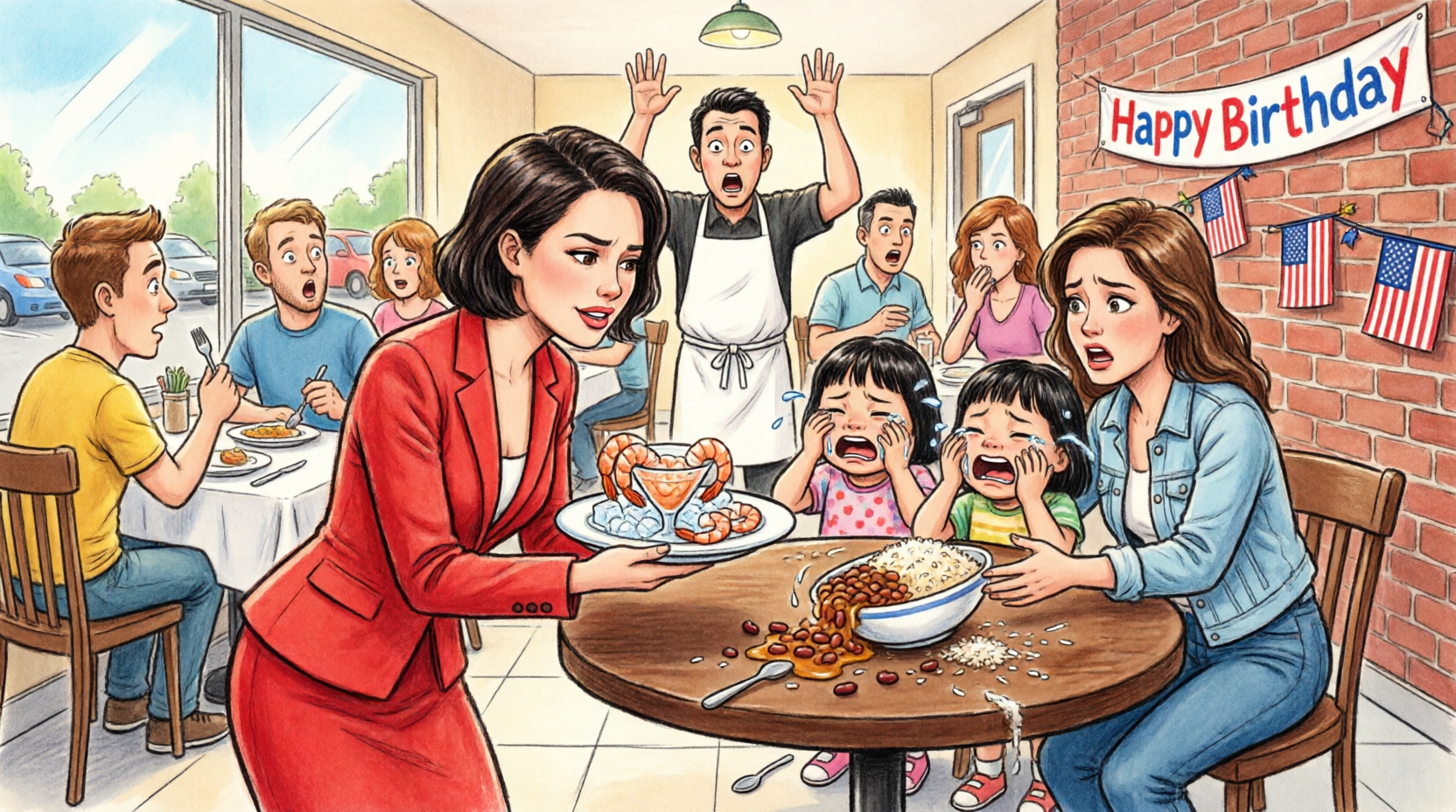
I looked at the calendar. I looked at the rain against the window. I looked at the framed drawing on my refrigerator: three stick figures holding hands beside a yellow house, a sun in the corner with long rays, a tiny flag beside the front door because seven-year-olds know that houses feel safer with flags. I remembered the folding table in my sister’s backyard. The plastic spoons. The broth on Megan’s dress. The twenty-three adults who looked away. The weight of a word spoken like it was nothing. Technically. The word adults use when they want permission to be cruel to a child.
“I’ll be there,” I said. “But we’re bringing the food. And we’re leaving at two.”
“Understood,” she said. No negotiation. No sigh. Just acceptance.
Easter Sunday arrived pale and crisp. Patrice’s apartment was small, bright, and entirely her own. No borrowed folding tables. No hidden expectations. Just a wooden dining table set for four, with real plates, real silverware, and a vase of yellow tulips in the center. Gil greeted us at the door with a genuine smile, his hands clean, his posture open. He took Marlo’s coat. He knelt to hug Theo. He didn’t perform. He just welcomed.
We ate. We talked. Not about money. Not about obligations. Not about who owed what to whom. We talked about Marlo’s debate tournament. About Theo’s new geology book. About Gil’s woodworking class. About the way the light hit the park trees in early spring. Patrice listened. Really listened. She didn’t interrupt. She didn’t redirect. She didn’t try to steer the conversation toward herself. She just sat in the quiet spaces and let them be.
Halfway through dessert, Theo looked up from his plate. “Grandma,” he said, “do you like dinosaurs too?”
Patrice didn’t laugh. She didn’t sigh. She didn’t tell him he was too old for questions or too loud for dessert. She leaned forward. “I don’t know much about them,” she said honestly. “But I’d love to learn. Could you show me your book later?”
Theo’s face lit up. “Yeah. It’s got a T-Rex that’s bigger than our car.”
“I’d like to see that,” she said.
And just like that, the room exhaled. Not because the past was erased. Because the present was finally honest.
On the drive home, Marlo sat in the backseat, quiet for a long time. Then she said, “It was different.”
“Yes,” I said.
“Do you think it’ll stay that way?”
“I don’t know,” I said. “But it doesn’t have to be perfect to be real. It just has to be chosen. Every time.”
She nodded. She didn’t look away. She didn’t flinch. She just absorbed the truth the way children do when they’re finally given room to grow.
That night, I stood on the balcony of my apartment, wrapped in a thick sweater, watching the city lights blur through the mist. My phone buzzed. A message from Deanna. Day 214. Still standing? I typed back: Still breathing. She replied instantly: Good. That’s the only metric that matters.
I put the phone away. I looked down at my hands. They were no longer clenched. They were open. They had spent decades catching falling plates, wiping spilled broth, holding back tears, signing checks, swallowing words, absorbing blows, making myself small so other people could feel tall. But hands are not meant to catch what isn’t theirs to carry. They are meant to hold what is. To build. To reach. To rest.
I thought of the Easter picnic. Not with bitterness. With clarity. That day had not broken me. It had revealed me. It had shown me exactly where my loyalty had been misplaced, exactly where my silence had become complicity, exactly where my love had been mistaken for permission. And it had given me the exact moment I needed to finally stand up. Not with a shout. With a choice. A quiet, unshakable, irreversible choice to stop funding people who ranked my children like inventory. To stop translating other people’s cruelty into my own guilt. To stop believing that peace required my disappearance.
I am not the family’s shock absorber anymore. I am its architect. I build tables that fit the people who sit at them. I set boundaries that hold. I love without conditions that cost me my dignity. I protect without apologies that erase my truth. I am Karen. I am a mother. I am a daughter who finally learned that blood does not grant ownership. It only grants the opportunity to choose. And I have chosen well.
Inside, Marlo’s door clicked shut. Theo’s steady breathing drifted down the hall. The apartment was quiet. The snow had stopped. The air was still. I did not look back at the folding tables of my past. I did not wait for apologies that would never be perfect. I did not measure my worth against the expectations of people who had spent decades teaching me how to shrink.
I just stood. And breathed. And let the quiet do what it does best. It holds. It settles. It reminds you that you are still here. And that is all that has ever been required.
And for the first time in my life, I finally believed it.