By the time Marissa turned onto Ridge Hollow Lane that afternoon, she was only thinking about avocados.
The firm had let everyone leave early because the server went down just before four, and she had stopped at the market almost on instinct.
Caleb liked guacamole on Thursdays.
That was such a small, married thought that it almost hurt her later.
She bought avocados, limes, cilantro, and the expensive tortilla chips he always complained were too salty but finished before dinner anyway.
The paper bag was too full, and one of the twisted handles cut a red groove into her fingers as she walked up the driveway.
Nothing about the house looked wrong from the front.
The sprinklers ticked over the strip of grass between the sidewalk and the mailbox.
The curtains in the upstairs bedroom were half open.
Caleb’s new $64,000 truck was in the driveway, clean enough to reflect the sky.
The truck had been another argument disguised as a celebration.
He said he deserved it after a brutal quarter at work.
Marissa said a person could deserve something and still need to count the money.
Caleb had smiled then, kissed her forehead, and told her she worried beautifully.
That was one of his tricks.
He made condescension sound like affection.
They had been married long enough for Marissa to recognize his tones, but not long enough, apparently, for her to stop excusing them.
Ridge Hollow was the kind of subdivision where people pretended privacy existed because the fences were tall.
It did not.
Everyone knew who got a new car.
Everyone knew whose dog barked too much.
Everyone knew Vanessa from number 218 came over every Tuesday to borrow sugar, even though she hosted dinner parties with desserts that looked like magazine covers.
Vanessa had been easy to like at first.
She was the kind of neighbor who remembered birthdays, complimented patio plants, and laughed at the exact volume that made a person feel included.
She had brought banana bread when Marissa had the flu.
She had watered the basil once when Marissa and Caleb went to Austin for a long weekend.
She knew the gate code because Marissa had given it to her herself.
That was the part Marissa would replay later.
Not the pool.
Not the bikini.
The gate code.
Betrayal rarely kicks the door in.
Sometimes it waits for you to hand it a key and call that kindness.
The backyard smelled like chlorine when Marissa opened the kitchen door.
It was the clean, sharp smell that always rose from the pool on hot days, mixed with warm stone and the green peppery scent of basil near the grill.
The sun hit the glass doors hard enough to make the patio glare.
For half a second, she could not see clearly.
Then the water slapped the tile.
Once.
Twice.
Steady.
Wrong.
Caleb was in the pool.
Vanessa was in his arms.
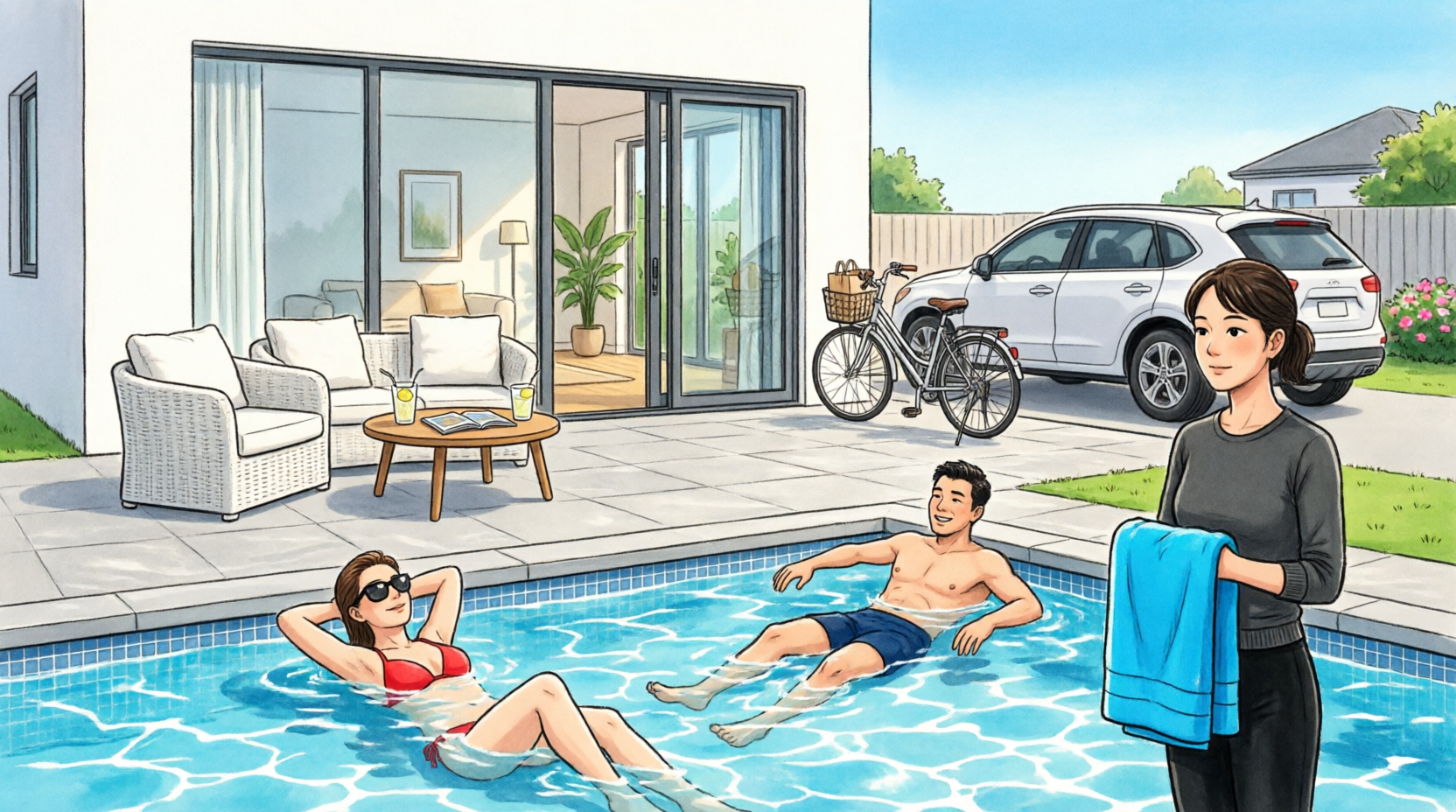
Her black bikini top was on Marissa’s patio chair.
His linen pants were beside it, folded in a way that suggested nobody had been in a hurry until the door opened.
Caleb saw her first.
His hands left Vanessa’s waist so fast that the water jumped around them.
“Marissa,” he said.
He said her name like a problem.
Vanessa sank lower until only her shoulders and mouth stayed above the water.
Her lipstick was red and smeared at the corner, the same shade Marissa had seen on a coffee cup the week before.
That memory came back with a clarity that made Marissa feel almost stupid.
Vanessa had stood at Marissa’s kitchen island that Tuesday, holding the mug with both hands, asking whether Caleb was still working late so often.
Marissa had answered honestly.
She had trusted the question because she trusted the woman asking it.
Now there were wet footprints leading from Marissa’s kitchen door to the pool.
Not from the side gate.
Not from the guest path.
From the kitchen.
The paper grocery bag sagged in Marissa’s hand.
She thought, absurdly, that the cilantro would wilt.
Then she set the bag on the outdoor counter because some part of her still refused to make a mess in her own house.
One avocado rolled out.
It tapped against the stainless-steel sink.
The sound was small and final.
“Don’t make a scene,” Caleb said.
That was when the marriage ended.
Not when she saw his hands on Vanessa.
Not when she saw the clothes.
Not even when she noticed Vanessa’s phone glowing with three missed calls from her husband.
It ended when Caleb looked at his wife standing in the doorway with groceries in her hand and decided his first concern was volume.
Marissa did not scream.
She did not cry.
She walked to the lounge chairs.
Caleb’s shirt was damp at the collar.
His belt was looped once through itself.
His keys were under the towel.
Vanessa’s sundress had fallen partly onto the stone.
Her sandals were turned sideways as if she had stepped out of them laughing.
Her phone lit again.
Mark.
That was Vanessa’s husband.
Marissa gathered everything slowly.
She folded each piece over her arm.
Vanessa whispered, “Please. We can explain.”
Marissa looked at the wet footprints.
“You already did.”
Caleb moved toward the pool edge.
“Don’t be dramatic.”
There it was again.
The performance he had already cast her in.
If she raised her voice, she would be unstable.
If she cried, she would be hysterical.
If she demanded answers, she would be humiliating him.
Men like Caleb did not simply betray you.
They reserved the right to review your reaction.
Marissa’s fingers tightened around the clothes until the wet fabric pressed cold against her skin.
She noticed her own wedding ring.
It looked strangely separate from her hand.
The red emergency button was beside the kitchen entrance.
It sat on the security panel Caleb had mocked for months.
Marissa had paid $2,700 for that system after a rash of break-ins two streets over, and Caleb had called her paranoid at least six times.
He had made jokes about it at dinner parties.
He had told Vanessa, once, while Vanessa laughed over a glass of wine, that Marissa was turning the house into a bank vault.
The system connected the side gate camera, the pool camera, the front doorbell, and the patrol dispatch.
It also sent automatic alerts to the monitoring company and pushed emergency notices into the Ridge Hollow community app.
Caleb knew all of that.
That was why his face changed before she pressed it.
“Marissa. No.”
She pressed once.
The siren tore through the backyard.
It was not a polite alarm.
It was sharp, brutal, and designed to be impossible to ignore.
Dogs erupted down the block.
Curtains moved in front windows.
A garage door lifted two houses away, groaning into the noise.
Mrs. Palmer leaned over her fence wearing gardening gloves, one hand still muddy.
The old man across the street stepped onto his porch holding a coffee mug.
Two teenagers stopped their bikes near the curb.
A delivery driver froze beside his open van with one box tucked against his hip.
For a few seconds, the entire subdivision paused around the sound.
A sprinkler kept ticking across someone’s lawn.
Mrs. Palmer’s mouth opened, but no words came out.
One of the teenagers looked at the ground, then back toward the fence.
Nobody moved.
Caleb shouted, “Turn it off!”
Marissa stood beside the alarm panel with their clothes over one arm.
“Why?” she asked.
Her voice was steadier than she felt.
“You brought this five feet from my kitchen.”
Vanessa covered her face with both hands.
The water could hide skin, but it could not hide facts.
Caleb tried to climb out.
Then he remembered he had nothing to climb out in.
Marissa’s phone buzzed.
Security Company: Emergency alert confirmed. Patrol notified.
Then the Ridge Hollow community app lit up.
Backyard alarm at 214 Ridge Hollow Lane.
That alert mattered more than Caleb understood.
It created a timestamp.
It created witnesses.
It created a public record of the exact minute the story stopped belonging only to the person who had been hurt.
At 5:42 p.m., the lie became an event.
Marissa reached into Caleb’s pants pocket.
She found the key fob to his new $64,000 truck.
Caleb’s mouth opened.
She held it between two fingers.
“This,” she said, “is the last thing of yours going into my pool.”
Then she dropped it into the deep end.
The fob disappeared under the rippling blue water.
For the first time, Caleb had nothing to say.
Vanessa turned toward the side gate.
Then another car door slammed out front.
The sound cut through the siren in a way that made Vanessa’s face collapse.
A black SUV stopped at the curb.
Vanessa whispered, “Mark.”
Marissa did not move.
She tightened her grip on the clothes.
The driver’s door opened.
The siren kept screaming.
Mark came up the front walk slowly.
He was not running.
That was somehow worse.
A running man still has hope that he can interrupt something before it becomes real.
Mark walked like a man who already knew he was arriving after the truth.
Marissa’s phone buzzed again.
Doorbell camera.
Motion clip saved: Front entry. 5:39 p.m.
She looked down.
The thumbnail showed Caleb and Vanessa at the kitchen door.
Caleb’s hand rested low on Vanessa’s back as he guided her inside.
Three minutes before Marissa came home.
Not the side gate.
Not the patio entrance.
The kitchen.
The same kitchen where Vanessa had borrowed sugar.
The same kitchen where Marissa had left coffee for Caleb on early mornings.
The same kitchen where she had trusted both of them to stand.
Marissa opened the clip.
There was no audio from inside, only the small camera view from the porch angle, but the image was enough.
Caleb glanced behind him before entering the code.
Vanessa laughed.
He kissed her once before the door opened.
It was quick.
Careless.
Familiar.
Marissa felt something in her chest go quiet.
Not numb.
Organized.
That was the word.
The hurt did not leave.
It arranged itself.
Vanessa saw Marissa’s face and whispered, “What?”
Marissa turned the screen toward Caleb.
He stared at the video.
His expression did not show guilt first.
It showed calculation.
That hurt more than guilt would have.
“Marissa,” he said, lowering his voice under the siren. “Don’t show him that.”
The doorbell rang.
The sound came through the backyard speaker, absurdly clean and polite.
Marissa looked at Caleb in the pool.
Then she looked at Vanessa.
Then she answered through the camera.
“Mark.”
His face filled the screen.
He was pale, but his voice was controlled.
“Marissa, before you open this door, tell me one thing.”
She waited.
“How long has my wife been using your kitchen door?”
Vanessa made a sound behind her.
Small.
Broken.
Marissa did not answer immediately.
She looked down at the saved clip again.
Then she scrolled.
There were more motion events from earlier Tuesdays.
Not all of them showed anything dramatic.
Some showed Vanessa arriving with an empty measuring cup.
Some showed Caleb opening the door when Marissa was not home.
Some showed Vanessa leaving with sunglasses on and her hair different from when she arrived.
The camera had not known what it was saving.
That was the cruel mercy of machines.
They do not understand betrayal.
They simply keep the time.
Marissa opened the front door.
Mark stood there in a dark polo shirt, one hand braced against the frame as if he had needed it to steady himself.
The siren screamed behind her.
The patrol vehicle had not arrived yet, but the whole block was already watching.
“I’m sorry,” Marissa said.
It was the first useless thing she had said all afternoon.
Mark looked past her toward the backyard.
Then he heard Vanessa sob.
His face changed.
He walked through the house without asking permission.
Marissa followed.
When he stepped onto the patio, Vanessa covered her mouth.
“Mark,” she said.
He did not answer her.
He looked at Caleb first.
Then he looked at the clothes over Marissa’s arm.
Then he looked at the patio chair, the bikini top, the linen pants, the phone, the wet footprints, and the glowing security panel.
The scene explained itself with humiliating efficiency.
Caleb tried to speak.
“Mark, listen—”
Mark raised one hand.
Caleb stopped.
That single gesture did what Marissa’s pain had not been allowed to do.
It silenced him.
The patrol officer arrived six minutes after the alarm confirmation.
By then, three more neighbors were outside.
Mrs. Palmer had retreated from the fence but still watched through the slats.
The teenagers had rolled their bikes farther down the curb without actually leaving.
The officer asked whether there was an intruder.
Marissa said no.
Then she looked at Vanessa, still in the pool, and Caleb, still gripping the edge.
“Not the kind you can arrest today.”
The officer took a report because the emergency alarm had dispatched patrol.
He recorded the timestamp.
He recorded that Marissa was the homeowner.
He recorded that two people had been found in the backyard pool without clothing readily available.
He recorded that one of them had entered through the kitchen door shortly before the alarm.
Caleb hated that part.
Marissa could see it.
He kept trying to move the conversation toward privacy, misunderstanding, marital issues, anything soft enough to blur.
The officer kept writing.
Paper has a way of offending people who depend on charm.
Mark asked for Vanessa’s phone.
She hesitated.
That hesitation answered more than the phone ever could.
Marissa handed him the clothes instead.
Vanessa climbed out wrapped in a towel the officer gave her from the outdoor storage bench.
Caleb had to wait until Marissa tossed him his shirt and pants, one at a time, without stepping closer.
Nobody laughed.
That almost made it worse.
The neighborhood had seen enough to talk for years, but in that moment, nobody treated it like entertainment.
Even Mrs. Palmer looked away when Caleb pulled on his clothes.
Humiliation can be deserved and still ugly.
Marissa did not need to enjoy it.
She only needed not to protect him from it.
When the siren finally stopped, the silence felt enormous.
Caleb turned toward her.
“Can we talk inside?”
Marissa almost laughed then.
Inside.
After everything, he still thought the kitchen was neutral ground.
“No,” she said.
Caleb looked at the neighbors, the officer, Mark, Vanessa, the wet tile, the patio chair, the empty place where his truck key used to be.
“Marissa, please.”
She looked at him for a long moment.
This was the man who had stood beside her when the pool was installed.
The man who had complained about the $18,000 cost and then invited everyone over to admire it.
The man who had called her careful when he meant boring.
The man who had called her paranoid when he meant inconvenient.
“I’m done discussing my marriage in rooms where you bring other women,” she said.
Mark drove Vanessa home in silence………………………