Lily was two years old that summer, still young enough to sleep with one palm tucked under her cheek and old enough to believe every bright plastic thing in the world had been placed there for her to admire.
She had soft curls that sprang back when I brushed them, round cheeks that flushed when she laughed, and a habit of saying “mine?” in the gentlest possible voice whenever curiosity got ahead of her manners.
That Saturday was supposed to be simple.
A cookout at Ethan’s parents’ house.
A few hours in the backyard.
Hot dogs, corn, pasta salad, paper plates, the kind of family afternoon that should have ended with sticky fingers and a tired toddler asleep before we hit the second stoplight.
Ethan had been called into an unexpected shift that morning, and I remember standing in our kitchen with the fridge humming behind me while he kissed Lily on the top of her head and told me he would meet us later.
He told me to go ahead, and he promised he would get there as soon as he could.
I almost said no.
I almost told him I didn’t like going to his parents’ house alone, not because they were loud or messy or difficult in the normal family way, but because every visit there felt like walking into a room where everyone had already agreed you were overreacting before anything even happened.
But I had been trying.
For years, I had been trying.
I had tried through Diane’s tight comments about the way I packed Lily’s diaper bag, through Robert’s habit of talking over me like I was one of the kids, through Mark’s silence whenever his wife turned mean, and through Vanessa’s constant need to make motherhood into a scoreboard.
So I dressed Lily in her yellow sundress, found both white sandals even though she kicked one off twice before we left the driveway, and let her wear the tiny plastic bracelet she called her fancy jewelry.
The day was warm enough to make the steering wheel sticky.
The air smelled like cut grass and sunscreen when we pulled up, and somewhere down the block a mower buzzed in long, lazy lines.
Ethan’s parents lived on a quiet street with trimmed hedges, a basketball hoop over the garage, and a little flag clipped near the back porch that flapped whenever the wind came around the side of the house.
I balanced the glass dish of pasta salad against my hip, slung the diaper bag over my shoulder, and opened Lily’s door.
She reached for me immediately.
I lifted her out, fixed her sandal strap, and told myself we would stay for dinner, smile, thank everyone, and go home.
In the backyard, Robert was already at the grill, wearing mirrored sunglasses and holding a long pair of tongs like a badge.
He had a way of turning even hamburger patties into a performance.
Diane was at the patio table arranging napkins, cups, forks, and paper plates in little stacks, fussing over the corners as if the backyard might fall apart without her.
Mark stood near the cooler with his phone in one hand.
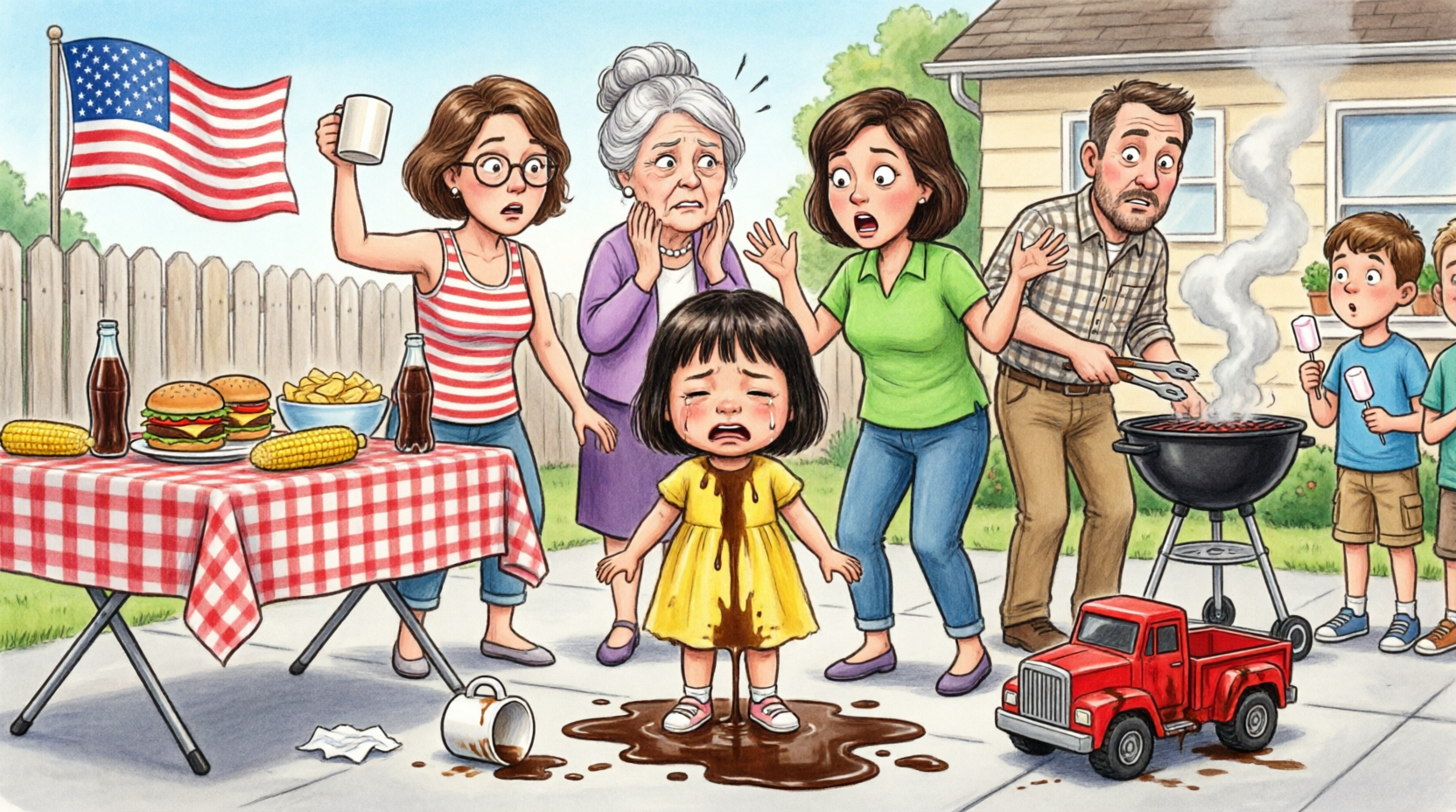
Vanessa sat in a patio chair beside a small side table, her sunglasses pushed onto her head, one manicured hand wrapped around a coffee mug.
Their son Caleb was four, all knees and elbows, racing between a soccer ball and a red toy truck he had been driving along the edge of the patio.
Vanessa saw me first.
Her smile came on fast and stopped at her eyes.
She called Lily a little princess.
It should have sounded sweet.
It didn’t.
I had learned the difference between a compliment and a test.
If Diane said Lily was polite, Vanessa would mention Caleb already knew how to say please and thank you in full sentences.
If Robert laughed because Lily danced to music in the kitchen, Vanessa would remind everyone Caleb had started soccer and had real coordination.
If Ethan’s parents bought Lily a small toy, Vanessa would explain that Caleb had outgrown that kind of thing months ago.
It was never about the children themselves.
It was about winning an invisible contest no one else had agreed to play.
I set the pasta salad on the table and kissed Diane on the cheek.
She smelled like hairspray and iced tea.
She asked where Ethan was, already glancing over my shoulder as though I had misplaced him.
I told her work had called him in, and he would come by later.
Robert gave a loud snort from the grill.
He said Ethan was always working, though Ethan had learned that from him.
I didn’t answer.
Some days, peace is just the decision not to pick up every stone someone throws at your feet.
Lily had already spotted the bubbles.
Caleb was blowing them near the lawn, and every time one floated low enough for Lily to clap at, her whole face opened with joy.
For twenty minutes, it almost felt normal.
The grill hissed.
The patio chair legs scraped softly.
Diane complained that the corn was taking too long.
Mark laughed at something on his phone.
I passed Lily a juice box and wiped a streak of dirt off her knee with a baby wipe.
I let myself believe we could get through it.
Then Caleb dropped his red toy truck near the patio steps and ran after the soccer ball.
It landed on its side, one black wheel still spinning.
Lily saw it the way toddlers see things, with full attention and no calculation.
She toddled over, bent her knees, picked it up with both hands, and turned the wheel with her thumb.
She didn’t snatch it from Caleb.
She didn’t hide it.
She didn’t even take a step away.
She just looked at it in the sunshine, serious and gentle, as if she had been trusted with something important.
I saw her and started toward her at once.
I told her it was okay, that Mommy was coming.
That should have been the end of it.
I would have handed the truck back, Lily would have cried for twelve seconds, and everyone would have moved on to corn and paper plates.
But Vanessa’s chair shot backward across the concrete.
The sound cut through the whole yard.
She snapped at me to tell my kid to stop touching her son’s things.
Lily looked up, startled by the sharpness.
I told Vanessa I had it, that Lily was two, that she had only picked it up.
Vanessa’s face changed.
It is hard to explain that kind of change unless you have seen an adult stop seeing a child as a child and start seeing them as an insult.
Her mouth tightened.
Her eyes hardened.
Her fingers closed around the handle of the ceramic mug sitting beside her chair.
Diane had poured that coffee only minutes earlier.
I remembered because she had warned Robert not to knock it over.
I saw the liquid move inside the cup.
I saw Vanessa’s shoulder lift.
I saw the decision happen before my brain had time to believe it.
Then she threw it.
The coffee flew in a dark arc across the patio and hit Lily across the cheek, chin, neck, and the front of her dress.
The red truck dropped from Lily’s hands.
The mug hit the concrete with a crack.
For a fraction of a second, the whole backyard froze around her scream.
Then my daughter’s pain tore through everything.
It was not a normal cry.
It was not embarrassment or fear or a tantrum.
It was the sound of a two-year-old body trying to hold agony too large for it.
I ran so fast I don’t remember crossing the patio.
My knees hit the concrete when I dropped beside her, and pain shot up my legs, but I barely felt it.
I pulled Lily into my arms and tried to wipe the coffee off with my hands.
Then with my shirt.
Then with the cleanest corner of a napkin I could reach.
Her skin was already angry and red beneath the liquid, and her small fingers kept clawing toward her own face.
I begged her not to touch, telling her Mommy had her.
She screamed into my chest, jerking and gasping, her curls damp against my arm.
That was when Diane started screaming too.
Not at Vanessa.
At me.
She yelled for me to get Lily out.
I looked up at her, sure I had misunderstood.
She was waving both hands toward the side gate, her face twisted in panic, not because Lily was hurt, but because Lily was loud.
Robert stepped away from the grill.
For one tiny second, I thought he was coming to help.
Instead he pointed at the gate and barked, “Get that child out of our house right now!”
That child.
Not Lily.
Not his granddaughter.
Not a baby with coffee burning her skin.
That child.
Mark had gone pale beside the table, his mouth open and useless.
Caleb stood near the lawn, confused and scared.
Vanessa was still breathing hard, still glaring, as though the problem was not what she had done, but the fact that everyone could now see it.
No one called 911.
No one ran for cool water.
No one handed me a towel.
No one asked if the coffee had gone into Lily’s eyes.
I had spent years trying to understand Ethan’s family, trying to explain away their coldness as stress or pride or old habits, but sometimes the truth of people arrives all at once and leaves no room for excuses.
I grabbed the diaper bag with one hand and held Lily against me with the other.
I ran.
Ethan’s name flashed on my phone as I reached the car.
I couldn’t answer.
My hands were shaking so badly I had trouble fastening Lily’s car seat straps, and I kept saying her name over and over like repetition could undo what had happened.
Her screams were breaking into gasps by the time I pulled away from the curb.
Every red light felt criminal.
Every car in front of me felt like a wall.
I drove to County Memorial with one hand on the wheel and the other stretched behind me whenever I stopped, touching Lily’s foot, her knee, the edge of her dress, anything I could reach.
The dashboard clock said 3:42 when I pulled under the emergency entrance.
I carried her through the sliding doors with the diaper bag half-open and my shirt wet from coffee, tears, and whatever I had tried to wipe away from her skin.
The woman at the intake desk looked up and stood immediately.
A triage nurse came around the counter, saw Lily’s face and neck, and took us back without asking me to sit.
After that, the world narrowed.
Fluorescent lights.
A rolling cart.
Cool compresses.
A tiny hospital bracelet around Lily’s wrist.
A consent form I signed with a hand that did not look like mine.
A nurse asking the time of injury.
Another nurse asking what liquid it was.
A doctor asking whether it had been spilled or thrown.
I heard myself answer.
Thrown.
The word sounded unreal in the room.
A pediatric burn specialist examined Lily while I stood close enough for her to grip my finger.
He said there were first-degree burns in some areas and partial-thickness burns in others, especially along one cheek and under her chin.
He explained that hot liquid can cling to skin, that small children burn faster than adults, and that they would manage her pain while watching for blistering and swelling.
His voice stayed controlled.
His face did not.
Then he said something I will never forget.
The injury pattern was consistent with hot liquid striking her at close range.
At close range.
I felt those words move through me like a door locking.
Not an accident.
Not a spill.
Not a clumsy hand at a crowded table.
A strike.
I thought of Vanessa’s fingers on the mug.
I thought of Diane waving toward the gate.
I thought of Robert saying that child.
Something inside me went very quiet.
A hospital social worker came in a little later, wearing a soft cardigan and a badge clipped near her shoulder.
She pulled a chair beside mine and introduced herself in the careful voice people use when they already know the answer may be awful.
Lily was lying against the pillow with gauze under her chin and medication making her heavy-eyed.
Every few minutes, she whimpered without fully waking.
The social worker asked what happened.
I told her.
I told her about the toy truck and Vanessa’s chair scraping across the concrete.
I told her about the mug.
I told her about the coffee hitting Lily’s face.
I told her that Diane screamed at me to get Lily out of the house.
I told her Robert pointed at the gate.
I told her Mark did nothing.
The social worker wrote steadily on her clipboard.
She did not make a shocked face.
She did not interrupt.
She did not ask me whether I was sure.
That, somehow, made me feel believed in a way my own family by marriage never had.
When I finished, the room felt too quiet.
The nurse at the computer kept typing, but slower now.
A cart rolled past in the hallway.
Somewhere behind a curtain, another child cried and then stopped.
The social worker looked at Lily, then back at me.
Her voice dropped.
She asked if I wanted them to contact law enforcement from there.
For a moment, I could not speak.
The word law made the whole thing feel larger than the backyard, larger than Ethan’s parents, larger than all the little insults I had swallowed.
I looked at the plastic belongings bag near the chair.
Inside it was Lily’s yellow dress, damp and stained.
Beside it were her sandals, one strap twisted sideways.
On the counter were pages waiting for signatures and instructions.
My phone lit up again.
Ethan.
I had ignored the earlier calls because there had been no room in me for anything except keeping Lily breathing, checked, treated, held.
This time, I answered.
His voice sounded strained, but there was something else in it too.
Confusion.
His parents had called him first.
They said Lily got upset and I took off.
For one second, I stopped feeling the hospital floor beneath my shoes.
In that silence, I understood that Diane had already started cleaning the story before the coffee had even dried on the patio.
I told Ethan to come to County Memorial.
I did not explain over the phone.
I did not fight.
I did not scream.
I only told him to come see his daughter.
He arrived later, still in his work shirt, hair damp at the temples, face pale from the rush.
He stepped into the room ready to ask questions.
Then he saw Lily.
He saw the gauze.
He saw the chart.
He saw the tiny hospital bracelet on her wrist and the way she flinched when the nurse adjusted the blanket.
His hand went to the wall.
For a moment, he looked like a man whose whole childhood had just walked into the room and confessed.
Then he sat down hard in the plastic chair beside the bed and covered his mouth with both hands.
I did not comfort him right away.
That may sound cruel, but my arms were full of our daughter, and for the first time that day, I needed him to feel the truth without me softening it.
The social worker asked if we wanted a report started.
Ethan looked at me.
I looked at Lily.
Then I called my father.
My father was not a dramatic man.
He did not raise his voice for effect.
He had spent his whole life fixing things quietly, the way some men fix loose hinges, leaking faucets, and scared daughters who call from hospital hallways.
He answered on the second ring.
I told him everything.
I did not say Vanessa lost her temper.
I did not say coffee spilled.
I did not say there was a misunderstanding.
I said she threw it.
I said Lily was burned.
I said Ethan’s family tried to make me leave before anyone helped her.
My father listened until I ran out of breath.
Then he asked if Lily was safe, if I was still at the hospital, and if there was a social worker there.
I answered yes to all three.
Then he told me to tell the truth once, clearly, and let every person with a badge, chart, form, or report write it down exactly as it happened.
My throat closed.
Behind me, Ethan made a sound I had never heard from him before, not a sob exactly, but something breaking loose after being held in place for too long.
My father’s voice stayed low.
He told me not to go back to that house that night, not to answer their calls alone, and not to let anyone turn it into family drama.
A grown woman had thrown hot coffee at a two-year-old, and grown people had tried to remove the evidence instead of helping the child.
I looked at Lily’s small hand curled against the blanket.
I looked at the dress in the plastic bag.
I looked at the social worker’s pen hovering over the page.
For years, I had worried that standing up to Ethan’s family would make me the problem.
That day, I understood the problem had been protected by everyone else’s silence.
The social worker slid a form closer.
Ethan reached for my hand with trembling fingers.
My father waited on the phone.
And in that bright hospital room, with Lily breathing softly beside me and the truth finally sitting where everyone could see it, I whispered the words I had been too polite, too tired, and too afraid to say before.
“Tomorrow,” I told my father, “we end them.”
There was silence on the line.
Then he said, “No, sweetheart. We start tonight.”
And that was the moment I realized Ethan’s family had no idea what was already moving toward them.
PART TWO: THE ARCHITECTURE OF RECKONING
At 9:15 a.m., Lily fell asleep against my chest. Her breathing was deep. Her face was calm. The gauze rested lightly against her skin. The burns would heal. The scars might fade. But the lesson would remain. And lessons, once learned, cannot be unlearned.
I didn’t dream of the patio. I didn’t dream of the coffee. I didn’t dream of the gate or the laughter or the silence. I dreamed of a ledger finally balancing. And for the first time in years, I let myself believe that truth was not a negotiation. It was a fact. And facts, once documented, cannot be unmade……………………………………..