My parents turned Thanksgiving into a public attack because I refused to cover my sister Natalie’s $5,000 luxury rent.
My father grabbed me by the throat, kicked my eight-year-old son when he tried to save me, my mother slapped my daughter, and the relatives who always talked about family sat around the table like cruelty was just another side dish.
I used to think the worst thing a family could do was abandon you.
That night taught me there is something worse.
They can stay in the room and watch.
What I remember most is not the turkey.
It is not the candles my mother lined down the center of the table or the white cloth she ironed until it looked like a hotel table instead of a family dining room.
It is the sound my son made when he hit the floor.
Tyler was eight years old.
He had worn a navy sweater because he wanted to look grown-up for Thanksgiving dinner.
Megan, my ten-year-old, helped him comb his hair in our bathroom before we left, both of them giggling while he turned his face side to side in the mirror and asked if he looked like a man.
I told him he looked handsome.
I told myself the same lie I had told myself for years.
One dinner could not hurt us if I stayed quiet enough.
Two hours later, my little boy was curled on my parents’ hardwood floor beside the dining table, one arm wrapped tight around his ribs, trying not to cry because my father had kicked him and told him to stay down.
All because I said no.
Natalie’s rent was $5,000 a month.
Five thousand dollars for a shiny downtown apartment with floor-to-ceiling windows, a gym she never used, and a lobby where somebody else opened the door for her.
She could not afford it.
She would not leave it.
And somehow, in my family, that meant I was supposed to rescue her.
Natalie was thirty-four, employed, childless, and allergic to consequences.
If she quit a job, she was overwhelmed.
If she missed a payment, she was stressed.
If she needed money, my parents called it family.
But when I worked full-time, raised two kids alone, paid a mortgage, covered school fees, grocery bills, car repairs, co-pays, and every surprise expense life threw at me, my mother called it being dramatic.
That was our family math.
Natalie’s problems were emergencies.
Mine were excuses.
Thanksgiving began the way their gatherings always began, with everyone pretending the house was warmer than it really was.
The dining room looked almost beautiful under the chandelier.
The air smelled like butter, cinnamon, beer, and the kind of perfume my mother only wore when she expected people to admire her.
Forks clicked against china.
The heat hummed through the vents.
Outside, November pressed itself cold against the windows.
My mother, Elaine, moved around the room correcting things no one else noticed.
She straightened napkins.
She turned a serving spoon a quarter inch.
She told Megan not to lean on the table, then smiled at Natalie as if my daughter had embarrassed her by breathing too loudly.
My father, Richard, sat at the head of the table with a beer in his hand, the way he always did when he wanted the room to remember who owned the house.
Uncle Warren was loud before the blessing.
Aunt Linda complained about her knee.
Cousin Michael kept checking his phone under the table.
Uncle James and Aunt Susan smiled polite, empty smiles because smiling was easier than taking a side.
Natalie arrived late in a cream dress and glossy heels.
She brought no dish, no flowers, and no apology.
She hugged my mother like she had survived a disaster and sighed loud enough for everyone to hear.
“I almost didn’t make it,” she said.
My mother touched her arm like Natalie had walked through fire instead of traffic.
“Oh, sweetheart.”
Tyler leaned into my side.
“Is Aunt Natalie sick?” he whispered.
“No,” I whispered back.
“Just tired.”
For the first hour, dinner stayed inside the lines.
Plates passed from hand to hand.
Megan complimented my mother’s pie crust, and my mother did not hear her.
Tyler tried to tell my father about his science project, but Richard cut him off to ask Natalie about her apartment building.
I watched my son’s face close a little.
I watched Megan notice.
That was the thing about being a single mother in a room full of people who thought you asked for too much.
You learned to notice the tiny wounds before anyone else admitted they existed.
Then my mother cleared her throat.
It was a small sound, but my body knew it before my mind did.
That sound had followed me since childhood.
It meant the soft part of the night was over.
Someone was about to be corrected, judged, or humiliated in front of witnesses.
Usually, that someone was me.
“We need to discuss Natalie’s financial situation,” she announced.
The room went quiet in the practiced way my family went quiet when they knew a performance was beginning.
Natalie looked down at her plate.
Her face had already arranged itself into injury.
My father set his beer down with slow control.
“Your sister needs help with rent,” he said, staring at me.
“Five thousand a month. You’re going to cover it.”
For one second, I honestly thought I had misheard him.
“I’m sorry?”
“Don’t make me repeat myself.”
My mother leaned forward.
“Natalie cannot be expected to move right now. She is under tremendous stress.”
“She lives in a luxury apartment downtown,” I said.
“If she can’t afford it, she needs to move.”
Natalie’s eyes filled instantly.
“See? I told you she would say that. She doesn’t care if I end up homeless.”
“Homeless?”
I stared at her, waiting for somebody else to say the obvious thing.
Nobody did.
“Natalie, you could rent somewhere affordable tomorrow. You just don’t want to.”
My mother’s mouth hardened.
“You have a house.”
“I have a mortgage.”
“You have stability.”
“I worked for it.”
Natalie looked at me like those words had insulted her.
“You have children,” she said.
“People feel sorry for single moms. Everyone helps you.”
I almost laughed.
Not because it was funny, but because the room had tilted so far from reality that laughter felt like the only way not to scream.
No one helped me when Tyler was sick.
No one came when Megan had a fever.
No one sat with them when their father decided parenting was something he could drop when it got inconvenient.
No one offered to cover my mortgage, my electric bill, the school supplies, the prescriptions, the tires, the broken dishwasher, or the little emergencies that become mountains when you are the only adult standing under them.
I pressed my fingers flat against my napkin.
My children were watching.
I could feel Megan’s eyes on my face.
I could feel Tyler sitting very still beside me, trying to understand why grown-ups were talking about money like it mattered more than people.
Some families do not measure sacrifice.
They only measure usefulness.
The moment you stop being useful, they call it betrayal.
“I am not paying your rent,” I said.
My mother’s eyes narrowed.
“You will not embarrass this family by letting your sister struggle.”
“Mom, her rent is more than my mortgage.”
“Then budget better.”
“I have two children.”
“And Natalie is my child,” she snapped.
There it was.
The sentence underneath every birthday, every holiday, every phone call, every time I had been told to be the bigger person because Natalie was sensitive and I was strong.
Natalie was her child.
I was her resource.
I looked at my sister.
“Move somewhere you can afford.”
Natalie’s face changed.
The helplessness slipped off so quickly it was almost frightening.
Under it was something older and uglier, something that had been sitting there for years.
“You always thought you were better than me,” she said.
“Good grades, scholarships, your little house, your perfect responsible act. You act like you earned everything.”
“I did earn it.”
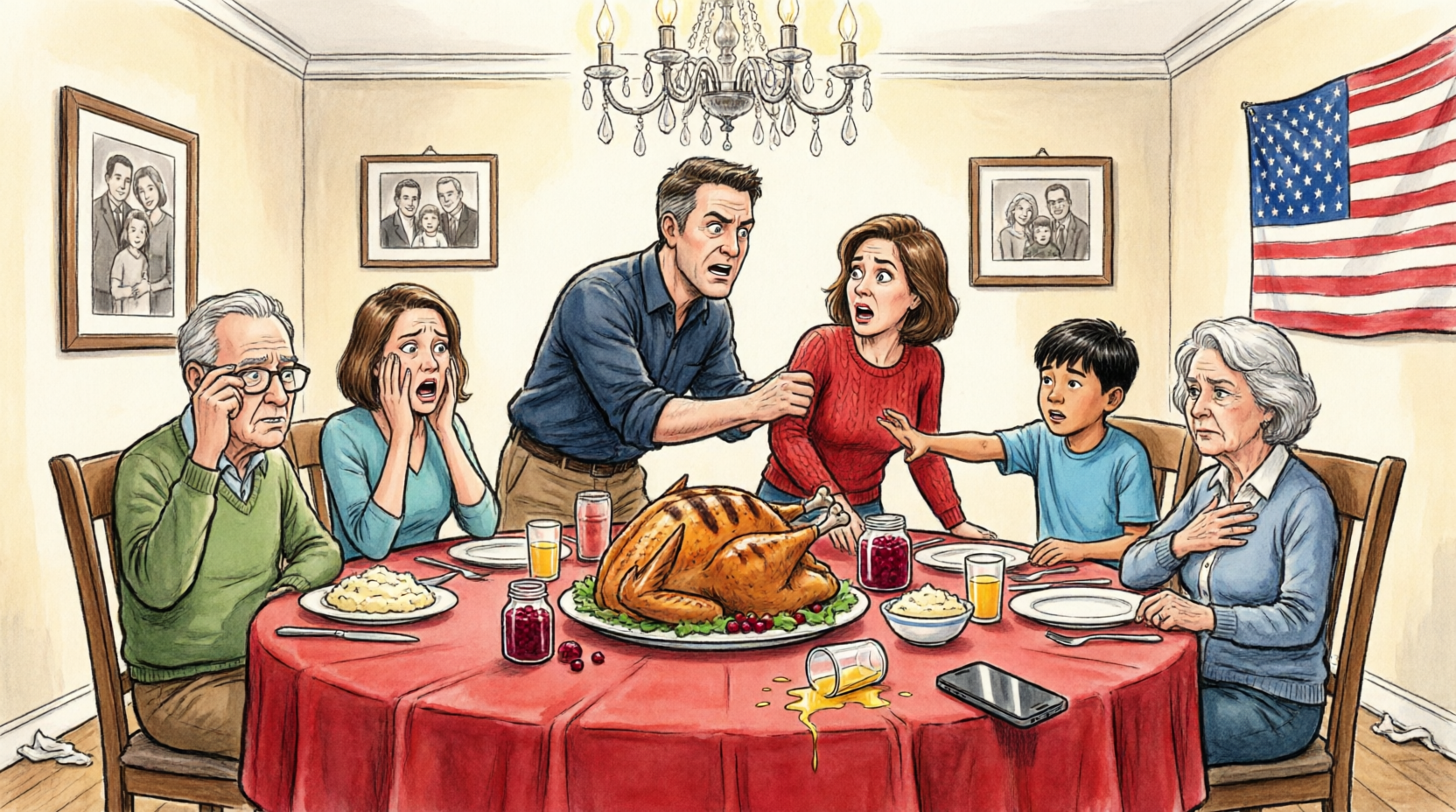
My father’s fist slammed the table.
The glasses jumped.
Forks froze halfway to mouths.
Candle flames trembled.
Cranberry sauce slid off a serving spoon and stained the white cloth.
Aunt Linda stared into her lap.
Cousin Michael lowered his phone just enough to watch.
Uncle James and Aunt Susan sat stiff and silent.
Nobody moved.
Richard stood slowly, his chair scraping the hardwood behind him.
“Your mother asked you to help your sister.”
“No,” I said, though my voice had gone quiet.
“She demanded I pay for Natalie’s choices.”
He moved before I understood he meant to touch me.
One second I was seated at the Thanksgiving table.
The next, his hand was around my throat.
My shoulder hit the wall first.
The back of my head struck the framed family photos behind me.
Air vanished.
The chandelier blurred into gold streaks above the table.
My fingers clawed at his wrist, trying to make space, trying to breathe, trying to understand how my own father could look at me with that much disgust.
He leaned close enough that I could smell beer on his breath.
“Useless daughter,” he hissed.
“After everything we did for you, this is how you repay us?”
I heard Megan scream.
I heard my mother say, “Maybe now she’ll listen.”
I heard Natalie laugh softly.
Not a shocked laugh.
Not a nervous laugh.
A satisfied one.
Like this was not violence.
Like this was proof.
Then Tyler’s chair scraped back.
“Let her go!” he shouted.
“You’re hurting my mom!”
My little boy rushed at my father with both hands out.
He was brave in the terrible way children are brave before they understand adults.
Richard let go of me.
I dropped to the floor, choking.
Then he turned and kicked Tyler in the ribs.
Tyler folded instantly.
The sound he made when he hit the floor did something permanent to my heart.
Megan ran toward him, sobbing, but my mother grabbed her arm and slapped her across the face.
The crack echoed off the dining room walls.
Megan’s head snapped sideways.
Her glass tipped over, and cranberry juice spread across the white tablecloth like a warning nobody wanted to read.
Uncle Warren threw beer over me while I crawled toward Tyler.
It soaked into my hair and blouse, cold and humiliating.
Ice cubes bounced across the hardwood.
“Pay up or get out,” he barked.
That was when I looked around the table and saw my family clearly.
Aunt Linda kept her eyes on her lap.
Cousin Michael looked back down at his phone.
Uncle James and Aunt Susan looked uncomfortable, but they did not stand.
Nobody asked if Tyler could breathe.
Nobody told my mother to take her hands off Megan.
Nobody looked at my father and called him what he was.
Natalie sat there smiling.
“Finally,” she said.
“Someone is making you understand.”
I do not remember deciding to leave.
I remember gathering my children.
Tyler could barely stand, so I supported him with one arm and pulled Megan close with the other.
My throat burned.
My lip had split.
My legs shook all the way to the front door.
Behind us, they shouted the names they had saved for me my whole life.
Selfish.
Ungrateful.
Bad mother.
Bad daughter.
The cold November air hit my face when we stepped outside.
The neighborhood looked normal in a way that felt cruel.
Porch lights glowed.
Cars lined the curb.
Somewhere nearby, another family was probably laughing over pie.
I helped Tyler into the back seat first.
Megan climbed in beside him, pressing a frozen bag of peas against her cheek.
I sat behind the wheel with my hands shaking so badly I could barely turn the key.
The drive home took forty minutes.
My throat hurt every time I swallowed.
In the rearview mirror, Tyler sat hunched over, silent tears sliding down his cheeks.
Megan stared out the window, one side of her face swelling beneath the frozen peas.
At home, our little colonial sat under the evening sky like the only honest place left in the world.
It needed gutters.
The front step had a crack.
The kitchen cabinets were old.
But that night, it felt safer than any house I had ever known.
I cleaned Megan’s face in the bathroom.
She sobbed so hard her shoulders shook.
“I didn’t do anything,” she said.
“I just wanted to help Tyler.”
“I know,” I told her, holding her against me.
“You did nothing wrong.”
Then I checked Tyler.
He said he was fine.
He was not fine.
When he finally lifted his shirt, the bruise across his ribs was already darkening.
I made a sound I tried to swallow, but he saw my face and looked terrified.
“Am I in trouble?” he asked.
“No, baby.”
I touched his hair because I did not know where else to put all the love and horror inside me.
“Never.”
“We can’t tell,” he whispered.
“Grandpa will get mad.”
That sentence broke something open in me.
Not because I did not already know my father was dangerous.
Because my son did.
I drove him to the emergency room anyway.
The ER clock said 8:47 p.m. when we walked in.
Under those bright hospital lights, with a nurse at the intake desk asking questions and a clipboard in my hand, I did the thing I am most ashamed of.
I lied.
I said Tyler fell.
I said Megan bumped her face.
I said I had choked on food.
The doctor did not believe me.
Her eyes stayed too steady.
She looked at Tyler’s ribs, Megan’s cheek, my throat, and the way neither child would speak unless I looked at them first.
But Tyler’s ribs were bruised, not broken.
After X-rays, ice packs, discharge instructions, and a white hospital envelope, we went home.
That night, I did not sleep.
My hair still smelled like beer.
My throat pulsed.
My lip stung.
I listened to Tyler and Megan crying quietly in separate rooms because each one was trying not to scare the other.
By morning, I understood something I had avoided for years.
My parents had not lost control.
They had shown it.
At 9:18 a.m., I opened the white ER envelope on my kitchen table.
The discharge papers slid out clean and flat under the morning light.
There were printed instructions, a hospital intake sheet, and the blank line I had left empty the night before.
I stared at it until the words blurred.
How did the injury occur?
My hand went cold around the pen.
For years, my family had trained me to swallow the truth before it made anyone uncomfortable.
For years, I had called it peace.
But peace that requires your children to bleed quietly is not peace.
It is surrender.
Megan came into the kitchen first, barefoot, hair tangled, the side of her face still swollen.
She stopped when she saw the papers.
Tyler stood behind her in his pajama pants, one hand pressed carefully against his ribs.
Neither of them asked what I was doing.
They just watched me.
And for the first time in my life, I understood that my answer would teach them what kind of love they were allowed to expect.
My phone buzzed on the table before I could write.
One message from my mother.
Then another from Natalie.
Then a third from an unknown number that I recognized only because Uncle Warren had once called me from it when he needed a ride after drinking too much at a barbecue.
I did not open them right away.
I looked at the blank line again.
I looked at my children.
Then I picked up the pen.
PART TWO: THE ARCHITECTURE OF THE AFTERMATH
I stood on the porch as the sun dipped below the tree line. The air was warm. The street was quiet. Somewhere down the block, a dog barked. A neighbor watered their lawn. The world kept moving, entirely indifferent to the quiet revolution that had taken place inside my chest. I did not need it to care. I only needed to keep breathing.
And for the first time in thirty-four years, I finally knew how…………………………..

