The House Remembers
The morning they read my grandmother’s will, I walked out with a house already coming apart at the seams, and my father’s voice still ringing in my skull like a verdict.
“She gave you what you could handle,” Richard Harrow said, as if my grandmother’s love had always been a measurement rather than a choice.
Everyone else walked out with things that looked like winning. I walked out with a key that felt heavier than metal should.
My name is Elise Harrow. I am twenty-eight years old. I work at a housing nonprofit in Fairfield County, Connecticut, helping families navigate systems that weren’t built to help them. My family has always treated this as a charming hobby rather than a career. I’ve been sitting at the far end of their dinner table since I was old enough to clear plates without being asked.
Every Sunday at six, the Harrows gathered in a colonial house with white columns and black shutters, a lawn trimmed so precisely it looked artificial. From the street, it was a family portrait. From the inside, it was a courtroom where the verdict had been drafted long before you walked in.
My father sat at the head of the table because he believed heads of tables belonged to men like him. My mother Vivian sat at his right, smile curated, eyes always scanning for the angle that made the moment look best. My sister Celeste sat to his left wearing her accomplishments like armor. And then there was me, tucked at the far end like an afterthought, close enough to the sink to be useful and far enough from the conversation to be ignored.
My grandmother Margaret was different.
She remembered my favorite cake. She called every week and asked about my cases, the families I’d helped, the ones I couldn’t. She listened the way people rarely listen, without waiting for her turn to redirect the conversation. Three months before she died, we sat on the porch of her old house in Ridgefield, the one she grew up in, the one nobody visited anymore because it was too inconvenient and not glamorous enough for family photos.
“There are things I’ve hidden in this house, Elise,” she said softly.
I laughed, thinking she meant keepsakes. Old letters. Recipes.
“When the time comes,” she added, “you’ll understand.”
I thought she meant memories.
The call came at 2:07 a.m. on a Tuesday. A nurse’s careful voice: Ms. Harrow, I’m calling about your grandmother, Margaret Harrow. She passed in her sleep approximately one hour ago. I’m very sorry.
I don’t remember hanging up. I remember my shoes. I put them on the wrong feet and didn’t notice until I was already on the highway, hands tight on the wheel, driving as if speed could outrun the words before they became real.
At the hospital, I found my family in the hallway near the vending machines. Richard was nodding like he was in a business meeting. Vivian adjusted her scarf with the focused attention of a woman who understood that how she looked in a difficult moment was part of the moment. Celeste leaned against the wall scrolling her phone, face dry, posture bored. Beside them stood a man in a gray suit I did not recognize, holding a leather folder.
No one noticed me at first. Or perhaps they did and chose not to.
I walked past them and into Margaret’s room alone.
She lay still, hands folded, the monitor dark. The room had a quality of held breath, as if she had just finished a sentence and the air was waiting for someone to answer.
On her wrist she still wore her silver bracelet, thin and tarnished, the one she had worn every day for forty years. My mother had always dismissed it as costume jewelry.
I closed my hand around it gently and held on.
When I stepped back into the hallway, Richard was buttoning his coat. No hand on my shoulder. No are you okay. “We need to discuss the estate,” he said. “Soon.”
The man in the gray suit avoided my eyes. I would learn later his name was Gordon Blake. I would learn later that my grandmother had never hired him. I would learn later how unusual it was for a lawyer to materialize at a hospital at three in the morning before the family had even been properly notified. But that night I didn’t know any of that. That night I only knew the bracelet in my coat pocket, warm from her skin or from my palm, and the specific quality of grief that comes from being loved well by someone the rest of your world never recognized clearly enough.
Three weeks after the funeral, we were summoned to Gordon Blake’s office. My family didn’t invite; they commanded.
Blake read without looking up.
To Richard and Vivian Harrow: management of the family trust, approximately one point eight million dollars. To Celeste Harrow: the primary residence in Weston, Connecticut, and the associated investment portfolio. To Elise Harrow: the property at fourteen Birch Hollow Road, Ridgefield, Connecticut.
I waited for more. There was no more.
Fourteen Birch Hollow was Margaret’s childhood home, abandoned for over a decade. Roof leaking. Walls cracking. Electrical condemned. Everyone in that room knew exactly what kind of gift it was: a burden wrapped in legal language.
Richard turned to me, face wearing the careful blank of a man who rehearsed cruelty. “Your grandmother knew your limitations, Elise. She gave you what you could handle.”
Vivian folded her hands. “At least you have a roof,” she said. “Not everyone gets that.”
I stood, picked up my coat, and walked out.
In the parking garage, I sat for eleven minutes before I could turn the key. My hands shook. I pressed them flat against the steering wheel until they stopped.
Then I noticed something I hadn’t let myself notice in the conference room.
The address.
Fourteen Birch Hollow Road.
The same porch. The same walls Margaret had stared at when she said the house holds secrets.
I drove there directly.
The house looked like it had lost a fight with time. Victorian bones. A wraparound porch sagging on the left. Gutters hanging. Weeds tall enough to brush my thighs. I pushed the front door and it groaned open. Inside, the floors softened under my steps in places, the railing was missing half its spindles, a bird rustled somewhere in the ceiling.
It was, objectively, a disaster.
And yet, standing in that wreck, I felt my grandmother.
In the kitchen, behind a film of grime, a framed photograph leaned against the wall. A young woman holding a baby in front of this very house when it was clean and bright. I turned it over.
In ink bled with age: For my Elise. The house remembers.
I called Frank Delaney that afternoon. My coworker had sworn by him. He came, walked the house in silence, tested floors with his boot, ran a hand along walls. When he finished, he stood on the porch and exhaled.
“Sixty to seventy grand minimum,” he said. “You got that kind of money?”
I had twenty-three thousand in savings and a credit line I’d never touched.
“I’ll make it work,” I said.
His crew started Monday. On the second day, Frank called me over to the living room.
“This wall’s weird,” he said. He aimed a flashlight at exposed framing. “Double layered. Someone built a false wall here. On purpose.”
A false wall wasn’t a repair. It was a hiding place.
“Keep going,” I told him.
That evening, my father called.
“That house is a money pit,” Richard said. “I’ll buy it from you. Fifteen thousand cash. At least you’ll walk away with something.”
“No,” I said.
Silence. Then: “You’re making a mistake.”
I hung up.
Four months after the will reading, at 10:03 p.m. on a Thursday, Frank called.
His voice was low. Tight. Careful.
“Ma’am,” he said. “We found something inside the wall.”
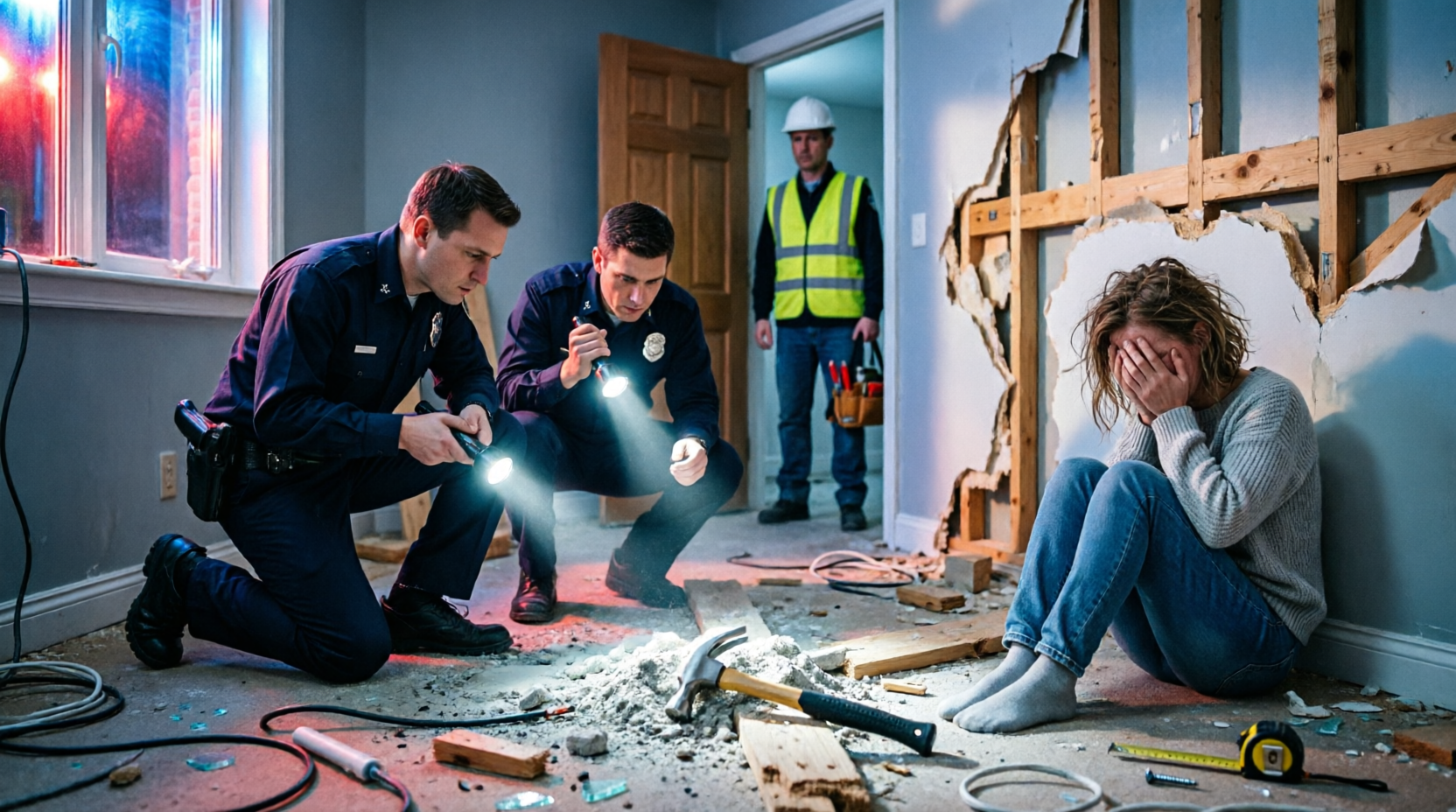
By the time I arrived, police lights were already spinning across the wet trees. Frank stood under the porch light, hat in both hands, face pale in a way I had never seen on a man who had spent decades wrestling rotten beams and stubborn foundations.
Inside, in the hollow between studs where the false wall had been, sat a steel box coated in decades of dust. On its lid, etched into the metal in deliberate strokes that cut through the grime with the precision of someone who wanted to be absolutely clear: E. H.
My initials.
My legs folded. I dropped to my knees in the sawdust and the plaster dust and pressed my fingers against the engraving. Two letters. My grandmother had put this here, behind a false wall inside a house she gave only to me, and she had marked it with my initials because she wanted me to find it and she wanted me to know immediately, before I opened it, that it was for me and only me.
“How long has it been here?” I whispered.
“Hard to say,” the officer said. “The false wall was built on purpose. Whoever did it knew what they were doing.”
The lock was a four-digit combination. I thought of all the numbers Margaret had ever made me memorize, her way of pressing the important things into my hands. She used to say: don’t rely on other people to remember the important things for you.
I entered my birthday.
March 19.
The lock clicked.
The box had three compartments, each lined with cloth. The kind of careful you give to things that matter.
The first held a thick envelope sealed with wax. Inside: a handwritten document, four pages, Margaret’s unmistakable script. At the top: Last Will and Testament of Margaret Anne Whitfield Harrow. Dated eighteen months before the will Gordon Blake read in his office. Two witness signatures. A notary stamp.
My vision blurred.
This wasn’t a copy. This was an original testament. A real will.
The second held a letter addressed to me. The first line: My dearest Elise, if you are reading this, then they did exactly what I feared they would do.
She wrote about Richard. About Vivian. About pressure and fear and two years of being stolen from, slowly, carefully, just enough at a time to be hard to see.
The third compartment held a smaller envelope stamped PRIVATE. The officer present gently advised that a lawyer should review it first. Evidentiary, he said.
I held up the real will. My hands were trembling but my voice came out steady.
“Her real will,” I said. “The one they tried to erase.”
The real will left everything to me: the trust, the Weston house, all assets. Celeste received the Ridgefield house and fifty thousand dollars. Richard and Vivian each received one dollar. And at the bottom, in Margaret’s hand: So they know I did not forget them. I simply did not forgive.
A week later, I retained Eleanor Voss, probate fraud specialist. She called after reading everything.
“Your grandmother didn’t just leave you a house, Elise,” she said. “She left you a case.”
The third envelope’s contents, processed by the FBI: bank statements spanning twenty-three months, annotated in Margaret’s handwriting, tracing three hundred forty thousand dollars transferred from her trust into a personal account under Richard Harrow’s name. Each transfer had an authorization form. Each form bore Margaret’s signature.
Except Margaret had written in the margins in pencil, small and steady: I did not sign this. This is not my handwriting.
She had requested duplicate statements mailed to a private PO box. She had tracked every fraudulent transfer herself. She had built the file from inside the house they were stealing from her.
When Eleanor filed the challenge in Fairfield Probate Court, the denial came back in forty-eight hours. No hearing. No forensic review.
“The judge didn’t schedule a hearing,” Eleanor told me from her car. “He issued a summary denial.”
“That doesn’t happen,” I whispered.
“No,” she agreed. “It doesn’t.”
Judge Kern and my father were members of the same country club. They had dinner together three times in the month before the ruling.
My grandmother had written it plainly: They did exactly what I feared they would do.
Eleanor filed to go federal. The FBI backed the transfer.
That was when a number I didn’t recognize flashed on my phone.
“Miss Harrow,” a man said, voice low and precise. “My name is Marcus Whitfield. I’m a retired special agent with the FBI. I’ve been asked to consult on your case.”
Whitfield. My grandmother’s maiden name.
We met at a café in Westport. He was already seated, silver hair neatly combed, brown tweed jacket over a pressed shirt. He didn’t start with documents.
He started with her.
“Tell me about your grandmother,” he said.
I wasn’t expecting that. I talked. I told him about lemon cake and Sunday calls and Margaret’s porch. He listened without interrupting. Once, just once, he looked away, and I saw something move behind his expression that wasn’t professional distance.
When I finished, he told me the FBI was opening a federal investigation. Subpoenas. Forensic analysis. Court outside Fairfield’s reach.
As we stood to leave, he reached out and took my hand, holding it a moment longer than a stranger would.
“You have her eyes,” he said softly.
I blinked. “People say I look like my mother.”
“No,” Marcus said. “You look like Margaret.”
Margaret’s oldest friend Dorothy Callahan called me the following week and asked me to come to her house.
Her living room smelled like bergamot and old paper. She sat in a wingback chair and told me about my grandmother’s life before Richard, before Harold, before the Harrow polish. There had been someone else: a young man named Marcus, whom the family had made her leave.
“What happened to him?” I asked.
“He disappeared,” Dorothy said. “Margaret married Harold the next year. Then one day, maybe fifteen years ago, she told me she’d found him. ‘He never stopped looking for me, Dorothy.’”
Dorothy reached behind her chair and pulled out a small wooden box. Margaret had given it to her a year before she died with instructions: give it to Elise, and only Elise.
Inside: a black-and-white photograph. A young woman and a young man, arms linked, in front of a building I didn’t recognize. On the back: M & M. 1974…………………………………