Part 1
You always knew your father’s sixtieth birthday would be a performance.
Not a celebration, not really. A performance. The kind of family event where people dressed up resentment, plated old power on expensive serving trays, and called it tradition because that sounded prettier than fear. The invitations had gone out six weeks earlier on thick cream cardstock with gold lettering, because your mother believed good paper could make ugly people look respectable.
The party was held at your parents’ house in Oak Ridge, an affluent suburb outside Columbus where the lawns were trimmed with military precision and every porch looked like it had been staged for a magazine spread. Your father loved that house because it announced things before he even opened his mouth. The wide brick entrance. The double staircase in the foyer. The stone patio out back where he grilled steaks in a starched apron and acted like feeding people was proof of character.
By six o’clock, the place was full.
Your mother floated between guests in a sapphire dress, smiling the way women smile when they’ve spent decades smoothing over damage they never had the courage to stop. Your older sister, Rebecca, stood near the kitchen island with a glass of white wine and that permanently superior expression she had somehow worn since age twelve. Your father, Thomas Wren, moved through the crowd like a local king, accepting handshakes, shoulder claps, and admiration with the easy entitlement of a man who mistook being feared for being respected.
You came because of Lily.
That was the truth you hated most. Not because your daughter wanted to celebrate him. At three years old, Lily barely understood birthdays beyond cake, balloons, and the possibility of brightly wrapped surprises. You came because she had asked, in that sweet, serious way only small children can ask, whether Grandpa would be happy to see her in the yellow dress with the tiny embroidered daisies. And because you had spent your whole adult life trying to believe distance, maturity, and boundaries had turned your father into a man who was harsh but manageable instead of what he had once been.
You wanted to be wrong about him.
Or maybe you wanted your daughter to have at least one grandparent memory that wasn’t poisoned before it formed.
Your husband, Ben, couldn’t make it. His flight from Denver had been delayed by storms, and he was supposed to land after nine and drive straight over if the party was still going. You told him not to rush. It was only dinner, you said. Just cake and family. Nothing dramatic.
You would remember those words later with the kind of bitterness that lives a long time.
At first, the evening moved the way these evenings always did. Too much laughter, too much bourbon, too much pretending. Your father told the same three stories about his career in commercial real estate, each one polished into legend over time until he sounded less like a man who bought office parks and more like a war hero who had liberated downtown Cleveland with a spreadsheet. Guests nodded on cue. Rebecca laughed a beat too hard. Your mother refilled glasses before anyone had to ask.
Lily stayed close to you at first.
She wore white sandals and carried a stuffed rabbit with one bent ear, though she kept setting it down and forgetting where. She was small for her age, with dark curls and wide, observant eyes that made strangers lower their voices without knowing why. She had Ben’s patience and your tendency to study a room before deciding whether it was safe.
She didn’t like your father.
Not openly. Not in a way anyone could accuse her of. But children have instincts adults often train themselves out of, and Lily always went a little quiet when Thomas was near. He thought it was shyness. You knew better. She felt the temperature drop when he entered a room, the same way you had once felt it as a child and spent years learning to read as warning.
By seven-thirty, the kitchen had become the gravitational center of the party.
People clustered around the marble island, opening bottles, rearranging platters, arguing lightly about football. There were tubs of ice by the back door, coolers filled with soda and beer, a cake box the size of a suitcase resting unopened on the far counter. Your father liked excess in visible forms. It impressed people who had never looked closely at what it cost others.
You were in the dining room with one of your mother’s church friends when Lily slipped away.
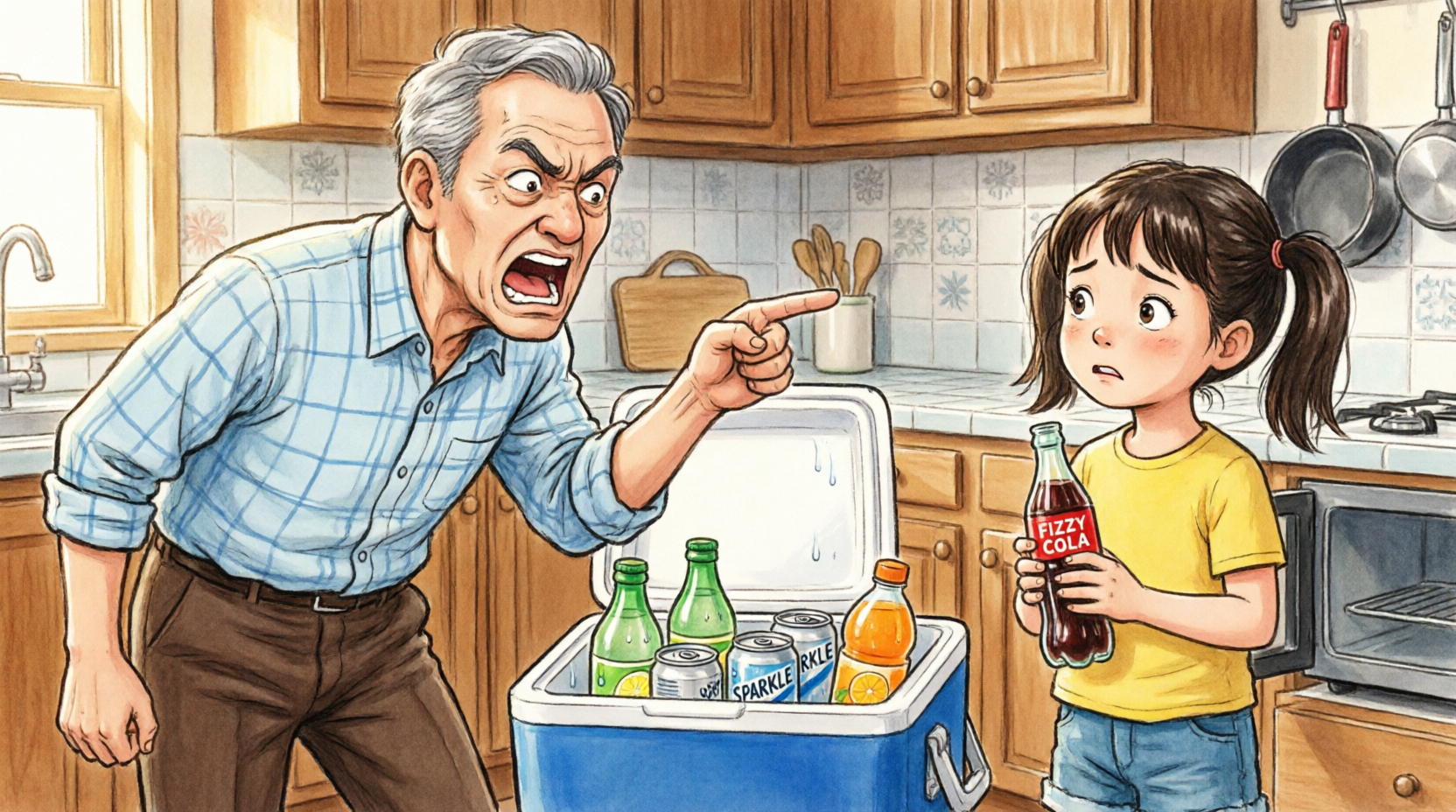
It was only for a minute. Maybe less. Long enough for her to pad into the kitchen on quiet little feet and spot the cooler near the mudroom door, the one stacked with canned sodas under a layer of crushed ice. She loved orange soda. You usually limited it to special occasions, which in toddler logic made it halfway between treasure and magic.
When you turned and didn’t see her, a small current of unease passed through you.
Then you heard your father’s voice.
“Hey!”
The word cracked through the kitchen like something thrown against glass.
Every muscle in your body locked.
You reached the doorway just in time to see Lily standing beside the cooler with a can in both hands, already flinching before she understood why. Your father had come in behind her from the patio, and his face had transformed with such speed it felt unreal, like watching a mask drop in reverse. Not irritation. Not even anger. Something uglier. Something possessive and humiliating and wildly out of proportion to the scene in front of him.
“That’s my soda,” he barked. “Did you ask permission?”
Lily looked up at him, startled. “I’m sorry, Grandpa. I didn’t know.”
Her voice wobbled on the last word.
That should have been the end of it. A correction. A redirect. Any normal adult would have bent down, taken the can, handed her a cup of juice, maybe teased her gently and moved on. But normal had never been your father’s language. Power was. Submission was. And children, in his world, were often just smaller stages.
His jaw tightened. “You don’t take things in my house without asking.”
You were already moving.
“Dad,” you said sharply. “She’s three.”
He ignored you.
Lily’s fingers loosened on the can. It slipped, hit the floor, and sprayed orange fizz across the tile. For one split second everything seemed to pause in a strange, suspended stillness. The hiss of carbonation. The overhead lights gleaming off the mess. Your daughter’s face crumpling not from pain yet, but from the terror of a child who senses she is suddenly in danger and has no idea why.
Then your father pulled off his belt.
It happened so fast it almost didn’t register as real.
You shouted. Rebecca gasped. Someone dropped a plate. But your father had already folded the leather over once in his fist, his face set with that terrible old certainty you knew from childhood, the certainty of a man who believed discipline was simply whatever he wanted it to be. The first strike was not the worst thing because of force. It was the worst thing because it made the rest possible.
Lily cried out and stumbled backward.
The second motion was chaos. You lunging. Your mother screaming his name. A guest swearing. Lily losing her balance on the slick tile and falling hard, the back of her head striking the floor with a sound you would hear in your sleep for years. Then silence. Not total silence. The kind that roars because everyone knows something irreversible may have just happened.
You dropped to your knees so fast they hit the tile painfully.
“Lily! Lily, baby, look at me.”
She didn’t answer.
Her little body twitched once, then went frighteningly still. The stuffed rabbit lay nearby under the island stool as if it had been thrown there in fear too. Your hands shook so badly you almost couldn’t get your phone unlocked. Then all your training kicked in, because unlike most people in that kitchen, you did not freeze well. You acted.
You were an assistant district attorney for Franklin County. Child abuse cases, domestic violence, family crimes. You had spent years standing in courtrooms translating horror into evidence, trauma into timelines, chaos into charges. You knew exactly how bad the next sixty seconds could become.
You hit 911.
Your father remained standing with the belt in his hand.
Even then, even with your daughter unconscious on the kitchen floor and strangers staring, he managed to look offended rather than horrified. As if the true violation was not what he had done, but that anyone might question his right to do it.
“She deserved it,” he said. “Disrespect starts small.”
The room tilted.
Rebecca crossed her arms. “Dad didn’t mean for her to fall. She should’ve listened.”
Your mother said nothing. She looked pale and stunned, but she did not go to Lily. She did not scream at your father. She did what she had always done when his violence crossed a line too obvious to deny. She retreated inward and called it helplessness.
Around the room, several guests were already holding up their phones.
Some were recording.
Some were whispering.
One man, one of your father’s golfing friends, had the decency to look sick. Another woman started crying. But nobody touched your father. Nobody took the belt away. In a room full of adults, it was suddenly terribly clear how many people mistake witnessing for innocence.
The 911 operator was talking, asking questions, and you answered with clipped precision while cradling Lily’s head carefully and checking her breathing. Yes, she was breathing. Yes, she had lost consciousness. Yes, an adult male had struck her with a belt. Yes, multiple witnesses were present. Yes, the assailant was still on scene.
You said the word clearly.
Assailant.
Your father’s eyes snapped to yours.
It was the first time all evening he looked uncertain.
The sirens came fast.
Maybe because the neighborhood was affluent. Maybe because “child unconscious after assault” moves differently through dispatch than other calls. Maybe because some corners of America still mobilize quickest when tragedy spills across polished countertops instead of cheap apartment linoleum. You didn’t have time to dwell on it. Paramedics rushed in with a gurney, followed seconds later by police officers who took one look at the scene and immediately separated the room into practical categories. Victim. Witnesses. Suspect.
Your father hated that word even before anyone said it aloud.
The paramedics assessed Lily, stabilized her neck, loaded her onto the stretcher, and moved with the brisk controlled urgency you had seen in so many body cam videos but never from this close, never while your own blood felt like ice water. You rode in the ambulance gripping the rail with one hand and Lily’s sock-clad ankle with the other because it was the only part of her you could touch without interfering. She still hadn’t opened her eyes.
At Riverside Methodist, everything became fluorescent and procedural.
ER nurses took over. A doctor asked you questions. Forms appeared. A CT scan was ordered. You answered on instinct, though part of your brain had split off and was hovering above the entire night, observing it the way prosecutors observe crime scenes before the first report is even filed. Mechanism of injury. Approximate time. Statements uttered spontaneously by the suspect. Witness count. Potential video evidence. Child’s age. Prior history.
There was prior history.
Not with Lily. Never with Lily. You had kept distance for reasons even Ben didn’t fully understand until that night. But with you? With Rebecca? With other children in the orbit of your father’s authority? Yes. God, yes.
When the ER physician finally emerged and told you Lily had a concussion, extensive bruising, and would need overnight observation but showed no sign of brain bleeding, your knees nearly gave out from relief. You cried then. Not elegantly. Not briefly. You cried with your face in your hands in the corner of a pediatric observation room while machines beeped steadily and your daughter slept under hospital blankets that made her look even smaller.
Ben arrived at 11:14 p.m.
He came in carrying his suitcase because he’d driven straight from the airport and abandoned the rental in a loading zone. The minute he saw Lily, all the color drained from his face. When you told him what happened, his body went so still that for a moment it frightened you more than shouting would have.
“He did what?”
“With a belt,” you said. “In front of everyone.”
Ben stared at your sleeping daughter, then at the bruising visible near the edge of the blanket, and a kind of fury settled over him so cold it seemed to lower the temperature in the room. He kissed Lily’s forehead, then looked at you and said, very quietly, “Tell me the police arrested him.”
You shook your head once.
“They detained him. Then released pending statements. They said they had enough for probable cause but wanted the hospital report and witness interviews first.”
Ben laughed once, disbelieving and ugly. “Of course.”
The next morning, two detectives came to take your formal statement.
Because of your profession, the conversation was awkward at first. No one likes investigating the colleague of a colleague’s family, and everyone knows it. But once the recorder was on, titles became irrelevant. You described the sequence of events. You repeated your father’s exact words. You identified witnesses. You informed them, carefully, that multiple guests had recorded at least part of the incident, and that immediate steps should be taken to preserve those videos before people started deleting or “losing” them.
One detective nodded. “We’re working on that now.”
You looked him straight in the eye. “Work faster.”
By noon, Child Protective Services had also made contact, standard procedure whenever severe injury to a minor occurs within family context. That conversation might have offended some parents. It didn’t offend you. It reassured you. Systems, when they function, are supposed to touch everything around a child’s harm. You answered their questions too. You gave them names. Dates. Background.
That was when the second story began.
Because Lily was not your father’s first victim.
You hadn’t spoken that truth aloud in years, not in full. Ben knew pieces. Therapists knew more. But institutions require chronology, specifics, corroboration. And as you sat in the hospital family room with a legal pad on your lap, you began writing what you hadn’t written since law school: your own history.
The paddle when you were seven.
The belt when you were nine.
The bloody lip Rebecca got at eleven and still blamed on “running into a cabinet” because your mother made her.
The way your father would call it correction, training, respect.
The way everyone in church praised him for “raising disciplined girls.”
The way your mother learned to clean up evidence with ice packs and long sleeves.
The way you left for college and never fully came back.
You wrote it all.
Not because your old pain was the case. It wasn’t. Lily was the case. But patterns matter. Family mythology crumbles fastest when dates are attached.
By Monday, the videos started surfacing.
One guest, a woman named Marlene who had been married to one of your father’s business associates for twenty years and looked like she had spent nineteen of them regretting it, sent her recording directly to detectives and then called you herself. The video didn’t show the entire assault, but it showed enough. Your father pulling off the belt. Lily crying. Your shout. The aftermath. Most devastating of all, it captured his voice with horrifying clarity after the fall:
“She deserved it.”
No amount of legal spin could dress that up.
Another guest had audio. Someone else had a partial clip from farther back in the kitchen showing your father’s stance and Rebecca’s comment about “teaching manners.” A timeline formed rapidly, jagged but strong. And like all strong timelines, it began forcing people to choose.
Your mother chose badly.
She called Monday evening while Lily was asleep on the couch, still woozy and clingy and asking every hour whether Grandpa was mad at her. That question nearly killed something inside you every time. You stepped into the hallway to answer.
“Your father did not mean to hurt her like this,” your mother said immediately. No greeting. No how’s Lily. Straight to defense.
You closed your eyes. “Mom, he beat a three-year-old.”
“He was angry. It got out of hand.”
“That sentence is what defense attorneys say before plea negotiations.”
Her voice sharpened. “Don’t talk to me like I’m on trial.”
“You’re not,” you said. “You’re on the phone.”
There was a pause. Then the quieter manipulation came, the tone she used when she wanted suffering to sound noble. “If you do this publicly, it will destroy your father.”
You leaned against the wall and looked toward the living room where Ben was reading softly to Lily from a picture book about ducks. “He did this publicly.”
She inhaled shakily. “Families handle things privately.”
“No,” you said. “Families like ours bury things privately.”
She began to cry.
You had once been vulnerable to that sound. As a child it made you feel cruel, then responsible, then silent. But adulthood had taught you a harder lesson. Tears are not always evidence of innocence. Sometimes they are grief for the collapse of a lie someone preferred.
“You should think about Rebecca,” your mother whispered. “About what this will do to all of us.”
You answered before you could soften it. “I am thinking about the child your husband put in the hospital.”
Then you hung up.
Part 2
The charges were filed on Wednesday.
Felony child endangerment. Felonious assault under aggravating circumstances was considered, then held pending further review of medical evidence and intent analysis. The belt strike itself, Lily’s age, the head injury, the witnesses, the statements, the video, your father’s prior pattern, all of it made the case stronger than anyone in your family expected. Strong enough that the local paper picked it up by Thursday afternoon when the arrest photo hit public booking records.
Thomas Wren did not look like a monster in the photo.
That infuriated you more than if he had.
He looked like what monsters often look like in suburban America. Neatly groomed. Expensive haircut. Pressed collar. Slight frown, as if inconvenienced by procedure. Men like him are protected for years by aesthetics, reputation, and the public’s reluctance to imagine brutality in a golf-shirt zip code. You had built half your career on watching jurors confront that discomfort.
Now your own family name was attached to it.
Rebecca showed up at your house that night unannounced.
Ben opened the door and immediately blocked the frame with his body. “Bad idea,” he said.
“She’s my sister,” Rebecca snapped.
“You defended a man who beat our daughter.”
The silence after that was blade-thin.
From the hallway behind Ben, you said, “Let her in. I want to hear which version she brought.”
Rebecca walked into the living room stiff-backed, carrying outrage like a handbag she thought elevated the outfit. She looked around at the toys, the folded hospital discharge papers on the coffee table, the stuffed rabbit Lily refused to sleep without now. Still, she did not begin with remorse.
“You’ve destroyed this family,” she said.
You laughed, short and stunned. “That’s your opening line?”
She folded her arms. “Dad made a mistake. A horrible mistake. But criminal charges? Media? CPS? You are making this into something bigger than it needs to be because you always wanted to punish him.”
Ben swore under his breath and turned away before he said something irreversible.
You rose slowly from the couch. “Bigger than it needs to be?”
Rebecca’s mouth tightened. “You know what I mean.”
“No,” you said. “Say it precisely.”
She held your gaze. “He disciplined her. It went too far. You’re acting like he’s some kind of savage.”
That was the moment you understood something you should have understood years ago. Rebecca had not escaped your father by siding with him. She had simply chosen survival through resemblance. Some children become softer than the violence that shaped them. Others become its translators.
“You know what the difference is between discipline and assault?” you asked.
She rolled her eyes. “Don’t do courtroom voice with me.”
“Intent and power,” you said. “A three-year-old cannot meaningfully threaten an adult’s authority. Which means when an adult escalates to physical domination over a toddler, it is not correction. It is self-indulgence in the costume of morality.”
Rebecca looked away first.
You stepped closer. “And if you testify for him, if you lie for him, if you go on one more phone call telling people Lily ‘had it coming’ because she touched a can of soda, I will make sure the prosecutor’s office gets every text you’ve sent minimizing it.”
Her eyes snapped back. “You recorded me?”
“No,” you said. “I saved you.”
It was true. After the incident, Rebecca had sent four texts. Three to you. One mistakenly to Ben, meant for your mother. All of them were foul. All of them suggested overreaction, old grudges, and the idea that “kids today need consequences.” You had preserved them in three places.
Rebecca went pale.
“You wouldn’t.”
You stared at her. “Watch me.”
She left without another word.
The case fractured the family at speed.
Cousins called. Some to support you. Some to ask whether things had “really gotten that bad,” as if the hospital photos were perhaps decorative. Your aunt Carol, who had once whispered to you at Thanksgiving when you were fourteen that “your father has a nasty streak,” suddenly became brave enough to remember specific incidents from the past. A former neighbor sent an email describing the day she’d seen your mother ice your arm on the back porch when you were eight. Even your father’s younger brother, Michael, called from Arizona and said, “I should have done something years ago.”
You wanted to ask why he hadn’t.
Instead you just said, “You can do something now.”
He did. He agreed to testify about Thomas’s violence toward him as a teenager, back when their own father used belts and silence interchangeably.
These things matter in criminal cases less than people think and more than juries feel. Prior bad acts are tricky, often limited, often fought. But patterns shape plea talks, judicial views, sentencing narratives, and the courage of others. Truth has a strange way of growing teeth once several people tell it out loud.
Lily improved physically faster than emotionally.
The bruises yellowed, then faded. The concussion symptoms eased. But fear lingered in quiet, devastating ways. She startled at raised voices. She cried when Ben took off his belt at night even though he did it slowly, speaking softly, showing her it was only for his work pants. She became obsessed with permission, asking before touching her own crayons, asking before taking apples from the fruit bowl, asking before sitting on your lap.
That was the part that broke you.
Children are supposed to test ownership lightly, innocently. That is how they learn the world is not a minefield. Watching Lily behave like a tiny guest in her own home filled you with a fury so vast it was almost clarifying. Trauma, stripped to its ugliest function, is the theft of ease.
So you did what you knew how to do. You built structure around the wound.
A pediatric trauma therapist. A child psychologist. Soft routines. Predictability. No forced family conversations. No exposure to media. No letting relatives “explain” what happened. Every decision felt both obvious and insufficient. Healing a child is not a checklist. It is a long, repetitive act of proving safety until her nervous system begins to believe you.
Your father, meanwhile, hired the kind of defense attorney wealthy men always seem to find: expensive, smooth, silver-haired, deeply committed to the idea that harm becomes more understandable when the person causing it has a résumé. He signaled through intermediaries that he was willing to apologize if that would “reduce escalation.” He wanted counseling instead of jail. Anger management instead of felony stigma. Private family resolution wrapped in legal language.
You told the prosecutor not to relay further offers unless they were filed properly.
Then, three weeks before the preliminary hearing, your father did something astonishing.
He sent you a letter.
Not an email. Not a message through counsel. A handwritten letter, delivered by courier, in the same slanted, forceful penmanship that used to sign your report cards. Ben wanted to burn it unread. You opened it anyway because abusers are often most revealing when they think they are reconciling.
The first two paragraphs were exactly what you expected. Regret without ownership. Pain without responsibility. “I never intended…” “Things happened so fast…” “You know how I was raised…” Classic architecture. Then came the real point.
If you continue this prosecution, Lily will grow up known forever as the little girl whose grandfather was imprisoned. Is that the identity you want for your daughter? Families survive by closing ranks, not by feeding each other to wolves.
You read that sentence three times.
Then you handed the letter to Ben, who stared at it and said, “He really thinks he’s the victim.”
“No,” you said. “He thinks identity is still negotiable.”
The prosecutor loved the letter.
Not for trial. It was messy, potentially inadmissible for some purposes, possibly framed as settlement communication if the defense got creative. But as leverage in plea positioning? As insight into his complete lack of remorse? As evidence that even now he was trying to manipulate rather than take accountability? It was gold with a pulse.
The preliminary hearing was a spectacle.
Your father arrived in a navy suit and a tie the color of expensive restraint. Rebecca sat behind him. Your mother sat two seats away with a tissue in both hands and the expression of a saint trapped by bad weather. The courtroom filled with local press, curious attorneys, and enough whispering observers to make the room feel like church before a scandal sermon.
You testified first.
Taking the stand in your own county courthouse felt surreal, like walking into a dream someone else had written with too much detail. But once the oath was administered, training steadied you. You described the evening in chronological order. You resisted embellishment. You did not overdramatize. Truth is often most devastating when given room to stand plainly.
The defense attorney tried to soften the scene.
Was Thomas Wren known to be physically violent in recent years?
Yes.
Toward Lily specifically before that night?
No.
Did you dislike your father before this incident?
Yes.
Could that bias your interpretation?
No. Video exists.
It was almost enjoyable watching that line die in his hands.
Then Marlene testified. Then the paramedic. Then one detective. The judge viewed the video in chambers, then again in open court after arguments. When your father’s voice filled the room saying she deserved it, even his own attorney stopped pretending there was a harmless explanation waiting just around the corner.
Probable cause was found immediately.
The case was bound over.
Outside the courthouse, cameras gathered. You said nothing. Ben said nothing. Your father tried to push through the crowd and muttered, not quietly enough, “This is obscene.” A reporter caught it on tape. It aired on the six o’clock news beneath his booking photo and Lily’s hospital age, which was enough to make half the city decide exactly who he was before trial ever began.
That night, you sat at the kitchen table long after Lily had gone to sleep and realized something uncomfortable.
You did not only want conviction.
You wanted exposure.
Not because you were bloodthirsty. Not because jail felt like revenge. But because men like your father survive on careful image management, and for the first time in his life the image had cracked in public. Some part of you, the old child part maybe, needed witnesses to see what had always been hidden.
Ben set down a mug of tea beside you. “You’re doing the thing.”
You looked up. “What thing?”
“The one where your face gets calm when you’re furious. You start sounding almost detached.”
You wrapped both hands around the mug. “Detached is useful.”
“For court,” he said. “Not for your soul.”
You almost smiled. “That sounded annoyingly healthy.”
“I married annoyingly healthy. You’re welcome.”
He sat across from you. For a minute the kitchen was quiet except for the refrigerator hum and the soft thud of branches brushing the window outside. Then he said what had clearly been waiting in him for days.
“Were you going to tell me how bad it was when you were little?”
You stared into the tea.
“I told you enough.”
“No,” he said gently. “You told me selected chapters.”
He wasn’t accusing. That made it harder.
You let out a slow breath. “Because selected chapters were survivable. Full editions are heavier.”
Ben nodded once. “I can carry heavier.”
You believed him. That didn’t make it easier to hand over.
So you told him more. About the summer you were ten and dropped a tray of lemonade glasses and your father made you kneel on uncooked rice in the laundry room “to teach care.” About the time Rebecca lied and blamed you for scratching the Buick because she knew he would punish you harder. About your mother standing in doorways, always nearby enough to count as a witness, never brave enough to count as an interruption.
Ben listened without interrupting.
When you finished, he covered your hand with his. “Then this isn’t just about Lily.”
You shook your head. “No. But I will not let anyone say I’m prosecuting my childhood. He did this to her. That’s enough.”
“I know,” Ben said. “I’m just saying maybe you’re finally refusing all of it at once.”
The plea offer came in late October.
Fifth-degree felony child endangerment reduced on recommendation if your father accepted responsibility, served local time, completed mandatory treatment, surrendered firearms during probation, and agreed to a permanent no-contact order with Lily unless and until she, as an adult, initiated otherwise. It was not generous. It was also not the prison term the original filings had threatened.
The prosecutor wanted your input, not because the decision was yours, but because victim-family position matters. You read the offer twice and felt the old lawyer brain split from the old daughter brain in ways that made you almost dizzy. One wanted certainty. Resolution. A guaranteed conviction. The other wanted a jury to hear the video and recoil.
Ben asked, “What do you think he’ll do?”
You didn’t hesitate. “Reject it. He’d have to say he was wrong.”
You were right.
He rejected it in language so pompous his own attorney likely wanted to sedate him. Thomas Wren would not plead guilty to being “criminalized for traditional discipline.” He was prepared, the filing said, to “vigorously defend paternal authority against prosecutorial overreach.”
You laughed so hard when you read that phrase you scared yourself.
It was not joy. It was disbelief sharpened into something almost feral.
“Paternal authority,” you repeated to Ben. “She was three.”
“I know.”
“He’s going to trial over a toddler and a soda.”
Ben looked at you. “Then let him.”
Part 3
Trials rearrange people.
Even when you know the system intimately, even when you have lived in courtrooms for years and can predict the choreography of objections before they happen, there is something uniquely brutal about watching your private life be converted into exhibits, witness lists, and numbered facts. By the time jury selection began in early December, you had memorized the case file so thoroughly it no longer felt like memory. It felt like infrastructure.
Your father sat at counsel table every day like a man unfairly summoned to jury duty.
His defense rested on three pillars, none of them noble. First, that he never intended serious harm. Second, that Lily’s fall, not the belt, caused the major injury. Third, that the event had been magnified by your personal bias and professional influence. In another kind of case, with murkier witnesses and no recording, those arguments might have carved room for reasonable doubt. But this was not that kind of case.
The prosecution kept it simple.
A three-year-old child took a soda. A grown man responded with violent force. She was injured. He showed no remorse. His own words, his own conduct, and the witness testimony did most of the work. Simplicity is often devastating in front of a jury when the defense is trying to float abstraction over something brutally concrete.
Lily did not testify.
You would have burned the courthouse down before allowing that unless it became absolutely necessary, which it did not. Her statements were handled through medical providers and therapeutic documentation where appropriate, and even there the prosecution was careful. No spectacle. No exploitation. Just enough to establish impact without forcing a child to narrate her own terror before strangers.
That restraint mattered.
So did the guests.
Marlene was excellent. One of your father’s golfing friends was less excellent but useful in that fumbling reluctant-witness way that jurors often find credible. He did not want to be there. He did not want to condemn Thomas. But under oath, confronted with the video and his own prior police statement, he admitted, “It looked like Tom lost control.” In Ohio Midwesternese, that was practically a siren.
Rebecca testified for the defense.
It was a disaster.
She entered the witness box polished and defiant, but arrogance ages badly under cross-examination. At first she tried to soften everything. Dad was startled. Dad was stressed. Dad just reacted. The prosecutor let her build that structure. Then he dismantled it with her texts, her recorded statement at the scene, and the simple fact that nowhere in any of her first accounts had she described concern for Lily beyond saying the incident “got dramatic.”
When asked whether she believed a three-year-old deserved to be struck with a belt over a soda, Rebecca paused too long.
That pause convicted her in the eyes of everyone who mattered.
Your mother never made it to the stand.
On the second morning, she collapsed in the hallway outside the courtroom. Not theatrically. Not manipulative this time. Just physically, like a system finally overloaded by years of denial. It turned out to be an anxiety episode compounded by dehydration and blood pressure issues, but for a few hours everyone was shaken. You rode with her to the hospital because despite everything, decades of conditioning don’t vanish on command.
In the ER bay, after they stabilized her, she looked older than you had ever seen her.
“I should have stopped him years ago,” she whispered.
It was the first honest sentence she had given you in months.
You stood at the foot of the bed and felt no triumph at all. “Yes,” you said.
She nodded, tears slipping into her hairline. “I thought keeping peace was protecting you girls.”
“No,” you said, not cruelly this time. “It was protecting yourself from choosing.”
She closed her eyes.
A long silence passed. Then she said, “I don’t know how to fix any of this.”
You looked toward the half-closed curtain, the IV line, the neutral beige institutional walls that make every confession seem lonelier. “You can start by telling the truth.”
She did not testify, but she gave a statement. Limited, careful, painful. Not enough to redeem years of silence. Enough to matter.
The defense called no character witnesses after that.
Closing arguments came just before Christmas.
By then, snow had begun crusting along the courthouse steps and holiday lights glowed in storefronts across downtown like the city was trying to insist on cheer while your life sat under fluorescent scrutiny. The prosecutor spoke plainly. Not grandly, not morally inflated. He talked about vulnerability. Proportion. Choice. The duty adults owe children. He repeated your father’s words from the video and then let the jury sit with them.
The defense tried one final pivot toward generational misunderstanding. Old-school parenting. Tragic accident. Family conflict weaponized. But the phrasing sounded thin now, like a costume everyone could see through.
The jury was out for just under four hours.
You were in the victim-witness room when the bailiff came to get everyone. Ben took your hand. You realized, walking back into the courtroom, that your knees were shaking. Not because you doubted the evidence. Because verdicts are where evidence stops belonging to you.
The foreperson was a woman in her fifties with silver hair and kind eyes. She did not look at your father when she read.
Guilty.
The word was a clean cut through years of distortion.
Not guilty on the more severe top count the state had weighed and not taken forward fully, but guilty on the central felony child endangerment charge and guilty on the related assault count as instructed. Enough for a real sentence. Enough for a felony record. Enough for the courtroom air to change around your father in a way he had probably believed impossible.
He didn’t explode.
You had half expected rage, the old theatrical thunder. Instead, he just looked stunned, as if the world had violated procedure by not folding around him. Rebecca put a hand over her mouth. Your mother cried silently in the back row. Ben squeezed your fingers so hard it almost hurt.
You felt almost nothing for one long second.
Then relief came in a wave so powerful it left you dizzy.
Sentencing was set for January.
The holidays passed in an artificial haze. Lily decorated cookies with too much icing and insisted Santa preferred pink sprinkles. Ben hung lights with aggressive cheerfulness because action steadied him. You avoided church, ignored most extended-family messages, and let your voicemail become a graveyard for people suddenly interested in nuance.
One message stood out.
It was from your father.
Recorded from jail intake holding after a probation violation-related remand pending sentencing terms, his voice low and measured in a way you recognized from childhood. Not apology. Calculation.
“You think you’ve won,” he said. “But one day Lily will know what kind of daughter and granddaughter she comes from.”
Ben listened once and asked if you wanted it deleted.
You shook your head. “No. Save it.”
“Why?”
“Because I’m done misremembering who he is.”
At sentencing, the courtroom was quieter than at trial. Spectacle drains after conviction. What remains is consequence.
Victim impact statements were offered. Ben spoke briefly, and his restraint made it stronger. He talked about hearing his daughter ask permission to drink water in her own home. He talked about how fear had moved into routines that should have belonged to childhood. Then he sat down, jaw clenched, eyes wet.
You spoke last.
You did not speak as an attorney. You did not cite case law or social science or sentencing trends, though all of those lived in your bloodstream. You spoke as Lily’s mother and as Thomas Wren’s daughter, which turned out to be a harsher combination than either role alone.
“You taught me when I was very young that violence becomes most dangerous when a room agrees to rename it,” you said. “Discipline. Temper. Stress. Tradition. Family matter. I grew up inside those words. My daughter will not.”
Your father stared at the table.
“You are not here because family betrayed you. You are here because for the first time, family refused to lie.”
The judge listened without expression, the way good judges do when they’ve heard every performance and are waiting for the truth to sound different. When she sentenced your father to a real custodial term, supervised release conditions, mandatory treatment, and a permanent no-contact order protecting Lily, she said something you would remember forever.
“A child is not a canvas for an adult’s anger.”
That was it. No poetry. No fireworks. Just clarity in a black robe.
Your father was led away in handcuffs.
He looked back once.
Not at Lily, of course. She wasn’t there. At you.
There was hatred in the look, yes. But beneath it something smaller and more revealing. Confusion. As if he still couldn’t understand how the system he had used all his life to organize other people had finally organized itself against him.
After sentencing, the family ended in pieces.
Rebecca moved to Nashville six months later after a spectacular implosion in which several local friends, appalled by the trial details, quietly stepped back from her. She sent you one email that began, I still think you took it too far, and ended, but maybe I don’t know what normal is. You never responded. Some realizations deserve silence as their first consequence.
Your mother filed for separation in March.
That startled everyone, including you. Forty years too late is still late, but it is not nothing. She sold the Oak Ridge house the following fall. The kitchen where it happened was demolished in a renovation by the new owners, which you found out through a neighbor’s gossip chain and sat with in complicated relief. She began therapy, actual therapy, not church counseling in pastel rooms with women who recommended patience as a spiritual gift. Your relationship with her remained fragile, but it existed now in reality instead of ceremony.
As for Lily, healing came in loops.
There was no cinematic instant where she forgot. That is not how children recover, and anyone who tells you otherwise has either never known trauma or has built a business pretending to simplify it. Instead there were months of small returns. Taking juice from the fridge without asking. Laughing when Ben took off his belt because now he would let her “help” loop it through the empty pant holes like a game. Sleeping through the night. Trusting loud sounds again. Touching strangers less cautiously.
One afternoon in May, nearly ten months after the party, you found her in the kitchen standing on a stool, opening the refrigerator.
Your whole body went tight before your brain caught up.
She looked over her shoulder and said cheerfully, “I’m getting my yogurt, Mommy.”
You stared at her.
Then you smiled so hard it hurt. “Okay, baby.”
She paused. “I don’t have to ask, right?”
“No,” you said, your throat thickening. “Not in this house.”
That night, after she was asleep, you cried in the pantry where no one could see you. Ben found you anyway because marriage is basically a long-term study in where the other person goes to fall apart privately.
“She got yogurt,” you said into his shirt.
“I know.”
“She just got yogurt.”
He held you until the shaking eased.
A year after the trial, a producer from a true-crime streaming series contacted the prosecutor’s office asking whether the case might be available for a special on family violence behind affluent images. The prosecutor forwarded the inquiry to you out of courtesy. You deleted it within thirty seconds.
No documentaries. No panel discussions. No monetized pain.
But you did say yes to something else.
At the request of a local children’s advocacy center, you agreed to speak at a fundraiser about mandatory reporting, family-enabled abuse, and the social camouflage of respectable violence. It was the first time you stood at a podium and told the broad outline publicly in your own name rather than through filings or testimony. Your hands shook before you started. Then they steadied.
You looked out at social workers, teachers, pediatric nurses, prosecutors, donors, survivors, and ordinary people who had come because they believed children should be safer than secrecy allows. And you said the one thing you wished someone had said when you were eight, or ten, or fourteen.
“Being related to danger does not make danger more acceptable.”
The room went still.
Afterward, three women and one man approached you separately to say versions of the same thing. Me too. My father. My uncle. My mother’s boyfriend. We never told. We told and no one acted. Thank you for saying it plainly.
That was when you understood something crucial.
Justice had not ended with your father’s conviction. Convictions end cases. Truth told clearly begins other things.
Two years later, Lily no longer remembered the details in adult terms.
She knew there had been a bad night at Grandpa’s house. She knew Grandpa was not safe and that some grown-ups had failed her. She knew the court was a place where people tell the truth even when it is hard. She knew Mommy and Daddy believed her body belonged to her and that no one, not even family, had the right to scare or hurt her. For a child, that was enough. She did not need the legal architecture. She needed the moral foundation.
On her sixth birthday, she asked if she could have orange soda with her cake.
The request hit you and Ben at the same time. You looked at each other across the kitchen island, and for one brief second the old memory flashed between you. Then Ben smiled gently and said, “Absolutely.”
You opened the can yourself and handed it to her.
She took it with both hands, grinned, and ran outside to the backyard where her friends were chasing bubbles through late afternoon sunlight. No fear. No apology. Just a little girl with sticky fingers and a paper crown.
You stood at the window watching her.
Ben came up behind you and slid an arm around your waist. “You okay?”
You leaned back into him. “I think so.”
Outside, Lily tilted the can too fast and soda fizzed down her wrist. She laughed, wiped it on her dress, and kept running. The sound carried across the yard bright and careless and gloriously ordinary.
That was the moment, more than the verdict, more than the sentence, more than all the paperwork and testimony and righteous fury, when you finally understood what victory looked like.
Not your father in cuffs.
Not headlines.
Not even conviction.
Victory was your daughter learning that a kitchen was just a kitchen again. A drink was just a drink. A mistake was just a mistake. And home was the place where none of those things could ever cost her love or safety.
Years from now, people might remember the scandal differently.
They might say it was the birthday where the wealthy patriarch fell. The party where a respected businessman was exposed. The trial that split an old Ohio family down the middle. They will not be entirely wrong. But those are adult summaries, and adults are often seduced by scale.
You know the real story.
It was never about a sixty-year-old man losing his reputation.
It was about a three-year-old girl learning, after something terrible, that the world still contained adults willing to stop the violence, name it correctly, and choose her over bloodline.
That is the only ending that matters.