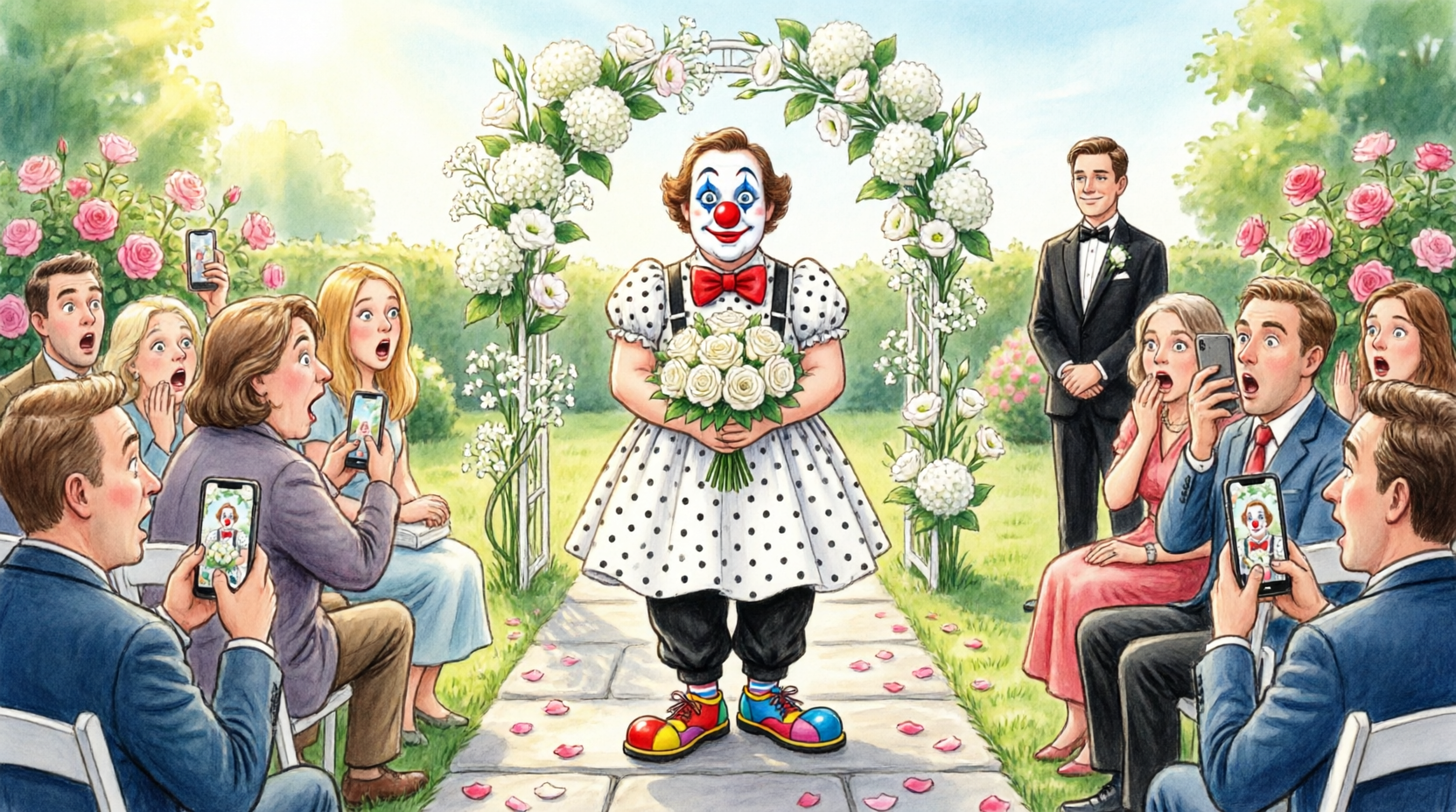
The morning of my wedding, I unzipped my garment bag expecting lace and silk… and pulled out a full clown costume—red nose, rainbow wig, oversized shoes. My future MIL had swapped it, certain I’d panic and cancel, proving I didn’t belong. For a moment, I just stared. Then I smiled. If she wanted a show, I’d give her one. I put it on, fixed my makeup, and walked down that aisle—ready to turn her humiliation into my spotlight.
The morning of my wedding should have felt like a dream—soft light through the curtains, quiet anticipation, the kind of nervous excitement people talk about for years. Instead, it felt… still. Almost too still. I stood in the center of the room, staring at the garment bag hanging neatly against the wardrobe, my heart beating just a little faster than it should. Everything had gone perfectly up to that point. The venue was ready, the guests were arriving, the schedule was flawless. I reached for the zipper slowly, letting the moment stretch, wanting to feel it fully—the transition from everything I had been into everything I was about to become. I pulled it down. And froze. For a second, my brain refused to process what I was seeing. Bright colors. Loud colors. Red. Yellow. Blue. Not lace. Not silk. Not anything remotely close to a wedding dress. My hands moved before my thoughts caught up, pulling the fabric out fully—and there it was. A full clown costume. Red nose. Rainbow wig. Oversized shoes stuffed awkwardly into the bottom of the bag. It wasn’t subtle. It wasn’t accidental. It was deliberate. Calculated. Designed to humiliate. The room felt smaller suddenly, like the air had shifted. I stared at it, waiting for anger, for panic, for something to break through the shock. And then I understood. My future mother-in-law. The comments she made. The smiles that never reached her eyes. The way she always spoke about “standards,” about “fitting into the family.” She had been waiting for this moment. Testing me. Pushing me. Hoping I would crumble just enough to prove her right. That I didn’t belong. That I wasn’t good enough. That I would embarrass them. I let out a slow breath, my fingers still holding the ridiculous fabric in front of me. She expected chaos. Tears. A scene. Maybe even a canceled wedding. That was the plan. And for a moment—just a moment—I almost gave it to her. But then something shifted. Not anger. Not revenge. Something sharper. Clarity. If she wanted a performance… then I would control the stage. A small smile formed before I could stop it. Not forced. Not dramatic. Just certain. I set the costume down carefully, then picked it up again, this time with intention. “Alright,” I murmured softly to myself. “Let’s make this memorable.”
The makeup was the first thing I adjusted. Not exaggerated, not theatrical, but deliberate. If I was going to wear the costume, it wouldn’t be as a victim of someone else’s joke—it would be as the person rewriting it. I kept my movements calm, steady, like I had all the time in the world, even though I knew the ceremony was minutes away. Every detail mattered. The wig sat neatly, not messy. The shoes—ridiculous as they were—fit into the rhythm of each step I practiced across the room. When I looked at myself in the mirror, I didn’t see humiliation. I saw control. That was the difference she hadn’t accounted for. The door knocked softly. “Are you ready?” my bridesmaid called. I glanced at the reflection one last time, then turned the handle. When I stepped out, the reaction was immediate. Silence first. Then confusion. Then shock. No one knew how to respond. And that was exactly what I needed. Because uncertainty shifts power. “Trust me,” I said quietly to my bridesmaid, whose eyes were wide with disbelief. “Just… let it happen.” She didn’t understand, but she stepped aside. The music began. The doors opened. And I walked. Slowly. Deliberately. Down the aisle. The reaction rippled through the room like a wave. Whispers. Gasps. Someone let out a nervous laugh that died quickly when no one joined. Heads turned, eyes widened, phones subtly lifted to capture what they thought was a disaster unfolding. But I didn’t rush. I didn’t hesitate. I walked like I belonged there. Because I did. Halfway down the aisle, I saw her. My future mother-in-law. Her face had gone pale, her expression frozen somewhere between triumph and confusion. She had expected chaos. Instead, she got composure. She had expected me to break. Instead, I adapted. That’s when the shift happened. People stopped laughing. Stopped whispering. They started watching. Really watching. Because something about the way I carried myself didn’t match the costume. And that contradiction demanded attention. When I reached the altar, I turned—not to my fiancé first, but to the room. “Before we continue,” I said clearly, my voice steady, carrying through the silence, “I think we should address the elephant in the room.” A few nervous chuckles broke out, unsure. I let the moment stretch just enough before continuing. “This wasn’t a mistake,” I said. “This was a test.” I didn’t look at her yet. Not directly. Not until the room was fully listening. “Someone wanted to see if I would panic. If I would run. If I would prove that I don’t belong here.” Now, I turned. Slowly. Intentionally. My eyes met hers. And for the first time, she looked uncertain. “But here’s the thing,” I continued, a faint smile returning. “Belonging isn’t decided by someone else’s expectations. It’s decided by how you respond when those expectations are meant to break you.” The silence that followed wasn’t awkward anymore. It was heavy. Focused. Real.
I reached up slowly and removed the red nose, holding it between my fingers for just a moment before setting it aside on the altar. The gesture was small, but it shifted something in the room. It wasn’t about the costume anymore. It was about intention. “You wanted a show,” I said calmly, my gaze still steady, not aggressive, not emotional—just clear. “So here it is.” My fiancé stepped closer then, his expression unreadable at first, but his eyes… his eyes told me everything. Not embarrassment. Not anger. Understanding. That was all I needed. Because this moment wasn’t just about me. It was about whether he would stand in the same space I was claiming. “I could have left,” I continued, my voice softer now but no less certain. “I could have gone back, changed, pretended this never happened. But that would mean accepting something I don’t agree with.” I glanced around the room briefly, meeting a few curious, a few supportive, a few still uncertain faces. “Respect isn’t conditional,” I said. “And neither is dignity.” Then I turned fully toward my future mother-in-law. “If this was your way of deciding whether I belong in this family,” I added, “then I think we have our answer.” The room held its breath. Because now, it wasn’t about me proving anything. It was about her. Her response. Her position. Her next move. But she didn’t have one. Not a good one, anyway. Because anything she said now would only confirm what everyone had just seen. The power had shifted, quietly but completely. I turned back to my fiancé, meeting his eyes directly. “The real question,” I said, my tone softening just enough, “is whether this is still the kind of family you want to build.” That was the only moment I allowed uncertainty to enter. Not weakness. Just truth. Because strength isn’t about controlling everything—it’s about being willing to face whatever comes next. He didn’t hesitate. Not even for a second. He reached for my hand, holding it firmly, grounding the moment in something real. “I’m not marrying a family,” he said clearly. “I’m marrying you.” And just like that, everything settled. Not perfectly. Not cleanly. But honestly. The tension in the room broke—not into laughter this time, but into something closer to respect. Genuine, earned, undeniable. I smiled then, not because everything was resolved, but because I had taken something meant to humiliate me and turned it into something no one could ignore. As the ceremony resumed, I stood there—not as the woman who had been tested, but as the one who had passed without ever playing by the rules set against her. And if you were in that moment—handed something meant to break you—would you try to fix it quietly, or would you turn it into something so powerful that no one could ever use it against you again?