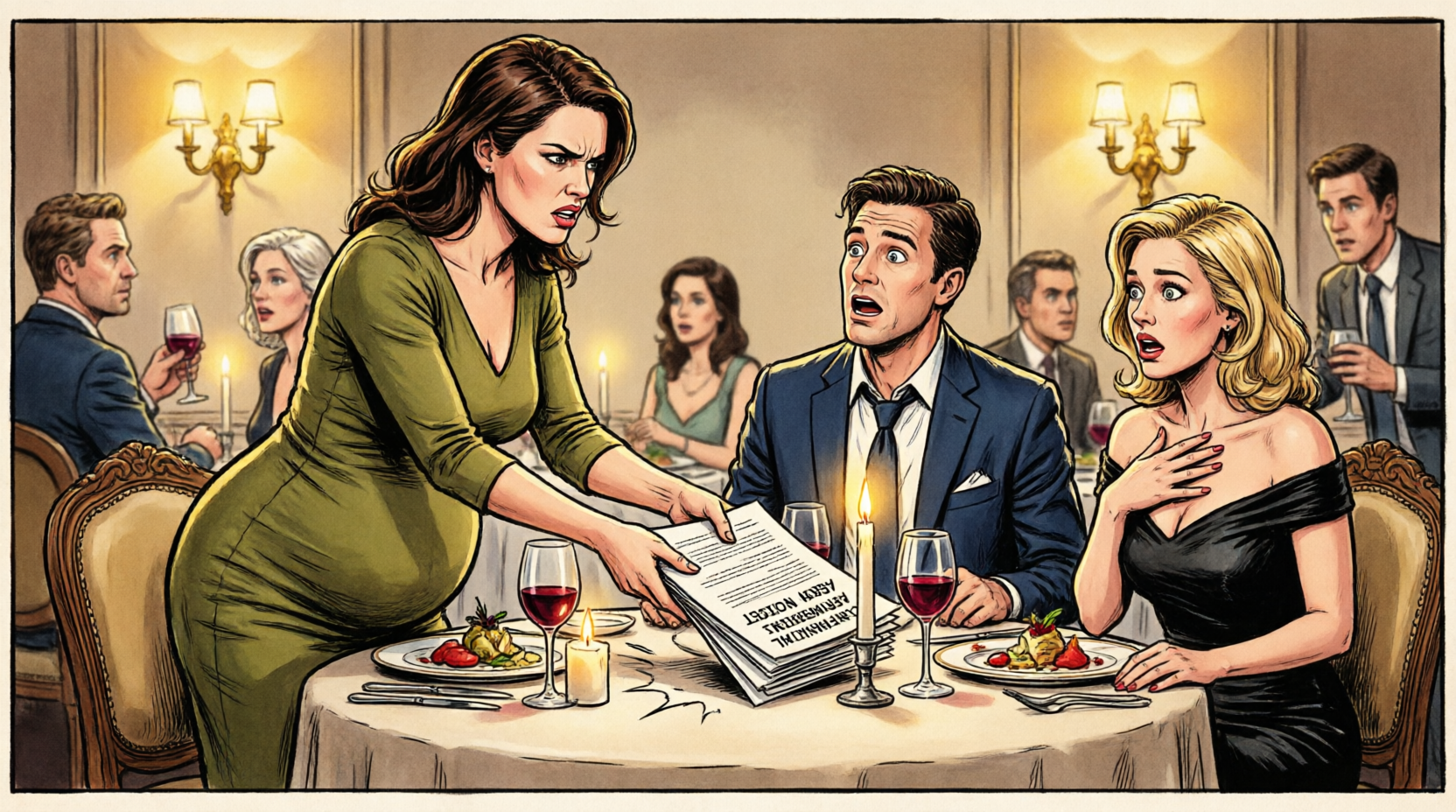
Part 1
The night my husband was smiling at another woman over candlelight and a bottle of Pinot he probably charged to one of his business accounts, I was in the nursery on my knees, sorting baby socks by color like that kind of control could protect me from anything.
The room smelled like fresh paint and lavender detergent. I had painted the walls myself in late September, one careful roller stroke at a time, while Nathan stood in the doorway with a coffee cup and told me I should sit down more often. He said it like concern. Nathan said a lot of things in a concerned voice that were really instructions.
By October, I was eight months pregnant, sleeping badly, and moving through our six-bedroom house in Westport like I was carrying not just a child but the whole weight of the life I had agreed to build. Nathan loved that house. Loved the symmetry of it, the white columns, the iron lanterns by the front door, the way guests always paused in the foyer and said wow before they saw the rest.
He loved rooms that made people think he was a certain kind of man.
At 7:12 that Tuesday morning, he stood at our bathroom mirror knotting his tie with one hand while checking emails with the other. He had that steady, self-pleased energy some men wear like expensive cologne. Not loud. Just constant. He was forty-five, broad-shouldered, handsome in a polished, practiced way, and he had spent seventeen years building Callaway & Associates into one of the most admired architecture firms in the Northeast.
He looked at me in the mirror while I sat on the edge of the bed rubbing lotion into my stomach.
“You should rest today,” he said.
“I’m nesting.”
“You’ve been nesting for three weeks.”
“That’s because babies don’t care about deadlines.”
He smiled, but only with his mouth. “Don’t wait up tonight. Client dinner ran long last Thursday, and this one probably will too.”
Tuesday. Then Thursday. Then Tuesday again. A rhythm so normal by then it was almost invisible.
He bent, kissed my forehead, and left behind the smell of shaving cream and cedar aftershave. I listened to his footsteps go down the hallway, the soft chime of his keys in the bowl by the door, then the low growl of his car pulling out of the driveway.
A lot of marriages break with shouting. Mine broke with a spreadsheet.
I spent the morning doing the slow, unglamorous work of late pregnancy. Laundry. Emails. Half a peanut butter sandwich because everything else sounded disgusting. Around four that afternoon, I sat at the kitchen island with my laptop open, reconciling our household accounts the way I always did.
Nathan used to call that one of my “cute little systems.”
Before marriage, before the house, before I agreed to “step back for a while” because his career was in a growth phase and one of us needed flexibility, I had been a forensic accountant. Not bookkeeper. Not “good with numbers.” I was the person companies hired when someone was skimming money through fake vendors or burying assets behind layered LLCs. Numbers had once spoken to me more clearly than people did. They still did, if I was honest.
I wasn’t looking for betrayal. I was looking for a missing insurance charge.
The hotel entry caught my eye because it repeated too cleanly.
The Meridian Hotel — $420.
I clicked back one statement.
The Meridian Hotel — $420.
Another one.
Tuesday. Thursday. Tuesday. Thursday.
I stopped breathing for a second. Not from drama. From concentration.
I kept going back.
Eight months of statements. Thirty-two charges. Same amount, same pattern, like a metronome. Always on the nights he said client dinners ran late. Always posted just after eleven or just before midnight.
I remember very clearly what I heard in that moment: the refrigerator humming, the grandfather clock in the sitting room, a leaf blower somewhere down the street, the tiny scratch of my own fingernail against the trackpad.
The baby shifted hard under my ribs, a slow, heavy roll.
I put one hand on my stomach and stared at the screen until the letters blurred.
Maybe there was an explanation. Maybe the hotel had a restaurant. Maybe he was booking rooms for clients. Maybe maybe maybe. Women can build whole houses out of maybe if they’re scared enough.
Then I checked his calendar.
I knew his passwords. Nathan never worried about that kind of access because he’d spent years making me feel like the domestic manager of his life, not the auditor of it. Tuesday client dinner: Midtown investor. Thursday contractor review: Upper East Side. Tuesday networking reception. Thursday vendor meeting.
All neat. All plausible. All arranged like furniture in a room no one was meant to examine too closely.
I stood up too fast, and a sharp pull ran across my lower back. I gripped the counter until it passed, then walked upstairs to our bathroom and locked the door.
The tile floor was cold even through my leggings. I sat down on it anyway and let myself cry.
Not the pretty kind. Not silent tears sliding down one cheek. I cried the humiliating, body-shaking kind, with snot and hiccuping breaths and one hand pressed to my mouth because I could not stand the idea of anyone hearing me even though I was alone.
I gave myself four minutes.
I know that because I set the timer on my phone.
At four minutes, I stood up, washed my face, and looked at myself in the mirror.
My eyes were red. My hair had come loose from its clip. My wedding ring flashed under the vanity light when I braced both hands on the sink. I looked tired. Pregnant. Hurt.
But under all that, something else came back.
I knew that look. I had seen it years ago reflected in conference room windows and dark computer screens at midnight, when a fraud case finally tipped from suspicion into proof.
I went to the bedroom, took the small black notebook from my bedside drawer, and wrote a single line.
Meridian Hotel. 32 charges. Tues/Thurs. Pattern confirmed.
Then I sat very still on the edge of the bed and thought about the last nine years.
About how Nathan had once told me I worked too hard, that I didn’t have to prove anything anymore, that we were a team. About how easy it was to confuse being cherished with being gradually reduced. About how I had let my certifications lapse, one renewal at a time, because there was always a vacation to plan or a fundraiser to host or a dinner table to style for people Nathan wanted to impress.
I didn’t call him.
I didn’t smash a glass or throw his suits into the driveway or text a photo of the statements to whatever woman was occupying my Tuesday and Thursday nights by proxy.
I called my sister.
Roz answered on the third ring. In the background, I heard a monitor beeping and somebody laughing too loudly, which meant she was probably near the nurses’ station at Stamford Hospital.
“Hey, Cece, can I call you back in—”
“He’s cheating on me.”
Silence.
Three seconds. For Roz, that was basically a religious experience.
Then she said, very calmly, “Tell me you haven’t confronted him.”
“I haven’t.”
“Good. Don’t. I’m getting off in twenty.”
I looked down at my notebook, at the slanted line of my own handwriting.
Outside, dusk was starting to blue the windows. Somewhere in Manhattan, Nathan was probably lifting a wineglass and smiling like his life was perfectly arranged.
By the time Roz got to my house, I had found all thirty-two charges.
And by then, I wasn’t waiting for an explanation anymore.
I was following a trail.
Part 2
Roz arrived with two grocery bags, her keys between her fingers like claws and her ER badge still clipped to her scrubs. She kicked the door shut behind her with her heel and set the bags on the kitchen island like she was unloading emergency supplies.
“What’s in there?” I asked.
“Ice cream, chips, a legal pad, and sparkling water because you’re pregnant and I’m trying not to be trash.”
“Only trying?”
She gave me a look. “Don’t be cute. Have you touched any knives?”
Despite myself, I almost laughed. “No.”
“Good. We stay off true crime tonight.”
Roz and I looked enough alike that strangers always guessed sisters, but that was where the easy comparison ended. She was quick and loud where I was measured and quiet. She had shoulders like she was perpetually ready to carry bad news and a face that people trusted within about six seconds. She’d been an ER nurse for twelve years and spoke about chaos the way some people talk about weather. Calmly. With good shoes.
I laid out the statements, the calendar entries, the dates. I told her about the pattern. About the hotel. About the way it kept repeating until the repetition itself felt intimate.
Roz listened without interrupting, which was how I knew she understood the scale of it.
When I finished, she took the legal pad out of the grocery bag, clicked a pen open, and said, “Okay. Here’s what we’re not going to do. We’re not going to cry on his shoulder so he can control the narrative. We’re not going to warn him. We’re not going to give a man with expensive suits and a god complex time to move money.”
I stared at her.
She pushed the pen toward me. “You used to do this for a living.”
I looked down at the blank yellow page.
My stomach twisted. “This is different.”
“Sure. Because it’s your life. Which means you need to be colder, not softer.”
That hit me because it was true.
I had spent years reading other people’s lies from a safe professional distance. Now the lie was sleeping in my bed and kissing my forehead on the way out the door. That changed the emotional temperature, but not the structure. Money still moved. Time still left fingerprints. People still got arrogant when they thought no one was looking.
So I made headings.
Dates
Charges
Claimed Location
Verified Location
Notes
Roz watched me for a minute, then opened the ice cream and handed me a spoon.
“There she is,” she said quietly.
I started with what I already had. Thirty-two hotel charges. Nathan’s shared calendar. Firm events. Dinner reservations I could find in our email confirmations. Then I moved to the smaller things.
He had started showering later on Tuesdays and Thursdays. He had come home twice smelling not like his own soap, but like the bright, citrusy kind hotels stocked in sleek little bottles. One Thursday in September, I had found glitter on the cuff of his jacket and told myself it was from an event. Two months before that, he had bought a sapphire pendant from a jeweler on Madison, then told me the stone was set wrong and he returned it.
At the time, I barely looked up from the baby registry when he said it.
Now I wrote it down.
By midnight, I had pages.
By one in the morning, I had emailed an old colleague named Dennis, who used to joke that I could smell fraud before the coffee finished brewing. He wrote back at 6:14 a.m. with one line.
You need a PI and a bulldog lawyer. Calling now.
The private investigator’s name was Doug Mercer. No relation to the lawyer I would meet later, which I only note because for a weird twenty-four hours I thought the universe might have developed a sense of narrative style.
Doug was a retired detective with a flat voice, a gray mustache, and the kind of patience that makes guilty people underestimate you. He met me in a diner off I-95 on a rainy Friday morning. The vinyl booth stuck to the back of my thighs. Coffee smelled burnt. My wedding ring felt too tight.
He didn’t waste time pretending my situation was unique.
“Cheaters,” he said, stirring Sweet’N Low into his coffee, “love routine more than honest people do. Makes them feel safe.”
I slid the printed statements across the table.
He looked at the dates, then at me. “You want confirmation or a file?”
“A file.”
That made one corner of his mouth twitch. “Good answer.”
Over the next two weeks, I lived in two realities at once.
In one, I was visibly pregnant, shopping for crib sheets, timing Braxton Hicks contractions, answering Nathan’s distracted questions about stroller colors, and listening to him describe fictional client dinners while he loosened his tie at the kitchen counter.
In the other, I was building a case.
Doug sent updates through an encrypted email account I created under my old college login, one Nathan didn’t know existed because it belonged to a version of me he had quietly encouraged out of the frame. The first photos came in on a Thursday night while Nathan was supposedly with a contractor from Boston.
I opened them at 11:32 p.m. in the nursery, my laptop balanced on a stack of unpacked diaper boxes.
There he was.
Nathan, stepping out of a black town car outside the Meridian. Hand on the lower back of a woman in a cream coat. Her hair was dark blonde, long and expensive-looking, the kind that always falls back into place after wind. In the next image, they were at a restaurant three blocks away, leaning toward each other over candlelight.
Nathan was smiling.
Not his public smile. Not the polished one he wore at galas or client dinners. This one was loose. Easy. Boyish, almost. I had not seen that expression directed at me in years, and it hit harder than the hotel charge ever did.
I clicked to the third image and went completely still.
The woman had tucked her hair behind one ear.
At her throat, catching the restaurant light, was the sapphire pendant.
For a second I genuinely thought I might throw up. Instead, I zoomed in until the pixels broke apart.
Same oval stone. Same delicate silver setting. Same tiny asymmetry on the left side of the chain where the jeweler had shown me a sample on his website when I was researching anniversary gifts I never ended up buying.
He hadn’t returned it.
He had moved it.
I closed the laptop and sat with both palms flat on the rug while the baby rolled inside me like she was trying to reposition herself under stress.
That image did something the statements hadn’t.
Numbers told me my husband was cheating.
The necklace told me he had lied to my face, casually, while deciding another woman should wear what he pretended had never belonged to anyone.
I emailed Doug back in three words.
Find out her name.
He replied twelve minutes later.
Already on it.
The next morning, Nathan left for work in a navy overcoat and kissed the top of my head while I stood at the stove pretending to scramble eggs.
“You okay?” he asked. “You seem tired.”
I looked at his reflection in the microwave door. Crisp shirt. Smooth jaw. Not a crease out of place.
“Just not sleeping great.”
He touched my shoulder. “We’re almost there.”
We.
After he left, I stood in the kitchen until I heard the garage door close.
Then I took my plate to the sink, dumped the eggs into the trash, and opened my laptop.
Doug’s new email was already there.
Her name is Brooke Kensington.
And underneath that, attached like a blade wrapped in velvet, was a full report.
By the time I finished reading, the house around me looked the same.
White cabinets. Morning light. Bowl of lemons on the island. Baby monitor still in the box.
But I wasn’t the same woman standing in it.
Because now I had a name, a face, a hotel, a pattern, and a necklace he had bought with the kind of confidence only a man certain of his own safety ever has.
What I didn’t know yet was how much more there was to find.
And how ugly men can get when they realize you’re not crying anymore.
Part 3
Sandra Mercer’s office was on the fourteenth floor of a brick building in downtown Stamford, and everything in it looked chosen on purpose.
Not flashy. Not soft either. Dark wood shelves. A slate-gray rug. Clean lines. A glass bowl of peppermints nobody touched. The kind of office that made you think the person behind the desk did not need to raise her voice to ruin your week.
Sandra was in her mid-fifties, silver-haired, beautifully put together, and had the steady gaze of someone who had spent two decades listening to people lie for sport.
I brought her three folders.
One for the affair. One for the timeline. One for the money.
She read in silence while I sat across from her and watched a square of winter light move slowly across her desk. My back ached. The baby had parked herself high under my ribs that week, and every breath felt slightly borrowed.
Sandra finished the third folder, closed it, and looked up.
“Mrs. Callaway,” she said, “most people come in here with intuition and tears. You came in with exhibits.”
“I used to do this for a living.”
“I can tell.”
She asked for the short version of my marriage and got the useful one. Nathan and I met at a fundraising event nine years earlier when I was leading an asset-tracing team for a regional accounting firm. He was charming in that deliberate way successful men can be when they’ve learned to mirror your ambition back at you. He loved that I was smart. Then, gradually, he loved that I was available. Those are not the same thing, though it took me too long to admit it.
When I got pregnant after years of thinking it might not happen for us, he doubled down on his concern. I should slow down. Rest more. Stop worrying about renewing certifications while carrying his child. He framed retreat like tenderness, and I accepted it because by then I was tired and hopeful and wanted to believe being taken care of meant being valued.
Sandra listened, then asked, “Prenup?”
“Yes.”
“Bring it.”
I did. She read that too.
Nathan’s attorney had done a beautiful job protecting the firm, his pre-marital assets, his future equity, and every expensive corner of his life. What the agreement did not do, because at the time children were a vague someday item and Nathan was more focused on real estate than diapers, was solve for custody or child support.
Sandra tapped one manicured finger on the relevant section.
“He thought this was a wall,” she said. “It’s a fence.”
“What does that mean?”
“It means he’s protected in some ways he’s counting on. It also means your child changes the math in ways he did not plan for.”
I felt something strange then. Not hope exactly. Hope was too soft a word. It was more like traction.
For the first time since I’d seen the hotel charges, the ground under me felt like it might hold.
Over the next eight weeks, I built my exit in pieces so small they looked harmless if you didn’t know what you were looking at.
I opened a personal checking account at a different bank using my maiden name. I started moving money in careful, forgettable amounts, never enough to trigger questions, always enough to matter later. I rented a third-floor apartment near the Saugatuck River with east-facing windows and a second bedroom already painted pale cream. I signed the lease with a pen that shook only once.
Then I started moving parts of myself there.
Not the obvious things first. Not clothes or baby furniture. I moved the pieces Nathan would never notice were gone because he had never truly seen them.
My framed CPA certificate. The photo of me speaking at a financial fraud conference in Boston. Research notebooks from my old cases. A box of tax law binders I had kept in the study closet. The navy blazer I used to wear on depositions. Every trip felt less like packing and more like excavation.
One Tuesday afternoon, I carried a banker’s box down the apartment stairs and had to stop halfway because the baby lodged a heel so sharply into my side I almost laughed. The hallway smelled like old radiator heat and somebody’s garlic dinner. I leaned against the wall, one hand on the box, one on my stomach.
“You and me,” I whispered. “We’re getting out.”
At home, Nathan moved through the weeks with absolute confidence.
He complained about city traffic. Asked if we had decided on a pediatrician. Kissed me absentmindedly in the kitchen while texting someone else under the table. Once, when I was loading the dishwasher, he came up behind me, slid a hand over my hip, and said, “I know I’ve been busy. Things will settle down after the baby.”
I nearly dropped a plate.
That was the part that kept shocking me—not the affair anymore, but the audacity of his ease. The way he could stand in the warm yellow light of our kitchen, smelling like expensive wool and hotel soap, and talk about the future as if he still belonged in it.
Then, on a Wednesday night in late November, he called me at 7:40 p.m. from the city.
His voice was too warm.
“I cleared tomorrow morning,” he said. “Thought maybe we could spend it together. Look at nursery stuff. Get breakfast. Just us.”
I was sitting in the rocking chair in the nursery folding tiny cotton sleepers. My fingers went still around a pink cuff.
Nathan did not clear mornings. Nathan protected billable hours the way dragons protect gold.
“That sounds nice,” I said.
The second we hung up, I opened my banking app.
At first, I didn’t see it. Then I switched to joint-account transactions and there it was, sitting three days back like a lit match in dry grass.
Douglas Wright Investigative Services — $200.
I closed my eyes so hard stars burst behind them.
I had paid one invoice from the joint account during a transfer week. One. I had meant to move it and never did. Nathan, or someone in his office, had seen it.
He might not know what I knew.
But he knew enough to suspect I was looking.
I called Sandra. She answered on the fourth ring, voice crisp.
“He saw the investigator charge,” I said. “He called tonight and suddenly wants to spend tomorrow morning with me.”
A pause.
Then: “We move faster.”
The next morning, Nathan got up around five-thirty to use the bathroom. His phone was on the nightstand between us. Unlocked.
I had maybe fifteen seconds.
I picked it up, opened messages, and saw a thread near the top with one name.
Henry.
Nathan’s older brother. His business partner. The man who had toasted at our wedding and called me “the smartest person in the room” like it was a compliment instead of a warning.
The most recent message read: We need to talk about the accounts. Something is off. Call me before you do anything.
The bathroom door clicked open.
I set the phone back exactly where it had been and rolled onto my side, heart thudding so hard I felt it behind my teeth.
When Nathan climbed back into bed, he touched my arm like a husband.
I lay still and stared into the dark.
I had prepared for my husband to become my opponent.
I had not prepared for his brother to become his accomplice.
By sunrise, I knew my plan was no longer a clean, careful exit.
It was a race.
And I had just learned I wasn’t the only one running.
Part 4
The papers were supposed to be served at Nathan’s office.
That had been my favorite part of the original plan.
I wanted him in his glass tower in Manhattan, surrounded by polished concrete and awards and assistants who called him Mr. Callaway in voices sharpened by respect. I wanted the envelope waiting on his desk when he came out of an investor meeting. I wanted the silence of his office to do part of the work for me.
Instead, because he suddenly cleared his schedule and stayed home that Thursday morning with suspicious, over-bright energy, the courier came to the house.
I was in the kitchen when the doorbell rang.
The kettle had just started ticking toward a boil. Rain tapped against the back windows. I remember the exact shape of the light on the marble countertop and the fact that there were three oranges in the fruit bowl because I had thrown the fourth one away the day before when I found mold near the stem.
Nathan crossed the foyer in sock feet and opened the door.
There was a brief exchange. A signature. The soft scrape of a clipboard.
Then he came back into the kitchen holding a cream-colored envelope.
“Something from a law office,” he said, almost amused. “Did you order a lawsuit?”
I didn’t answer.
He looked down, read the return address, and everything about his face changed.
Not all at once. It was almost worse than that. First confusion. Then calculation. Then a stillness so complete it made the room colder.
He turned the envelope over, slit it open with his thumb, and started reading.
I stayed where I was, one hand braced against the counter, because if I moved too much I thought I might either throw up or start shaking so hard my teeth would chatter.
The first page was the petition.
The second was the financial summary.
Then he hit the photographs.
His eyes flicked over the date stamp, the hotel entrance, the restaurant shot. I watched him land on the image of Brooke in the sapphire necklace.
He looked up.
“You had me followed.”
His voice was quiet. That frightened me more than if he’d yelled.
“You gave me a reason,” I said.
He set the photos down and kept reading. I watched his jaw flex once, hard, as he moved through the timeline I had built: hotel charges, fake dinners, consultancy account, documented pattern of deception. Sandra had laid it out with the kind of language that leaves very little room for improvisation.
When he finished, he put both hands flat on the island and leaned into them.
“So that’s what you’ve been doing,” he said.
“Yes.”
“In my house.”
I stared at him. “In my marriage.”
He laughed once, without humor. “You think this is a game?”
“No. I think this is evidence.”
His eyes sharpened. For a second I saw something naked and ugly there, something beyond anger. Contempt maybe. Or panic wearing contempt’s coat.
“You want to tear apart everything I built?”
My whole body went cold.
Everything I built.
Not we. Not us. Not our home. Not our child.
I said, very evenly, “You already did that.”
He pushed away from the island so fast the stool beside him tipped and hit the floor.
“Don’t do that,” he snapped. “Don’t stand there acting righteous like you haven’t been living off my name, my money, my work for years. You were nothing when I found you.”
There are sentences that don’t just hurt. They rearrange the room.
For one heartbeat, I could not hear the rain anymore. I could only hear that line echoing inside my skull.
You were nothing when I found you.
I had been twenty-nine, making more money than anyone in my family ever had, leading investigations people twice my age tried to bluff their way through. I had been competent and wanted and tired and alive.
Then I married a man who admired me best when I was useful to his image.
I felt tears rise, hot and humiliating. I swallowed them.
“No,” I said. “I was a woman on track to make partner. You just preferred me quieter.”
He grabbed his keys from the counter.
For one absurd second I thought he might apologize.
Instead he said, “You have no idea what you just started.”
Then he walked out.
The front door slammed so hard a framed wedding photo in the hallway fell and shattered. The crack ran straight down the glass between our faces, splitting us cleanly in two.
I stayed in the kitchen until I heard his car peel out of the driveway.
Then I called Roz.
“He got served,” I said.
“How bad?”
I looked toward the hallway at the broken frame still lying faceup on the floor. “He said I was nothing when he found me.”
Roz went quiet for about two seconds. “Wow. He really went with full villain dialogue.”
I let out a sound that wasn’t quite a laugh.
“Are you safe?”
“Yes.”
“Do you need me there?”
“I don’t know.”
“Well, that’s useless, so I’m coming anyway.”
She arrived forty minutes later with coffee and a roll of packing tape, because apparently her answer to emotional crisis was always practical weirdness. She taped butcher paper over the broken photo so I wouldn’t cut myself and made me sit down while she heated soup I did not want.
By late afternoon, Nathan still hadn’t called.
Sandra did. “He retained Gerald Ashford.”
I knew the name. Anyone in Fairfield County who had ever whispered about a vicious divorce knew the name. Gerald specialized in polished brutality. He billed like a surgeon and liked to sound reasonable right before he carved something open.
“Good,” Sandra said before I could respond. “Now we know who we’re dealing with.”
The first retaliation came faster than I expected.
The following Friday, I stopped at the pharmacy to pick up prenatal vitamins and antacids. I was wearing leggings, an oversized wool coat, and no makeup. My hair was up in the kind of bun that announces to the world you are operating on functionality alone.
The pharmacist smiled at me. “Almost time, huh?”
“Feels like it.”
She rang everything up. I handed over my card.
Declined.
I frowned. “That’s weird.”
I tried another card.
Declined.
The woman behind me in line suddenly became deeply interested in her gum display.
Heat climbed up my neck. I paid in cash from the emergency twenty-dollar bill I kept in my wallet and took the paper bag with hands that felt clumsy and huge.
In the car, I sat with the engine off and called the bank.
The joint accounts had been frozen.
All of them.
Insurance float. Household operating money. The account our medical bills auto-drafted from. Every dollar I touched in the visible life Nathan had built for us had just been put behind glass.
I called Sandra from the parking lot with my seatbelt still hanging loose against my shoulder.
“He froze everything.”
“Of course he did,” she said, already moving. I could hear papers shifting. “I’ll file emergency relief this afternoon.”
I pressed the heel of my hand against my eyes.
The humiliation at the pharmacy wasn’t really about vitamins. It was about the message. Nathan wasn’t just angry. He wanted me reminded, publicly and efficiently, that access had always flowed through him.
That same evening, Sandra had the emergency filing drafted.
By Monday, Gerald filed back.
His motion landed in my inbox at 4:17 p.m.
Emergency request for psychological evaluation of petitioner.
I read the title twice because my brain refused to accept how nakedly ugly it was.
Then I kept reading and realized something even worse.
He wasn’t calling me crazy in a sloppy way.
He was doing it elegantly.
My documentation became obsessive surveillance. My financial preparation became erratic secrecy. My professional precision became evidence of paranoid overreach. Every strength I had used to protect myself had been translated into pathology.
By the time I reached the last page, my hands were shaking.
He had taken the best thing about me—my ability to see clearly—and filed it as proof that I was unstable.
And for the first time since I found the charges, I was no longer angry first.
I was scared.
Part 5
Sandra told me to come to her office immediately, which I did in leggings, a black sweater, and the kind of swollen-eyed face no woman wants to bring into a legal strategy meeting.
She read Gerald’s motion once, slow and expressionless, then set it down and leaned back in her chair.
“This,” she said, “is textbook.”
“That’s supposed to make me feel better?”
“No. It’s supposed to make you recognize the move.”
I sat across from her, one hand spread over the top of my stomach because Nora—though she did not have a name yet, I was already thinking of her that way—had spent the morning elbowing my organs like she objected to everything.
Sandra folded her hands. “When a woman prepares, they call it obsession. When she protects herself, they call it aggression. When she’s organized, they call it controlling. The point isn’t accuracy. The point is to make you defend your own competence until you’re too tired to keep fighting.”
I stared at the motion again.
“He used the truth.”
“Of course he did. Good liars usually do.”
That steadied me in a strange way.
Because she was right. Gerald hadn’t invented anything. I had hired an investigator. I had documented patterns. I had moved money. I had built a case. He had simply changed the story those facts told.
Sandra started making notes.
“We answer with context, documentation, and witnesses. And if Ashford wants to argue your behavior was irrational, we remind the court that you spent nearly a decade doing asset-tracing professionally.”
I nodded.
Then my phone buzzed.
Henry.
I showed the screen to Sandra.
She looked at it, then at me. “Speaker. And if Connecticut law worries you, don’t secretly record. Just take notes after. Better yet, tell him you’re putting him on speaker because you’re pregnant and tired.”
I answered.
“Henry.”
His voice came warm and smooth, the way expensive whiskey looks in a glass. “Celeste. I’ve been wanting to check on you.”
I nearly smiled at the audacity.
“That’s kind.”
“I mean it. This whole thing is painful for everyone.”
Everyone. Not you. Not my unborn daughter. Everyone.
I said nothing.
He filled the silence gracefully, which told me he had rehearsed.
“I just think,” he went on, “that when emotions run high, people can create narratives that don’t reflect the full picture. If this gets contentious, there may be testimony from firm events, dinners, holiday functions. I’d hate to see anyone misunderstood.”
Sandra’s pen stopped moving. Her eyes lifted to mine.
I kept my voice flat. “Misunderstood how?”
A pause. Tiny. Satisfied.
“Well, there were a few occasions over the years where you seemed… emotional. Overwhelmed. I do remember one Christmas party where you drank more than was wise and said some things that struck me as erratic. I’m sure it was stress.”
It was a lie so bald I almost respected the lack of effort.
At that party, I had drunk exactly one glass of champagne, then left early because Nathan had spent forty minutes with his hand on the back of a female developer and I did not yet have a language for the humiliation of being sidelined in your own marriage.
“I see,” I said.
“I’m just saying courtrooms can turn impressions into facts.”
There it was. Clean. Polite. Threatening.
When the call ended, Sandra sat back.
“He just handed me leverage.”
I blinked. “How?”
“Because his brother is a potential witness, and he just tried to shape your testimony through intimidation. Men like Henry think if they don’t shout, it doesn’t count.”
I let out a shaky breath.
For about five minutes, I felt almost held together.
Then the hearing date came in.
Monday morning.
Four days away.
The weekend felt endless. Nathan didn’t call me directly. Everything moved through lawyers now, which somehow made it uglier. It gave his cruelty formatting.
I barely slept Sunday night.
On Monday, the courtroom was smaller than I expected. Wood-paneled. Quiet. Efficient. The kind of room where every cough sounded rude. I sat beside Sandra with my hands clasped so tightly my knuckles ached. Nathan was across from me in a charcoal suit, looking composed and freshly trimmed, like this was a board meeting and not an attempt to pathologize the mother of his child.
Gerald stood first.
He was silver-haired, tan, and exquisitely mannered. The sort of man who probably remembered judges’ birthdays and knew exactly how to pitch his voice so even nonsense sounded measured.
He described my behavior as “concerning.” He spoke of secretive financial movements, compulsive documentation, excessive monitoring. He implied that my pregnancy, combined with marital strain, had produced a destabilizing emotional state that warranted evaluation before any custody decisions were made.
He never once used the word crazy.
He didn’t need to.
Then Sandra stood.
She didn’t pace. Didn’t dramatize. She simply placed one folder on the table and started talking like truth was something physical she could set down between us.
“My client is a former forensic accountant,” she said. “For nine years, she traced hidden assets and financial deception as a profession. The behavior opposing counsel calls obsessive is, in context, disciplined investigative work performed by someone with highly specialized training in precisely this kind of analysis.”
She walked the judge through the charges. The timeline. The photos. The necklace. The consultancy account. She showed the pattern so clearly even I felt embarrassed for Gerald trying to blur it.
Then she did something I hadn’t expected.
She introduced an affidavit from Tobias Grant.
Nathan’s assistant.
My head turned so fast my neck cracked.
In the affidavit, Tobias stated that Nathan had repeatedly blocked Tuesday and Thursday evenings for over a year under false calendar labels and that those blocks were not, to his knowledge, legitimate business meetings.
Gerald objected.
The judge overruled.
Nathan didn’t move, but I saw one muscle jump in his jaw.
Sandra ended simply.
“Preparation is not instability,” she said. “A woman gathering evidence of her husband’s deception while pregnant is not evidence of mental illness. It is evidence she understood she would need proof before anyone took her seriously.”
The judge denied the psychological-evaluation request.
Just like that.
Denied.
She ordered temporary access restored to the joint accounts. Temporary financial relief. Provisional custody protection in my favor until final hearing.
I didn’t cry in the courtroom.
I waited until I got outside and the December air hit my face like something honest.
Roz was parked at the curb in her SUV, illegally, of course. She leaned over and shoved the passenger door open before I even reached it.
“Well?”
“We won this round.”
“Excellent,” she said. “I brought emergency donuts.”
There was a pink box on the seat between us. I laughed, this time for real, and the sound startled me. It felt rusty.
I bit into a sprinkle donut and sugar hit my tongue so suddenly it almost hurt. For ten minutes, driving back toward Westport, I let myself believe maybe the worst of it had already passed.
Then, two days later, Tobias called me directly.
His voice was low and tight.
“Mrs. Callaway,” he said, “I think there’s more you need to see.”
I glanced around my apartment, half-packed boxes stacked by the wall, winter light on the floorboards, the bassinet still waiting in the corner.
“What kind of more?”
A pause.
“The kind that made me ask to meet in person.”
It wasn’t relief in his voice.
It was fear.
Part 6
We met at a diner in Norwalk because apparently every important turn in my life now happened under fluorescent lights next to a coffee machine that had seen better decades.
Tobias was younger than I remembered from office events. Early thirties, neat haircut, tired eyes. He kept checking the front windows like he expected Nathan to come through them.
“Thank you for meeting me,” he said.
He slid a manila folder across the table.
Inside were transfer records. Entity registration documents. Wire confirmations. A spreadsheet printout with initials and dates in Tobias’s tidy assistant handwriting.
I knew what I was looking at within five seconds.
Nathan had started moving money.
Major money.
Not the petty, impulsive kind men stash when they think they’re being clever. This was structured. Layered. Routed through a new LLC registered under Margaret Callaway—Henry’s wife. The paper distance was meant to look clean. The timing was not. Three transfers, just under the threshold that would have made certain internal controls louder, all within the same three-week window after I filed.
My pulse settled in a way that would sound strange to anyone who didn’t understand me. Fear sharpened me. Numbers steadied me.
“He told you to process these?” I asked.
Tobias nodded. “He told me not to put them through the regular system. Said it was temporary restructuring.”
“It’s concealment.”
“I figured.”
I kept flipping.
Then I saw a billing code for outside legal work routed through the firm’s internal expense ledger and my eyes narrowed.
“He used firm resources.”
“Some of them,” Tobias said. “There’s more.”
The waitress came by with coffee I hadn’t ordered. Tobias didn’t touch his.
“What else?”
He looked down at the table, then at me. “Brooke Kensington is pregnant.”
The words sat there for a second, stupid and flat.
Pregnant.
I heard the clink of silverware from the kitchen pass-through. The hiss of bacon on a grill. A Christmas song playing too softly over the speakers. Everything normal. Everything wrong.
“How do you know?”
“I overheard him talking to Gerald. Eight weeks, maybe nine. He said they’d present it as evidence of a stable future home if custody got ugly.”
I stared at him.
Stable future home.
My daughter hadn’t even been born yet, and Nathan was already building a legal fantasy where the woman he had been cheating with became part of the argument for why he deserved more of her.
I put both hands flat on the table because suddenly the room felt tilted.
For ten seconds, I couldn’t think like an accountant or a wife or even a person. I could only feel.
Betrayal has layers. The affair was one. The money was another. But there is a particularly obscene layer reserved for the moment you understand someone is trying to replace you while you are still carrying their child.
“I’m sorry,” Tobias said quietly.
I nodded once. “You did the right thing.”
When I got back to Sandra’s office the next morning, I was running on maybe two hours of sleep and the kind of hollow anger that makes coffee taste metallic.
I put the folder on her desk.
“He’s hiding assets. His mistress is pregnant. They’re going to try to turn that into some kind of family-values argument.”
Sandra took off her reading glasses, looked at me, and said, “Okay.”
That was it.
Not sympathy. Not alarm. Just okay, like she was handing me back my own center.
Then she leaned forward.
“Celeste, listen carefully. You spent years tracing hidden money. He is hiding money. This is not a plot twist. This is your home field.”
I stared at her.
The room went very quiet.
And then she was right there, right where the truth tends to hurt and help at the same time.
This was my field.
He had not chosen a new battlefield. He had wandered, stupidly, onto mine.
That afternoon, I dug out my old laptop from storage because it had software Nathan never knew I kept. I set up at the small desk in my apartment’s second bedroom with a heating pad against my lower back, a glass of ice water sweating rings onto a coaster, and transaction records spread around me like pieces of a map.
For three weeks, I lived inside the numbers.
I traced formation documents through registered agents. Cross-referenced wire timings against internal ledger anomalies. Built transaction chains through shell entities designed to create distance from Nathan’s name. He’d layered it well, better than I expected, but he had one fatal weakness all arrogant men have: he thought complexity was the same thing as invisibility.
It isn’t.
Complexity just gives you more edges to grab.
By the second week, I had reconstructed nearly the entire concealment path. By the third, I could prove that $2.8 million in marital assets had been routed through three entities and partially masked with firm-related billings.
That last part mattered.
Not just because it was ugly, but because it dragged the architecture firm toward tax exposure and internal fraud questions Nathan absolutely did not want anywhere near a divorce judge.
Sandra reviewed the file slowly.
When she finished, she smiled without warmth. “I’m filing an amended petition.”
Word traveled fast after that.
Gerald called her twice in one day.
Henry retained separate counsel by the end of the week.
The fault line between the brothers opened exactly where I expected it would: at liability. Henry would help Nathan cheat on his wife. He would not happily risk his own finances, reputation, and wife’s name once the paper trail had his fingerprints on it.
Two days later, Nathan texted me directly for the first time in weeks.
We need to talk. You are blowing this up beyond reason.
I looked at the message while sitting on the floor beside a half-built dresser for the baby’s room. The instruction manual lay open beside me. One tiny sock had somehow stuck to my sweater with static.
I typed back:
No. You did that.
He didn’t answer.
That same night, while I was putting onesies into a drawer in size order because nesting is apparently what women do when their lives are on fire, a sharp band of pain wrapped across my stomach and held.
I froze.
Waited.
Another one came eleven minutes later.
Then another.
I looked down at my belly, high and hard under my T-shirt, and laughed once out of pure disbelief.
Thirty-one days after Nathan opened those divorce papers in my kitchen, with a fraud filing in motion and his brother inching toward betrayal of a different sort, my water broke on the hardwood floor beside a box labeled BABY BLANKETS.
And suddenly the only thing in the world that mattered was getting my daughter safely here.
Part 7
Labor stripped everything down.
All the legal strategy, all the betrayal, all the rehearsed speeches I’d had with myself in the shower and the car and the middle of the night—none of it mattered once the contractions settled into a pattern that felt less like pain and more like being gripped from the inside by something ancient and unsentimental.
Roz made it to my apartment in twelve minutes.
I know that because I had texted her one word—now—and she arrived in scrub pants, snow boots, and a sweatshirt that said TRAUMA IS MY CARDIO.
“Okay,” she said, already grabbing the hospital bag by the door. “Breathe, don’t panic, and if Nathan somehow appears I will handle it.”
“You sound excited.”
“I’m a little excited.”
My contractions were six minutes apart by the time we got in the car. The windshield wipers made that rubbery, urgent sound against sleet. The inside of Roz’s SUV smelled like peppermint gum and hand sanitizer and the French fries she swore she hadn’t eaten but definitely had.
“Did you tell him?” she asked as we merged onto the highway.
“Not yet.”
“Good. Let him hear about his daughter through the proper channels for once in his life.”
Even then, bent forward and breathing through another contraction, I laughed.
The hospital room was too bright, too warm, and full of noises I would later remember more vividly than faces. The blood pressure cuff inflating. Monitor beeps. The soft rip of Velcro. The squeak of sneakers in the hallway. Somebody wheeling a cart past my door at two in the morning.
Roz stayed for every minute.
She didn’t flood me with encouragement or tell me I was “made for this” or any of the other things people say when they want to turn suffering into poetry. She handed me ice chips. Rubbed my lower back. Counted breaths when I forgot how numbers worked. When I swore at a nurse, she did not apologize on my behalf.
At one point, somewhere around hour six, I grabbed her wrist and said, “If I die, burn his suits.”
She squeezed my hand. “If you die, I’m haunting him personally. But you’re not dying, so focus.”
The pain became the whole room for a while. Not dramatic. Just total. There is a point in labor where there is no marriage, no court, no history. There is only the next breath and the fact that the world is asking your body to open wider than fear.
Then, all at once and not all at once, she was there.
My daughter came into the world at 10:08 p.m., red-faced and furious and perfect.
Seven pounds, four ounces.
Dark eyes.
A serious little mouth.
The first time they laid her on my chest, she smelled like skin and milk and something clean and raw and impossible to describe unless you’ve held brand-new life against your own.
I cried so hard I couldn’t speak.
Not because I was sad.
Not even because I was relieved.
Because after months of lies and maneuvering and rooms full of strategy, here was something utterly honest.
I named her Nora.
It had been my grandmother’s name, though my grandmother spelled it Norah and corrected people with the kind of crispness that made children sit straighter. When Roz asked if I was sure, I nodded and kissed my daughter’s damp hair.
“She gets something solid,” I said.
Roz looked down at the baby in my arms, and for once the sarcasm dropped completely out of her face.
“Yeah,” she said softly. “She does.”
I slept maybe ninety minutes in broken pieces after delivery. When I woke, the room had gone that strange pre-dawn blue and Roz was in the chair by the window, holding Nora like she had been born knowing exactly how.
“She has your nose,” she whispered.
“Poor kid.”
“Your nose is fine. Your taste in men was the problem.”
That time I smiled without effort.
Nathan was notified through Gerald’s office the next morning. Healthy baby. Healthy mother. Limited hospital visit available during a set window.
He showed up at 1:58 p.m. carrying a stuffed rabbit in a gift bag so expensive it looked embarrassed to be in a hospital room.
He knocked before coming in.
For one second, seeing him there hit me in a place I hadn’t planned for. He looked tired. Actually tired. Not artfully rumpled. Not charmingly overworked. Just a man who had slept badly and maybe discovered that some moments do not care how important you think you are.
I didn’t invite him farther than the foot of the bed.
“That’s her?” he asked, voice quieter than I’d heard in months.
“That’s Nora.”
He looked at her like she had rearranged gravity.
I told him visitation would be coordinated through attorneys. I told him consistency would matter more than speeches. I told him I expected him to be her father even if he had failed everywhere else.
He nodded through all of it.
Then he asked, “Can I hold her?”
I hesitated.
Not because I thought he would drop her. Because I knew the image would hurt.
Still, I placed Nora into his arms.
His hands trembled.
He held her too carefully at first, like she might vanish if he breathed wrong. Then she made one tiny snuffling sound, and something in his face cracked open. Not redemption. I don’t believe in single-moment redemption. But there was recognition there. The kind that comes too late and is real anyway.
“I’m sorry,” he said.
No explanation. No performance. No if.
Just sorry.
I looked at him for a long second.
“I know,” I said. “That doesn’t fix anything.”
He swallowed. Nodded. Gave her back.
After he left, the room seemed bigger. Emptier. More mine.
I thought that would be the end of the day’s emotional violence.
It wasn’t.
Three days later, after I brought Nora home and was learning the humiliating, tender mechanics of postpartum life—mesh underwear, leaking milk, exhaustion so deep it felt cellular—Sandra emailed me the latest filing from Gerald.
I opened it one-handed while Nora slept on my chest in a halo of warm breath and baby shampoo.
Nathan was seeking expanded custody.
The filing emphasized his recent “commitment to stability,” his intention to create “a two-parent support structure,” and the broad claim that his environment could offer “continuity and emotional consistency.”
Brooke’s name appeared in a footnote about household support.
A footnote.
Like she was furniture.
I stared at that page while my daughter slept through it all, one fist tucked under her cheek.
She hadn’t even been home a week.
And Nathan was already trying to build his second life on top of her first.
Part 8
The first month with a newborn is not a month. It is weather.
Morning and night stop making clean sense. You learn time by feedings, by diaper counts, by the color of the light when you finally notice a window. My apartment smelled like lanolin cream, coffee gone cold, and the warm yeasty sweetness of baby skin. Some days I felt capable. Some days I cried because the fitted sheet on the bassinet wouldn’t go on straight.
In the middle of all that, I was also preparing for final hearing.
Sandra said that with the calm certainty of a woman who had never bled through a maternity pad while reading legal filings at three in the morning.
“Let him look stable,” she told me. “We’re dealing in documented reality.”
Nathan, to his credit or strategy—sometimes those looked the same—showed up for every scheduled visit. He arrived on time. He didn’t argue. He held Nora with a care that seemed newly earned and painful to watch. I refused to confuse consistency with forgiveness, but I noticed it.
That made me angrier some days.
Because if he could be careful now, then every careless thing before had been a choice.
Two weeks before the hearing, Brooke Kensington contacted me directly.
Her email subject line read: I know this is inappropriate.
I stared at it for a full minute before opening it.
She asked to meet. Said she had information I should have. Said she understood if I ignored her.
I almost did.
Then I pictured her necklace in that photo. The cream coat. The candlelight. The easy lean of Nathan’s body toward hers. I wanted to hate her in a clean, uncomplicated way. But reality was rarely generous enough to stay simple, and information is information.
So I met her.
We chose a coffee shop in Darien on a Monday afternoon because it was neutral and full of witnesses. I left Nora with Roz, who responded to the plan by saying, “If she gets cute, call me. I can be there in eleven minutes and I am not above public shame.”
Brooke was already there when I arrived.
She stood when I walked in, then sat back down almost immediately like she’d realized movement could look like confidence and didn’t feel entitled to it. She was prettier in person than in Doug’s photos, which annoyed me in a petty, human way. Dark blonde hair, camel coat, little gold hoops, the careful polish of a woman used to taking up space attractively.
She was also very obviously pregnant now.
For one ugly second, I had to grip the back of the chair before sitting because the sight of it felt like being slapped with my own timeline.
“I know you don’t owe me this,” she said.
“You’re right.”
She nodded once, accepting it.
The coffee shop smelled like espresso and cinnamon syrup. Someone at the next table was interviewing for a job. Outside, sleet had turned to a wet gray drizzle that streaked the windows.
Brooke wrapped both hands around her cup but didn’t drink.
“Nathan told me your marriage had been over for a long time,” she said. “I believed him.”
I laughed once, short and sharp. “Of course he did.”
“I’m not asking you to forgive me.”
“Good.”
She exhaled. “I ended things with him last week.”
That surprised me enough that I looked up fully.
“Why?”
“Because I found out about the money. And because…” She hesitated. “Because I heard him on the phone talking about your daughter like she was part of a positioning strategy.”
I said nothing.
Brooke reached into her tote and slid a small envelope toward me.
Inside were printed screenshots. Text messages. Emails.
Nathan promising her a new apartment in the city. Nathan saying the court would “understand optics once the dust settles.” Nathan referring to “a household the judge can trust.” Nathan telling her not to worry, that by spring everything would look “cleaner.”
Cleaner.
Like he was staging a room.
My stomach dropped so hard I felt it in my knees.
“I didn’t know what he was doing,” Brooke said quietly. “Not fully. I knew he was selfish. I didn’t know he was… strategic.”
I flipped through more messages. Enough to show intent. Enough to reveal that he had imagined a future where Brooke and her unborn child were set pieces in his argument for fatherhood.
Something cold moved through me then, and it wasn’t grief anymore.
It was clarity becoming final.
I looked up. “Why are you giving me this?”
Brooke held my gaze. “Because he lied to both of us. And because I’m not going to testify for him.”
There was no friendship in that moment. No alliance with pretty music under it. Just two women sitting across from each other in a coffee shop, both staring at the shape one man’s vanity had made out of our lives.
I stood.
“I won’t thank you,” I said.
“I know.”
“But I will use it.”
She nodded. “I hoped you would.”
When I got back to Sandra’s office, she read the screenshots and let out a long breath through her nose.
“Well,” she said, “that is an unusually stupid thing for a wealthy man to put in writing.”
The week of the hearing arrived in hard, bright cold. Nora developed a talent for sleeping only in forty-minute bursts unless she was on my chest. I learned how to draft timelines with one hand while bouncing her gently with the other. My hair lived in a clip. My body still felt like borrowed architecture.
The night before court, I laid out my clothes on the back of the bedroom chair: charcoal dress, black pumps, silver studs. I packed bottles for Roz, who would keep Nora during the hearing. I checked the folder Sandra wanted me to bring even though she already had copies of everything. Then I stood in the tiny kitchen of my apartment and looked around.
Lamp glow on the counter. Drying rack full of baby bottles. The river beyond the window, black and quiet. My whole life had been reduced and rebuilt in rooms smaller than the pantry of my old house.
And somehow, standing there, I didn’t feel reduced at all.
The next morning, I walked into the courthouse carrying a leather folder, a breast pump in my tote bag, and a calm I had not expected.
Nathan was already there.
He looked at me once, then away.
Henry sat three seats behind him with his own attorney and the face of a man who had discovered blood loyalty gets very expensive once it enters evidence.
When the clerk called our case, I rose.
My hands were steady.
And for the first time since I found the hotel charges, I understood something simple and absolute:
I was not the one about to be exposed.
He was.
Part 9
Court does not feel dramatic when you are inside it.
That surprised me.
I had expected some cinematic crackle, some sense that the room itself would react when truth landed hard enough. Instead, the final hearing began the way most life-altering things do: papers shuffled, people stood, somebody coughed, the judge adjusted her glasses.
Gerald went first.
He talked about progress. Therapy. Consistency. Nathan’s sincere commitment to being an engaged father. He made his voice warm when he spoke about Nora and cool when he spoke about me. He emphasized “conflict escalation,” “mutual breakdown,” “misunderstanding.” He did not say Brooke’s name out loud. He didn’t need to. The point was to suggest a fresh, stable future without making the mistress too visible in the architecture.
I sat still and let him build his story.
Then Sandra stood and dismantled it brick by brick.
She started with the affair because betrayal matters less legally than people think, but timing and patterns still shape credibility. She laid out the hotel charges, the fake calendar entries, the investigator’s photographs, the necklace, the fourteen months of deception. Not luridly. Precisely. Like a surveyor marking foundation cracks.
Then she moved to the money.
That was where the room changed.
She walked the judge through the shell entities, the transfer dates, the LLC in Margaret Callaway’s name, the routing through firm-related expense channels. She showed how the concealment began after service, how the amounts were structured, how Nathan’s own assistant had been instructed not to log them conventionally.
Tobias testified.
He looked terrified and told the truth anyway.
Henry testified too, after his attorney negotiated the exact edges of his cooperation. Watching him do it was like watching a bridge decide it would rather collapse in a different direction. He confirmed Nathan’s instructions. Confirmed the restructuring was not legitimate firm work. Confirmed, under oath, that the concealment had been purposeful.
Gerald objected twice during Sandra’s cross on the asset transfers.
The judge overruled both times.
Then Sandra introduced the screenshots Brooke had given me. Not as gossip. As evidence of Nathan’s intent to shape the custody narrative around appearance rather than substance. His references to “optics.” His talk of what would look “cleaner” by spring.
Gerald’s jaw tightened.
Nathan finally looked at me.
Not angry. Not exactly.
It was the look of someone realizing too late that the person he counted out had been taking notes the whole time.
When it was my turn to testify, I swore in and sat down with my back straight.
Gerald tried the angle I expected.
He asked if I had tracked my husband’s movements. Yes. If I had moved money without informing him. Yes. If I had rented an apartment in secret. Yes. If I had recorded dates, times, and discrepancies in a private notebook. Yes.
Then he leaned in, voice gentle.
“Mrs. Callaway, would you agree that level of monitoring goes beyond what most spouses do?”
I looked at him.
“No,” I said. “I would agree that most spouses don’t need to do it because most spouses aren’t being lied to with that level of repetition.”
A small silence followed.
He asked if I had been angry. Yes. Hurt. Yes. Frightened. Yes.
“Then your actions were emotional.”
“My actions were informed,” I said. “The emotions came with them. They didn’t replace them.”
Sandra’s mouth almost smiled.
When court broke for lunch, I went into the restroom and locked myself in a stall and pumped milk while staring at the metal door three feet in front of me. That is the least glamorous sentence I will ever write about one of the most important days of my life, but truth has no brand standards.
By three-thirty, the judge had heard enough.
She ruled from the bench.
Primary physical custody to me.
Joint legal custody with decision-making protections because of Nathan’s prior concealment and intimidation behavior.
Substantial child support calculated against full documented income and assets, including the previously hidden money.
Property settlement structured to provide independent income.
Visitation for Nathan, meaningful but contingent on ongoing compliance, punctuality, and clean documentation.
Then the judge addressed the concealment itself.
Her language was formal, but the meaning was simple: she did not like being manipulated, and she liked witness intimidation even less.
Nathan sat there and took it.
For the first time in all those months, he wasn’t performing husband, victim, entrepreneur, reformed father, or misunderstood man under pressure. He looked exactly what he was.
A person who had believed he could manage consequences the way he managed buildings—through design, scale, and the assumption that people would stay where he placed them.
Afterward, the hallway outside the courtroom smelled like wet wool and old paper. Lawyers moved in murmuring clusters. Somebody laughed too loudly near the elevators.
Sandra squeezed my arm once.
“You did well.”
“I’m not sure I did anything.”
“You showed up prepared,” she said. “That’s most of adulthood.”
Roz was waiting downstairs with Nora in her carrier, pink hat crooked over one eye. The second I saw my daughter, everything in me that had been held upright by adrenaline loosened.
I touched one finger to her cheek. Warm. Real. Mine.
Nathan came out of the elevator ten minutes later.
He stopped when he saw us.
For a second I thought he might try to talk about us, about regret, about second chances. Men like Nathan often mistake a crisis survived for intimacy regained.
Instead he looked at Nora, then at me, and said, “I won’t miss visits.”
I believed him.
Not because I trusted him the way I once had.
Because after all that damage, consistency was the only form of self-respect still available to him.
“Good,” I said.
He nodded once.
Then he walked out into the cold.
Winning did not feel triumphant the way revenge stories promise. It didn’t come with fireworks or music or the instant cleansing of pain. It felt stranger than that.
It felt like leaving a building where the air had been bad for so long I had stopped noticing, stepping outside, and realizing my lungs had been trying to tell me something for years.
But court orders end one kind of war.
They do not tell you who you become after.
That part began quietly.
With midnight feedings.
With invoices from my new attorney-approved accounts.
With a job interview scheduled for six weeks later.
And with a voicemail from Nathan I did not return, in which he said my name like it still belonged to his mouth.
Part 10
The first paycheck I earned after Nora was born made me cry harder than my wedding ever did.
Not because it was huge. It wasn’t. Not at first. I joined a midsize accounting firm in Stamford that specialized in compliance, restructuring, and sustainability finance, which sounds dry until you realize every serious financial story is really a human story wearing a tie. The hours were demanding, the commute was annoying, and pumping between client calls was a particular modern insult I still haven’t forgiven the universe for.
But the money hit my own account.
The account with my name on it.
That mattered.
I returned to work four months after the hearing. By then, my apartment had settled into itself. Nora’s crib sat under the east window, and every morning the sun crawled across the floorboards in gold bands she would later chase on unsteady toddler legs. My coffee maker sputtered like an old man clearing his throat. The downstairs neighbor played Sinatra on Sundays while cooking red sauce. Real life had small noises. It comforted me.
At work, I felt rusty for about three days.
On day four, a client tried to explain away a missing tranche with language so polished it could have cut glass, and something old and sharp in me sat up smiling. By the end of the month, I was leading my own portfolio again. By the end of the year, I had a senior advisory role and people using my analysis in meetings where nobody once called my systems cute.
Nathan never missed a visit.
He showed up on time, in weather that would have excused lesser men. He learned how Nora liked her bottles warmed. He texted about pediatric appointments and did not abuse the privilege. He did therapy. I knew because the court required documentation at first, and because eventually his face changed in subtle ways men’s faces do when they are no longer spending all their energy on maintaining an image. Softer around the mouth. More tired in the eyes. More honest, maybe. Honesty is not attractive to me by itself, but it is noticeable after years of performance.
None of that made me forgive him.
People confuse release with forgiveness all the time.
I released the daily weight of him because I had a child to raise and work to do and a life that deserved my full attention.
Forgiveness, though? That implies a debt cleared.
I didn’t owe him that.
A year after the divorce was finalized, Brooke had her baby—a boy. I know because Nathan told me once during a handoff, not as a plea, just as information he knew might matter in the weird overlapping geography of our daughter’s life. Brooke had moved to Boston. They were not together. Henry left the firm and sold out his stake at a loss. The brothers spoke rarely, if at all.
One rainy Thursday in March, about eighteen months after court, Nathan lingered at my apartment door after dropping Nora off from a visit.
She had fallen asleep in his car seat, cheeks flushed from too much playground air. I was bent over unbuckling her when he said my name.
I looked up.
The hallway light caught rain on his coat shoulders. He looked older. Not ruined. Just less protected.
“Can I ask you something?” he said.
I almost said no.
Instead: “Depends.”
His jaw worked once.
“Will there ever be a point where you forgive me?”
The apartment was warm behind me. I could smell tomato soup on the stove. Nora made a tiny sleeping noise in the car seat, a puff of breath through half-open lips.
I straightened slowly.
“No,” I said.
He flinched, barely.
I kept going because some answers deserve clarity.
“I’m not saying that to punish you. I’m saying it because it’s true. I can co-parent with you. I can be civil. I can want Nora to love you and still not forgive what you did to me. Those are separate things.”
He looked down the hallway for a second, then back at me.
“I deserve that.”
“Yes,” I said. “You do.”
He nodded once and left.
I closed the door gently behind him.
Inside, I lifted my daughter from her seat and carried her to the couch. She smelled like applesauce, sunscreen, and her father’s laundry detergent. That hurt less than it used to. Not because the past got smaller, but because my life got larger around it.
Somewhere in the middle of all that rebuilding, I started writing.
At first, it was just notes in the evening after Nora went to sleep. Things I wished women had told me sooner. How financial dependence doesn’t always arrive looking like weakness. How control can wear the face of generosity. How returning to work after motherhood and betrayal feels like learning to use your own hands again.
A small online magazine published one of my essays.
Then another.
Emails started coming in from women in Ohio, Arizona, Vermont. Women who had hidden grocery cash in coat pockets. Women who had left law school for a husband’s startup and woke up twelve years later not recognizing the sound of their own opinions. Women who thought starting over meant public failure instead of private rescue.
I answered as many as I could.
Roz came every Sunday. Always. Sometimes with takeout, sometimes with lasagna, once with a manila folder labeled MEN WHO SHOULD BE FINED, which turned out to be printouts of awful dating profiles she thought I needed for morale.
“You know,” she said one Sunday while Nora mashed banana into her high chair with terrifying focus, “you’re allowed to have a life beyond work and righteous fury.”
“I have a life.”
“You know what I mean.”
I did.
And maybe because she said it, or maybe because time had finally thinned the scar enough, I went to dinner two months later with a man named Elias who worked in urban planning and had laugh lines that looked earned instead of curated. He didn’t arrive with flowers. He arrived with two clementines and said, “Roz told me citrus reminds you of your grandmother’s kitchen.”
That made me look at him twice.
We took it slow.
Very slow.
So slow it barely deserved a label for a long time.
He never once asked me to be less busy, less sharp, less anything. When I mentioned a late meeting, he said, “Okay, what night works better?” like my time had shape and value of its own. You don’t realize how intimate basic respect is until you’ve lived without it.
I didn’t need him.
That was the whole point.
Need is where I had gotten myself in trouble before.
By the third year after the divorce, my life no longer felt like a response to Nathan. It felt like its own architecture—careful, bright in the right places, strong where it had once been decorative.
Nora was in preschool by then. She talked constantly and slept with one sock off every night. She loved rain boots, grilled cheese, and narrating absolutely everything she did. Nathan was still consistent. Still careful. Still outside the circle, exactly where I had placed him.
Then one Thursday afternoon at the school gate, he looked at me in a way that told me some conversations don’t really end.
They just wait for better light.
Part 11
The school gate was painted blue, though years of weather had faded it at the edges to something closer to memory.
It was April, one of those Connecticut spring afternoons where the air still held a little bite under the sunshine. The blacktop glittered with old chalk dust. Children poured out in loud, bright clusters, backpacks bouncing, lunchboxes swinging, every emotion at maximum volume. Somebody’s mother was calling for a missing cardigan. A little boy in a dinosaur hoodie was crying because he had dropped half a granola bar.
I stood near the gate with Nora’s art folder tucked under my arm and watched for her classroom line.
Three years.
That’s how long it had been since I sat on my bathroom tile floor with a hotel charge glowing on my laptop.
Three years since the cream envelope. Since the pharmacy humiliation. Since the courtroom. Since the first time Nathan held our daughter and said sorry like it had weight.
Three years is enough time for a child to grow from a bundle of milk breath and fists into a person who can tell you, with total seriousness, that purple is a feeling and not just a color.
It is not enough time to turn betrayal into something noble.
Nathan’s car pulled up along the curb right on time.
That part of him had become dependable to the point of ritual. Thursdays were his. He parked, got out, and scanned the gate until he saw Nora. She saw him a split second later and lit up so fast it was like watching a lamp come on.
“Daddy!”
She broke from the line and ran, pigtails flying, one shoe untied because of course it was. Nathan crouched automatically and caught her against him with both arms. She started talking before he even stood up.
“I made a bridge and Ms. Elena said mine held the most blocks and also Liam picked his nose at circle time and I drew a fox but it looked like a dog and can we get pretzels?”
He laughed.
Not the restaurant laugh from the photo. Not the slick public one either. Just a father’s laugh, slightly surprised, entirely present.
I let myself watch that for one beat too long, maybe because truth deserves to be noticed even when it comes from broken places.
Then he looked up and saw me.
Nora wriggled free and started digging in her backpack for the bent paper fox-dog hybrid she urgently needed him to admire. Nathan took two steps toward me and stopped at the respectful distance he had learned not to cross.
“Celeste.”
His voice was calm. Careful.
I nodded.
For a moment, we stood in the ordinary noise of pickup hour—the slam of car doors, a whistle from the crossing guard, the squeak of sneakers on pavement—and I realized how little drama there was left between us. Not because what happened had become small, but because I had built a life too full to keep feeding it.
He glanced down at Nora, who was now explaining bridge engineering with cracker crumbs at the corner of her mouth.
Then he looked back at me.
“I know we already talked about… all of it.” He paused. “But I wanted to say something.”
I waited.
He took a breath. “She comes back from your house happy. Grounded. She talks about routines and books and Sunday dinners with Roz and”—he almost smiled—“the absurd amount of labels on everything in your apartment.”
“That’s not absurd. That’s organization.”
He nodded like he deserved that correction. “I know. I just…” He stopped and started again, which was a thing old Nathan never did. “You built a good life for her.”
I felt the art folder press into my ribs.
The old version of me might have taken that sentence like water in a drought.
This version didn’t need it. That changed the whole texture of hearing it.
“I built a good life for me,” I said. “She gets to grow inside it.”
He looked at me for a long second.
Then, because truth sometimes arrives very quietly, he said, “I know.”
Nora ran back over waving her drawing. “Look! It’s a fox but maybe also a dog.”
Nathan bent beside her immediately. “I can tell. Very advanced species.”
She giggled.
I could have left it there.
But some endings deserve a final clean line.
“Nathan.”
He straightened.
“Nora talks about your time together with real happiness,” I said. “I thought you should know that.”
His face changed in a way I can only describe as unguarded. Not hopeful. Just hit. Because praise from a woman who no longer needs anything from you lands differently than forgiveness ever could.
“Thank you,” he said.
I nodded once.
Then I turned toward the parking lot.
My car was three rows down. Elias was in the driver’s seat because he’d picked up takeout for all of us after work and texted, I’m early, so I stole the good parking spot. Through the windshield, I could see him pretending not to watch while absolutely watching, one hand draped over the steering wheel, patient in the way that still surprised me.
I did not hurry.
I did not look back right away.
When I finally did, Nathan was kneeling again so Nora could show him where the fox’s tail had turned into what was clearly, to her, a rocket.
And I felt it then—not forgiveness, not vindication, not grief.
Completion.
Later that night, after dinner, after bath, after Nora had insisted on two stories and one extra sip of water and a detailed discussion of whether foxes like peanut butter, I stood in my kitchen rinsing plates while the dishwasher hummed.
The apartment smelled like dish soap and basil and the faint sweet scent of my daughter’s shampoo lingering in the hall. Sunday’s casserole dish from Roz was still in the drying rack because some things in life should remain predictable. Elias had gone home with a kiss to my temple and a promise to call in the morning. The river beyond the windows was dark, but the city lights made soft broken lines on the water.
I thought about the woman I had been when Nathan told me not to wait up.
How quiet she had become inside her own life.
How easy it was, little by little, to mistake disappearing for peace.
People sometimes ask when I knew I would be okay. They expect a moment. A courtroom ruling. A first paycheck. A new love. A dramatic revelation under clean white light.
That isn’t how it happened.
I became okay in increments.
In legal pads and moving boxes. In midnight feedings and direct deposits. In saying no and meaning it. In learning that co-parenting is not reconciliation, that civility is not surrender, that a woman can close one door without slamming every window in herself.
I never forgave Nathan.
I never needed to.
He became the father of my child, not the center of my story. That was enough grace from me.
What I built afterward mattered more than what he broke.
A daughter who sleeps with one sock off.
A career with my name on the door.
A sister who still arrives carrying snacks and opinions.
A home where the morning light moves across the floor like it belongs there.
A love that came gently, without asking me to shrink to fit it.
That is not a consolation prize.
That is the whole life.
And if there is one thing I know now, all the way down to the bone, it is this:
The day I stopped waiting for him was the day I started coming back to myself.
He thought the story ended when the papers reached his hands.
It didn’t.
That was only the moment he realized I had already left the part where he got to decide who I was.