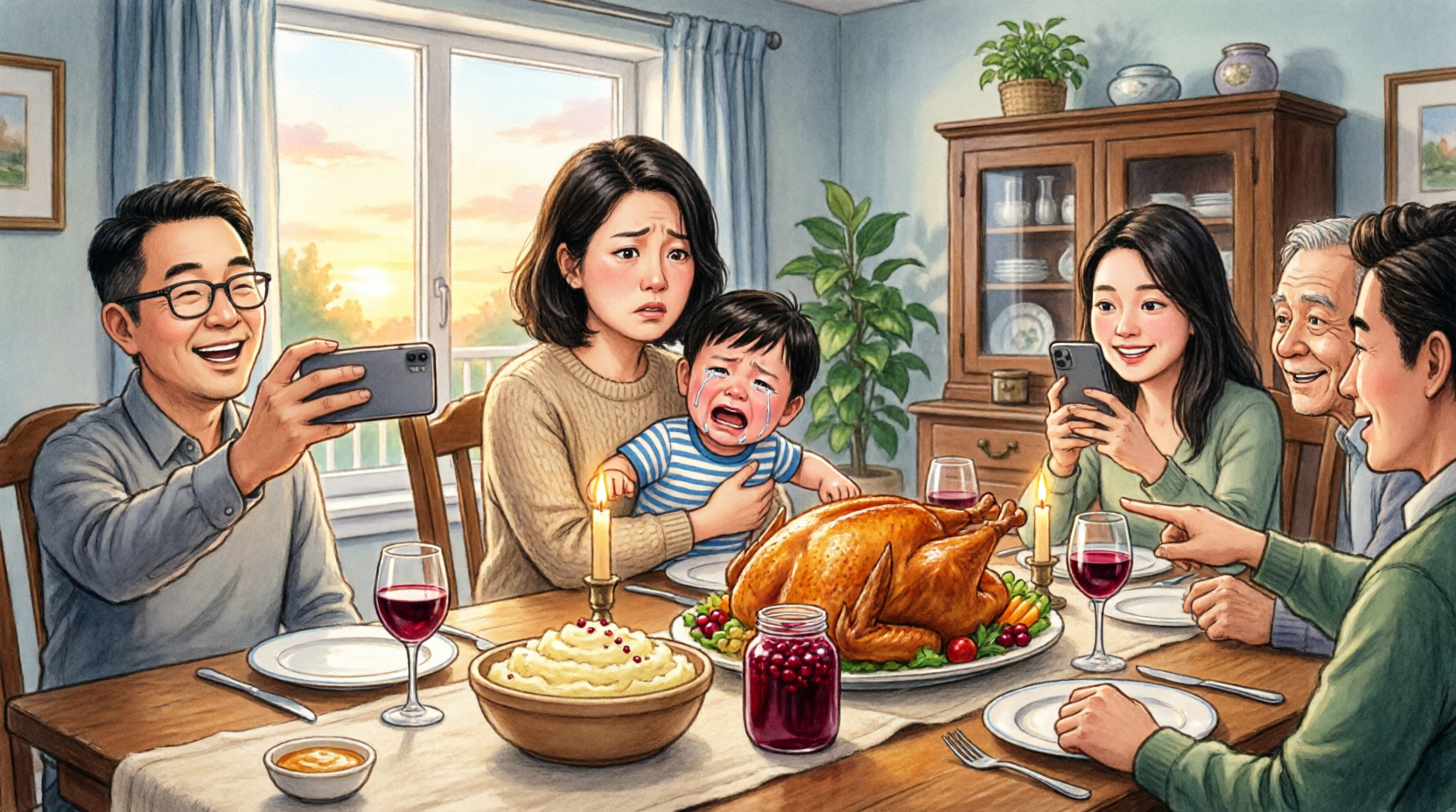
When Tracy Dalton leaned across the dining table and called my son sweetheart, my hand had already started shaking around the fork resting above my plate. The smell of roasted turkey filled the dining room of my parents’ house in Silver Brook, Kansas, yet the moment felt colder than the wind outside.
“Sweetheart,” Tracy said brightly so that everyone around the table could hear her clearly, “Thanksgiving turkey is for family.”
Then she slid the large serving platter away from Miles as if he had reached for a decorative centerpiece instead of food meant for dinner.
A short snort came from somewhere near the far end of the table, and one of my uncles released a tight laugh that sounded forced and uncomfortable at the same time. It was the kind of laugh people make when they know the joke is cruel but they still do not want to stand out by refusing to laugh.
My mother Darlene Whitaker stared down into the dark red wine inside her glass as though studying it very carefully. My father Franklin Whitaker continued carving the turkey in silence while pretending he had not heard a single word, as if avoiding eye contact could somehow erase the moment.
Miles froze with his small plate still half extended toward the platter, his hand hanging uncertainly in the air while his ears slowly turned pink. His gaze drifted down to the tablecloth decorated with tiny orange leaves, the one my mother only brought out for holidays she wanted to look perfect.
He did not protest or say the words that would have been painfully simple. He did not say that he belonged there.
He simply pulled his plate back little by little and stared at the lonely scoop of mashed potatoes already sitting on it while swallowing hard. A hot pressure filled the back of my eyes and tightened across my ribs as if someone had wrapped a strap around my chest and started pulling it tighter.
My first instinct was to stand up immediately, flip the table over, and throw the entire turkey against the wall so that every person present would be forced to face what had just happened. Instead I forced myself to remain completely still because the boy beside me needed calm more than he needed rage.
Tracy laughed and pushed the turkey dish closer to her own children, then she added in a tone that sounded falsely kind, “You can have more potatoes, Miles, because you already had pizza at your dad’s place this week and you are not missing anything important tonight.”
Miles nodded quickly as if agreeing would make the moment disappear, and he answered softly, “Yeah, it’s okay.”
I looked around the table and waited for someone to object or even frown, but nobody spoke and the silence stretched like an invisible rope around the room. My mother cleared her throat as though she might say something, yet Tracy interrupted with a brittle smile.
“Relax, Mom,” Tracy said while waving her hand casually. “It was just a joke and he knows we love him.”
That word joke always worked the same way in my family because it tried to cover cruelty with a thin layer of perfume. People shifted in their chairs and someone clinked a glass against another, then the conversation lurched forward as though nothing had happened at all.
Miles stared at his plate because he knew that if he looked at me the truth would become unavoidable. I pushed my chair back and the scraping sound across the tile floor echoed through the room sharper than I intended.
“Hey buddy,” I said while standing and forcing my voice to remain steady. “Go grab your jacket.”
Miles blinked with confusion in his eyes and asked quietly, “Are we leaving already?”
“Yes,” I answered while reaching for his hand even though my palm was damp with nerves. “We are going.”
Nobody reacted at first and the only sound was the slow ticking of the kitchen clock. Then my father finally looked up with the carving knife still in his hand.
“Taylor, come on,” Franklin said with a sigh. “We just sat down for dinner.”
I kept my eyes away from him and repeated gently, “Miles, your jacket.”
Tracy leaned back in her chair and laughed again in the same sharp way she had laughed since childhood whenever she turned me into the family punchline. “Are you honestly storming out because of turkey?” she asked with open disbelief.
I finally looked at her and answered quietly, “I am leaving because my son deserves better than this table.”
Miles returned with his blue jacket and slipped his hand into mine without saying anything. We walked toward the door while conversations behind us faded into awkward murmurs that nobody seemed brave enough to turn into real words.
Cold air greeted us the moment we stepped outside and Miles breathed out slowly like someone escaping a crowded room. The sky above Silver Brook was already dark and the porch light glowed yellow behind us.
“Did I do something wrong?” he asked after a few seconds.
I knelt beside him and shook my head firmly. “You did nothing wrong at all.”
He hesitated before asking another question that sounded older than his years. “Am I not family to them?”
I took a long breath before answering because honesty mattered more than comfort in that moment. “Some people forget what family means, but that does not change the truth.”
Miles studied my face carefully. “Then what does family mean to you?”
“It means the people who show up for you and treat you like you belong,” I said while squeezing his shoulder gently.
We drove away from Silver Brook that night without finishing dinner and without saying goodbye to anyone still sitting around that table. The highway stretched ahead under quiet stars and Miles eventually fell asleep in the passenger seat.
Life after that evening slowly began to change in ways I did not expect.
Miles and I started creating our own traditions instead of trying to squeeze ourselves into gatherings that left us feeling small. We took short trips across the country whenever school vacations arrived, and every journey felt like building a new memory strong enough to replace an old one.
One spring we camped beneath the enormous skies of Texas, where Miles lay on the grass and tried counting stars until he lost track somewhere past a hundred. Another year we spent a long weekend in New Orleans, and he laughed after biting into his first powdered beignet because sugar covered his nose.
“These taste like clouds,” he declared happily while brushing powder from his jacket.
During a summer road trip we drove north through Colorado to visit his father in Durango, and along the way we stopped at mountain viewpoints where Miles stretched his arms wide toward the peaks.
“Do you think people can hold mountains inside their hearts?” he asked one afternoon while the wind rushed through the valley.
“I think hearts grow when we fill them with good things,” I replied.
Back home something else began to shift slowly.
My parents started reaching out more often after that Thanksgiving, and although the first conversations were awkward they gradually became sincere. My father attended one of Miles’s school science fairs and asked careful questions about a project involving planets.
My mother began calling on birthdays and sending postcards from places she visited with my father. They were not perfect changes, yet they were real efforts.
Tracy also changed in her own way after starting therapy and finding steady work at a small design company in Omaha, Nebraska. She stopped pretending that life was flawless and began rebuilding her relationship with Miles step by step.
She attended his soccer games quietly and clapped for him without teasing. She even apologized one afternoon while sitting on my porch.
“I handled that Thanksgiving terribly,” she admitted with a tired expression. “I thought humor would hide the tension but it only made things worse.”
Miles listened carefully before nodding. “You can still come to my games,” he said.
Years passed and the fragile pieces of our family slowly formed something steadier. Meanwhile I learned a lesson that stayed with me longer than any argument or apology.
I stopped trying to earn a seat at someone else’s table. Instead I built one where kindness was not optional.
The following Thanksgiving Miles and I hosted a small dinner at the farmhouse of my friend Natalie Ortiz outside Boulder, Colorado. Friends arrived with children and warm dishes while laughter drifted through the house without the sharp edges that once haunted our holidays.
When it was finally time to serve the turkey, Miles stepped forward holding his plate and smiling widely.
I carved a generous slice and placed it on his plate before saying warmly, “Turkey is for family.”
Miles looked around the room filled with people who genuinely cared about him. Then he nodded with bright eyes and answered, “Good, because we are.”