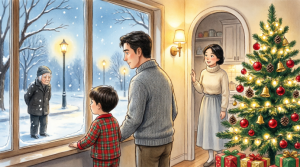
I was five years old the first time I saw him. It was Christmas Eve, 1994. Snow was falling outside, big fat flakes that caught the light from our porch and sparkled like diamonds. I was supposed to be in bed, supposed to be asleep so Santa could come, but I had snuck downstairs to peek at the presents under the tree. I was crouched behind the couch, counting the boxes with my name on them, when I saw movement through the window. A man was standing across the street. He was tall, wearing a dark coat, his breath forming clouds in the frozen air. He was not moving, not walking anywhere, not waiting for someone. He was just standing there, perfectly still, staring at our house, staring at me. I did not scream. I did not run. I just stared back, this five-year-old boy in his pajamas locked in a silent exchange with a stranger in the snow. There was something in his eyes, even from that distance, that I could not understand. Something sad. Something desperate. Something that looked almost like love. Then my father’s hand clamped down on my shoulder.
“What are you doing out of bed?”
“Daddy, there’s a man outside.”
My father looked through the window, and his face changed. I had never seen that expression before, but I would see it many times over the years. Fear. Pure, naked fear.
“Go to your room. Now.”
“But Daddy—”
“I said now.”
I ran upstairs. From my bedroom window, I watched my father burst out the front door and march across the lawn. I could not hear what he was saying, but I could see him pointing, gesturing, his body rigid with anger. The man in the coat did not move, did not respond. He just stood there, absorbing my father’s rage as if it were nothing. Then the police car arrived. Two officers got out. They talked to my father, then walked over to the man. I watched them escort him to the patrol car, watched them put him in the back seat, watched the car drive away into the snowy night. The man looked up at my window as they drove past. Even through the glass, even through the falling snow, I swear he was looking directly at me. I did not sleep that night. I lay in bed staring at the ceiling, thinking about the man in the coat, thinking about the way my father’s face had changed when he saw him, thinking about that look in the stranger’s eyes. I did not know it then, but that Christmas Eve was the first of twenty-five. Every year, without fail, the man would return. Same spot, same time, same silent vigil in the snow. And every year, my parents would call the police.
I should tell you who I am. My name is Ryan Anderson, and I am thirty-five years old. I work as an architect in Philadelphia, designing buildings that I hope will still be standing long after I am gone. I have a good life by most measures, a career I love, an apartment in a nice neighborhood, friends who care about me, all the trappings of success you are supposed to accumulate by your mid-thirties. But I have always felt like there was something wrong with my life. Something off, like a painting that looks fine from a distance but reveals strange distortions when you look too closely. My parents were good people, or at least they seemed like good people. My father, Richard Anderson, was an accountant, steady and reliable, the kind of man who wore the same style of khaki pants every day of his life. My mother, Patricia, was a homemaker who later became a real estate agent. They lived in the same house in suburban Connecticut for forty years, attended the same church every Sunday, had the same friends over for dinner every month. They were normal. Aggressively, almost performatively normal, the kind of family that appears in stock photos for picture frames. But there was always something underneath, something I could never quite put my finger on. A tension in the air when certain topics came up. A guardedness in my mother’s eyes when I asked about my birth or my early childhood. A way my father would change the subject whenever I mentioned the man who came every Christmas.
“He is a stalker,” my father told me when I was eight, old enough to start asking real questions. “A dangerous man. He is obsessed with our family for some reason. The police know about him. They keep an eye on him.”
“But why does he come every Christmas?”
“Because he is sick in the head. Some people are. You just have to stay away from them.”
“Has he ever hurt anyone?”
My father’s jaw tightened.
“Not yet, but he could. That is why we have the restraining order. That is why you must never, ever go near him. Do you understand?”
“Yes, Daddy.”
“Promise me.”
“I promise.”
I kept that promise. Every Christmas Eve, when I saw the man across the street, I stayed inside. I watched from my window, watched this strange annual ritual as my father called the police and the officers came and took the man away. Year after year, the same performance, like a play that never changed. But I never stopped wondering. Who was he? Why did he come? What was he looking for in the windows of our house? And why were my parents so afraid of him?
As I grew older, the man aged too. I watched him go from a tall figure in a dark coat to a stooped old man in a threadbare jacket. His hair turned gray, then white. His posture curved. But he never stopped coming. I remember specific Christmases burned into my memory like photographs. When I was seven, it snowed so hard that the roads were nearly impassable. I thought for sure he would not come. But at exactly eight o’clock, there he was, standing in knee-deep snow, ice crystals forming on his coat. He stayed for three hours that night. The police took forty minutes to arrive because of the weather. He did not move the entire time. When I was ten, I got a telescope for Christmas. That night, after everyone was asleep, I pointed it at him. Through the lens I could see his face clearly for the first time. He was younger than I expected, and there were tears frozen on his cheeks. He was holding something in his hands, looking down at it. Years later, I would learn it was a photograph of my mother, his wife, Elizabeth, holding me in the hospital the day I was born. When I was thirteen, my father was out of town on a business trip. My mother called the police as usual, but something was different that night. After the officers took the man away, I saw my mother standing at the window watching. She was crying. Not angry tears, not frightened tears, just crying silently, her hand pressed against the glass as if she were reaching for something she could not touch. I asked her about it the next morning.
“I was not crying,” she said, not meeting my eyes. “You must have imagined it.”
I did not imagine it, and I never forgot it.
When I was twelve, I worked up the courage to ask my mother about him. Mom, who is that man, the one who comes every Christmas? She was washing dishes at the kitchen sink. Her hands stopped moving.
“What man?”
“You know what man. The one Dad always calls the police on.”
“He is nobody. Just a troubled person who fixated on our family.”
“But why? Why us?”
“I do not know, sweetheart. Sometimes there is no reason. Some people are just broken.”
“Has he ever tried to talk to you? To tell you why he comes?”
She turned to look at me, and I saw something in her eyes that I did not recognize. Fear, yes, but something else too. Something that looked almost like guilt.
“He has nothing to say that we need to hear. Trust me on that. Ryan,” her voice sharpened, “drop it, please. For your own good.”
I dropped it, but I did not forget. When I was fifteen, I did something I had never done before. I went outside on Christmas Eve. The man was in his usual spot across the street, half hidden by the shadows of the oak tree on the Hendersons’ lawn. I walked toward him slowly, my heart pounding, half expecting my father to burst out of the house and drag me back inside. The man saw me coming. His eyes went wide. He took a step back, then stopped, as if he had frozen in place. I stopped about ten feet away from him, close enough to see his face clearly for the first time. He was maybe sixty, with deep lines around his eyes and a weathered face that spoke of hard years. But it was his eyes that struck me. They were the same color as mine, the exact same shade of grayish blue I saw every morning in the mirror.
“Who are you?” I asked.
He opened his mouth, closed it, opened it again.
“I’m sorry,” he whispered. “I’m so sorry.”
“Sorry for what? What do you want?”
“Ryan!”
My father’s voice cut through the night like a knife.
“Get inside. Now.”
The man looked at my father, and something passed between them. Something dark, something hateful.
“Tell him,” the man said, his voice cracked and broken. “He deserves to know.”
“You do not get to say what he deserves. You gave up that right thirty years ago.”
“I did not give up anything. You took him from me.”
“Inside, Ryan. Now.”
My father grabbed my arm and pulled me toward the house. I looked back at the man still standing in the shadows, and I saw tears streaming down his face.
“Tell him!” he called after us. “Please tell him the truth!”
My father slammed the door. He turned to me, his face red with fury.
“What did I tell you? What did I make you promise?”
“I just wanted to know—”
“You do not need to know anything. That man is dangerous. He has been stalking this family since before you were born. The only reason he is not in prison is because he is smart enough to stay just on the right side of the law.”
“He said you took me from him. What did he mean?”
Something flickered in my father’s eyes, fear, panic, and then, just as quickly, it was gone, replaced by controlled anger.
“He is delusional. He has some fantasy in his head about being connected to our family. It is not true. None of it is true.”
“But his eyes, Dad. They look just like mine.”
“Coincidence. Nothing more.”
He put his hands on my shoulders, forcing me to look at him.
“Ryan, listen to me. That man would say anything, do anything, to get close to you. He is obsessed. Mentally ill. You cannot believe a word he says.”
“But—”
“No buts. I need you to trust me. I am your father. I have protected you your entire life, and I am telling you that man is a threat. Stay away from him. Do you understand?”
“Yes, sir.”
“Good. Now go to bed. It is Christmas.”
I went to my room, but I did not sleep. I lay awake all night thinking about the man’s eyes, thinking about the way he had said, I’m sorry, thinking about the words that kept echoing in my head.
“You took him from me.”
What did it mean?
I tried to find out. Over the next few years, I did research. I searched public records. I looked through old newspapers at the library. I even tried to find the man himself, to talk to him, to ask him directly what he had meant, but I could never find him. He seemed to exist only on Christmas Eve, materializing out of the darkness for a few hours before disappearing again. The police would not tell me anything. The restraining order was sealed. Every avenue I tried led to a dead end.
And then I went to college, and life got busy, and the mystery of the Christmas Eve man faded into the background. I still saw him every year when I came home for the holidays, still watched him from my window, older and frailer each time, still keeping his lonely vigil. But I stopped asking questions. Stopped trying to find answers. I told myself it did not matter. I told myself my father was right, that the man was just a disturbed stranger with a fixation on our family. I told myself some mysteries are better left unsolved.
I was wrong.
The call came on December 28, three days after Christmas. I was in my apartment in Philadelphia, still on vacation from work, enjoying the quiet days between holidays. My phone rang. An unfamiliar number with a Connecticut area code.
“Hello?”
“Mr. Anderson? Ryan Anderson?”
“Yes.”
“My name is Thomas Greenfield. I am an attorney in Hartford. I am calling about the estate of David Mitchell.”
“I don’t know anyone named David Mitchell.”
There was a pause.
“Mr. Anderson, David Mitchell passed away on Christmas morning. He left a will, and you are named as the sole beneficiary of his estate.”
“There must be some mistake. I have never heard of this person.”
“There is no mistake. Mr. Mitchell was very specific in his instructions. He wanted you, and only you, to inherit everything he had. He also left a letter for you, which I am legally obligated to deliver in person.”
My head was spinning.
“I don’t understand. Why would a complete stranger leave me his estate?”
Another pause, longer this time.
“Mr. Anderson, David Mitchell was not a stranger to you. He was the man who stood outside your parents’ house every Christmas Eve for the past twenty-five years.”
The world tilted. I grabbed the edge of my kitchen counter to steady myself.
“The stalker?”
“That is what your parents called him, yes. But that is not who he was. Not really. Mr. Anderson, I think you should come to my office. There are things you need to know. Things Mr. Mitchell wanted you to know before he died.”
I drove to Hartford that afternoon. Three hours on I-84, my mind racing the entire way. The man was dead. The man who had haunted my childhood, who had stood in the snow every Christmas Eve for a quarter century, was gone. And he had left me everything.
Why?
Thomas Greenfield’s office was in a small building downtown, above a bakery that smelled of fresh bread. He was older than I expected, maybe seventy, with wire-rim glasses and a gentle manner that put me immediately at ease.
“Thank you for coming so quickly,” he said, gesturing to a chair across from his desk. “I know this must be overwhelming.”
“That is an understatement. Can you please explain what is going on? Why did this man leave me his estate? What was his connection to my family?”
Greenfield removed his glasses and rubbed his eyes.
“This is not easy to say, Mr. Anderson. I have known David Mitchell for thirty years. He was my friend, not just my client. And he spent those thirty years carrying a burden that no person should have to carry.”
“What burden?”
“The burden of losing his son.”
The room seemed to shrink around me.
“His son?”
Greenfield reached into his desk drawer and pulled out a thick envelope yellowed with age, along with a newer envelope that was crisp and white.
“The older envelope contains documents. Birth certificate, adoption records, DNA test results. The newer one contains a letter from David to you. He wrote it last month when he knew his heart was failing.”
“I do not understand. What does his son have to do with me?”
Greenfield looked at me with something like pity.
“Mr. Anderson, David Mitchell was your biological father. You are the son he lost.”
I stared at him. The words did not make sense. They were just sounds, syllables arranged in an impossible order.
“That is impossible. I am not adopted. My parents are Richard and Patricia Anderson. I have their family photos. I have their stories about my birth. I have—”
“You have a carefully constructed fiction.”
Greenfield pushed the older envelope toward me.
“The truth is in here. David spent twenty years gathering this evidence. DNA tests, hospital records, testimony from nurses who worked at the hospital where you were born. It is all documented.”
I picked up the envelope. My hands were shaking.
“How… how is any of this possible?”
“It is a long story. Perhaps you should read David’s letter first. He explains it better than I could.”
I opened the white envelope. Inside was a handwritten letter, several pages long, written in a shaky script that spoke of age and illness.
My dear Ryan,
If you are reading this, then I am gone and you finally know the truth. I am sorry it had to happen this way. I am sorry I could not tell you myself, face to face, the way a father should tell his son. But your parents made sure that was impossible. They made sure we would never have a real conversation, never have a chance to know each other. So I am writing this letter instead, my last words to the son I watched grow up from across the street.
You were born on March 15, 1989, at Hartford General Hospital. Your mother’s name was Elizabeth Mitchell. She was my wife, the love of my life, and she died three days after you were born from complications of childbirth. I was devastated, lost. I did not know how to be a father without her. I did not know how to take care of a baby on my own. I was twenty-four years old, working at a factory, making barely enough to pay rent. I had no family, no support system, nothing.
Your mother’s doctor, a man named Harold Simmons, saw an opportunity. He told me that there was a couple who wanted to adopt a baby. Good people, he said. Wealthy, stable. They could give you everything I could not. He told me it would be better for you. I was weak, Ryan. I was grieving and scared, and I made the worst decision of my life. I agreed to let them take you.
But here is what I did not know. The adoption was not legal. Simmons was running a black-market operation, selling babies to couples who could not adopt through normal channels. Richard and Patricia Anderson paid him fifty thousand dollars for you. Cash, off the books. No court involvement, no legal process, no records. By the time I realized what had happened, by the time I understood that I had been manipulated, it was too late. You were already living with the Andersons. They had created a fake birth certificate. They had built a whole false history. And when I tried to get you back, they got a restraining order against me. They told the police I was a stalker, a dangerous man obsessed with their family. I hired lawyers. I fought for years, but they had money and connections, and I had nothing. Every case was dismissed. Every appeal was denied. The system was rigged against me from the start.
So I did the only thing I could do. I watched you grow up from a distance. Every Christmas Eve, I would come to your house. I would stand across the street and look at the windows and imagine what you were doing inside. Opening presents, laughing with your family, living the life I could not give you. I know how it looked. I know your parents told you I was dangerous. But I was not there to hurt anyone. I was there because I could not stay away. Because even one glimpse of you, even from across the street, was enough to keep me going for another year.
I saw you grow from a baby to a boy to a teenager to a man. I saw you learn to ride a bike. I saw you go to prom. I saw you graduate high school. I was there for all of it, even though you did not know. That night when you were fifteen, when you came outside to talk to me, was the happiest and saddest moment of my life. Happy because you were finally standing in front of me, close enough to touch. Sad because I could not tell you the truth. I could not explain who I was or why I came. I wanted to. God, how I wanted to. But your father was watching. The restraining order was still in effect. If I had said one wrong word, I would have gone to prison, and I would have lost even the small connection we had. So I said I was sorry, because I was. I am sorry for giving you up. I am sorry for not fighting harder. I am sorry for every Christmas you spent not knowing that your real father was standing just outside, loving you with everything he had.
I do not expect you to forgive me. I do not expect you to think of me as your father. Richard Anderson raised you. He was there for the scraped knees and the homework and the driving lessons. He earned the title that I gave away. But I wanted you to know the truth before I died. I wanted you to know that you were not abandoned. You were not unwanted. You were loved.
Ryan, every single day of your life, you were loved by a man who would have given anything to hold you just once.
I am leaving you everything I have. It is not much. A small house, some savings, a collection of photographs I took of you over the years from across the street through a telephoto lens. I know that sounds creepy. I know it sounds like everything your parents accused me of. But those photographs were all I had. They were my connection to you, my proof that you existed, that you were real, that the son I lost was out there living his life.
Go through the documents Mr. Greenfield has. Verify everything for yourself. And then, if you want, find out what really happened. Find out what Richard and Patricia Anderson did to get you. Find out how Dr. Simmons ran his operation. Find out how many other children were bought and sold while the police looked the other way.
You deserve the truth, Ryan. All of it.
I love you. I have always loved you. And I am sorry we never got the chance to know each other.
Your father,
David Mitchell
I read the letter twice, then a third time. The words blurred together through my tears.
“Is it true?” I asked Greenfield. “Is all of this true?”
“Every word. I helped David gather the evidence over the years. DNA tests, hospital records, everything. It is all documented in that envelope.”
“My parents bought me on the black market.”
“That is what the evidence suggests, yes. Dr. Simmons was eventually investigated in 2003, but he died before charges could be filed. The case was closed. The records were sealed.”
“And my father, my biological father, spent twenty-five years standing outside my house every Christmas Eve?”
“Without fail. He said it was the only time of year he could be sure you would be home. The only time he could see you, even from a distance.”
I put my head in my hands.
“I spoke to him once. When I was fifteen. He was crying. He said, ‘Tell him the truth.’ I thought he was crazy.”
“He was not crazy. He was a father who lost his son and spent his whole life trying to get him back.”
“Why didn’t he just tell me when I was old enough to understand?”
“The restraining order. Your parents threatened to have him arrested if he ever spoke to you directly. They told the police he was a danger to you. After that night when you were fifteen, they got the order extended. He was legally prohibited from coming within a hundred feet of you. But he still came every Christmas. He stayed on the other side of the street, technically outside the restricted zone. It was a loophole. The only way he could still see you.”
I opened the older envelope and started going through the documents. Birth certificate listing David Mitchell and Elizabeth Mitchell as parents. Hospital records from Hartford General. A DNA test from 2005 showing a 99.97 percent probability that David Mitchell was my biological father. Photographs of a young couple, the woman pregnant and glowing, the man looking at her as though she were his whole world. And adoption papers, falsified adoption papers, with Dr. Harold Simmons’s signature at the bottom. Everything David had written in his letter was documented, verified, real.
My entire life was a lie.
I drove to my parents’ house that night. I did not call ahead. I did not give them any warning. I just showed up on their doorstep with the envelope in my hand.
My mother answered the door.
“Ryan? What are you doing here? Is everything okay?”
“No. Everything is not okay. We need to talk.”
She saw the envelope. Her face went pale.
“Where did you get that?”
“From David Mitchell’s lawyer. He died on Christmas morning. But before he died, he left me his estate. And he left me the truth.”
My mother’s hand went to her mouth. She looked like she might faint.
“Richard,” she called, her voice barely above a whisper. “Richard, come here.”
My father appeared from the living room, newspaper in hand. He saw the envelope. He saw my face. I watched the color drain from his expression.
“Inside,” he said.
We sat in the living room, the same room where I had opened Christmas presents as a child, where we had watched movies on Friday nights, where we had lived our lives as a family. Only now that family felt like a fiction.
“Start talking,” I said. “Tell me everything.”
My father set down his newspaper. He looked at my mother. Something passed between them, some silent communication forged over decades of shared secrets.
“How much do you know?” he asked.
“I know that David Mitchell was my biological father. I know that you bought me from a doctor who was running a black-market adoption ring. I know that you spent twenty-five years lying to me about who I am.”
“It is not that simple.”
“Then make it simple. Explain to me how you justify buying a baby. Explain to me how you justify stealing someone’s child.”
“We did not steal you,” my mother said, her voice pleading. “He gave you up. He signed the papers.”
“He was manipulated. He was grieving. His wife had just died, and some doctor convinced him that giving up his son was the right thing to do.”
“We did not know that,” my father said. “Simmons told us the father wanted to give the baby up. He said it was a private adoption, legal and above board. We had no idea it was anything else.”
“Then why the fake birth certificate? Why the elaborate lies? Why did you treat David Mitchell like a criminal for twenty-five years?”
Silence.
“That is what I thought. You knew. You knew what you were doing. And when he tried to get me back, you used your money and your connections to shut him down.”
“We were protecting you.”
My father’s voice was hard now, defensive.
“That man was unstable. He showed up at our house demanding to see you. He made threats.”
“He said he would take me away from you because I was his son. Because you had his son.”
“You were our son. From the moment we brought you home, you were our son. We raised you. We loved you. We gave you everything.”
“You gave me a lie. My whole life, my whole identity, was built on a lie.”
My mother was crying now, tears streaming down her face.
“We did what we thought was best. Simmons told us the biological father was unreliable. He said the baby would be better off with a stable family. We believed him. And when David showed up, when he told us the truth, we did not believe him. We thought he was trying to con us to get money. It was not until later, until he started coming every Christmas, that we realized he might be telling the truth.”
“But you still did not give me back.”
“How could we?” My father stood up and paced the room. “You were five years old. You did not know any other family. Giving you back would have destroyed you.”
“So instead you destroyed him. You made him a pariah. You told everyone he was a stalker. A dangerous man. You took away his only chance to know his son.”
“We were protecting you.”
“You were protecting yourselves. You were protecting your secret.”
I stood up, the envelope clutched in my hand.
“I do not know if I can forgive you for this. I do not know if I can ever look at you the same way again.”
“Ryan, please.” My mother reached for me. “We love you. Everything we did, we did because we love you.”
“Love does not lie. Love does not steal. Love does not spend twenty-five years pretending that an innocent man is a monster.”
“He was not innocent. He gave you up.”
“He was twenty-four years old, and his wife had just died. He was manipulated by a doctor who saw him as a mark. And when he realized his mistake, when he tried to fix it, you made sure he never could.”
I walked toward the door.
“Ryan, where are you going?” my mother asked.
“I am going to find out the truth. All of it. I am going to talk to everyone who knew David Mitchell. I am going to find out exactly what happened and who was responsible. And then I am going to decide what to do about you.”
“What does that mean?”
“It means I do not know if I have a family anymore. It means I do not know who you are.”
I left. Behind me I could hear my mother sobbing, my father calling my name. I did not look back.
The next few months were a blur. I took a leave of absence from work. I moved to Hartford temporarily, staying in the small house David Mitchell had left me. I went through his belongings, his photographs, his journals. I pieced together the life of the father I never knew.
The house was modest, a small Cape Cod on a quiet street, the kind of house a factory worker could afford on a steady salary. Two bedrooms, one bathroom, a kitchen that had not been updated since the seventies. Nothing fancy, nothing extravagant. But it was full of me.
The first time I walked through the front door, I stopped in the living room and could not move. Every wall, every surface, every corner was covered with photographs of me. Not family photos, not posed portraits. Surveillance photos. Photos taken from across streets, through windows, at school events and baseball games and graduation ceremonies. Hundreds of them. Maybe thousands. They documented every stage of my life, from infancy to adulthood.
It should have felt creepy. It should have felt like proof that my parents were right, that this man was a stalker and obsessive and a threat. But standing there, surrounded by images of myself, I did not feel fear. I felt grief. A grief so deep and vast that I had to sit down on the floor and just breathe for twenty minutes before I could continue.
He had been there for everything. Every milestone, every achievement, every ordinary Tuesday. He had been there, watching from a distance, unable to reach me but unwilling to look away.
In the bedroom closet, I found boxes labeled by year. Each box contained a year’s worth of photographs, carefully organized and dated. He had started when I was born and never stopped. Thirty-five years of photographs. Thirty-five years of watching.
I also found the camera. A professional-grade Nikon with a telephoto lens so powerful it could capture faces from three hundred yards away. The lens alone must have cost more than a month of his salary. He had invested in the best equipment he could afford because he wanted to see me clearly. He wanted to see my face, even if I could not see his.
In the kitchen drawer, I found notebooks. Dozens of them, filled with handwritten observations.
March 15, 2002. Ryan’s thirteenth birthday. Saw him through the window blowing out candles on a cake. He looked happy. Patricia hugged him. Richard patted his shoulder. I wish I could have been there. I wish I could have been the one to hug him.
September 4, 2007. First day of senior year. Ryan drove himself to school in a blue Honda Civic. He parked in the student lot and walked in with two friends. He is so tall now. He looks like Elizabeth. The same way of walking, the same tilt of the head. I miss her so much.
June 12, 2011. Ryan graduated from college. I sat in the back row of the auditorium, too far away to be recognized. When they called his name, when he walked across that stage, I cried. My son. My son is a college graduate. Elizabeth would have been so proud.
I read every notebook, every entry. Thirty-five years of a father’s love documented in blue ink on lined paper. By the time I finished, I had cried so much my eyes were swollen nearly shut.
He had been a good man. Everyone I talked to said so. His neighbors. His co-workers at the factory where he had worked for thirty years. The pastor at the church he attended every Sunday.
“David was one of the kindest people I ever met,” the pastor told me. “He never had much, but he gave what he could. He volunteered at the food bank. He helped elderly neighbors with their yard work. He lived simply and asked for nothing.”
“Did he ever talk about me?”
“All the time. He had your photographs all over his house. He would show them to anyone who would look. ‘That is my son,’ he would say. ‘That is Ryan. He is an architect in Philadelphia. I am so proud of him.’”
I had to stop the interview because I was crying too hard to speak.
I found other victims of Dr. Simmons’s operation. Three families who had lost children to his black-market ring. Two of them had never found their children. One had reunited with her daughter only after the daughter did a DNA test in her forties and discovered the truth. Her name was Margaret. She was sixty-two now, a retired schoolteacher with gray hair and kind eyes. We met at a diner in New Haven, and she told me her story over coffee and pie.
“I was seventeen when I got pregnant,” she said. “Unmarried. My parents were furious. They sent me to a home for unwed mothers. One of those places where you were supposed to give birth in secret and then pretend it never happened.”
“And Simmons was involved?”
“He ran the whole operation. The home, the hospital, the adoptions. He told me my baby girl died during childbirth. He gave me a death certificate. I mourned for forty years.”
“But she was alive?”
“She was alive. She was alive and living in California. A couple had paid Simmons twenty thousand dollars for her. They raised her, loved her, gave her a good life. But she always knew something was wrong. She always felt like she did not belong.”
“How did you find her?”
“She found me. DNA database. She submitted her sample hoping to find biological relatives, and my niece’s daughter had submitted hers. The connection popped up, and she started asking questions.”
“What was it like meeting her after all those years?”
Margaret’s eyes filled with tears.
“It was the best and worst moment of my life. Best because she was alive. Because I got to hold my daughter, finally, after forty years. Worst because of all the time we lost. All the birthdays. All the Christmases. All the ordinary days. Gone. Stolen by a man who saw babies as commodities.”
“Did you ever get justice? Did anyone ever pay for what Simmons did?”
“No. He died before he could be prosecuted. The families who adopted the stolen children, most of them claimed they did not know. The system protected them, so it just ended. Nobody was held accountable.”
Margaret shook her head.
“That is how it works. The rich and powerful get away with things. The rest of us just have to live with the consequences.”
I thought about that conversation a lot over the following weeks. About justice. About accountability. About whether there was any point in trying to hold my parents responsible for what they had done. Part of me wanted revenge, wanted to expose them publicly, to ruin their reputation, to make them feel even a fraction of the pain David Mitchell had felt for thirty-five years. But another part of me, the part that had been raised by them, the part that had loved them despite everything, could not bring myself to do it. They were old now, in their seventies. Whatever punishment I could inflict would not change the past. It would not bring David back. It would not give me the childhood I should have had.
So I chose a different path.
“It never goes away,” Margaret told me when I asked how to move forward. “The anger, the grief. You learn to live with it. But it is always there.”
“How do you forgive the people who raised you? The people who bought you?”
“I do not know if I have. My adoptive parents are both dead now. We never talked about it. Maybe that is its own kind of forgiveness. Or maybe it is just cowardice.”
I thought about that a lot. About forgiveness. About what it means to love someone who has done something unforgivable. My parents called every day, left messages, sent letters. They were sorry. They said they had made mistakes. They wanted to explain, to make things right. I did not respond. Not yet. I was not ready.
Instead, I spent my time getting to know my father, the real father I never had the chance to meet. His house was small, modest, filled with thirty years of accumulated memories. Photographs of me at every age taken from a distance through windows and across streets. A scrapbook of newspaper clippings. Every article about me, from high school sports to my architecture firm’s projects. A drawer full of birthday cards he had written but never sent, one for every year of my life.
I read them all. Thirty-five cards. Thirty-five years of love I never received.
Happy 10th birthday, Ryan. I hope you are doing well. I hope you are happy. I watched you playing baseball last week. You have a good arm. Love, your father.
Happy 18th birthday, Ryan. You are a man now. I saw you at graduation. You looked so grown up. I am so proud of you. Love, Dad.
Happy 30th birthday, Ryan. I read about your architecture award. You are doing amazing things. I wish I could tell you in person. I love you, son.
Thirty-five years of longing condensed into handwritten cards.
I buried him in the spring. A small service, just me and a few of his neighbors, in a cemetery overlooking the Connecticut River. I read a eulogy I wrote myself, trying to capture the essence of a man I had known only through letters and photographs.
“David Mitchell spent his life loving someone he could not reach,” I said. “He made mistakes, like all of us do, but he never stopped trying to make things right. He never stopped hoping. He never stopped standing in the snow looking at a window, wishing things could be different. I wish I had known him. I wish I had more than photographs and letters and secondhand stories. But what I do have is this: the knowledge that I was loved. Every day of my life, I was loved by a man who would have done anything to be my father. I am not sure what happens after this. I am not sure how to reconcile the family I thought I had with the family I have discovered. But I know that David Mitchell deserves to be remembered. He deserves to be honored. And he deserves to finally rest in peace.”
I placed a flower on his grave. White roses, his favorite according to his neighbor.
“I’m sorry, Dad,” I whispered. “I’m sorry. I didn’t know.”
It took me six months to speak to my parents again. Six months of therapy, of processing, of trying to figure out how to move forward. I did not forgive them. I am not sure I ever will. But I accepted that they were part of my story, whether I liked it or not. They had raised me. They had shaped me. Cutting them out completely would mean cutting out a part of myself.
We met at a neutral place, a coffee shop in Hartford. My mother looked as though she had aged ten years. My father looked smaller somehow, diminished.
“Thank you for agreeing to see us,” my mother said.
“I am not here to reconcile,” I told them. “I am here to understand.”
“What do you want to know?” my father asked.
“Everything. From the beginning. No more lies.”
So they told me. They told me about the years of failed fertility treatments. About the desperation that led them to Dr. Simmons. About the moment they first held me in their arms and knew they would do anything to keep me. They told me about David showing up at their door when I was six months old. About the shouting match on the front lawn. About the threats that were made on both sides. They told me about the restraining order. About the lawyers. About the years of fighting that left everyone exhausted and bitter.
“We were wrong,” my father admitted. “We knew on some level that what we were doing was wrong, but we loved you so much. We could not imagine giving you up.”
“So you destroyed him instead.”
“We told ourselves he was dangerous. We told ourselves we were protecting you. After a while, we believed our own story.”
“And the Christmas visits? Every year for twenty-five years?”
My mother wiped her eyes.
“That was the hardest part. Knowing he was out there. Knowing he loved you as much as we did. But we were too afraid to change course, too afraid of what would happen if the truth came out.”
“The truth came out anyway.”
“Yes,” she said quietly. “It did.”
We sat in silence for a long time, three people connected by love and lies, trying to figure out where to go from there.
“I do not know what kind of relationship we can have,” I finally said. “I do not know if I can trust you again. But I am willing to try. Slowly. Carefully. With a lot of boundaries.”
“That is more than we deserve,” my father said.
“Yes,” I told him. “It is.”
It has been two years since David Mitchell died. Two years since I learned the truth about my life. I visit his grave every Christmas Eve. I stand there in the snow, just like he used to stand outside my window, and I talk to him. I tell him about my life, my work, the girl I am dating who knows the whole story and loves me anyway. I tell him I forgive him for giving me up, for not fighting harder, for all the years of standing in the cold instead of finding a way to reach me. I tell him I understand.
The relationship with my parents is complicated. We see each other a few times a year. We are careful with each other, polite, like strangers trying to become friends. Maybe someday it will be more than that. Maybe not. I have accepted that I cannot control the outcome. What I can control is how I live my life. What I do with the truth.
I have started volunteering with an organization that helps families affected by adoption fraud, connecting biological parents with children who were taken, advocating for better regulations, trying to make sure what happened to David Mitchell does not happen to anyone else.
Last month, I helped a woman named Teresa find her son. He had been sold through a different operation, similar to Simmons’s, but based in Florida. She had been searching for thirty years. When I handed her the folder with his contact information, she collapsed into my arms, sobbing.
“Thank you,” she kept saying. “Thank you. Thank you. Thank you.”
“Do not thank me yet,” I told her. “He might not want to see you. A lot of them do not.”
“I know. But at least now I have the chance. At least now I know he is alive.”
She called me two weeks later. Her son had agreed to meet her. They had talked for six hours at a restaurant in Miami. He was angry, confused, overwhelmed, but he was also curious. He wanted to know his story. He wanted to know where he came from.
“It is not going to be easy,” Teresa told me. “We have a long way to go. But we are trying. That is more than I ever thought I would have.”
That is what I do now. I help people try. I give them the chance David Mitchell never had.
Some nights, when I cannot sleep, I go through his journals again. I read his words, feel his presence, imagine what he would say if he could see me now. I think he would be proud. I think he would be glad his suffering led to something good.
At night, sometimes I dream about him, the man in the coat standing in the snow, looking up at my window. In the dreams, I go outside. I walk across the street. I stand next to him.
“I know who you are,” I say.
“I know,” he says. “I always hoped you would.”
And we stand there together, father and son, watching the snowfall on Christmas Eve. Sometimes we talk. Sometimes we just stand in silence, comfortable in each other’s presence. Sometimes he tells me stories about my mother, about Elizabeth, about the life they had planned before everything fell apart.
“She would have loved you so much,” he says in the dreams. “She only got to hold you for three days, but in those three days she loved you more than most people love anything in their entire lives.”
“I wish I remembered her.”
“You do not need to remember her. She is part of you. Every good thing you do, every kind word you speak, that is her. That is Elizabeth living on through her son.”
I wake up from those dreams feeling peaceful, feeling, for the first time in my life, like I know exactly who I am and where I came from.
That is the thing about truth. It does not undo the past. It does not fix what was broken. But it gives you something to build on, a foundation, a starting point. David Mitchell spent twenty-five years waiting for me to find him. He died before I did. But his letter, his documents, his photographs, they reached me when he could not. He finally got through. And I will spend the rest of my life making sure that matters.