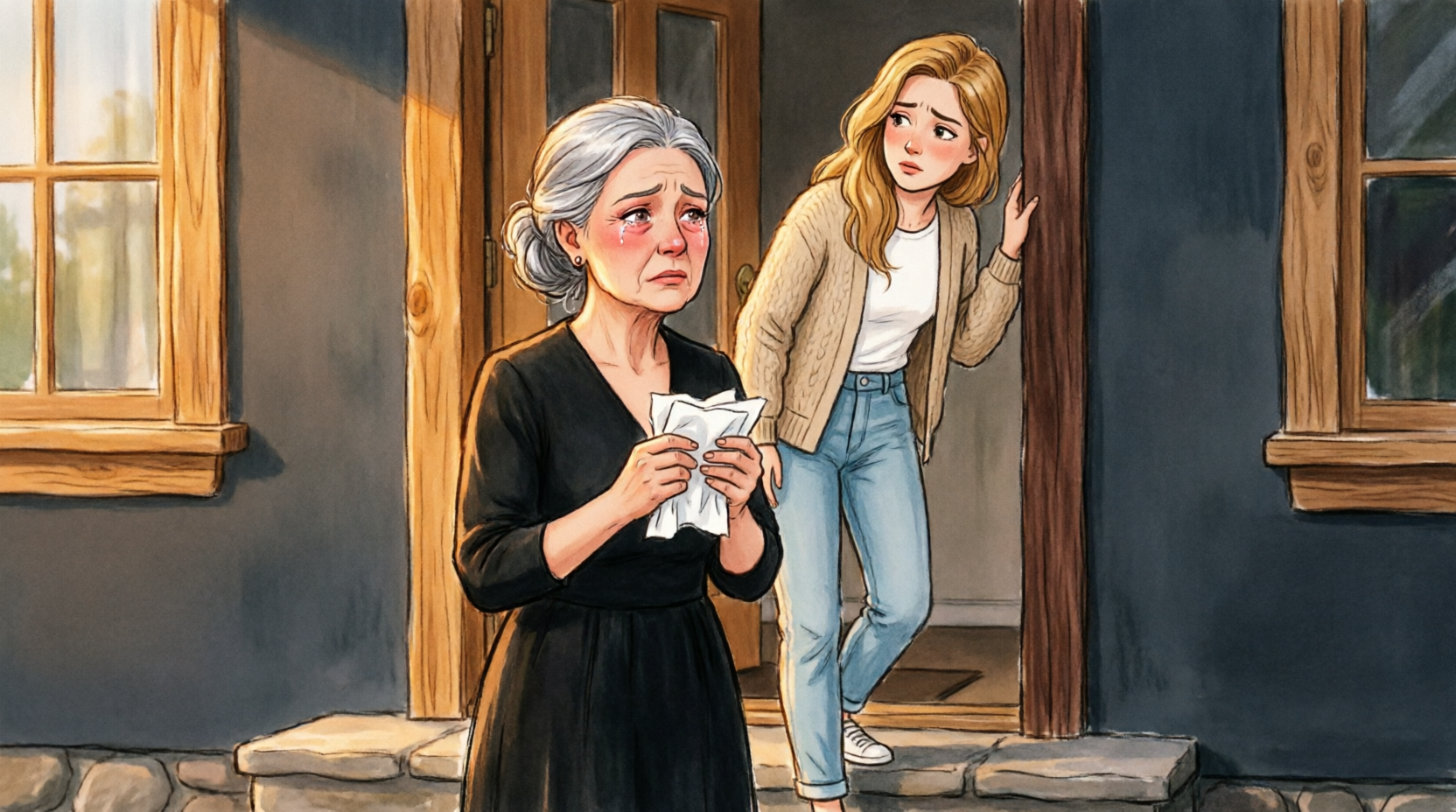
The envelope trembles in my hands before I even open it.
Not from the cold—though the mountain air has already sunk deep into my bones, personal and unforgiving. Not from grief either—though grief is everywhere, hanging in the rafters, pressing into my ribs, slipping under my skin with every breath. It’s because I recognize my son’s handwriting, and seeing it here, hidden beneath rotten floorboards in a ruined cabin my daughter-in-law used as punishment, feels far too intentional to be coincidence.
I sit on the splintered floor, the envelope resting in my lap, the metal box beside me.
For a long moment, I just stare at the word written across the front.
Mama.
No one has said it gently in days.
Since the funeral, every version of my name has sounded like a burden. Eulalia, when people wanted to know if I had somewhere to go. Señora, when officials pretended not to notice I was still wearing the same black shoes. “Vieja inútil,” when Monserrat stood in that four-million-dollar house and pointed me toward the mountain like I was something broken being thrown away.
I slide my finger under the flap and open it.
Inside, there’s a folded letter… and a small brass key taped to the corner. The paper feels thick, aged, like it has been waiting for me. My throat tightens before I read a single word, because there is something unbearable about being loved in advance by someone who is already gone.
I unfold it.
Mama,
If I’m reading this, it means one of two things. Either he had time to tell me the truth… or he didn’t, and left it here instead.
If it’s the second, I need to do something difficult.
I need to not trust Monserrat.
No matter what she says. No matter how she looks. No matter who defends her.
I stop reading.
The world tilts—not physically, but morally—the way it does when a single sentence shatters everything I thought I understood. For years, I trained myself to stay quiet about Monserrat. It felt disloyal to criticize her. Dangerous to make my son choose. Pathetic to sound like the bitter mother-in-law people whisper about.
So I swallowed everything.
I told myself Neftalí would see.
Maybe he did.
Maybe too late.
I keep reading.
The house is not what she says it is.
My eyes drift to the metal box beside me.
The brass key suddenly burns in my palm.
Outside, rain begins to fall—soft at first—but I barely hear it. I’m already inside another storm, built from memory. Monserrat calling me fragile at the funeral. Blocking me from taking my son’s photo. Saying, “Everything here is mine,” while others looked away.
I thought that cruelty was the end of the story.
Now I realize—it was the beginning.
The box is heavier than it looks. The lock is old. Ritual more than protection.
I insert the key.
It turns easily.
I open it.
Inside—three things.
A flash drive.
A stack of legal documents.
Another envelope with my name.
Underneath… something wrapped in cloth I’m not ready to touch.
I grab the second envelope and open it quickly.
Don’t go back alone.
Don’t show her anything.
Call Ben Harrow.
I close my eyes.
Scared.
I try to imagine my son writing that word. The boy who used to leap off roofs. The man who commanded rooms.
If he was scared… something was deeply wrong.
I go through the documents.
Legal phrases repeat.
Transfer on death.
Life estate.
Revocation clause.
I don’t understand everything.
But I understand enough.
The house Monserrat claimed… may not be hers at all.
Then I unwrap the final item.
A ledger.
Page after page of records. Numbers. Transactions.
Proof.
Not emotional proof.
Real proof.
The kind that destroys lies.
By midnight, the cabin no longer feels like a grave.
It still smells like damp wood and decay—but now it carries something else.
Intention.
My son didn’t send me here to disappear.
He sent me here to find power.
And that realization does not comfort me.
It does something stronger.
It gives my grief a backbone.
Because I wasn’t abandoned.
I was prepared.
And now, for the first time since I buried my son…
I am no longer helpless.