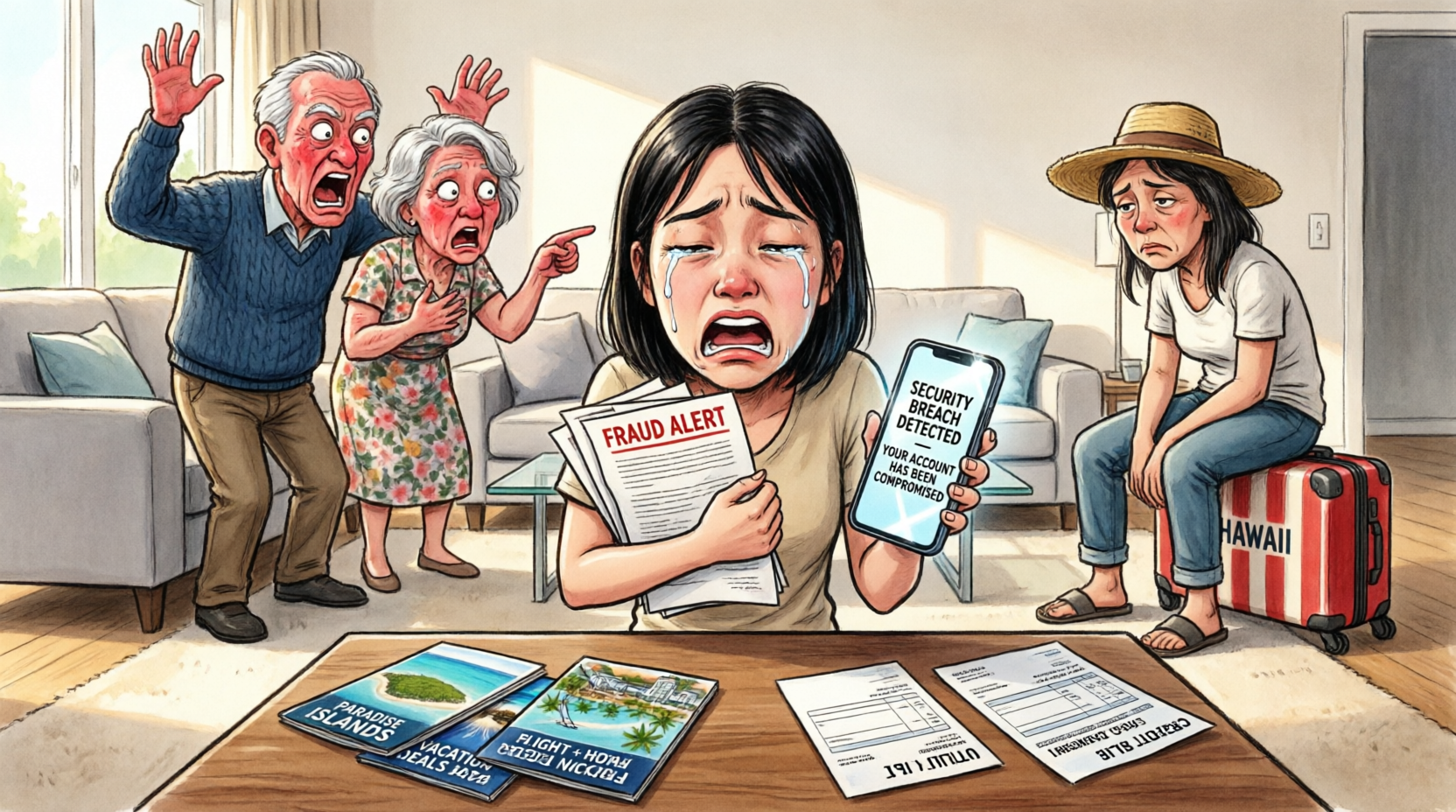
- My parents stole $99,000 from me, charging it to my American Express Gold card to pay for my sister’s Hawaii vacation. Then my mom called laughing, “Every dollar’s gone, worthless girl.” I told her, “Don’t laugh too soon.” When she got home, everything blew up.
-
that changed something in me. Not the theft. Not even the insult. The certainty. She really believed they had already won.
So I said the only thing that was true: “Don’t be quick to laugh.”
She actually paused. Just for a second.
Then she sneered, “Oh? What are you going to do?”
I looked at the transaction list, the one-time passcode change request, the merchant locations, and the travel names attached to the bookings. I thought about the conversation I’d had three months earlier with Ethan, the fraud specialist at my bank, after I told him I suspected family might someday try something drastic. I had taken precautions. Quiet ones. Legal ones. The kind desperate people never imagine until it is too late.
“You’ll see when you get home,” I said, and hung up.
That evening, while my parents were still laughing somewhere over the Pacific, the first wave hit.
Because when my mother opened her front door, she did not walk into a peaceful house.
She walked into two detectives, a uniformed officer, and a locksmith changing the locks on the very home she thought she controlled.
My mother called me thirteen times in six minutes after she got home.
I let the first eleven go to voicemail.
By the time I picked up, her laughter was gone. In its place was the high, breathless fury she slipped into whenever reality refused to follow the script she had written for it.
“What did you do?” she screamed the moment I answered. “Why are there police at my house? Why are they saying they need statements?”
I sat at my kitchen table with my laptop open, every document arranged in folders the way I had been forced to organize my life after growing up in a family where truth was whatever the loudest person said it was. “I reported ninety-nine thousand dollars in unauthorized charges,” I said. “Then I gave them the names of the people most likely to have access.”
My father grabbed the phone from her. I could hear the strain in his voice now, the panic trying to hide inside anger. “You insane little brat, you sent cops to our property?”
“No,” I said. “I sent them to the billing address tied to the device verification, the IP login match, and the travel confirmations. That happened to be your house.”
Silence.
Then, “What device verification?”
That was almost satisfying.
Three months earlier, after finding a credit card statement in the kitchen at my parents’ place with one line circled in my mother’s handwriting, I stopped dismissing my instincts. She had always been obsessed with what I earned, what limits I had, what accounts I used. Brianna treated security like a puzzle to beat for fun. So I called American Express, tightened every layer of protection I could, and then—on Ethan’s suggestion—enabled enhanced fraud tracing tied to digital access changes, merchant clustering, and known device authentication. It didn’t stop all fraud if the person had enough information. But it did create a trail.
And they had left one.
A login from my parents’ home network. A contact-preference update pushed through a tablet registered to Brianna’s Apple ID. Booking records matching her full travel name and passport details. Resort confirmations sent to an email alias my mother used for family bookings because she thought keeping things “organized” made them invisible.
I had not needed revenge. I had needed receipts.
Dad recovered first. “This is a misunderstanding.”
“No,” I said, “it’s felony fraud.”
Mom came back on the line and tried tears. Her favorite pivot. “You would destroy your own sister over a vacation?”
I nearly laughed. “You destroyed your own family over a vacation.”
That landed because it was true and because she had no moral language left to cover what they’d done. They had not borrowed. They had not panicked in an emergency. They had emptied my card to send Brianna to Hawaii in luxury and called me worthless for objecting.
What they didn’t know yet was that the “bomb” waiting at home was bigger than police questions and a locksmith.
The house they’d come home to was not just under police attention. It was under internal review by the lender too.
Years ago, after my grandmother died, my parents refinanced that house using income documentation that always seemed slightly too polished. I never had proof of anything concrete, only a long history of numbers around them not quite matching the lives they performed. But when I filed the fraud report, one investigator asked a routine question about possible financial motive and family dependency. I answered honestly. I mentioned their debts, my father’s failed contracting business, my mother’s habit of opening and closing store cards under “family management,” and Brianna’s expensive lifestyle with no stable income. That opened another door. One I did not personally control anymore.
So when they got home, detectives were there about my card. But taped inside the front entry was also a notice from their lender requesting urgent contact regarding irregular supporting documents recently reexamined during a compliance sweep. Coincidence? Technically, yes. Timing? Beautiful.
Mom was shouting now that none of this would hold, that family doesn’t prosecute family, that I was cruel, ungrateful, sick. All the old language. But fear had changed the rhythm. She kept asking who said what, what exactly the officers knew, whether Brianna had to come back immediately, whether I had told them about the safe.
The safe.
That was the second mistake she made on a recorded line.
I leaned back in my chair. “Interesting choice of words.”
She went quiet.
Because I had never told her how the card number had been stored. The only people who knew it was in my home safe were people who had been in my house without permission last Christmas while I was away on a work conference—the same holiday when my mother insisted on “watering my plants” and Brianna posted selfies from my living room.
Dad got back on the line, lower now, trying strategy instead of intimidation. “Listen. Let’s settle this privately. We’ll pay you back.”
“With what?” I asked. “The money you don’t have, or the vacation she’s already taken?”
He breathed once, hard.
That was when I realized the story they had built in their heads was collapsing faster than they could rebuild it. They thought they’d teach me a lesson, maybe scare me into silence with shame and family pressure. Instead, they had created a chain of documentation no one could explain away with tears at Thanksgiving.
I should say this clearly: I did not enjoy hearing them panic. What I felt was colder than enjoyment. Relief, maybe. Relief that for once, evidence existed outside my own memory.
Then my sister called from Maui.
She didn’t apologize either.
She only said, “Tell them I didn’t know it was your card.”
I stared at the phone and said, “That lie would work better if the resort booking wasn’t under your name.”
She hung up.
But the real collapse didn’t happen in Hawaii or on the phone.
It happened the next morning, when officers returned with a warrant for digital devices—and my mother finally understood that the joke she laughed about had turned into a criminal file number.
-
The next week was the longest of my life, not because I doubted what I had done, but because family fraud does something uniquely exhausting to your nervous system. It forces you to hold two realities at once: the legal facts, which are often clear, and the emotional history, which is packed with old reflexes. One part of me was calm, organized, answering questions, forwarding records, giving dates. The other part was still twelve years old, bracing for punishment because I had embarrassed my mother by telling the truth.
The case moved faster than I expected.
Brianna flew back early from Hawaii, not because she felt guilty, but because the card company had frozen parts of the itinerary and investigators wanted her statement. She arrived home to a family crisis she had apparently assumed Mom and Dad would smooth over. That was always the pattern. Brianna made messes; my parents turned me into the problem. This time they couldn’t.
American Express provisionally credited part of the disputed amount while the investigation continued, but that didn’t mean the matter vanished. Law enforcement had enough to treat it seriously because the transactions were coordinated, high-value, and digitally traceable. The device logs mattered. The contact update mattered. The travel purchases mattered. My mother’s recorded phone call mattered most of all. People like her forget that taunting someone after a crime is still evidence.
She kept calling. So did my aunt, then my cousin, then one church friend of hers who said I should show grace because “the enemy attacks families with division.” Funny how grace is always demanded from the person who was robbed.
I stopped answering everyone except my lawyer and the investigators.
Yes, my lawyer. That shocked some relatives more than the police did. They heard “lawyer” and suddenly realized this was no longer one of those family storms they could gossip through until the target got tired and folded. My attorney, Rachel Monroe, was not dramatic. She was precise, which is more dangerous. She told me exactly what to preserve: voicemail recordings, screenshots, statements, old texts where my mother referenced my card benefits, a Christmas Ring camera clip of my parents entering my house while I was away, and a note I had made months earlier after noticing paperwork moved near the safe. Tiny details become sturdy when lined up correctly.
My father tried a final approach through shame. He sent an email with the subject line Are you happy now? In it, he said my mother was “humiliated,” Brianna was “fragile,” and I had “always wanted to punish this family for loving your sister more.” That last line was the closest thing to honesty he had written in years.
I forwarded it to Rachel without replying.
The lender issue, meanwhile, turned out to be very real. I was not part of that matter directly, and I’m careful about saying more than I know. But from what filtered back through relatives, the compliance review on their mortgage was not trivial. The timing had nothing to do with me filing my fraud report in a formal sense, but once people start looking at one area of your finances, unrelated weaknesses stop staying hidden. My parents had built their lives on the assumption that each lie lived in a separate drawer. Real investigations open all the drawers at once.
Brianna eventually asked to meet me at a coffee shop. I went because I wanted to hear, once, whether there was a person underneath all that entitlement.
There wasn’t.
She wore expensive athleisure and cried with perfect control. She said she thought Mom had “worked something out” with me. She said everyone always acted like she was spoiled when she had “pressure too.” She said Hawaii was supposed to help her reset after a hard year. Then she asked whether I could “just tell them” she didn’t know the money was stolen.
I looked at her and finally understood something that should have been obvious much earlier: Brianna did not need facts to feel innocent. She only needed a story where someone else absorbed the cost.
“You booked first-class flights on my card,” I said. “You messaged the concierge from Mom’s email. You knew.”
She went still, then angry. “You always think you’re smarter than everyone.”
“No,” I said. “I just stopped pretending you’re helpless.”
That ended the meeting.
Over the following months, the practical outcomes took shape. The card company finalized most of the fraud findings in my favor. Restitution discussions began through the criminal process and civil exposure became real enough that my parents, for the first time in my life, started using words like resolve, accountability, and family healing. I noticed they still never used the word stole unless a lawyer forced the context.
The emotional outcome mattered more.
I changed my locks. I moved the safe. I froze my credit with every bureau. I stopped sharing my address with extended relatives who treated privacy like a community resource. I also stopped trying to win understanding from people committed to misunderstanding me. That part was harder than filing reports. It is one thing to prove your family committed fraud. It is another to accept that some bystanders will still ask what you did to provoke it.
But peace got easier once I stopped auditioning for fairness.
Months later, I got one handwritten letter from my mother. No apology. Just pages about stress, sacrifice, and how a mother should never be judged by her worst moment. That line sat with me for a while. Maybe that is true in some homes. But in mine, the worst moments were never accidents. They were windows. They showed exactly what my mother believed I was for.
Not anymore.
I paid off the remaining balance, rebuilt what needed rebuilding, and took my own trip eventually—not to prove anything, just because I wanted to stand somewhere beautiful that nobody had stolen from me. On the last evening, I watched the sun drop into the water and thought about how many years I spent confusing endurance with love. Taking the hit. Keeping the secret. Being the bigger person. Being the quiet daughter. None of that saved me. Documentation did. Boundaries did. Consequences did.
So when people ask whether I regret reporting my own parents, I tell them the truth: I regret needing to. I regret every earlier time I gave them access and called it hope. But the report? No. That was the first honest thing the whole family had done in years.
And when my mother laughed on that phone call, she thought she was standing at the end of the story. She had no idea she was standing at the beginning of a paper trail that would finally follow them home.

