The morning of my thirty-fourth birthday started with the kind of lie you tell yourself because it’s easier than facing what your gut already knows.
“It’s just brunch,” I muttered while I wrestled with my hair in the bathroom mirror. “A weekday brunch. People do that.”
People did not, in fact, usually do that. Not in my family. We were big on Sunday dinners, on holiday buffets, on chaotic potlucks where ten different aunts insisted their version of dumplings was the real one. But a Wednesday morning birthday brunch—at an expensive restaurant, no less—wasn’t our style.
Still, when Mom had called a week earlier and said, “Sweetheart, we’re taking you out on your actual birthday. Just us, the immediate family. Your father has a surprise,” I’d pushed aside the flicker of unease.
My parents loved a “surprise.” Surprises usually meant they had decided something “for my own good.”
I slid into a navy wrap dress, the one that made me look like I had my life perfectly together even on days I felt like a collection of to-do lists in human form. I checked the time. 10:06 a.m. I’d be fashionably late if I left now. Let them wait a little, I thought, and immediately felt guilty for a reason I couldn’t quite name.
The drive to the Ocean View Restaurant took fifteen minutes. The sky was stupidly beautiful—clear blue, a handful of thin clouds like someone had dragged a paintbrush across them. The closer I got to the marina, the more the air filled with that particular mix of salt and fuel, ocean and boat engines. It always made me think of possibility, of escape.
I’d escaped once already, in my own way. First to college, then to a tech consulting career that had me flying in and out of cities so often I started measuring time in airport codes. Over the years, I’d quietly shifted from just earning to building—taking bonuses and contract windfalls and parking them in real estate. A duplex here. A small apartment building there. A beach house on Seabreeze Lane that I’d fallen for the moment I’d stepped into its sun-washed living room.
Fifteen properties now. Seven states. A neat little empire inside an app on my phone.
My family knew I “did well,” but they didn’t know the numbers. That was by design. I’d learned early that in our house, money wasn’t just money. It was obligation. It was leverage. It was “family resources.”
And I was tired of being a resource.
I pulled into the restaurant parking lot, found a spot overlooking rows of white boats bobbing in their slips, and sat for a moment with my hands on the steering wheel. The Ocean View was my mother’s favorite spot. Floor-to-ceiling windows, white tablecloths, servers who somehow made asking if you wanted more coffee sound like a blessing.
Maybe, I told myself, the unease in my stomach was just about turning thirty-four. About realizing that, while my spreadsheet life looked impressive, my personal one could be summed up as: woman, laptop, suitcase, repeat.
I snorted softly. “Happy birthday, Natalie,” I said to my reflection in the rearview mirror. “Try not to start a fight before cake.”
Inside, the hostess recognized me immediately. “Table for four,” she said, checking the list. “Your party’s already here. Right this way.”
The room was all bright light and muted conversation. Sunlight spilled over the water, threw glittering diamonds across the marina, and then poured into the restaurant, landing in golden rectangles on the hardwood floor. My parents had chosen a table right by the windows, naturally. Mom liked to be seen.
“There she is!” Mom stood as I approached, arms wide. Margaret Chin: perfectly curled hair, pearls at 10:15 a.m., a silk blouse in soft pink that made her look like she’d stepped out of a lifestyle magazine’s “elegant at any age” feature.
She smelled like Chanel and citrus when she hugged me. “Happy birthday, sweetheart.”
“Happy birthday, Nat!” My brother Connor’s voice boomed from across the table. He stood as well, knocking his napkin to the floor in his enthusiasm. His wife Rachel laughed, bending to retrieve it.
Dad stayed seated, but he smiled that big, satisfied smile he used when something in his head had clicked into place. Robert Chin: former engineer, current family problem-solver, self-appointed patriarch who believed absolutely that if people would just listen to him, everything would be fine.
“Order anything you want,” Mom said, squeezing my hand as I took my seat. “This is your special day.”
I glanced at my watch. “Special days usually happen on weekends,” I teased, picking up the menu. “Some of us have jobs, you know.”
“Oh, don’t be dramatic,” Mom chided lightly. “Your calendar looked clear this morning.”
Of course it did. She had access to my shared “family” calendar. I’d stopped putting anything important on it months ago, after she’d tried to organize a surprise party for my cousin using my one free weekend in a month-long client project.
“We wanted your actual birthday,” Dad said, unfolding his napkin with the precision of a man drafting blueprints. “Not some random Saturday.”
Connor practically vibrated with excitement across from me. His leg jiggled under the table, rattling the silverware. Rachel kept sneaking glances at him, eyes bright, lips curved in a secret smile.
I studied them for a moment. Connor wore a too-tight button-down that strained around his stomach, his tie a little crooked. Rachel looked like she’d stepped straight off Instagram—perfect hair in beachy waves, subtle contouring, a dress that probably cost more than my first month’s dorm rent and belonged to one of those brands that marketed themselves as “aspirational lifestyle.”
The server came, took orders for mimosas and coffee and all the overpriced egg dishes. We made small talk. Connor’s kids. Mom’s garden club. Dad’s retirement projects. The weather. The traffic. Everything safe and surface-level.
Beneath the chatter, a taut thread of anticipation hummed. It seemed to vibrate especially hard in Dad’s jaw, in the way Mom kept smoothing her napkin, in how Connor’s eyes darted from Dad to me and back again like he was waiting for a cue.
The mimosas arrived. The server poured with a flourish, the champagne catching the light in the tall flutes. I took a sip that was mostly orange juice and barely alcohol. Mom wouldn’t approve if I drank too much before noon.
Dad cleared his throat.
It was a specific kind of throat-clearing, the one that had preceded every “family announcement” of my childhood—new job, new house, new rules. The hairs on the back of my neck stood up in recognition.
“Now that we’re all here,” he began, his tone warm, “your mother and I wanted to talk to you about your birthday gift, Natalie.”
I set my fork down carefully. “You know you didn’t have to get me anything,” I said automatically.
“Nonsense.” Mom smiled, but it didn’t quite reach her eyes. “Thirty-four is an important year.”
Says who? I thought, but I just smiled politely.
Dad reached down beside his chair and pulled up a manila folder. Not a card. Not a wrapped box. A folder. Of papers.
Oh no.
My stomach dropped.
“We know you’ve been working very hard,” he continued, sliding the folder onto the table like a presentation deck in a boardroom. “Always traveling for your tech… consulting. Never really settled. So we’ve made a decision that will benefit the whole family.”
Here we go, I thought. There it was—the word that turned everything into a group project: family.
“Okay…” I said slowly.
“We’re selling the beach house,” Dad announced, beaming. “And we’ve found a buyer already.”
For a second, the words didn’t compute. They hung in the air between us, bright and incomprehensible, like a foreign phrase I almost recognized but couldn’t translate.
“The… beach house,” I repeated.
My mind flashed, unbidden, to Seabreeze Lane. To the three-bedroom Cape Cod with the weathered shingles and the wraparound porch and the blue front door I’d agonized over choosing. To the sound of waves at night through the open bedroom window. To the smell of sunscreen and grilled corn and the old wood floors that creaked in the hallway.
“Yes,” Dad said, misunderstanding my tone as neutral interest instead of the quiet terror it was. “We got an incredible offer. Nine hundred fifty thousand dollars. Can you believe it? On something we got for six-eighty? That’s almost three hundred thousand in appreciation. Remarkable, really.”
A distant part of me registered the numbers. Six hundred eighty thousand. The purchase price I knew far too well because I’d wired the funds myself six years earlier. No mortgage. I’d drained my savings, taken a calculated risk, and bought the beach house in cash.
“Selling it,” I said, my voice flatter now.
“Yes,” Mom jumped in. “And the closing is next week. It all came together so quickly. We wanted to tell you in person since you’ve been using it so much.”
“Using it,” I echoed.
“As a little getaway,” Mom said, waving her hand. “You know, working from home at the beach.” She smiled brightly, utterly oblivious.
Because to her, that’s what I’d been doing. Using the house. Borrowing it, like a kid borrowing the family car.
Connor could no longer hold his excitement in. “And the best part,” he cut in eagerly, “is that Mom and Dad are giving us the proceeds. All of it, Nat. So Rachel and I can finally open our restaurant.”
Rachel’s face lit up at the word “restaurant.” “We’ve already signed a lease,” she said, leaning forward. “Found the perfect space downtown. We put down deposits with the contractors and equipment suppliers. It’s all lined up.”
My heartbeat thundered in my ears. “You’ve… what?”
“Put everything together,” Connor said, grinning. “We close on the restaurant property the same day as the beach house sale. It’s going to be huge. I’m telling you, this is the one.”
Images of Connor’s previous ventures flickered through my mind: the frozen yogurt shop that lasted eight months, the “mobile car detailing service” that mostly involved him borrowing Dad’s SUV and disappearing, the e-commerce business that had been more “com” than “merce.”
“Your parents are so generous,” Rachel added, resting her hand on Connor’s arm. “We couldn’t have done this without them.”
The mimosas suddenly tasted like acid in my throat.
I took a small, measured sip to buy time. “That’s… quite a plan.”
“We knew you’d understand,” Mom said, radiating approval. “You’ve always been so practical. So focused on your career. Connor needs this opportunity. He’s struggled so much trying to find his path.”
There it was again: Connor’s journey, Connor’s path, Connor’s third or fourth or fifth chance. Somehow, my path was always assumed to be fine, self-sustaining, needing no support.
I drew a slow breath. “When did you list the beach house?”
“About two months ago,” Dad said. “We didn’t want to bother you with the details. You’re always so busy with work.” He gestured at the folder. “We handled everything—photos, showings, negotiations. Found a lovely couple from Portland who fell in love with the place the moment they saw it. Young professionals. Good money. They plan to use it as a vacation home.”
I stared at him.
He spoke with the confidence of someone who had every right to orchestrate the sale of a property.
And he did not.
“You’re telling me,” I said, carefully, “that you listed the beach house. Conducted showings. Accepted an offer. Scheduled a closing. And committed the proceeds to Connor and Rachel. Without telling me.”
“We’re telling you now,” Mom said, like that made it reasonable. “In person. On your birthday. We thought it would be a nice surprise.”
A laugh bubbled up in my chest. I swallowed it.
“And you’ve already… spent the money,” I said, looking at Connor.
“Not spent,” Connor said quickly. “Committed.” He ticked items off on his fingers. “Restaurant lease. Equipment deposits. Contractor agreements. But it’s all contingent on the closing. Obviously.”
“Obviously,” I repeated.
“So you’re about two hundred thousand dollars deep in commitments,” I said, “based on selling a property in one week.”
“Two hundred forty thousand,” Rachel corrected cheerfully. “But it’s fine. The closing is locked in. The buyers already did their inspection, the appraisal came back great. It’s basically done.”
In the strangest, calmest part of my brain, a switch flipped.
The part that ran numbers, scrutinized contracts, checked contingencies. The part that had built my empire one careful acquisition at a time.
I reached for my phone.
“Dad,” I said, my voice steady in a way that surprised even me, “who did you use as the listing agent?”
He brightened, misinterpreting my interest as validation. “Sharon Mitchell. Coastal Realty. She’s been wonderful. Got us multiple offers over asking.”
I opened my property management app. Fifteen little thumbnails appeared, each one a tiny picture of a building with a label beneath: Clearwater Properties #1, #2, #3. The beach house sat in the second row. 847 Seabreeze Lane.
Beneath each property, a series of small icons showed occupancy, rental income, maintenance tickets…and a little shield icon for fraud alerts and unauthorized activity.
I swiped out of the app and into my contacts, searching for “Sharon.” There she was. I had her number saved, not because I’d worked with her, but because a couple of years earlier she’d cold-called me about “potential interest in selling” after seeing my LLC on county records. I’d kept it. Just in case.
I tapped the number.
The phone rang. Mom watched me like I’d stood up and started juggling.
“Natalie,” she whispered harshly. “What are you doing?”
“Solving a problem,” I said.
Sharon answered on the second ring. “Hello, this is Sharon.”
“Hi, Sharon. It’s Natalie. Natalie Chin.”
A beat of polite confusion. “I’m sorry, who—”
“We spoke a while back,” I prompted. “You reached out about possibly listing 847 Seabreeze Lane?”
Recognition dawned in her voice. “Oh! Yes, of course. Ms. Chin. How can I help you?”
“I’m sitting with my family right now,” I said, keeping my tone conversational. “They’ve just informed me they’re selling the property at 847 Seabreeze, and that you’re the listing agent.”
“Yes, I am,” she said briskly. “We’ve actually got it under contract. Closing is scheduled for next week. I think your parents mentioned—”
“They listed it under their names?” I interrupted.
“Yes,” she said. “Robert and Margaret. Very nice people. They had keys, detailed information—”
“Sharon,” I said, every word now edged with steel I didn’t bother to hide, “I need you to pull the county property records for 847 Seabreeze Lane. Right now.”
A pause. “Of course,” she said slowly. “Do you mind if I put you on a brief hold?”
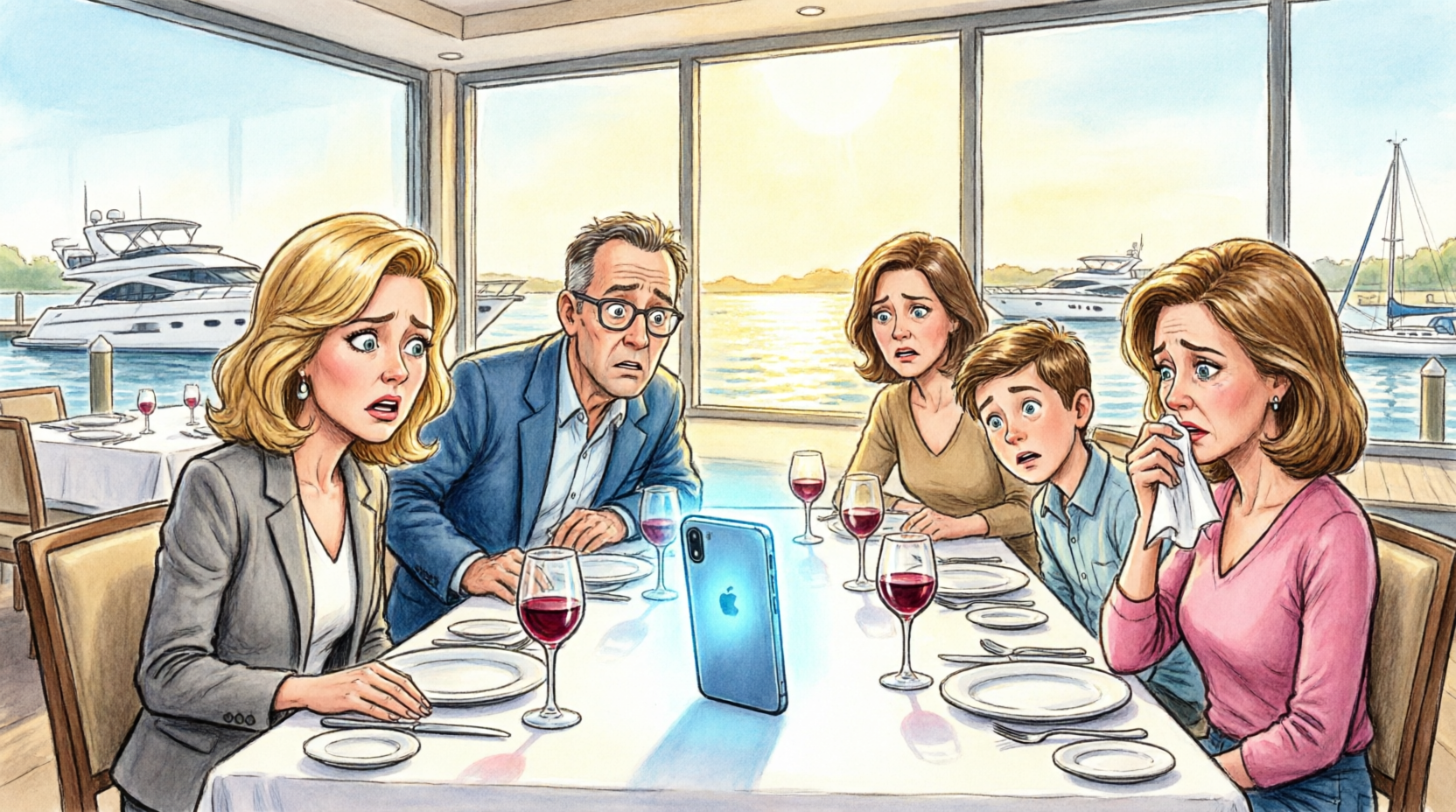
“Go ahead,” I said, hitting the speaker icon and placing the phone in the middle of the table.
My family stared at it like it might explode.
“What is this?” Connor demanded. “Nat, what are you doing?”
“Being practical,” I said softly. “You know. Like I always am.”
“Sweetheart,” Mom said, her voice tighter now, “you’re making a scene.”
“We’re in a restaurant,” Dad added, cheeks flushing. “Can we not–”
Sharon came back on the line.
“Ms. Chin?” she said, voice changed—cautious, all the bright sales-woman cheer stripped away. “I’ve pulled the records.”
“And?” I asked.
“The property at 847 Seabreeze Lane is owned by…” She trailed off. When she spoke again, her tone was very different. “Clearwater Properties LLC. Registered agent: Natalie Mei Chin.”
Silence slammed down over the table.
I watched my father’s face as the words landed. Color drained from his cheeks. His jaw moved soundlessly, like he was chewing invisible glass.
“That’s what I thought,” I said, my voice very calm now. “Sharon, my parents do not own that property. They never have. Any listing agreement they signed is fraudulent. The sale needs to stop immediately.”
“Oh my God,” Sharon breathed. Somewhere on her end of the line, a chair creaked. “Ms. Chin, I—I’m so sorry. They presented themselves as the owners. They had keys, photos, detailed knowledge of the property. I assumed—”
“As you can imagine,” I said, staring straight at Dad, “they’ve spent quite a bit of time there.”
He opened his mouth. Closed it.
“Sharon,” I continued, “I need you to contact your broker right away. The sale cannot proceed. I am the legal owner, and I have not authorized any listing or sale.”
“I understand completely,” she said, all business now. “I’m calling my broker the moment we hang up. We’ll cancel the listing and notify the buyers immediately. Again, Ms. Chin, I’m terribly sorry. I’ll also be conducting an internal review of how this—”
“Thank you,” I said. “Please confirm via email that the listing has been canceled.”
“Of course.”
I ended the call.
The restaurant noise washed back in—the clink of cutlery, the low murmur of conversation, the distant hiss of the espresso machine. At our table, though, there was only silence thick enough to chew.
“You…own the beach house?” Dad finally managed.
“Yes,” I said. “I do.”
“But we’ve been using it for years,” Mom sputtered. “Your father and I, Connor and the kids…we always thought—”
“That it was family property?” I finished.
She gestured helplessly. “Well, yes. I mean, the way we’ve all used it—”
“I bought that house six years ago,” I said. “Cash. No mortgage. In the name of my LLC, Clearwater Properties. I pay the taxes. I pay the insurance. I pay the utilities and the roof repairs and the new water heater and the sand removal after every storm. I own it. Not you. Not ‘the family.’ Me.”
Connor lurched to his feet so fast his chair scraped loudly against the floor, turning heads at nearby tables. “This is insane,” he exploded. “You let us believe we could sell it. You never said anything about—about owning it in some secret company.”
“I didn’t ‘let’ you believe anything,” I said, looking up at him. “You never asked. At no point did anyone say, ‘Hey, Natalie, is this house in your name? Is it okay if we sell it?’”
“We thought it was Dad’s,” Connor insisted, jabbing a thumb in our father’s direction. “He’s the one who handles this stuff. He’s the one who—”
“Signs paperwork he doesn’t read?” I suggested. “Commits other people’s property to your business ventures without verifying ownership?”
“That’s not fair,” Mom snapped. “Your father would never—”
“He just did,” I said.
Rachel had gone pale. Her hand trembled on the stem of her mimosa glass. “We’ve put down deposits,” she whispered. “The lease. The equipment. We can’t get that money back. What are we supposed to do?”
Something in me twisted. For a moment, I saw not the woman who’d cheerfully corrected the amount of their commitments but a person looking at the collapse of a dream. Then another part of me—the part that had pulled all-nighters and eaten at my desk and almost broken under the strain of building my business—rose up hard in response.
“That,” I said, “is something you should have considered before committing two hundred and forty thousand dollars based on selling a house you don’t own.”
“It was a misunderstanding,” Dad said, struggling to regain his smooth, reasonable tone. “Even if you’re technically the owner—”
“Stop,” I said.
He blinked. “Excuse me?”
“Stop calling it ‘technical.’” I picked up my phone again. “There’s nothing technical about it.”
As if on cue, my screen lit up. A text banner slid across.
Suspicious activity detected on property 847 Seabreeze Lane. Transaction flagged and frozen pending owner verification.
I turned the phone so Dad could see.
“My property management system has fraud alerts,” I said. “The moment Sharon tried to push the closing paperwork through, it pinged my bank. They’ve frozen everything until I confirm. Which, of course, I won’t.”
Dad stared at the message like it was in another language.
“We didn’t know it was fraud,” he said hoarsely. “We thought it was family property. We thought we were doing something good for your brother.”
“You were going to take something that didn’t belong to you,” I said. “Sell it. Give the money to someone else. And you never thought to check whose name was on the deed.”
Connor’s face was red now, a mottled anger that reminded me of the tantrums he’d thrown as a kid. “You’re really going to let us lose everything?” he demanded. “Your own brother? After everything our family has done for you?”
I almost laughed. “Everything you’ve done for me,” I repeated softly. “Like what? Raise me? That’s basic parenting, not a loan. Pay for college? I had scholarships and worked three jobs. Help me start my business? I built it from a laptop in my studio apartment.”
“You’re twisting things,” Mom said, her voice shaking.
“No,” I said. “For years, you’ve treated my success like it was community property. Like it was this pot we all could dip into when Connor’s latest idea needed seed money. I told you no. Repeatedly. So this time, you just…didn’t ask.”……………………….