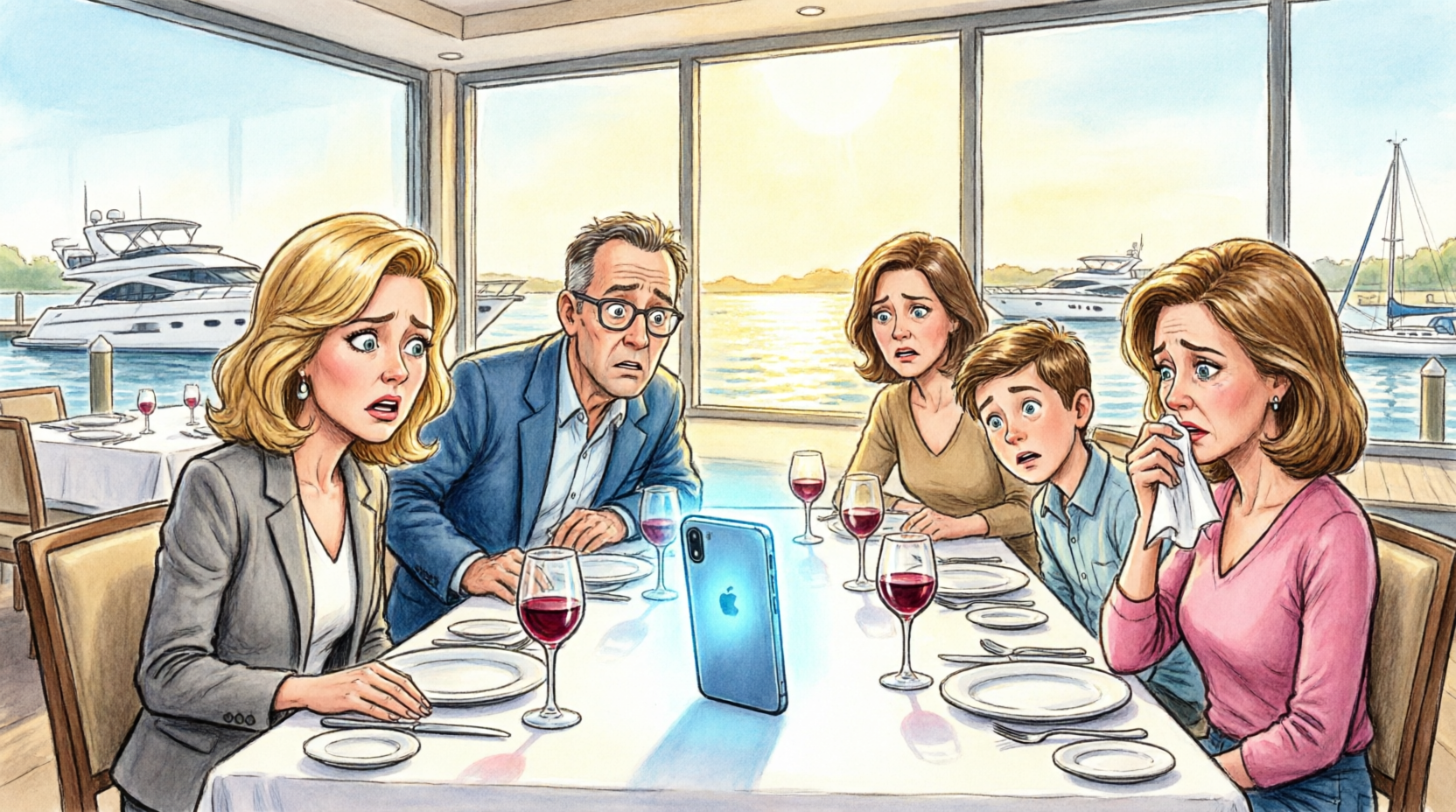
“You’re banning us from the beach house?” Connor blurted. “On your birthday? What kind of person does that?”
“The kind of person,” I said, gathering my bag, “whose family just attempted to steal her property to fund yet another of your failed ventures.”
I stood.
“Natalie, sit down,” Dad ordered, using that tone that had once made me freeze mid-step as a child. “We can talk about this.”
“We are talking,” I said. “And I’m done.”
I took a fifty from my wallet and set it by my untouched plate. “This is for my coffee and the entertainment.” I met each of their eyes in turn. “The beach house is mine. Access is revoked. Effective immediately.”
Then I walked out, my heart pounding, the echo of my heels sharp on the polished floor.
Outside, the bright sunshine felt like stepping into another world. Boats bobbed gently, indifferent. Gulls wheeled and cried overhead. My reflection swam faintly across the restaurant’s glass as I passed, my shoulders squared in a way I didn’t entirely feel yet.
I made it to my car before the shaking started.
I closed the door, hands gripping the steering wheel so tightly my knuckles whitened. For a long moment, I just sat there, staring at the marina.
They tried to sell my house.
Not ask me to sell it. Not discuss options. Not talk about a loan or an investment or a family partnership.
They had acted as if my asset was theirs.
My phone rang, jolting me. An unknown number flashed on the screen, local area code.
I swallowed and hit accept. “Natalie speaking.”
“Ms. Chin? This is Detective Alejandro Ramirez with the financial crimes unit,” a calm voice said. “Your bank flagged a possible real estate fraud involving a property on Seabreeze Lane. Do you have a moment to talk?”
I let out a short, disbelieving sound. Of course they had.
“Yes,” I said. “I do.”
He asked for verification details, then continued. “Our fraud department received an alert that someone attempted to initiate a sale on 847 Seabreeze Lane without matching the registered owner information. Can you confirm whether you authorized the sale of this property?”
“I did not,” I said. “My parents attempted to sell it without my knowledge or permission.”
There was a small pause. “Your parents?” he repeated.
“Yes,” I said, very tired all of a sudden. “They believed—incorrectly—that it was ‘family property.’ It’s not. It’s owned by my LLC. They signed a listing agreement as if they were the owners and proceeded all the way to closing.”
“I see,” Ramirez said, and I sensed him shifting mental gears. “Were they aware that they weren’t legally on the deed?”
I thought of Dad’s face in the restaurant when Sharon read out the property record. The way his certainty had crumbled.
“I believe they assumed my father owned it,” I said. “That’s what my brother said, anyway. They were wrong. But until today, I think they genuinely believed it.”
“Understood.” The detective cleared his throat. “In cases like this, Ms. Chin, we can proceed with charges for attempted fraud and forgery, if you wish to press them.”
The idea of my parents in handcuffs flashed across my mind, absurd and terrifying. Mom’s trembling hands. Dad’s face, slack with shock. Connor’s rage.
A younger version of me might have said, “No, no, forget it, it was just a misunderstanding.” A part of me still wanted to say that—to smooth it over, to make it easier for everyone but me.
But another part, the part that had watched them plan to hand over nearly a million dollars of my equity without a second thought, spoke louder.
“I don’t want to press charges at this time,” I said slowly. “But I do want the incident documented. On record. If anything like this is attempted with any of my properties in the future, I won’t be so generous.”
“That’s reasonable,” Ramirez said. “We’ll close this case as ‘no charges filed,’ but make note of the situation. If your bank flags any further suspicious activity, we’ll be in touch.”
“Thank you,” I said.
We ended the call.
I leaned my head back against the seat and closed my eyes. My pulse was finally starting to come down from hummingbird speed to something like human.
After a few minutes, I opened my property management app again. Fifteen properties. Seven states. A total value of four point two million dollars, according to the last valuation snapshot.
On the map view, they dotted the screen like little flags of all the lives I’d touched without anyone really knowing. Families lived in those units. People cooked dinner in kitchens I’d renovated, argued in living rooms I’d painted, slept under roofs I’d repaired.
None of it had been handed to me. None of it was a gift from my parents or a lucky lottery win. It was ten years of hustle, of working full-time while managing contractors on lunch breaks, of using vacation days to oversee closings, of watching friends blow paychecks on trips while I quietly wired another down payment.
My phone buzzed again. This time it was a series of messages.
Mom: Sweetheart, please call us. We can work this out.
Dad: That detective is blowing things out of proportion. Don’t be rash.
Connor: You’re really going to let me lose everything? After everything our family has done for you?
I stared at the last one for a long time.
After everything our family has done for you.
I thought about what “everything” actually meant.
The childhood of being the “good one” so they didn’t have to worry. The assumption that I’d be okay, that I didn’t need help, that my success was somehow inevitable and therefore unremarkable. Meanwhile, Connor’s every semi-functional day was celebrated like a miracle.
They’d paid more for his failed business attorney fees than they had contributed to my entire college education.
They’d offered to cover his rent in his thirties; I’d paid my own starting at nineteen.
Everything our family has done for you.
I blocked his number.
The fallout came fast and messy.
By the end of the week, Connor and Rachel had lost their deposits. The landlord for the restaurant space kept the first and last month’s rent because they were pulling out after signing. The contractors kept their non-refundable booking fees. The equipment supplier cheerfully informed them that per their agreement, the twenty-percent down payment was, regrettably, not recoverable.
Two hundred forty thousand dollars evaporated in a flurry of emails and phone calls.
Mom called it a “family tragedy” and cried on the phone to relatives. Dad framed it as a misunderstanding. In their retelling, the details shifted. The forgery of ownership morphed into something like a technical oversight; my refusal to hand over my asset became cold, selfish cruelty.
Cousins I barely knew sent texts like, Family sticks together. or Nat, why are you doing this to your brother?
None of them asked, “Why did your brother think it was okay to sell your house?”
No one asked, “Why did your parents sign papers for a property that wasn’t theirs?”
I blocked most of them too.
Three days after the brunch, my attorney, Jessica Park, called.
“Your father’s lawyer reached out,” she said without preamble. “You’re going to love this.”
“Hit me,” I said, lying on the couch with my laptop open and my brain too fried to focus on code or contracts.
“They’re claiming you gave them verbal permission to sell the beach house,” Jessica said. “That you told them, quote, ‘Do whatever you want with it, I don’t really use it.’”
I sat up. “I said nothing even remotely like that.”
“I know,” Jessica said dryly. “Last year you sent your parents an email reminding them to let you know when they were staying there so your cleaner could schedule around them. The email specifically referred to it as ‘my place.’”
“I remember,” I said. “Mom replied with something about bringing extra towels.”
“Exactly,” Jessica said. “We have a paper trail establishing your ownership and your view of it as your property. Nothing about shared family control. But here’s the ask: they want you to go through with the sale. Then transfer the proceeds to Connor as a ‘family loan.’”
I laughed. Actually laughed. “They want me to sell my investment, hand the equity to Connor, and call it a loan I’ll never see again.”
“Pretty much.”
“No,” I said. “Absolutely not.”
“That’s what I told them,” Jessica said, amusement in her voice. “But you should know they’re threatening to sue. Their theory is promissory estoppel—claiming you made promises or created reasonable expectations, causing them to incur costs.”
“For trying to sell my house?” I asked.
“For leading them to believe it was family property,” she clarified. “They’re arguing that by allowing everyone to use it freely, by not explicitly telling them they didn’t own it, you gave them the impression they could manage it as a family asset.”
My jaw clenched. “Let them sue,” I said. “We both know there’s nothing there.”
“I agree,” Jessica said. “But it’s going to be a pain, not gonna lie. I’ll file a motion to dismiss as soon as they file, but be prepared for some drama.”
The lawsuit landed two weeks later: Robert and Margaret Chin v. Natalie Mei Chin. Alleging breach of a verbal contract, detrimental reliance, promissory estoppel. Connor listed as a third-party beneficiary seeking damages for his lost restaurant.
Reading my own name on the defendant line felt surreal. Like I’d been recast in a family drama I hadn’t auditioned for.
We filed our response. Jessica’s motion to dismiss was brutal in its precision. She attached copies of the deed, the LLC registration, every email where I referred to the beach house as “my property.” Screenshots from the property management app with my name as owner. A summary of the fraud alert and the detective’s report.
The hearing was set for a Tuesday morning. I took the day off and wore my best gray suit, the one that made me feel like I could walk through fire and file a well-formatted report about it afterwards.
The courtroom was smaller than I’d imagined. Less Law & Order, more DMV with wood paneling. My parents sat at the plaintiff’s table with their attorney. Mom’s eyes were red; Dad’s jaw was tight. Connor sat behind them, in the gallery, his face pale and drawn.
I sat at the defense table with Jessica, my spine straight, hands folded.
When the judge took the bench, we all rose.
The arguments were brief. Jessica argued that there was no evidence of any contract, verbal or otherwise. That my parents had never been on the deed. That they had signed a listing agreement falsely representing themselves as owners.
“They are essentially asking this court,” she concluded, “to reward them for attempting to sell property they did not own, then to punish the actual owner for refusing to go along with it.”
My parents’ attorney tried to spin it. He talked about “understandable family assumptions,” about “patterns of use,” about “reasonable expectations” created by years of shared vacations. He spoke of Connor’s hopes, of the “devastating financial loss” he’d suffered.
The judge, a woman with steel-gray hair and glasses perched low on her nose, listened patiently. Then she picked up the deed.
“This is not complicated,” she said. “The property in question is owned solely by Clearwater Properties LLC, with Ms. Chin as registered agent. The plaintiffs’ names do not appear on this or any related document.”
She looked over her glasses at my parents. “You had no legal right to sell this property,” she said. “You incurred expenses in anticipation of receiving proceeds from a sale you had no authority to conduct. That is not Ms. Chin’s responsibility. That is yours.”
She turned to their attorney. “The court finds no evidence of a verbal contract, no writings, no emails suggesting Ms. Chin authorized any sale or transfer of funds. The plaintiffs’ claim is without merit.”
Her gavel came down with a crisp crack. “Motion to dismiss granted. Case dismissed with prejudice. Plaintiffs are ordered to pay the defendant’s reasonable attorney fees.”
Fifteen thousand dollars, as it turned out.
Outside the courthouse, the sky was overcast, the air heavy. My parents walked out together, silent. Connor followed a few steps behind, looking like someone had taken all the air out of him.
He caught my eye and strode over, shoulders tense.
“Are you happy now?” he demanded. “You’ve destroyed everything. The restaurant. My chance. The family.”
“I didn’t destroy anything,” I said quietly. “You chose to commit two hundred and forty thousand dollars based on selling something you didn’t verify you owned. You signed contracts without doing basic due diligence. That’s not on me.”
“We’re family,” he said, and the word came out like a weapon. “Family doesn’t do this to each other.”
“Family doesn’t commit fraud against each other,” I returned. “Family doesn’t try to steal someone’s house because they made sloppy assumptions.”
“I wasn’t—”
“Did you check the deed?” I asked. “Once. At any point. Did you go down to the county records office or pull it up online and confirm the names on the title before you started signing leases and writing checks?”
He worked his jaw. “Dad—”
“Dad is not the county recorder,” I said. “Dad is not the bank. You are a grown man, Connor. At some point, you have to stop blaming everyone else for the consequences of your choices.”
Rachel appeared at his elbow, tugging on his arm. “Let’s go,” she said sharply, eyes glittering with fury. She looked at me like I was something unpleasant on the bottom of her shoe. “I hope you’re proud of yourself,” she spat.
“I am,” I said. “I’m proud that I built something worth protecting. And I’m proud that I protected it from people who thought they were entitled to it.”
They walked away.
Six months later, I sold the beach house.
Not because of them. Not because of pressure or guilt or some ridiculous notion of “sharing.” I sold it because the market was hot, because an investor approached me with an offer of 1.1 million, and because I’d been eyeing some multi-unit properties in Denver that promised better cash flow than a single vacation home.
When the wire hit my business account, I looked at the numbers for a long, quiet moment. Then I bought two rental properties in Denver: an eight-unit building near a university and a four-unit in a rapidly gentrifying neighborhood.
Every penny of that beach house equity went into deals that had nothing to do with my parents or my brother or Rachel’s dream restaurant.
Dad found out anyway, of course. News travels fast through family grapevines. I got an email a week after the Denver closings.
You sold it and didn’t even offer us a share, he wrote. That tells us everything we need to know about you.
I stared at the line for a long time, then closed the email without replying.
Mom tried a different tack. Her email was softer.
I miss my daughter, she wrote. Can we please talk?
I sat with that one for days.
Finally, I replied with one sentence.
When you can acknowledge what you did was wrong, we can talk. Not before.
Three dots appeared, then vanished. No response came.
Connor filed for bankruptcy. Again. His second in less than a decade. Rachel left him six months after that, taking the kids to Ohio to live with her mother. I heard about it through a cousin’s social media post.
My parents downsized to a condo as legal fees and repeated bailouts strained their retirement accounts. The stories about me in the extended family kept swirling—some painting me as a villain, some claiming it was all a “hurtful misunderstanding.”
Meanwhile, my business thrived. I landed a long-term contract with a major client that gave me enough predictability to plan my investments even more strategically. My property portfolio grew from fifteen units to twenty-two, then twenty-five. I hired a virtual assistant. Then a bookkeeper. Then a part-time property manager.
I started dating someone who didn’t flinch when I talked about LLCs and cap rates. Who didn’t make jokes about “finding a rich husband” when I discussed my goals. Who understood that boundaries weren’t cruelty—they were self-respect.
A year to the day after the infamous birthday brunch, a letter arrived.
Not an email. Not a text. A letter. Handwritten. In my father’s distinctive, precise engineer’s handwriting.
I held the envelope for a moment before opening it, feeling the weight of it—literal and metaphorical.
Natalie, it began.
I’ve spent the last year trying to understand how we ended up where we are.
Your mother and I genuinely believed the beach house was family property. Not legally—I understand now that legally, it has always been yours. But morally. Emotionally. We believed that because we had used it for family gatherings, because we had made memories there, it belonged to all of us.
We were wrong.
Those three words made me blink.
The house was yours. The choice to share it was yours. We took your generosity for granted and then betrayed it by trying to take something you had never offered to give.
Connor has learned some very hard lessons this year. So have I.
I am sorry we tried to sell your property. I am sorry we sued you. I am sorry we put our wants above your rights.
I don’t expect your forgiveness. I just wanted you to know that I understand now. You were not being cruel. You were protecting what you had built. I should have been proud of that instead of trying to take it from you.
Love, Dad.
I read it three times.
It was not a perfect apology. There were still hints of justification, of “morally” this, “emotionally” that. But he’d written the important parts too: We were wrong. It was yours. We betrayed your generosity. I am sorry.
I didn’t respond immediately. But I didn’t throw the letter away either. I put it in a drawer with a few other things I couldn’t quite let go of: an old photo of us at the beach house, Connor at eighteen and me at twenty, both sunburned and laughing; a Mother’s Day card I’d drawn in crayon when I was seven; my first business card from when I’d gone freelance.
Two months later, on a quiet Thursday afternoon between client calls, I picked up my phone and typed a text to Mom.
Coffee?
Her reply came almost instantly. Yes. Please. Saturday? 10 a.m.? Anywhere you like.
We met at a coffee shop downtown that neither of us had any history with. Neutral ground. It was one of those places with exposed brick, plants in mismatched pots, and a menu full of drinks that were technically coffee but mostly adjectives.
Mom looked older than I remembered. Not dramatically. Just smaller somehow. Less certain. The lines around her mouth were deeper; her posture more hesitant.
When she saw me, her face crumpled, and she hurried forward to hug me. She held on longer than she ever had before, fingers digging into the back of my jacket.
“I’ve missed you,” she whispered.
I swallowed around the lump in my throat. “I’ve missed you too.”
We ordered coffee and sat at a small table by the window. For a minute, neither of us spoke. The silence between us was thick with everything that had happened and everything we hadn’t said.
“I read Dad’s letter,” I said finally.
She exhaled. “He meant every word,” she said. “We both did.”
She wrapped her hands around her cup like it was an anchor. “Natalie, we were wrong,” she said. “About the beach house. About Connor’s restaurant. About a lot of things.” She managed a weak smile. “About thinking we could still tell you what to do at thirty-four.”
“It was more than wrong,” I said softly. “It was fraud.”
She flinched at the word, but she nodded. “I know,” she said. “I hate hearing it put like that. But I know.”
“What made you…see it differently?” I asked.
She stared into her coffee. “Watching your father read the judge’s ruling,” she said. “Listening to her say out loud that we had no right to sell it.” She gave a small, humorless laugh. “And then meeting with our financial advisor and seeing the numbers on paper. Realizing how much of our retirement we’d spent bailing Connor out. Realizing how we’d expected you to just…fix things.”
She looked up at me, eyes bright. “You were always the responsible one,” she said. “From the time you lined up your stuffed animals in neat rows and made charts about whose turn it was to take out the trash.” A fond smile flickered across her face. “We took advantage of that. We told ourselves you ‘didn’t need as much’ because you were capable. It was unfair. It was easier to make you the adult, even when you were a child.”
Something cracked open in my chest.
“What’s happening with Connor?” I asked after a moment.
She sighed heavily. “He’s working construction,” she said. “Day labor sometimes. Trying to pay off what the bankruptcy didn’t wipe clean. He shares a small apartment with a friend now. Rachel took the kids to Ohio. He sees them once a month, if he can afford the flight.”
She blinked away tears. “He’s learning what rock bottom feels like,” she said. “I don’t know if it will stick. I hope it does.”
“It’s hard to watch your child suffer,” I said quietly.
“Especially when they did it to themselves,” she murmured. “But yes. It is.”
We sat in silence for a bit, listening to the whir of the espresso machine, the low murmur of other conversations, the occasional clink of cups.
“Can you forgive us?” she asked eventually, voice barely above a whisper.
I took a breath.
“I don’t know yet,” I said honestly. “But I’m willing to try. With boundaries.”
She frowned slightly. “Boundaries?”
“Rules,” I clarified. “For how we deal with each other. Clear ones.”
“We can do that,” she said quickly. “Just tell me what they are.”
“No more assumptions about my property,” I said. “No more treating what I own as a family resource. If I choose to share something—money, a house, my time—it’s a gift, not an obligation. And if I say no, that’s the end of the conversation. No guilt. No campaigns to ‘make me see reason.’”
She nodded slowly. “Okay.”
“No more bailing Connor out,” I added. “If he starts another business, if he takes on more debt, that’s between him and his creditors. Not between him and me. Not between him and your retirement.”
She opened her mouth, closed it, then nodded again. “Okay,” she repeated.
“And if anything like the beach house ever happens again,” I said, “if anyone in this family tries to touch my assets without my permission, I will press charges. I need you to understand that.”
Her throat bobbed. “I understand,” she said. “It won’t happen again.”
She reached across the table, then hesitated, her hand hovering near mine. “I love you, Natalie,” she said. “I’m proud of what you’ve built. I should have said that years ago. I should have asked how I could support you instead of assuming your success meant you owed us.”
Tears pricked my eyes.
I let her take my hand.
“I love you too, Mom,” I said.
It wasn’t forgiveness. Not fully. But it was the first step toward something that might become a new kind of relationship—one where I wasn’t a walking ATM disguised as a daughter.
Over the next year, my empire grew.
Twenty-five properties. Then thirty. I purchased a small commercial building and leased it to a local daycare. I did a joint venture with another investor on a mixed-use project. I set up a trust, updated my will, made sure that if anything happened to me, my assets would go exactly where I wanted them to—not into some vague “family pot.”
I kept everything in writing. Every property in an LLC. Every agreement with signatures and dates and terms so clear even a judge half-asleep could parse them.
Connor eventually sent me a text. Just one.
I get it now, it read. What you were protecting. I’m sorry I tried to take it.
I stared at it for a long time.
Thank you, I replied.
We weren’t suddenly close. He didn’t become my favorite person. But something in the tension between us loosened, just a little.
The beach house was gone. The blue-doored, sun-washed house where we’d built sandcastles and blown out birthday candles and, apparently, built an entire mythology of “family property” on top of my silent labor.
Sometimes I missed it—the way the light filtered through the kitchen in late afternoon, the smell of the ocean right before a storm, the sound of the screen door snapping shut behind me. But then I’d glance at my portfolio and see the buildings in Denver, in Seattle, in Austin. I’d see the steady rent deposits, the increase in equity, the diversification of my risk.
The beach house had taught me something I didn’t know I still needed to learn.
My success is mine.
Mine to build. Mine to protect. Mine to share, or not, on my terms.
Not a prize my family had “earned” by raising me. Not a resource to be quietly redistributed to cover my brother’s choices. Not a communal pot my parents could dip into whenever someone’s dream needed funding.
People often say that money changes you. That wasn’t true for me.
What money changed was how loudly I could say no.
It let me enforce boundaries in ways I’d never been able to before. It turned vague discomfort into firm lines. It exposed which relationships were built on mutual respect and which ones were built on the assumption that I would always, always give.
And it showed me something else—something I might never have believed if I hadn’t lived it.
Sometimes, protecting what’s yours doesn’t just save your bank account.
Sometimes, it’s the only way to save yourself.