The morning my family came to throw me out of my grandparents’ house, they arrived like people who had already decided the ending.
My father stepped out of the black SUV first, smoothing the front of his tailored suit with two sharp pulls.
My mother followed in a cream-colored dress that looked too expensive for mourning.
Jason came last, sunglasses still on, one hand around his phone, the other holding a folder like it could become a weapon if he needed it to.
I watched them from inside the living room.
The house still smelled faintly of lemon oil, old wood, and the coffee my grandfather used to brew too strong every morning before sunrise.
Outside, dry maple leaves scraped along the porch boards, and the small American flag my grandmother had tied to the porch rail fluttered once in the cold air.
Grandma’s quilt was folded over the back of the sofa.
Grandpa’s chipped mug still sat near the sink.
It had been three days since the car crash.
Three days since the hospital called.
Three days since a state trooper stood in a hallway under bright fluorescent lights and said Harold and Elizabeth had not survived.
Grief does strange things to a house.
It leaves everything exactly where it was and still somehow makes every room feel abandoned.
My grandparents had raised me more honestly than my parents ever had.
When my father forgot school plays, Grandpa came with a paper cup of coffee and sat in the front row.
When my mother said I was too sensitive, Grandma baked banana bread and told me softness was only weakness to people who liked breaking things.
When I became a kindergarten teacher, they bought me a box of crayons every August like I was still five years old.
So when Matthew Goldstein, their lawyer, told me I was the sole heir to their $26 million estate, I did not feel rich.
I felt terrified.
I thought first about the house.
Then about the business holdings.
Then about all the years my father had laughed under his breath whenever my grandparents said they trusted me.
The will had been clear.
PART ONE: THE ARCHITECTURE OF TRUTH
The laptop screen glowed in the dim morning light of my grandparents’ living room, casting long, fractured reflections across the faces of the people who had spent thirty-four years treating me like furniture. On the screen, my grandmother’s voice filled the quiet space, steady and unflinching, the way she had always been when the truth mattered more than comfort.
“Anna, honey, before they tell you this is about family, ask them why they needed the loan papers from—”
The recording cut off as Matthew’s finger hovered over the trackpad. He didn’t press play again immediately. He let the silence stretch, let it press against the walls, let it settle into the marrow of the three people standing on my grandparents’ rug. My father’s face had gone completely still. Not angry. Not defensive. Still. The kind of stillness that arrives when a man realizes the ground he has been standing on for decades was never solid. It was just painted to look like stone.
My mother’s fingers tightened around her purse strap. Jason’s phone slipped lower in his palm, no longer a weapon, just a dead weight. Even Chief Williams, who had remained perfectly motionless by the mantel, shifted her stance just enough to signal that the room had crossed from civil disagreement into legal territory.
Matthew finally tapped the spacebar. The video continued.
“…from the estate trust in 2018,” Grandma Elizabeth finished, her eyes fixed on the camera lens as if she could see through the screen into this exact morning. “The one Richard and Diane signed to ‘bridge’ Jason’s failed venture. The one Harold and I never authorized. The one that was supposed to be repaid with interest by December 2019. It wasn’t. And when we asked why the withdrawals kept happening, Richard told us Anna had agreed to cover it. Anna, who was teaching second grade and paying off student loans. Anna, who didn’t know the trust existed until last week.”
A heavy silence followed. My father’s mouth opened, then closed. The polished, commanding voice he had used to run boardrooms, to command family gatherings, to convince people he was untouchable, had nowhere to go. It simply dissolved into the quiet hum of the refrigerator down the hall.
Matthew closed the laptop. The screen went black. The reflection of our faces vanished.
“Before you speak,” Matthew said, his voice calm, precise, carrying the weight of a man who had spent thirty years watching liars trip over their own footprints, “you should understand what you are looking at. Harold and Elizabeth were not confused. They were not manipulated. They were accountants of the highest order, and they tracked every dollar that left this house, every signature that was forged in their names, every emotional leverage used to extract funds they never intended to give. They anticipated this morning. They anticipated this exact conversation. And they left you exactly what you earned.”
My mother made a small, involuntary sound. “This is absurd. We are family. We built this legacy together.”
“You didn’t build it,” I said. The words left my mouth before I could stop them. Not angry. Not trembling. Just factual. The kind of factual that comes when you finally stop translating other people’s cruelty into your own guilt. “You consumed it. You called it love when you asked for advances. You called it loyalty when you demanded I cover the shortfalls. You called it family when you kicked me out of my apartment because I wouldn’t hand over a will that protects the only person who actually showed up for them.”
My father’s eyes locked onto mine. For the first time in my life, he didn’t look at me like I was a problem to be managed. He looked at me like I was a stranger who had just walked through a door he thought he had locked forever.
“You think this changes anything?” he asked, voice low, measured, trying to reclaim the room. “You think a recording stops a contest? You think a kindergarten teacher can hold off a legal challenge from a family that has been funding your entire life?”
Matthew didn’t flinch. He opened the first folder on the table. The tab read: ESTATE TRUST WITHDRAWALS / UNAUTHORIZED TRANSFERS / FORGED SIGNATURES / 2018-2023.
“Actually, Richard,” Matthew said, sliding the first document forward, “it stops it entirely. Because the will wasn’t just contested. It was structured with a conditional clause that activates upon any attempt to dispute the primary beneficiary. The moment you walked through this door demanding Anna sign over control, the clause triggered. The estate automatically shifts into an irrevocable protective trust. Anna is not just the heir. She is the sole trustee. You have no standing. You have no claim. And every unauthorized withdrawal you made over the last five years is now subject to immediate restitution, civil recovery, and potential criminal referral.”
Jason stepped forward, his polished composure cracking. “You’re bluffing. You can’t just—”
Chief Williams finally spoke. Her voice was quiet, but it carried the kind of authority that doesn’t need volume to be felt. “Actually, we can. Because Harold and Elizabeth filed a formal fraud report with the county attorney three months ago. They didn’t wait for you to contest. They waited for you to show up. And you just did.”
The room went completely still. Not the stillness of shock. The stillness of a structure realizing its foundation has shifted. My mother’s face went pale. Not the pale of surprise. The pale of a woman who had spent decades believing that family loyalty was a currency she could spend without consequence, and who had just been handed the receipt.
I didn’t feel triumph. I felt the heavy, grounding weight of clarity. The kind that arrives when you finally stop fighting the current and let the architecture do the work. My grandparents hadn’t left me money. They had left me a blueprint. And blueprints don’t care about guilt. They only care about load-bearing walls.
Matthew turned to me. “Anna, the next step is yours. We have forty-eight hours before the protective trust officially locks. You can choose to pursue civil recovery for the unauthorized withdrawals. You can choose to file a formal complaint for the forged signatures. Or you can choose to let the estate absorb the losses and close the ledger quietly. The law will follow your lead.”
I looked at the folder. I looked at my father. I looked at the chipped coffee mug by the sink, the quilt draped over the sofa, the small American flag tapping softly against the porch rail. I thought of the years I had spent believing that love meant silence. That loyalty meant absorption. That peace meant swallowing the truth until it dissolved into my bloodstream and became part of my breathing.
I thought of the voicemail I had played three days ago, right after my father pushed the transfer papers across Matthew’s desk. “Sign it, Anna. Or lose us.”
I had signed nothing. I had packed my boxes. I had driven to this house with one key in my hand and a hollow chest. And now, standing in the living room where my grandparents had taught me how to read the world, I finally understood what they had been preparing me for.
Not wealth.
Not revenge.
Accountability.
I reached for the folder. I didn’t open it. I simply placed my hand flat on the cover, feeling the weight of the paper beneath my palm.
“Pursue civil recovery,” I said. “File the complaint for the forged signatures. And notify the county attorney that the estate will cooperate fully with any criminal referral.”
My father’s breath caught. Just a fraction. But I saw it. The exact moment he realized the script had burned.
“You can’t be serious,” he whispered. “This is your family.”
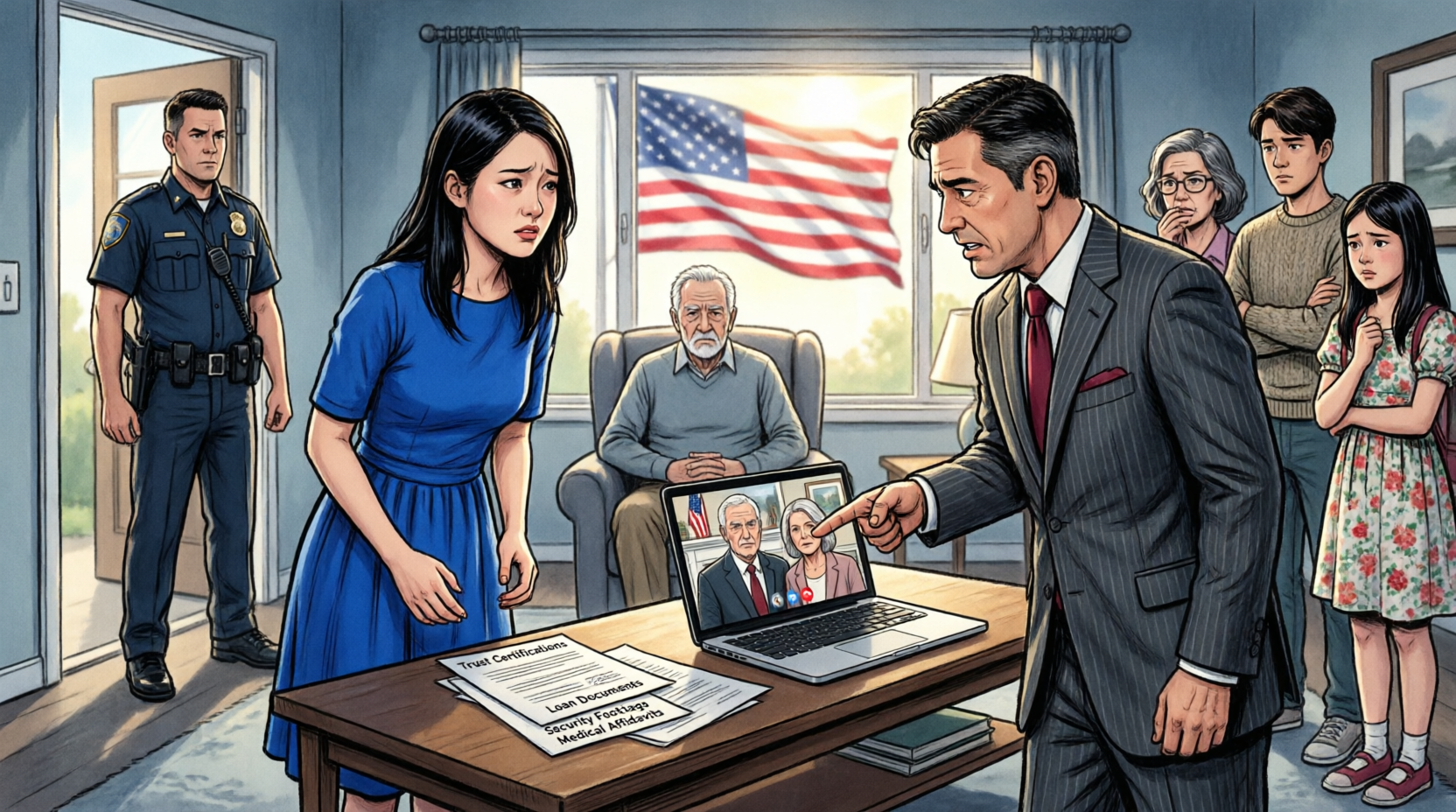
I met his eyes. “Family doesn’t forge signatures. Family doesn’t kick their daughter out of her home over a will. Family doesn’t treat silence as consent. You didn’t lose me because I was greedy. You lost me because you forgot how to be honest.”
He didn’t argue. He didn’t raise his voice. He just stood there, a man who had spent decades believing control was the same as love, finally realizing the difference.
Matthew nodded once. “Noted. I’ll draft the filings by end of day. The protective trust activates at midnight. Until then, the estate remains under temporary stewardship. I recommend you secure the property, inventory the assets, and begin the audit trail with George and Rosa.”
George Patel, who had been quietly observing from the dining table, stood. He adjusted his glasses, his posture shifting from observer to operator. “The financial records are already digitized. I’ve cross-referenced every withdrawal against the trust ledger. The discrepancies are extensive. We’ll need bank statements, property deeds, and a full forensic review of the 2018-2023 transaction logs. I can have the preliminary report ready in seventy-two hours.”
Rosa Martinez stepped forward, her expression calm, professional, stripped of theatrics. “The business holdings are secure. The operating accounts have been separated from personal trusts. The distribution agreements are intact. But we’ll need to verify the offshore filings and the subsidiary mergers. Harold kept meticulous records, but some of the shell structures require legal clarification. I’ll coordinate with Matthew on the compliance side.”
I listened. Each clause was a brick. Each request a wall. This wasn’t about punishment. It was about architecture. Building a structure so solid that no amount of manipulation could collapse it.
“Do it,” I said.
Chief Williams adjusted her stance. “We’ll remain on site until the protective trust locks. If anyone attempts to access restricted areas, remove documents, or interfere with the audit, they will be detained for obstruction. This is not a threat. It’s procedure.”
My mother finally spoke. Her voice was thin, stripped of its usual polish, reduced to something small and fractured. “Anna… please. We made mistakes. We can fix this. We can work something out. Just… don’t destroy us.”
I looked at her. Really looked. Not with hatred. Not with grief. With the cold, quiet clarity of a woman who has finally stopped confusing love with loyalty.
“You don’t get to fix it,” I said. “You get to wait.”
She flinched. The word landed exactly where it belonged. In the space between us, heavy and final.
Matthew gathered the folders. He handed me a slim envelope. “Your temporary trustee authorization. The bank will recognize it by noon. The estate accounts are already flagged. No further withdrawals will clear without your digital signature and a secondary verification.”
I took the envelope. It felt heavier than paper should. Not because the weight was gone. Because I was no longer carrying it alone.
My father turned toward the door. He didn’t look back. He just walked out, his shoulders rigid, his steps measured, the kind of walk a man uses when he’s trying to convince himself he’s still in control. My mother followed, her purse clutched to her chest like a shield. Jason lingered for half a second, his phone finally sliding into his pocket, his sunglasses slipping into his jacket. He didn’t speak. He just left.
The front door clicked shut behind them.
The room exhaled.
I stood alone in the living room, the morning light falling across the hardwood in slow, predictable strips. The quilt still rested on the sofa. The chipped mug still sat by the sink. The small American flag still tapped softly against the porch rail. Nothing had moved. Everything had changed.
George began organizing the financial files. Rosa opened her laptop. Chief Williams stepped onto the porch to coordinate with the officer stationed at the perimeter. Matthew packed his briefcase, his movements unhurried, precise, unhesitant.
I walked to the kitchen. I filled the kettle. I set a cup on the counter. I watched the water boil. I let the steam rise. I let the quiet settle into my bones.
When the kettle clicked off, I poured the water. I didn’t add sugar. I didn’t add cream. I just held the warm cup in my hands and listened to the house breathe.
At 10:14 a.m., my phone buzzed. Not a call. A text. From my father.
You’re making a mistake. This isn’t over. Family doesn’t disappear because you sign a paper. You’ll regret this.
I didn’t reply. I took a screenshot. Logged the timestamp. Forwarded it to Matthew. Then I powered down the phone. Not out of fear. Out of discipline. In law, you don’t argue with a symptom. You isolate the cause. The message was a symptom. The cause was control. And control dies when it’s documented.
At 11:32 a.m., the bank called. The estate accounts had been successfully transitioned. The protective trust was active. No further withdrawals would clear. The audit trail was initiated.
At 1:48 p.m., George delivered the preliminary financial report. The discrepancies were extensive. The unauthorized withdrawals totaled $1.2 million. The forged signatures spanned seven documents. The pattern was consistent. The ledger was clear.
I placed the report beside the kettle. I opened a fresh notebook. I turned to the first page. My hand moved slowly. Precise. Unshaken.
Day One. Video authenticated. Protective trust initiated. Civil recovery authorized. Forgery complaint filed. Audit trail active. Estate accounts secured. Family removed. System activated. Silence replaced by structure.
I closed the notebook. Set it beside the window. Turned off the lamp. The room fell into shadow. Outside, a dog barked twice. The wind moved through the trees. The world kept moving. It just moved differently now.
I didn’t dream of the eviction notice. I didn’t dream of the transfer papers. I didn’t dream of the years I spent swallowing silence.
I dreamed of a ledger finally balancing.
And for the first time in a long time, I let myself believe that truth was not a negotiation. It was a fact.
And facts, once documented, cannot be unmade………………………….