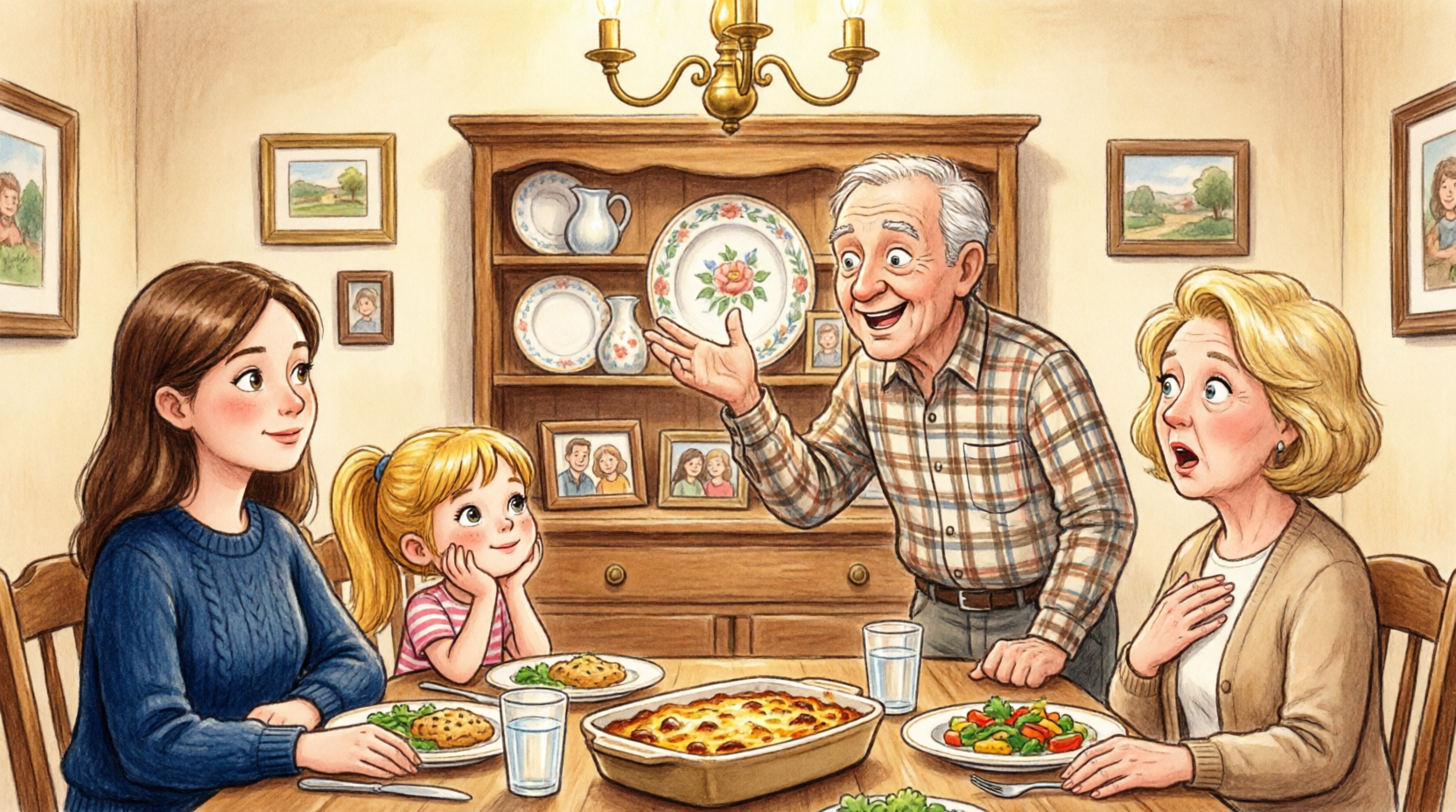
“You and your kid are just freeloaders.”
My father threw the words across my dining room table with enough force to make the silverware jump. My daughter Ava, twelve years old and halfway through lifting a forkful of roasted potatoes, froze in place. Her eyes moved from his face to mine and back again, wide with that awful kind of fear children get when they realize adults have stopped pretending to be safe.
What made it worse was not just the cruelty. It was the location.
They were saying it in my house.
The two-story colonial I had bought after years of overtime, side work, and a thousand careful compromises. The house with the pale blue shutters Ava picked out herself. The house my parents were only sitting in because I had let blood soften my judgment one more time. Two weeks earlier, when the foreclosure panic started swallowing them whole, I made the mistake of believing “temporary help” might still mean something when it involved family. So I let them come over for dinner, let them talk, let them make their case.
Now my father was leaning over my table, red-faced and shaking with indignation, as if I were the one who had arrived empty-handed and desperate.
“Dad,” I said, as evenly as I could, “you do not get to speak to her like that.”
He gave a sharp, humorless laugh. “I wasn’t talking to her. I was talking to both of you.”
My mother sat perfectly still beside him, her napkin folded in her lap like she was attending a church luncheon instead of a family ambush. She didn’t interrupt him. She didn’t even look embarrassed. She gave the tiniest nod, like a judge approving a fair sentence.
“Honestly, Natalie,” she said, her voice soft with manufactured disappointment, “if you had even a little gratitude, this conversation wouldn’t be necessary.”
Necessary.
That word almost made me smile.
Because by then I knew this dinner was not a plea. It was a performance. A last, angry attempt to bully me into doing what they had trained me to do my entire life: hand over what was mine and apologize while doing it.
Three days earlier, my mother had called crying so hard she could barely get through her sentences. The foreclosure notice was final. The bank was moving fast. They were terrified. Then my father got on the phone with that special tone men like him use when they want to sound reasonable after a lifetime of intimidation. He said they only needed two hundred thousand dollars to stop everything. He said family protected family. He said if I helped them now, they would never forget it.
I told him I would think about it.
What I didn’t tell him was that I had already started looking.
People always underestimated my job because it sounded boring. Claims auditing at a title company did not impress my mother, who believed any respectable career should come with a better title or a bigger office or a photograph worth posting on social media. But boring jobs teach you dangerous things. They teach you what desperate people sign. They teach you what property records reveal after the tears dry up. They teach you how often the truth is sitting in a county file cabinet while people are busy rehearsing their innocence.
And once my parents asked me for two hundred thousand dollars, every instinct I had told me the story they were selling was incomplete.
At eighteen, I had inherited one hundred thousand dollars from my grandmother.
Not from my parents. Not through my parents. From my grandmother.
She left it to me specifically. College money, security money, a doorway out of the chaos I grew up in. I still remember the day my mother told me the money had been “used for the family” because my father’s construction business hit a rough patch and some sacrifices had to be made. I remember how she said it like she expected applause. I remember my father telling me I was too young, too emotional, too irresponsible to understand what adults had to do to survive.
I believed them.
Or at least, I believed them enough to swallow it.
Then life kept moving. I pieced together my tuition one semester at a time. I worked nights. I lived in apartments with warped floors and heat that failed every winter. I had Ava young, and when her father disappeared before her first birthday, I stopped waiting for rescue from anyone. Meanwhile, my parents told relatives I was unstable, overwhelmed, always one bad month away from disaster.
They loved that version of me.
The struggling daughter.
The cautionary tale.
The woman who should stay humble and grateful because she never quite got her life together.
They did not notice when I stopped asking them for anything. They did not notice when I learned how to build quietly. They did not notice when survival hardened into discipline.
So when they called asking for a bailout, I opened every door I knew how to open.
The property records were ugly from the start. My father had refinanced the house twice in six years. There were hard-money loans on top of that, each one carrying the kind of terms people accept only when traditional lenders have stopped trusting them. Then I found a failed LLC with my mother’s name attached to it. Then another recorded transfer tied to equipment that no longer existed. None of that was normal, but none of it was what stopped me cold.
That came later, when I finally forced myself to request the probate file from my grandmother’s estate.
I sat in my office after hours with the fluorescent lights buzzing overhead and read every page twice. The will. The account instructions. The custodial authorizations. The withdrawal records. A transfer form signed under my mother’s authority when I was still legally too young to challenge anything. Another transfer into one of my father’s business accounts. Then disbursements. Business expenses. Mortgage arrears. Vendor payments. Personal debt.
They had not “used” my inheritance.
They had taken it.
Moved it.
Buried it.
And then they built an entire mythology around me being too immature to understand where it had gone.
When I finished tracing the first clear path of the money, I just sat there for a while with my hands in my lap, not crying, not shaking, not even angry in the way I expected. I felt something colder.
Final.
That afternoon, before my parents came to dinner, I sent every document I had gathered to a probate attorney and a forensic accountant. The inheritance file. The transfer forms. The business records. The old account closures. The mortgage history. The LLC documents. I wrote one sentence in the email: I believe my parents converted funds left to me as a minor and may have used those funds in real estate and loan transactions over multiple years.
Then I made one more call.
Not to save their house.
To the lender’s loss mitigation counsel.
I told them I had reason to believe the hardship package my parents were using to request foreclosure relief involved assets and transactions tied to misappropriated funds and undisclosed transfers. I did not dramatize it. I did not editorialize. I simply sent records and let the numbers speak.
That was all before they sat down to my food and insulted my child.
At the table, my father pointed at Ava’s plate as if she were an expense line. “She’s living off what should be helping us. If you had any decency, you’d sell this house before letting your own parents lose theirs.”
Ava shrank back so visibly that something inside me went still.
I set down my fork. I folded my napkin and placed it beside my plate. Then I looked directly at him.
“You want to talk about freeloaders?” I asked.
My mother’s eyes sharpened immediately. “Don’t start.”
I kept my gaze on my father. “You stole a hundred thousand dollars from your daughter before she was old enough to stop you. You used my grandmother’s gift to cover your debts, and then you spent fifteen years calling me irresponsible because it was easier than admitting you robbed me.”
The air left the room.
My father’s face changed first. Only for a moment, but I saw it. That flash of recognition people get when they realize the truth has arrived fully dressed and carrying receipts. Then outrage surged in to replace it.
“You ungrateful little—”
“No,” I said, cutting through him. “You don’t get to do that in here.”
My mother pushed back her chair so fast the legs scraped hard against the floor. “How dare you drag old family matters into this house in front of Ava?”
I turned toward her. “You brought it into this house the minute you sat down and tried to shame my daughter into paying for your lies.”
Ava whispered, “Mom…”
Without looking away from my parents, I reached for her hand. Her fingers were cold.
My father let out a thin, nasty laugh. “What are you going to do? Scream online? Try to ruin us? You think anybody will believe you over us?”
That was when I smiled.
Because even then, he still thought this was about emotion. About who could cry harder. About who could sound more wounded in front of relatives.
It wasn’t.
I looked at my mother, then back at him, and said the sentence that stopped every fork, every breath, every last ounce of smugness in that room.
“I didn’t call to save your house,” I said. “I called to find out whose name is really going to be on the fraud complaint.”
My mother sat down so suddenly it looked like her knees had given out. My father actually stepped back from the table.
Ava’s grip tightened around mine.
And for the first time in my life, neither of them looked at me like a disappointment.
They looked at me like a threat.
I told them dinner was over. I told them they had ten minutes to leave my house.
My mother recovered first, because that was always her gift. She could turn shock into performance faster than anyone I had ever known. She dabbed at the corners of her eyes, stood up carefully, and said, “You are sick, Natalie. Truly sick. After all we’ve done for you.”
My father muttered a string of names under his breath while he grabbed his coat. At the front door he turned back once, glaring at me with the same fury he used to wear when I was sixteen and asked too many questions about bills. “You have no idea what you’re starting.”
I opened the door wider.
“No,” I said. “You’re the one who never realized it started years ago.”
They left.
Ava waited until their car disappeared before she finally exhaled. Then she looked up at me with eyes too old for twelve and asked, “Did they really take your money?”
There are moments when a parent understands that the answer matters less than the tone. I knelt in front of her and tucked her hair behind one ear.
“Yes,” I said. “But what matters is that none of this is your fault, and none of it is yours to fix.”
She nodded once, trying very hard to be brave.
That night I slept badly, which was still better than I expected. At 6:14 the next morning, my phone started vibrating hard enough to walk itself across my nightstand. Three missed calls from my aunt. Two from a cousin I barely spoke to. A string of texts from numbers I had not seen in years. When I opened TikTok, there she was.
My mother.
Same blouse she wore at my table.
Mascara streaked just enough to look accidental.
Voice trembling just enough to sound sincere.
She told the camera that her daughter had abandoned her aging parents in their hour of need. She said I had money and no heart. She said Ava was learning selfishness by example. She never once mentioned the inheritance. She never once mentioned the documents. She never once mentioned demanding two hundred thousand dollars over roast chicken in my dining room while my daughter sat there shaking.
The video spread faster than I expected.
Sympathy always travels well when it wears tears.
By nine in the morning, people I had gone to high school with were leaving comments about family values. Distant relatives were posting Bible verses. A woman from my mother’s church wrote that “children who forget sacrifice always answer to God eventually.”
I did not respond.
That bothered my mother more than anything could have.
At 10:03, my attorney called. Her voice was calm and brisk, the way competent people sound when they are moving several pieces at once.
“We filed the petition,” she said. “Emergency accounting, preservation of records, and a claim for constructive trust if tracing holds. The forensic accountant is already comfortable with the first flow of funds. Also, you were right to notify the lender. Their counsel acknowledged receipt.”
I closed my office door and leaned against it. “What does that mean for my parents?”
“It means,” she said, “they are no longer dealing with a private family story. They are dealing with discoverable documents.”
An hour later, my father called.
I let it ring until voicemail.
Then he called again.
Then my mother.
Then my father once more, and because I wanted a record, I finally answered and put him on speaker.
“You think you’re clever?” he snapped before I could say hello. There was wind in the background and the sound of a car door slamming. “You think sending a few papers makes you powerful?”
I glanced at the clock on my desk. 11:21.
“Where are you?” I asked.
“At the house,” he barked. “Trying to stop this lunacy.”
Something in his voice had shifted. The rage was still there, but beneath it was strain. Not fear exactly. Not yet.
“Did the lender call?” I asked.
Silence.
Then, “What did you say to them?”
“The truth.”
“You had no right.”
I almost laughed. “That’s interesting coming from you.”
He started shouting then, but I only half listened because my attorney’s email had just hit my inbox. Attached was a filed copy of the petition and a second message beneath it: Field investigator and process service anticipated today. Advise no direct contact.
My father was still yelling when another sound cut through the phone.
A man’s voice. Close by. Professional.
“Mr. Mercer?”
My father went quiet mid-sentence.
Then the voice again, firmer this time. “Mr. Mercer, I’m with counsel for your mortgage servicer. I need a moment regarding your workout submission and the transfers connected to Mercer Family Restoration LLC.”
I straightened in my chair.
For a second there was only static and breathing.
Then my father came back on the line, but his voice had changed completely.
“What did you do?” he asked.
I could hear it now—the white draining out of him without seeing his face.
I spoke slowly, so there would be no misunderstanding.
“I told the people deciding whether to save your house that some of the money underneath your story was never legally yours.”
He whispered something to someone away from the phone. Then my mother’s voice cut in from farther back, high and panicked. “Who is that? What do they want? Harold, what is happening?”
Another voice joined the first. A woman this time.
“Mrs. Mercer? I have service for both of you.”
There was a pause so complete it almost felt staged.
Then my father said, very quietly, “Natalie…”
I had waited half my life to hear uncertainty in his voice.
“What?” I asked.
“What is this?”
“It’s the point where your roof stops being your only problem.”
He hung up.
I sat there for a full minute after the call ended, staring at the dark screen of my phone. Not because I felt triumphant. The truth is, revenge is a much colder feeling than people imagine. There was no rush of joy. There was relief. There was grief. There was the strange, disorienting sensation of finally standing where your fear used to live and realizing it cannot actually control you anymore.
That evening my mother posted again, but the tone had changed. Less righteous. More frantic. She said “legal threats” were being used to intimidate them. She said family should not weaponize paperwork. She said there were “misunderstandings about old accounts.” The comments got sharper. People started asking questions she didn’t know how to answer.
What old accounts?
What misunderstanding costs exactly $100,000?
Why would a lender care if there was nothing wrong?
She deleted that video within two hours.
Then came the calls from relatives, but those were different now. My aunt phoned to ask, in a voice suddenly stripped of all certainty, whether it was true my grandmother had left me money. A cousin texted, “Your mom says this is all being twisted. Is there anything you can actually prove?” I replied with one sentence: Ask her why my inheritance went into Dad’s business account three weeks after the probate transfer.
I got no answer to that.
Over the next several weeks, the story my parents had lived inside for fifteen years started collapsing under the weight of records. The forensic accountant traced enough of the inheritance to support the claim. My attorney moved for a formal accounting. The lender suspended the foreclosure workout review and demanded supplemental disclosures. My parents’ own lawyer—once they finally hired one—requested an extension almost immediately. That alone told me how bad the documents looked.
My father called twice more. The first time to threaten me. The second time to propose that we “settle this privately like family.” I asked him whether “like family” meant the way he handled my grandmother’s money. He disconnected so hard I heard the click.
My mother tried another tactic. She sent a long email about forgiveness, memory, stress, and how “sometimes parents make impossible choices to keep everyone afloat.” She described the inheritance as though it had drifted naturally into the household, like rainwater into a gutter. She never used the word stole. People like her never do.
I forwarded the email to my attorney.
Meanwhile, my house grew quieter.
That mattered more than the legal filings.
Ava stopped flinching every time the doorbell rang. She stopped asking whether Grandma might show up crying. One Saturday morning we painted the small room off the kitchen into the reading nook she had wanted for a year. We spread old sheets over the floor, ate grilled cheese on paper plates, and listened to terrible pop songs while she rolled paint onto the wall with too much enthusiasm and not enough precision.
At one point she looked at me, paint on her cheek, and asked, “Are they going to be mad forever?”
I set my roller down and thought about how to answer without handing her my bitterness.
“They might,” I said. “But being angry doesn’t make them right.”
She considered that with the seriousness children bring to things adults spend years avoiding. Then she nodded and went back to painting.
That became the real center of everything for me. Not money. Not punishment. Not even vindication.
Space.
The kind where my daughter could grow up without learning that love always arrives with a bill.
Months later, the case had not fully finished, but enough had happened to change the shape of all our lives. My parents did not get the rescue package they wanted. Their lender moved forward on terms far harsher than the ones they had begged me to fund. The smear campaign dried up once their attorney realized every public accusation created another record. My mother removed the remaining videos. My father stopped calling.
And for the first time since I was eighteen, the story they told about me stopped being the loudest one in the room.
I still think about my grandmother sometimes when the house is quiet. I imagine what she would say if she knew how long it took me to understand that what was stolen was never only money. It was ease. Time. Confidence. The chance to begin adulthood without someone else’s debt tied to my ankles.
But I also think she would understand something else.
That getting it back was never going to look like a dramatic speech or a shattered plate or a slammed door.
Sometimes justice is quieter than that.
Sometimes it sounds like one sentence at a dinner table.
Sometimes it sounds like a calm voice on the phone telling the truth to someone who finally has to hear it.
And sometimes, after years of being treated like the weak one, the unstable one, the daughter who should stay grateful for scraps, it looks exactly like this:
You sit in your own house.
You take your child’s hand.
You look the people who built themselves on what they stole from you dead in the eye.
And when they demand one more sacrifice, you give them the only thing they were never prepared for.