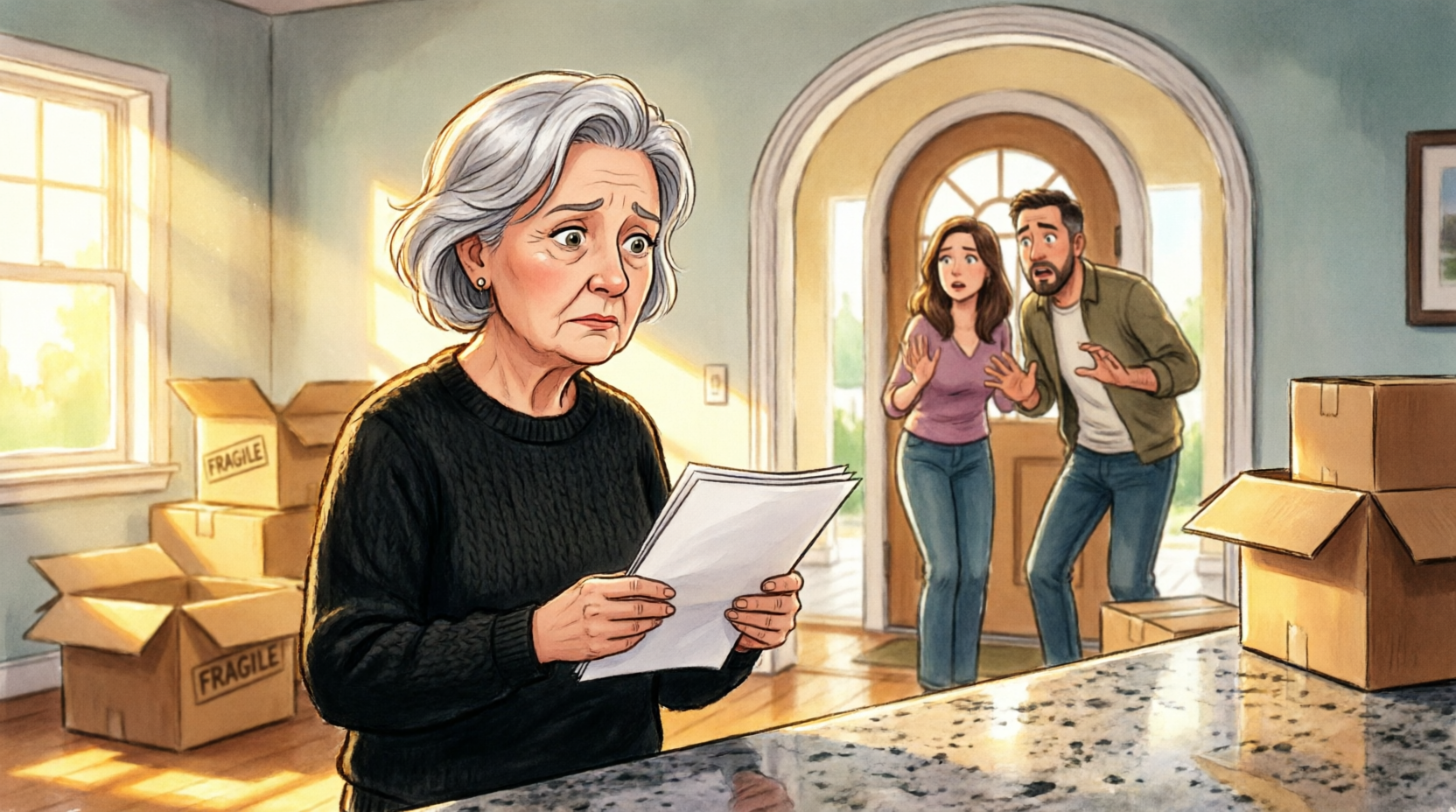
Margaret Lawson heard the sentence by accident, but once she heard it, she could never unknow it.
Her son Daniel had called while driving, talking too quickly, his Bluetooth connection crackling in and out. He thought he had ended the call after asking if she could “keep an eye on a few packages” while he and his wife were in Italy for two weeks. Margaret had been setting her phone down on the kitchen counter when she heard his voice again, farther away now, careless and unguarded.
“I’m telling you, Melissa, she’s a burden,” he said. “As soon as we get back, we need to push her to sign the place over. We can’t keep waiting forever.”
Margaret stood still, one hand on the back of a dining chair.
Melissa laughed softly. “She’ll do it. She always does.”
Then Daniel said the part that split something open inside her. “Once we move in, we can put her in one of those senior apartments. She won’t need all that space anyway.”
The line went dead.
Margaret remained in her Scottsdale kitchen for a long time, staring at the fruit bowl she no longer remembered buying. She was sixty-eight, widowed for nine years, and still living in the four-bedroom home she and her late husband, Thomas, had paid off together. Daniel had been dropping hints for months. He called the house “too much responsibility.” Melissa kept sending links to “beautiful retirement communities” and saying things like, “You deserve something simpler.” Margaret had mistaken manipulation for concern because mothers are trained to translate insult into love.
By sunset, she had stopped translating.
The next morning, she called a real estate agent named Karen Blake, a woman her age with a clipped voice and no patience for nonsense. Margaret asked one question: “If the house is in my name alone, how fast can I sell it?”
Karen came that afternoon.
Within ten days, the house had a cash offer: eight hundred seventy-five thousand dollars, no financing contingency, close in two weeks. Margaret signed every page with a steady hand. She opened a new bank account Daniel did not know existed, transferred the proceeds there, moved her jewelry, documents, and photographs into a climate-controlled storage unit, and leased a one-bedroom apartment in Flagstaff under her full legal name, not “Mom.”
She told no one except Karen and her attorney, Victor Hale, who updated her will, medical directives, and beneficiary forms. Daniel had once been listed on everything. Now he was not.
On the day before Daniel and Melissa were due home from Europe, Margaret walked through the empty house one final time. The rooms echoed. The walls looked pale where pictures had hung for years.
She left a single envelope on the kitchen island.
Inside was one page.
I heard what you said. I was your mother, not your burden. This house was never your reward for waiting me out. Do not contact me until you understand the difference.
Then Margaret locked the door, handed the keys to the buyer’s agent, got into her car, and drove north before sunrise.
At 4:17 p.m., her phone lit up with Daniel’s first missed call.
By 4:19, there were six.
Margaret did not answer any of them.
By the time she reached Flagstaff, Daniel had called fourteen times, Melissa nine, and an unknown number twice. Margaret checked into her apartment with two suitcases, a folder of legal documents, and a fatigue so deep it felt like illness. She sat on the edge of her new bed while her phone vibrated across the nightstand like an angry insect.
The first voicemail was confusion.
“Mom, call me back. We’re at the house and something is wrong.”
The second was sharper.
“What do you mean by this note? Where are you?”
The third carried Melissa’s voice in the background, high and furious. By the fourth, Daniel was no longer pretending. “You sold the house? Without telling me?”
Margaret deleted them all.
The next morning, she met Victor Hale by video call. He had already anticipated the panic. The house had legally closed. The funds were in Margaret’s sole account. Her will had been revised. Her powers of attorney had been reassigned to a professional fiduciary until Margaret chose otherwise. Daniel had no ownership claim, no financial authority, and no legal standing to demand anything. Victor’s face remained calm as he said, “You are protected. The only remaining question is whether you want contact.”
Margaret looked out the window at a row of pine trees bending in the wind. “Not yet.”
What Daniel had not known—what he had never bothered to learn—was that Margaret had seen this pattern before. After Thomas died, Daniel’s grief had been sincere. So had hers. But grief hardened differently in each of them. Margaret kept working for three more years as an escrow officer and quietly paid off old debts. Daniel, meanwhile, moved from one expensive plan to another: a restaurant franchise that failed, a cryptocurrency obsession that vanished, a luxury SUV he could not afford. Each crisis came with the same language. Just temporary. Just until I get stable. Family helps family.
Margaret had helped. She had covered a hospital deductible after Melissa’s difficult pregnancy. She had paid private school tuition for their daughter Chloe one year when Daniel fell behind. She had even loaned Daniel thirty thousand dollars to save him from a lawsuit connected to his failed business. He never repaid it, and over time he stopped calling it a loan.
What changed everything was not the money. It was entitlement.
Six months earlier, Daniel had asked for a copy of the deed “for insurance planning.” Melissa had started talking openly about “future renovations.” Daniel once joked that Margaret’s downstairs bedroom would be easy to convert into a “mother-in-law suite,” which amused him because it was already her bedroom. When Margaret pushed back, he smiled with that polished impatience adult children sometimes use on aging parents, the smile that says you are inconvenient, but I am trying to be kind about it.
Now, stripped of access, Daniel changed tactics.
He sent texts that swung wildly between guilt and accusation.
We were trying to help you.
How could you humiliate us like this?
Chloe is crying because she thinks you disappeared.
Melissa says this is elder instability and maybe we should request a welfare check.
That last message nearly made Margaret laugh. Instead, she forwarded it to Victor.
Two days later, Daniel appeared in Flagstaff.
Margaret saw his truck from the apartment window and felt her chest tighten, but she did not hide. She walked downstairs before he could bang on the door hard enough to make a scene. Daniel looked exhausted, still sunburned from Italy, his shirt wrinkled, anger barely held together under panic.
“Mom,” he said, stepping toward her. “What are you doing?”
“I’m living,” Margaret said.
“You sold the house behind my back.”
“There was no ‘our back,’ Daniel. It was my house.”
He lowered his voice, aware of the neighbors. “We were counting on that place.”
Margaret stared at him. “That is exactly the problem.”
For a moment, neither spoke. Then Daniel said, with the wounded outrage of a man discovering consequences for the first time, “You really left us with nothing.”
Margaret’s expression did not change.
“No,” she said quietly. “I left you with yourselves.”
Daniel came back the next day asking for coffee, which was how he had always approached difficult conversations when he was younger, as if a paper cup could soften bad behavior. Margaret agreed to meet him at a diner near Route 66 because public places make honesty less theatrical.
He arrived early. She could tell from the untouched mug in front of him that he had been rehearsing.
For the first ten minutes, he tried strategy instead of remorse. He said Melissa had misunderstood his comments. He said the call Margaret overheard was “taken out of context.” He said Europe had been a disaster because the airline lost one of their bags, as if travel stress explained character. Margaret listened without interrupting until he finally ran out of explanations and fell silent.
Then she asked, “When exactly were you planning to tell me that my future had already been decided for me?”
Daniel looked down.
“You were going to pressure me,” she said. “Then shame me. Then call it love.”
His jaw tightened. “That’s not fair.”
“No,” Margaret replied. “What you said about me was not fair.”
The waitress refilled their coffee and moved on. Daniel rubbed both hands over his face. When he spoke again, his voice was lower, closer to the boy he had once been. “We were in trouble.”
Margaret said nothing.
“The Europe trip was paid for months ago,” he said. “Nonrefundable. Melissa insisted we go because things were already bad and she thought we needed one good memory before…” He stopped.
“Before what?”
“Before the debt collectors started formal action.”
That got Margaret’s attention. Daniel admitted he had borrowed against future commissions that never materialized. Melissa had taken out credit cards he knew about and two he did not. Their rent had increased. The private school tuition was impossible now. They had been fighting for months. The plan, loosely formed and increasingly discussed, was to move into Margaret’s house “temporarily,” persuade her to transfer the property into a family trust they controlled, refinance it, and use the equity to stabilize everything.
Margaret let the truth settle between them like broken glass.
“So I was your bailout,” she said.
Daniel did not argue.
He looked older than his forty-two years in that moment, not because of hardship but because self-deception had finally become expensive. “I know how it sounds.”
“It sounds exactly like what it was.”
He nodded once.
For the first time since Flagstaff, Margaret felt something other than fury. Not forgiveness. Not yet. But clarity. Daniel had not become cruel overnight. He had become incremental: one rationalization, one rescue, one unreturned loan, one assumption after another. Margaret had helped build the staircase that led him here. Love without boundaries had trained him to mistake access for entitlement.
So she set boundaries that sounded, to him, like stone.
She would not give him money.
She would not co-sign debt.
She would not let him move in.
She would speak to Chloe, because the child was innocent.
She would consider rebuilding contact with Daniel only if he and Melissa entered financial counseling and family therapy, and only if six months passed without lies, pressure, or requests for money.
Daniel stared at the table. “Melissa won’t agree to that.”
“Then Melissa is making a choice.”
He exhaled hard, almost a laugh, almost a sob. “You changed.”
Margaret looked out the diner window at the late afternoon traffic, the old motel signs, the ordinary lives continuing in every direction.
“No,” she said. “I stopped pretending.”
Three months later, Melissa filed for legal separation. Daniel moved into a smaller apartment in Phoenix and, for the first time in his adult life, took a second job. It embarrassed him. It also kept him honest. He began attending counseling alone after Melissa refused. He missed two sessions, then returned, which Margaret considered a truer sign of effort than dramatic apologies ever could be.
Margaret called Chloe every Sunday.
She furnished her Flagstaff apartment slowly, choosing each piece herself: a blue chair, a narrow oak bookshelf, a kitchen table for two that usually seated one. She volunteered twice a week at a literacy center and started hiking short morning trails with women who knew her only as Margaret, not as someone’s mother, widow, or solution.
In winter, Daniel mailed her a handwritten letter. Not a text. Not a plea. A letter.
He wrote: I was ashamed long before you left. I just made you carry that shame for me. I am trying to learn how not to do that anymore.
Margaret read it twice, then placed it in a drawer rather than the trash.
In spring, she invited him to visit.
Not to ask for anything.
Not to reclaim anything.
Only to sit across from her, tell the truth, and see whether a relationship could still be built where an inheritance scheme had once stood.
When Daniel arrived, he brought supermarket flowers and looked terrified.
Margaret opened the door anyway.
Some endings are not revenge.
Some are boundaries with a pulse.
And sometimes the most dramatic thing a mother can do is refuse to disappear inside the life her child had already planned for her.