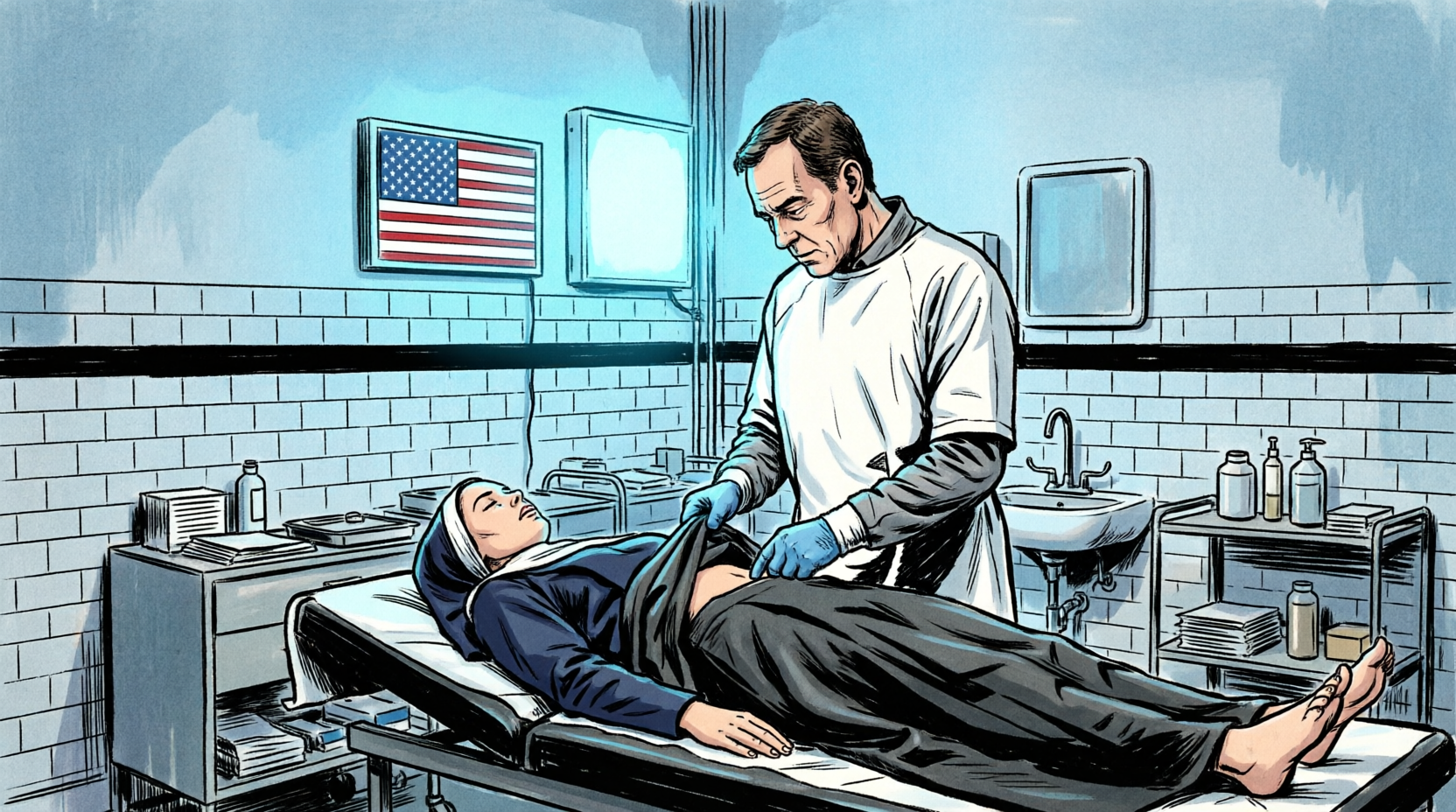
They brought a dead nun to the morgue, but upon cutting her habit, a phrase appeared: “do not perform the autopsy”; what they found later did not seem like a miracle, but a nightmare capable of destroying an entire convent.
Part 1
“Doctor… doctor, come look at this,” Camilo said, his voice breaking, taking two steps back as if the stretcher had just pushed him away.
Doctor Esteban Fonseca looked up from the instrument table. He had been working in the central morgue of Puebla for over fifteen years, and almost nothing managed to disturb his pulse. Almost nothing. But tonight, the body resting on the frozen steel was not just any body.
It was a nun.
The young woman was still wearing her black habit, neatly arranged over her slender frame. Her face was serene, almost luminous, as if she weren’t dead but merely asleep after a long day of prayer. She had been brought from a convent on the outskirts of the city with orders to perform an autopsy because no one had been able to explain with certainty why she had died so suddenly.
“What’s wrong?” Fonseca asked, stepping closer.
Camilo swallowed hard.
“There’s an opening in the fabric… on her back. And I think she has a tattoo.”
Fonseca frowned.
“It wouldn’t be that strange. Not all of them enter the convent as children. Some had lives before their vows.”
But even he didn’t sound convinced.
As soon as he approached, he saw the dark mark peeking through a tear in the habit. He exchanged a brief look with Camilo, and without another word, both carefully turned the body over. Fonseca offered a small prayer out of reflex, as he always did when a corpse commanded more respect than habit. Then, he asked for scissors and began to cut the fabric.
It only took a few seconds for his breath to freeze.
It wasn’t a tattoo.
It was a message.
An inscription written directly onto the girl’s skin, in trembling but perfectly legible handwriting:
Do not perform the autopsy. Wait two hours. What you need is in the pocket of my habit.
Camilo immediately crossed himself.
“No… it can’t be.”
Fonseca carefully ran his finger over the letters, as if still doubting his own eyes.
“Check the pocket,” he ordered in a low voice.
The young man reached into one side of the habit. At first, he found nothing. In the second pocket, however, his fingers brushed against a small, hard object. He pulled it out slowly.
A USB drive.
The two looked at each other, not knowing what to say. Outside in the hallways, the morgue sounded as it always did: metallic wheels, distant footsteps, the hum of the refrigerators. But inside that room, the air had changed.
Fonseca took the device and brought it to the adjoining room, where they kept an old computer for reviewing records and laboratory files. Camilo followed him without taking his eyes off the body, as if fearing the nun might stand up at any moment.
When they opened the file, she appeared on the screen.
The same pale face. The same habit. The same cross hanging from her neck. She was sitting on a simple bed in an austere room, lit only by a dim lamp. Her eyes were filled with fear.
“If you are watching this,” she said, her breath ragged, “it’s because my body has already reached the morgue… or because something worse happened to me.”
Camilo felt his skin crawl.
“I don’t have much time. Please, do not trust the Mother Superior. She is not who she says she is. Do not—”
Suddenly, brutal banging was heard at a door. The young woman turned in terror, and the video cut off. The silence that remained in the room was so thick it was painful.
“We need to call the police now,” Fonseca whispered.
But before he could get up, a sound came from the hallway. Three sharp knocks. A pause. Three more.
Fonseca went toward the main door of the morgue, his heart beating faster than usual. When he opened it, he froze.
Standing before him was a woman in her sixties, in an impeccable habit, a crucifix on her chest, and a soft smile that failed to bring peace.
“Good evening, son,” she said in a sweet voice. “I’ve come to say goodbye to Sister Inés.”
Fonseca felt a shiver run from the back of his neck to his waist. The Mother Superior had arrived. And something inside him screamed, without any explanation, that he must not let her in.
He stepped into the doorway before she could move past him.
“Visitation is not permitted during examination intake,” he said. “You’ll need to wait until the report is processed.”
Her smile stayed exactly where it was, but her eyes hardened in a way that made Camilo, watching from behind, lower his gaze.
“I understand procedure,” she replied. “I also understand compassion. She belonged to my house. She died under my care. I should pray over her before strangers open her body.”
Fonseca had testified in murders, mass accidents, cartel executions, and cases so ugly the police themselves would not meet his eyes. Yet the way that woman said the word body made him feel as if he had been handed something cold and wet in the dark.
“The autopsy is required,” he said.
“Is it?” she asked. “Or are you choosing to insist on it?”
Camilo looked at the wall clock. Eleven thirteen. He mouthed it silently, reminding the doctor of the message. Wait two hours.
The Mother Superior noticed.
“Was there something unusual about Sister Inés?” she asked gently.
“No.”
“Then why do you look frightened?”
Fonseca almost answered before he realized that was what she wanted: a crack, however small. He folded his arms instead.
“You should return to the convent.”
“I won’t.” She leaned in slightly. Her perfume reached him then, though it was not perfume at all. It smelled like old incense and something medicinal underneath, like a clinic trying to disguise decay with frankincense. “She was a holy girl. Very sensitive. She would not want knives.”
“She’s dead,” Fonseca said.
For the first time the Mother Superior’s smile faded.
“That,” she said, “depends on what men like you mean by dead.”
The fluorescent lights buzzed overhead. Somewhere deeper in the building, a steel tray clattered to the floor with an echo like a gunshot. Camilo flinched. The Mother Superior did not.
Fonseca closed the door on her as politely as he could, then immediately slid the inner lock.
Camilo spoke first. “She knows.”
“She suspects,” Fonseca said, though he did not believe it. “Call Detective Lucía Ortega. Tell her I have a suspicious death and possible obstruction. Don’t mention the video over the main line.”
Camilo hurried to the desk phone.
Fonseca went back to the computer and reopened the USB. There was only one visible file, the interrupted video, but he had seen enough panicked recordings in his life to know desperate people rarely made just one. He clicked through the hidden folders. Empty. He tried recovery software. One folder blinked into existence with fragments of deleted files.
The second video was shorter and shakier. Inés sat closer to the camera this time, whispering so fast her words ran together.
“If she reaches the morgue before two hours have passed, do not let them cut me. Do not let Mother come near me. You must wait. It dies after two hours. Before that it moves.”
The file glitched, then resumed.
“If they open me too soon, it will spread. Please listen. Please. Sister Alba wrote the warning. Trust the sister who limps. Under the chapel there are—”
The screen filled with digital noise, then went black.
Camilo hung up the phone. “Lucía’s on her way.”
“Good.”
“Doctor…” He hesitated. “What moves?”
Fonseca stared toward the autopsy room, where Sister Inés lay beneath the cold lights like a photograph of peace.
“I don’t know,” he said. “And for once I would like very much not to find out.”
They returned to the body together. The air in the room seemed colder than before, yet a sheen of moisture had formed at the young nun’s hairline. Fonseca touched her neck. It was still cold, but not with the rigid cold of freezer storage. It was changing somehow, like stone warming under indirect sun.
Camilo took two steps back. “She can’t be alive.”
“She isn’t.”
“How do you know?”
Fonseca looked at him.
“Because I signed the intake. No pulse. Fixed pupils. No respiration. She is dead.”
Camilo swallowed. “Then what is happening?”
Fonseca did not answer.
Minutes stretched. The clock over the sink ticked louder than any clock had a right to. Eleven twenty-seven. Eleven thirty-one. Eleven thirty-eight. Every few minutes Camilo would glance through the narrow wire-reinforced glass in the door to the hallway. The Mother Superior remained outside, seated on the wooden bench as if she had all the patience in the world. Hands folded. Back straight. Motionless.
At eleven forty-six, Detective Lucía Ortega arrived.
She was in plain clothes, leather jacket damp from the night rain, dark hair tied carelessly at the nape of her neck. The second she saw the Mother Superior outside the morgue doors, her expression changed from tired irritation to sharp attention.
“Mother Magdalena,” she said.
“Detective Ortega.” The old woman rose. “How good of you to come.”
Lucía stopped. “You know each other?” Camilo whispered.
Fonseca nodded once. “Everyone in this city knows people they would rather forget.”
Lucía came inside after the lock was released. She listened to the summary without interrupting, watched both video files, and then stood so still that even Camilo understood she was angry.
“My captain has buried complaints against that convent for years,” she said. “Missing girls from church shelters. Sudden deaths. Records rewritten. Every time we tried to look, somebody from the diocese or the state government called within the hour.”
Fonseca frowned. “Why are you telling me this now?”
“Because now I have a body, a message on skin, a witness, and a dead woman saying not to trust the Mother Superior.” She looked toward the autopsy room. “How long until the two hours are up?”
“Fourteen minutes.”
Lucía’s jaw tightened. “Then we wait.”
Outside, the Mother Superior resumed her seat.
At eleven fifty-three, the security monitor on the wall flickered. Camilo checked it and saw static in corridor three, corridor five, then the loading entrance. For one frame only, the screen showed the nun’s stretcher from above. Something beneath the habit lifted sharply, like a fist pressing from inside, and fell again.
Camilo made a sound somewhere between a gasp and a sob.
Lucía crossed the room in two strides. “What was that?”
Fonseca had already moved. He pushed back through the doors into the autopsy room. Sister Inés lay where they had left her. Still. Peaceful. Impossible.
Then, in the absolute silence, a faint clicking came from inside her chest.
Camilo backed into the sink.
Lucía reached for the pistol at her side out of pure instinct, then seemed embarrassed by the absurdity of it. “Tell me that was metal settling.”
“It was not metal settling,” Fonseca said.
The clicking came again, not loud, but definite. Like fingernails tapping on the underside of wood.
Twelve o’clock arrived.
The sound stopped.
Every person in the room looked at the wall clock, then at the body.
Fonseca exhaled once. “Camilo, mask. Shield. Full barrier. Detective, stay behind the line unless I tell you otherwise.”
“You think it’s infectious?”
“I think a dead nun told us to wait two hours before opening her body.”
“That’s not an answer.”
“No,” he said, reaching for the scalpel, “but it is the best one we have.”
They began carefully.
The first incision opened the habit. The second opened skin.
No blood welled up.
Instead, a clear, viscous fluid slid between the parted tissue, carrying with it that same smell of incense and antiseptic. Fonseca cut deeper, exposing the sternum. His gloved hands did not shake, but Camilo saw the tension in his shoulders and knew he was forcing them not to.
When the chest plate was opened, Camilo turned away and vomited into the sink.
Because what lay inside Sister Inés was not anatomy as any of them understood it.
Her lungs were wrapped in white filaments, thousands of them, thin as threads at the edges and thicker near the center where they braided around the heart in a dense, glistening knot. The tissue looked neither plant nor fungus nor parasite, but something that had stolen from all three. It pulsed faintly in the light.
Lucía whispered, “Jesus Christ.”
“No,” Fonseca said hoarsely. “Not Him.”
One of the filaments, disturbed by the cooler air, lifted slowly from the cavity and curled toward the lamp.
Camilo made a broken sound in his throat.
Fonseca took the forceps and pinned the strand to the steel tray. It writhed once, then settled.
Beneath the left lung, hidden among the white growth, they found a small cloth packet stitched to the rib lining with black thread. Fonseca cut it loose, set it on the table, and opened it carefully.
Inside were two things.
A brass key.
And a folded strip of paper stained with some dark substance that might once have been blood.
Lucía unfolded it.
Beneath the chapel floor.
They are not dead.
Burn the incense.
For a moment no one spoke.
Then Camilo, still pale, pointed with a trembling hand toward the observation window in the door.
The Mother Superior was standing there.
No one had heard her enter the inner corridor. No one had heard the second lock open. She simply stood on the other side of the wire glass, face half-shadowed, looking directly at the opened chest of Sister Inés.
And slowly, with the calm tenderness of someone finishing a prayer, she raised one finger to her lips and smiled.
Part 2
The first thing Lucía did was run to the door.
By the time she yanked it open, the corridor beyond was empty.
No footsteps. No habit disappearing around the turn. No echo. Just the buzzing fluorescent light and the smell of rain drifting faintly from the loading entrance fifty feet away.
“She was there,” Camilo insisted. “I saw her.”
“I know you did.” Lucía turned to Fonseca. “Lock down the room. Nobody goes in or out without me. I’m calling someone from the university and one officer I can still trust.”
“Your captain?”
“My captain can go to hell.”
By one in the morning, the morgue had become something between a crime scene and a quarantine zone. The body of Sister Inés remained open on the steel table, covered with a sterile sheet over the parts that still resembled a person. Samples of the white growth sat sealed in containers on a separate tray. Every few minutes, Camilo checked them, half-expecting the lids to bulge.
At one twenty, Dr. Renata Ávila arrived from the university microbiology department, furious at being dragged out of bed until she saw what was waiting under the autopsy lights.
After that, she stopped complaining.
She was younger than Fonseca had expected, sharp-featured and severe, with the exhausted confidence of a woman who trusted evidence more than any institution built by men. She stood over the opened chest for a long time without speaking, then leaned closer behind her face shield.
“This should not be possible,” she murmured.
Camilo gave a strangled laugh. “That helps.”
Renata ignored him. “It’s vascularized. Look at the branching. It integrated with pulmonary tissue and the pericardial sac. If I didn’t know better, I’d say it learned her anatomy while she was alive.”
“Can it spread?” Lucía asked.
Renata looked up. “Probably. The real question is how.”
Fonseca handed her the recovered videos and the note. While she reviewed them, he examined the rest of the body. There were puncture marks along Inés’s inner arms, old and new. There were faint bruises beneath the collarbone, and more of the white filaments had wound themselves like lace along the inner side of her ribs. At the base of the skull, just under the hairline, he found a cluster of tiny healed incisions as neat as sewing marks.
“Someone treated her,” he said. “Repeatedly.”
“Or cultivated her,” Renata replied.
Lucía looked as if she might punch something.
The recovered files on the USB yielded more by degrees. There were three short video diaries, fragments of scanned ledger pages, a list of names and dates, and still photographs taken in secret.
In one video, Inés sat in the same narrow room, but she was calmer. Her eyes were still frightened, yet behind the fear was the stubbornness of someone who had already chosen what mattered more than survival.
“My name is Sister Inés Salvatierra,” she said. “If this reaches anyone outside Santa Matilde, then I have failed to leave alive. I need you to understand that what happens there will be called devotion. It is not devotion. It will be called illness. It is not illness. It will be called a miracle because that word is easier for cowards than the truth.”
The video shook as if she had heard something, but she continued.
“The Mother Superior discovered something beneath the old chapel during renovations six years ago. The workers thought it was mold in the crypt walls. She told us it was proof of incorrupt saints. At first only the older sisters went below. They came back peaceful. Smiling. They said they heard singing. Then they began to forget things. Then some of them stopped leaving the infirmary at all.”
She swallowed hard.
“Girls from the shelter arrived. Women with nowhere else to go. Some pregnant, some beaten, some addicted, some only poor. Records changed. Names disappeared. We were told they had been transferred. They had not.”
The screen filled with static again, then restored just long enough for her to say, “Do not inhale the incense during vigils.”
Another file contained photographs of ledger pages. Donations from businessmen, politicians, wealthy families. Large sums marked as restoration funds, medical charity, pastoral care. Names of women written beside numbers and dates. Several were listed as deceased. Several had death certificates attached. Lucía zoomed in on one and froze.
“Ana Ortega,” she said quietly.
Camilo looked over. “Your relative?”
“My cousin,” Lucía said. “She vanished six years ago after entering a church shelter in Cholula. My aunt died waiting for answers.”
Fonseca watched the detective’s face harden into something colder than anger. It was grief after years of being denied an object.
Officer Morales arrived at one fifty-two, broad-shouldered, wary, and visibly unhappy that he had chosen loyalty over sleep. When Lucía brought him into the room and showed him the ledgers, the note, and the body, he crossed himself so quickly he nearly struck his own chin.
“We need a warrant,” he said.
“We need the convent before sunrise,” Lucía replied.
“You know they’ll kill this if it goes up the chain.”
“I know.”
Morales stared at the white filaments in the chest cavity. “And if we go without one?”
Lucía met his eyes. “Then for once we’ll be doing the illegal thing for the right reason.”
The decision, once spoken, seemed to make itself.
They copied the entire USB three times. One drive stayed with Fonseca. One went into Lucía’s jacket. One Camilo hid in the heel compartment of his work shoe after Renata suggested, dryly, that pious women often overlooked practical design.
Before they left, the morgue guard told them the Mother Superior had gone fifteen minutes earlier. She had not argued. She had not raised her voice. She had only thanked him and said, “By dawn, they’ll understand they opened the wrong door.”
The convent of Santa Matilde stood on a low hill outside Puebla, surrounded by stone walls older than the road leading to it. Even at night it looked less like a place of prayer than a fortress pretending to be humble. Rain glistened on the walls. The iron gate was shut. The chapel bell tower rose behind the roofline like a finger warning the sky.
They parked half a kilometer away and came on foot through the orchard behind the property.
Sister Alba was waiting for them by the old laundry outbuilding.
She was narrow-shouldered, in her forties perhaps, with dark circles under her eyes and a limp so pronounced that every third step seemed to cost her something. The second she saw Lucía, she almost fled, but then Camilo lifted the printed still of Inés from the USB and held it out.
Alba pressed her fist to her mouth.
“I wrote on her back,” she whispered. “I used silver nitrate from the infirmary. It darkens with cold. She said the morgue would be colder than Mother’s room.”
Lucía stepped closer. “How many are down there?”
Alba looked toward the main chapel as though the walls themselves might overhear. “I stopped counting after eleven.”
“Alive?”
The nun’s face broke.
“Not the way you mean.”
They followed her through the laundry room, past rusted irons and shelves of yellowing linens, to a trapdoor hidden beneath a stack of flour sacks. Below it, a narrow staircase descended into damp darkness that smelled of stone, rot, and old wax.
As they went down, Alba talked in bursts, as if every sentence might be her last.
“Mother found the chamber under the chapel years ago. There was white growth in the walls. The first sister exposed to it said she felt all pain leave her body. She smiled for two days and then forgot her own mother’s name. Mother said suffering had been removed. She said obedience came more easily when fear was gone.”
“Obedience,” Lucía said.
Alba nodded once. “At first it was only the dying. Women no one would miss. Then novices who doubted. Then anyone who resisted.”
“Why didn’t you leave?” Camilo asked before he could stop himself.
Alba did not even look at him. “Because I was twenty-one and believed authority was holiness. Because when I finally understood, the gate was always watched. Because every girl I tried to save had nowhere to go. Choose whichever answer makes you hate me least.”
Camilo said nothing after that.
At the bottom of the stairs they entered a corridor so old it had likely once belonged to the colonial structure beneath the convent. Niches lined the walls, many of them bricked over. Moisture gleamed on the mortar. The air felt thick, almost sweet.
Then they reached the chamber beneath the chapel.
Morales whispered an oath.
Rows of narrow alcoves had been carved into the stone walls and fitted with glass panels. Behind the glass lay women in white nightgowns, hands crossed over their chests like saints in funeral paintings. Some were old. Some were heartbreakingly young. Their eyes were closed. Their skin was pale and bloodless.
And every few seconds, if one looked closely enough, one could see the rise and fall of breathing.
Lucía walked to the nearest panel and stared at the nameplate below it.
Ana Ortega.
For one terrible moment she did not move.
Then she slammed the butt of her flashlight against the latch so hard the glass cracked.
“Lucía,” Renata snapped. “Don’t break containment blind.”
“Containment?” Lucía turned on her. “That’s my cousin.”
Ana’s face behind the glass was thinner than the photographs from six years earlier, older and somehow younger at once, preserved in suffering. White veins traced faintly beneath the skin of her neck.
Fonseca found metal cabinets at the far end of the chamber. Inside were patient files, injection schedules, donor reports, and sealed jars filled with the same white growth suspended in yellowish fluid. One cabinet held censers, packets of powdered incense, and silver communion vessels stained on the inside with residue.
Renata lifted one packet carefully. “This is how,” she said. “Aerosol delivery. Heat-activated dispersal.”
Camilo turned in a slow circle, horror dawning by inches. “They burned this in the chapel?”
Alba nodded.
“During vigils,” she whispered. “During penance. During funerals. During healing prayers.”
Lucía struck the glass again. This time it shattered. Cold, sweet air spilled out.
Ana’s eyelids fluttered.
And then, from somewhere above them, a microphone crackled.
The Mother Superior’s voice filled the chamber, warm as candlelight.
“You should have stayed with your dead,” she said. “Now you will join my living.”
All at once, iron locks slammed into place at both ends of the corridor.
And in the glass alcoves lining the walls, several pairs of closed eyes began to open.
Part 3
The first scream came from Camilo.
Not because the women in the alcoves rose like monsters from old stories. They did not. The horror was worse than that. They sat up slowly, stiffly, like invalids waking from sedation, their movements gentle and incomplete. Their faces were expressionless. Their eyes were open, but not fully aware. They breathed as if each breath had to travel from very far away.
“Away from the glass,” Renata shouted.
One by one, the latch mechanisms clicked.
Alba gripped Camilo’s arm. “Don’t let them touch your face.”
Lucía had already torn open Ana’s chamber. Her cousin collapsed forward into her arms, cold, feather-light, and still half-unconscious. White filaments glimmered under the skin at her throat. Lucía held her as though anchoring herself to the earth.
“Morales, get that door,” she barked.
Morales ran to the sealed iron gate at the far end and tried the wheel lock. It would not move.
The Mother Superior’s voice returned.
“You confuse rescue with kindness,” she said. “Pain is all the world ever gave these women. I gave them peace.”
Lucía looked up toward the hidden speaker. “You buried them alive.”
“No. I kept them where no one else could use them.”
The words echoed through the stone chamber with enough calm certainty to curdle the blood.
Fonseca moved between the opening alcoves and the others, surgical saw still in hand because it was the only tool that felt honest in that place. “Sister Alba,” he said, “is there another way out?”
“There’s an old drainage tunnel behind the reliquary room, but Mother keeps it barred.”
“Then we find the bar.”
The first woman stepped out of her alcove.
She was perhaps thirty, barefoot, emaciated, a hospital band around one wrist browned with age. Her pupils were hugely dilated. White lacework moved faintly beneath the skin along her temples. When she opened her mouth, a thin trail of clear fluid slipped from one corner.
She did not charge them.
She reached.
That, Camilo would later say, was the worst part. Not violence. Need. A reaching as soft as a child asking to be picked up.
Then another woman emerged. And another.
Renata backed toward the cabinets with the sample case clutched to her chest. “The growth affects motor control but not completely,” she said through gritted teeth. “Catalepsy. Dissociation. Possibly extreme compliance. I don’t know if they’re contagious through touch, but I’m not voting to find out.”
The chamber door behind them rattled. Someone was unlocking it from the outside.
Morales finally forced the wheel lock enough to bend the internal bolt, but when the gate opened, three more figures stood beyond it in the corridor.
Mother Magdalena in front.
Two nuns behind her, both elderly, both serene in the awful way Inés had been serene. One held a censer on a chain. Pale smoke drifted from it in a curling ribbon.
“Masks on!” Renata shouted.
Camilo fumbled with his respirator. Lucía used one arm to hold Ana upright and the other to drag the mask into place. Fonseca kicked the censer from the nearest nun’s hand before it could swing properly, spilling hot coals and powder onto the floor.
The smell hit even through the filter: sweet, floral, medicinal, wrong.
Mother Magdalena looked almost disappointed.
“You’re making this ugly,” she said.
Lucía stepped forward. “Ana Ortega. Eleven women in hidden chambers. Fraud ledgers. Chemical dispersal through incense. Want to keep talking while I list the rest?”
Magdalena met her gaze. “Do you know what your cousin begged me for the night we found her? Silence. She wanted silence. She had been beaten for years by a man your family never managed to stop. In my care, she never feared him again.”
Lucía’s hand tightened on Ana’s shoulder. “You stole six years of her life.”
“I removed six years of terror.”
“And replaced it with a coffin.”
Magdalena’s eyes shifted to Fonseca. “Doctor, you saw what was in Sister Inés. Did it look cruel to you? It sustained her heart beyond what her fear would have permitted. It carried her deeper than pain.”
Fonseca said, “It hollowed her out.”
The old woman smiled sadly. “That is what all healing looks like to men who need suffering to remain visible.”
Morales took a step to the side, aiming his service weapon though nobody believed bullets belonged in that chamber.
“Drop to the floor,” he said. “All of you. Now.”
One of the elderly nuns beside Magdalena moved faster than seemed possible. She threw a handful of powdered incense into Morales’s face.
He shouted, staggered, and fired. The shot cracked the stone and burst one of the wall lamps. Darkness lunged into half the room. The other elderly nun slammed into him with enough force to send them both to the ground.
Then everything broke at once.
Lucía shoved Ana into Camilo’s arms and drove her shoulder into the gate, trying to force space open. Fonseca seized a metal cabinet door and used it like a shield as two half-conscious women drifted toward him with outstretched hands. Renata kicked the spilled censer under a shelf and shouted that fire would sterilize the powder. Alba limped toward a side archway, yelling, “This way! The tunnel!”
Magdalena did not move from the doorway.
She simply watched.
The expression on her face was not rage. It was conviction, and that made it monstrous.
Camilo, shaking so badly he could barely stand, dragged Ana across the chamber while she mumbled fragmented words against his shoulder.
“Bell… under the bell… she keeps it under…”
“What?” he asked.
Her eyes rolled toward him, unfocused. “The mother root.”
Lucía reached them first and took Ana back. Morales, eyes streaming, managed to scramble free and slam the iron gate into the elderly nun who had attacked him. Fonseca overturned a cabinet full of jars, shattering glass. Yellow fluid spread across the floor. White masses writhed weakly in it like drowned nerves.
Renata froze for one fraction of a second.
“Don’t breathe,” she said, voice suddenly thin with fear. “Don’t breathe, don’t breathe, don’t—”
Magdalena lifted her hand, and the women from the alcoves stopped moving.
Not all the way. Not naturally. But enough that the chamber itself seemed to hold its breath with them.
“You still think I control this,” she said to Lucía. “That’s the simplest lie your world tells itself. Control. Choice. Purity. Those are words for people who have never had to keep broken girls alive with no money, no doctors, no state, no family, and a Church that only loves women once they stop speaking.”
Lucía stared at her. “So you turned them into this?”
“At first, I gave them relief.”
The old woman’s calm finally cracked, and in the crack Lucía saw not innocence, not redemption, but the original sin of every tyrant: the belief that desperation had made her permission divine.
“When I first found it,” Magdalena said, “it grew in the crypt wall around the bones of a novice buried during the cholera years. A worker exposed it, inhaled it, and slept for two days without pain despite his broken leg. I brought a dying girl from the shelter to the chamber. She had been sold by her uncle, infected by men with money, and tossed at our gate like garbage. She smiled for the first time in months. She said she heard her mother singing. Tell me, Detective, what would you have done? Sent her back to a hospital with no bed? To a state home full of predators? To the street?”
Lucía answered without hesitation. “I would not have buried her.”
“Neither did I. Not at first.”
That was the first honest thing she had said.
The chamber shook faintly. Above them, the bell tower began to ring, slow and deep, though no hour required it.
Alba appeared at the side archway. “Now!” she cried. “The tunnel’s open.”
“Move!” Lucía shouted.
They ran.
The side passage was low and wet, with roots hanging from the ceiling and ancient drainage channels cut into the floor. Behind them, footsteps echoed. Not just one set. Many.
Morales covered the rear, half-blind but moving. Fonseca and Renata carried the archive box between them. Camilo stumbled under the weight of two extra sample cases because even terrified, he had not forgotten that proof mattered. Alba led the way by memory and terror combined.
The tunnel narrowed, bent sharply, and opened into a circular room beneath the bell tower.
At its center stood a stone reliquary chest veined with the same white growth they had found inside Inés.
Ana lifted her head weakly from Lucía’s shoulder and began to shake.
“Don’t open it,” Alba whispered.
Magdalena’s voice came from behind them in the tunnel.
“You already did.”
The white veins in the stone brightened.
Not with light. With movement.
A seam along the top of the reliquary split open by a hair.
Something inside inhaled.
Renata grabbed Lucía’s arm so hard it would bruise. “If that’s the source colony, then every air shaft in this building probably runs through here. The bells vibrate the ducts. They’ve been spreading it for years.”
Camilo turned, horrified. “Then why keep it this close to the chapel?”
“Because she wanted worship to be exposure.”
Morales fired once at the old lock on the far grate. The bullet shattered the hinge. Fonseca and Camilo threw their weight against the rusted bars until they gave with a scream of metal.
Cold night air rushed into the tunnel.
They spilled out into the orchard behind the convent just as the first lick of fire appeared inside the drainage arch, where the overturned censer and spilled chemicals had finally caught.
Magdalena did not follow them out.
She stood in the tunnel mouth, backlit by orange light, habit untouched, face grave and almost pitying.
“You think fire will save you,” she said.
Lucía held Ana tighter and backed away.
“Tomorrow night,” Magdalena continued, “the city will come to mourn Sister Inés. They always come when the dead are beautiful. And when they breathe my incense, all your truth will sound like cruelty.”
The flames rose behind her.
Then she stepped back into the convent and vanished.
By dawn, the story was already being stolen.
Lucía’s captain called her reckless and ordered her suspended. The diocese issued a statement mourning “the desecration of a sacred residence by unauthorized personnel.” A local television station aired footage of the convent gates at sunrise, candles gathered outside them, the anchor solemnly repeating that anti-religious hysteria had endangered vulnerable women.
And in the cramped isolation room at the university lab, Renata rolled up her sleeve with silent hands and showed Fonseca the thin white line beginning to curl beneath the skin at her wrist.
“We have less than twenty-four hours,” she said.
That evening, every channel in Puebla carried the same announcement live from the convent steps.
Mother Magdalena, composed as a monument, invited the public to a vigil for Sister Inés.
“A night of healing,” she called it.
“A night of grace.”
Part 4
By noon the next day, the city had turned the convent into a battleground of faith and rumor.
Vendors sold candles at the roadside. Women knelt with rosaries in the mud outside the walls. Television vans lined the shoulder. Half the town had decided Santa Matilde was the site of a miracle. The other half thought it hid a scandal. Both halves intended to watch.
Lucía spent the day fighting three separate wars at once.