Nolan showed up at my house on a bright Saturday morning in early June. One of those summer days that feels almost staged—the sky too blue, the air too warm, everything too calm to last.
I stood at the door with a nervous kind of anticipation. It had been months since I’d last seen him, back at Christmas when he barely spoke and stayed tucked into the background like a shadow no one quite noticed.
Nolan was my sister’s boy, and after she died, he’d been passed from one temporary place to another.
He was the sort of kid people described as “easy,” when what they really meant was invisible. I wanted this summer to be different for him. I wanted him to breathe. To rest. To just be fifteen for once.
When I opened the door, he was standing there with a backpack that looked too small for a whole summer and a duffel bag that looked too heavy for someone his age. But what caught my attention immediately were the gloves. Tight black leather gloves. In June.
“Nolan,” I said, pulling him into a quick hug before he could recoil. He was tall and bony, all elbows and caution, hunched in a way that made him seem like he was apologizing for taking up space. “You made it.”
“Yes, sir,” he said automatically, then flinched. “I mean… Uncle Ryan.”
I gave a small laugh. “No need for that here. Come inside.”
From the second he stepped in, I noticed how careful he was. He wiped his shoes even though the porch was clean. He thanked me for the water. Thanked Marissa, my wife, for asking how the trip was. Even when the dog brushed past him, he murmured a polite little “sorry,” like he’d inconvenienced the animal just by existing.
But more than the manners, it was the gloves.
He kept them on while eating. He used a napkin to pick up food instead of touching it directly. When he folded laundry, when he sat on the couch, when he carried a plate to the sink—those gloves stayed on like they were part of him.
At first I chalked it up to nerves, maybe one of those odd coping habits kids develop after too much instability. I told myself not to make a thing out of it.
Still, they bothered me. They didn’t feel like a quirk. They felt like armor.
That evening, while Marissa watered the herbs on the patio, I found Nolan sitting on the back steps, spine straight, hands tucked together in his lap.
“You settling in okay?” I asked.
“Yes, sir—yes. Uncle.”
I smiled. “Good. It’s quiet here. Safe.”
He nodded, but his eyes were fixed on the yard like his mind was somewhere else entirely.
After a moment, I said gently, “You know, you don’t have to wear the gloves here.”
He glanced down at them, then away. “My hands get cold,” he said. “That’s all.”
It was too quick. Too practiced. But I let it go.
The days passed in a strange rhythm. Nolan never caused trouble. He helped when asked, never complained, kept to himself. But that same answer came every time.
My hands get cold.
It sounded less like an explanation and more like a line he’d memorized.
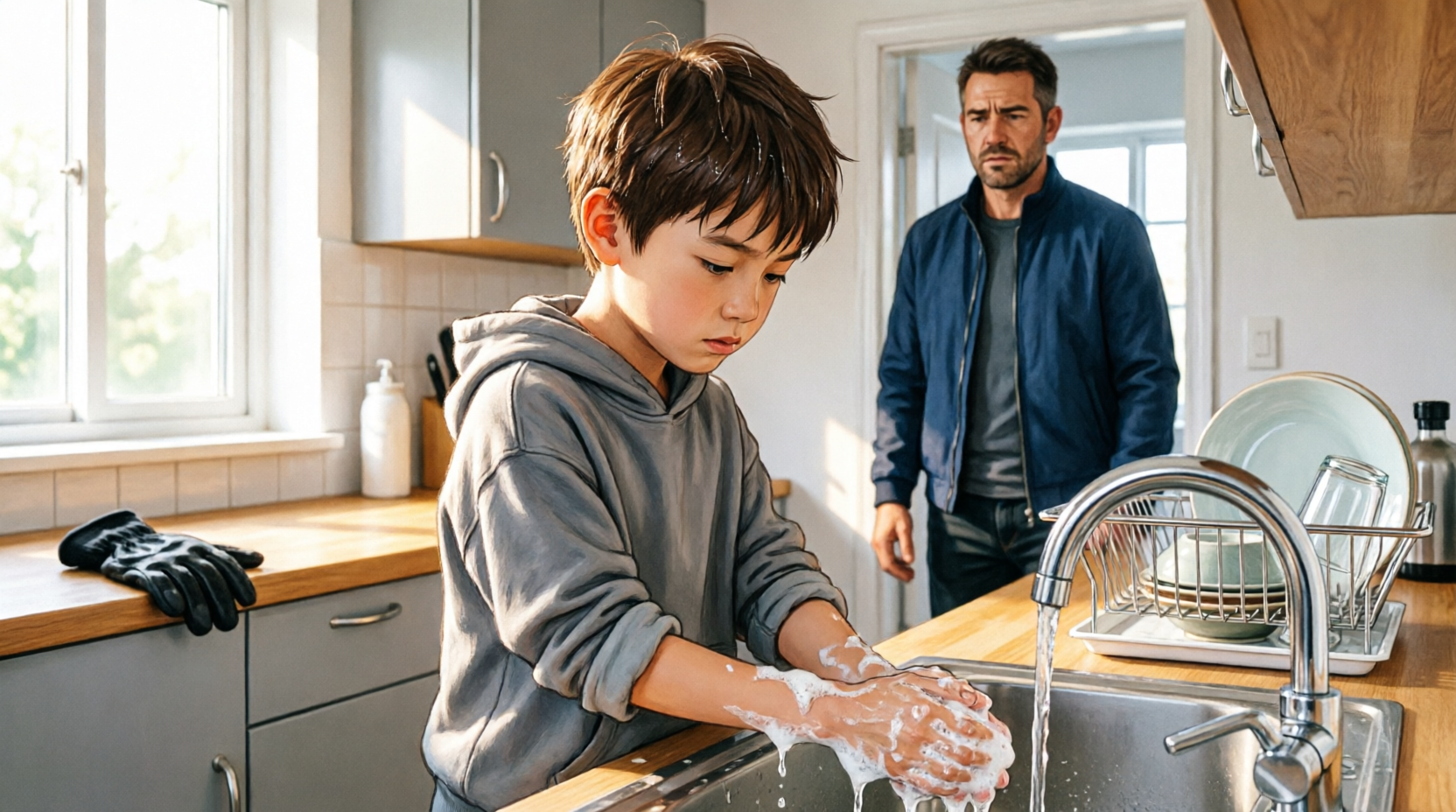
Then one night, after dinner, I heard water running down the hall. At first I thought someone had left the sink on. Then I heard another sound—scrubbing. Slow, hard, relentless.
I walked toward the bathroom. The door was cracked open just enough for light to spill into the hall. I hesitated, feeling like I was about to cross a line, but something in my gut told me this wasn’t nothing.
I pushed the door open.
Nolan stood at the sink with his head lowered, shoulders bare, the gloves lying on the counter for the first time since he’d arrived. He was scrubbing his hands with a force that made my chest tighten. Water poured over skin that looked wrong—too red, too raw. Angry lines crossed his palms and wrists as if something had been pressed there over and over.
Then I saw it.
In the center of his left palm was a mark.
Not a cut. Not a scar you’d get by accident. A deliberate emblem, burned clean into his skin. A police insignia.
I froze.
He kept washing for another second before finally looking at me through the mirror, his face unreadable.
“You weren’t supposed to see that, Uncle,” he said quietly.
My throat went dry. “What happened to you?”
He didn’t answer at first. He just lifted his hands a little, as if showing me what words wouldn’t. Then he reached for the gloves again.
“Please don’t ask,” he said. “I don’t want to talk about it.”
But I did ask. I couldn’t stop myself.
“Who did this? Why hide it? Why the gloves?”
He slid them back on with practiced speed, shutting himself down right in front of me.
“It doesn’t matter,” he said, voice suddenly flat. “I’m fine. Just let it go.”
He left the room, and the distance between us doubled.
For the next few days, the house felt too quiet. Marissa moved around the kitchen like she sensed something was wrong but didn’t know where to place it. Nolan got even quieter. And I couldn’t stop seeing that symbol burned into his palm.
One evening, while he was outside and Marissa was cooking, I found myself standing outside the guest room. I hadn’t wanted to invade his space. But I also couldn’t keep pretending everything was normal.
Inside, the room was dim and tidy in that temporary way rooms feel when someone is living there without expecting to stay. His backpack sat by the desk. In the corner was a small metal file drawer, slightly open.
I knew I shouldn’t.
I opened it anyway.
Inside were notebooks, loose receipts, and beneath them an old yellow envelope. It felt heavier than paper should. When I opened it, several photographs slid into my hand.
The first showed a group of police officers outside a building. Standing among them was Nolan. Younger, but unmistakably him. Same guarded eyes. Same haunted stillness.
The second showed a house I almost recognized. In front of it stood a uniformed man and a dark-haired woman. His hand rested on her shoulder in a way that wasn’t comforting. It looked possessive. Wrong.
The last photo hit hardest.
Nolan, maybe ten years old, sat at a kitchen table beside a woman I knew had to be his mother. She looked exhausted, worn thin. Behind them, on a chalkboard, were numbers—coordinates. She was teaching him something. Passing something on. And on his face wasn’t curiosity.
It was fear.
The gloves. The brand. The silence. Suddenly none of it felt random.
I shoved the photos back just as I heard footsteps. When I turned, Nolan was standing in the doorway.
“I didn’t think you’d find that,” he said softly.
I stared at him. “What is all this?”
He stepped inside and closed the door behind him.
“I’m sorry,” he whispered. “I didn’t want you involved.”
“Involved in what?”
He looked exhausted suddenly, older than fifteen. “There’s someone who’s been watching me my whole life,” he said. “Someone who doesn’t let go. If you keep asking questions, they’ll come for you too.”
My heart started pounding. “Who?”
He hesitated, then something in him gave way.
“The police,” he said. “Or people inside it. My mom was part of something undercover. Not the kind they put in reports. She worked for a unit that did things off the books. Things that got buried. And when I learned too much… I stopped being her son and started being a liability.”
I felt cold all over.
“The mark?” I asked.
He looked down at his gloved hands. “A warning. A claim. You get branded so you remember who owns you.”
“And your mom?”
His eyes darkened. “They said she killed herself. I don’t believe them.”
The room went still.
He told me they had watched him for years. That he had been moved, hidden, tracked. That whatever his mother had been part of hadn’t ended with her. It had followed him.
When he finally stopped talking, I realized there was no safe distance left between us. Whatever this was, it was already here.
“Nolan,” I said, forcing steadiness into my voice, “you’re not alone in this anymore.”
He shook his head. “It’s too dangerous.”
“I don’t care.”
Over the next days, Marissa and I pieced ourselves into his fear. We asked questions carefully. We started looking into his mother’s disappearance, the unit she worked with, the people who might still be watching. The more we uncovered, the worse it got—connections into law enforcement, money, old sealed cases, vanished names.
It was bigger than one boy. Bigger than one dead woman.
But they had underestimated one thing.
Family.
One evening, Nolan sat at the kitchen table with us, shoulders bowed from carrying too much alone for too long. Slowly, for the first time without panic, he pulled off his gloves and set them down between us.
His hands trembled.
“I don’t know how to stop running,” he admitted.
I reached across the table and put my hand over his. “Then we start by not running alone.”
Marissa came to sit beside us. “We’re in this with you,” she said.
For the first time since he arrived, something in his face softened. Not trust exactly. Not yet. But maybe the beginning of it.
The days after that became a blur of research, calls, planning, names pulled from old records and stories pieced together from people who had once known his mother. A hidden network. Buried operations. Powerful people who thought fear would keep everyone quiet forever.
Maybe it had.
Maybe until now.
On the morning we finally decided to act, I looked at Nolan and realized he no longer looked like the boy who had shown up on my porch trying to disappear inside himself. He still carried fear, but now there was something else standing beside it.
Resolve.
“We’ve got this,” I told him.
He met my eyes and nodded once. “Yeah,” he said. “We do.”
And together, we moved forward—toward the shadows that had chased him for years, and toward whatever came next.